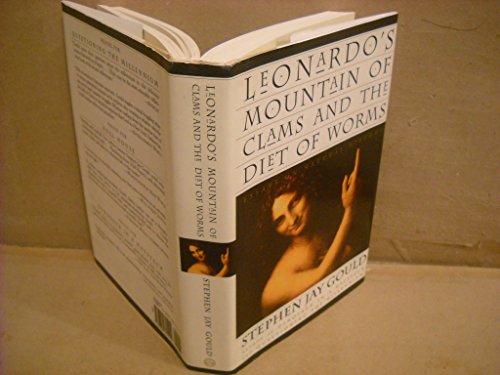
Leonardo's Mountain of Clams and the Diet of Worms is the newest collection of best-selling scientist Stephen Jay Gould's popular essays from Natural History magazine (the longest-running series of scientific essays in history). It is also the first of the final three such collections, since Dr. Gould has announced that the series will end with the turn of the millennium.
In this collection, Gould consciously and unconventionally formulates a humanistic natural history, a consideration of how humans have learned to study and understand nature, rather than a history of nature itself. With his customary brilliance, Gould examines the puzzles and paradoxes great and small that build nature's and humanity's diversity and order. In affecting short biographies, he depicts how scholars grapple with problems of science and philosophy as he illuminates the interaction of the outer world with the unique human ability to struggle to understand the whys and wherefores of existence.
"synopsis" may belong to another edition of this title.
Stephen Jay Gould is the Alexander Agassiz professor of zoology and professor of geology at Harvard and the Vincent Astor visiting professor of biology at New York University. Recent books include Full House, Dinosaur in a Haystack and Questioning the Millennium.He lives in Cambridge, Massachusetts, and New York City.
Praise for Questioning the Millennium
"Gould poses three questions about the millennium in this delicious science-historical jeu d'esprit. . . . [This] may be the most enjoyable millennium book of the second millennium."
--Booklist
"With a humorous Everyman approach, Gould juggles a mind-boggling array of various calendrical concepts as he explains why creating a reliable calendar was one of man's greatest struggles. Whether nailing down the precise date of the birth of Christ or airing his suspicion that God is a New York Yankees fan, Gould teaches rather than preaches."
--Entertainment Weekly
Praise for Full House
"Bacteria and baseball. Few authors besides Stephen Jay Gould could write convincingly about both. . . . Wandering about [Full House's] well-decorated rooms, nooks, and attics is a pleasure left to the reader."
--Washington Post Book World
"A tour de force of scientific reasoning, one that puts evolution in an astonishing new light."
--Wall Street Journal
"A veteran intellectual daredevil, Gould climbs further out on a thought-limb than ever before in his paradigm-shattering book. . . . Gould elegantly lays down a gauntlet here, and readers should rush to witness the first thrust in what may become a royal scientific duel."
--Publishers Weekly (starred review)
Praise for Dinosaur in a Haystack
"[Gould] writes in a consistently graceful, approachable style, with easy elegance and clarity, and he is an incomparable explainer of difficult ideas."
--New York Times Book Review
"Passionate, eloquent. His is an unintimidating, entertaining, and masterful technique."
--San Francisco Chronicle
do's Mountain of Clams and the Diet of Worms</b> is the newest collection of best-selling scientist Stephen Jay Gould's popular essays from <i>Natural History</i> magazine (the longest-running series of scientific essays in history). It is also the first of the final three such collections, since Dr. Gould has announced that the series will end with the turn of the millennium.<br> <br>In this collection, Gould consciously and unconventionally formulates a humanistic natural history, a consideration of how humans have learned to study and understand nature, rather than a history of nature itself. With his customary brilliance, Gould examines the puzzles and paradoxes great and small that build nature's and humanity's diversity and order. In affecting short biographies, he depicts how scholars grapple with problems of science and philosophy as he illuminates the interaction of the outer world with the unique human ability to struggle to under
As in his previous collections of essays from Natural History magazine (Dinosaur in a Haystack, 1996, etc.), here again Gould artfully transports readers through the complex and enchanting realms of the natural world. This time, though, he peers less at nature than at scientists' attempts to understand and explain its wonders. Ranging far and wide through the history of science, Gould's sketches in "humanistic natural history" examine the "grand false starts in the history of natural science"?for he contends that nothing is as "informative and instructive as a truly juicy mistake." In an essay on the Russian paleontologist Vladimir Kovalevsky, for example, Gould applauds his subject's meticulously detailed observations on the fossils of horses and his consequent development of an evolutionary history of the horse as an animal of European descent. Yet, Gould points out, Kovalevsky was mistaken, for horses had evolved in America and migrated to Europe. Another famous "mistake" Gould explores is Emmanuel Mendes da Costas's taxonomy of earth and stones according to Linnaeus's taxonomy of organic life. As usual, Gould proceeds to his conclusions by indirection; he opens his essay on Mendes da Costa, for instance, by disclosing how Linnaeus compared the shape and function of a clam to female sexual anatomy. Gould's elegant prose transmits the excitement and wide-eyed wonder of a scientist who never ceases to be amazed and amused at what he finds. 30 b&w illustrations.
Copyright 1998 Reed Business Information, Inc.
The art of the essay is not much practiced now, but Gould is a master of it: the beguiling subject, the juicy feast of facts and thoughts related to the subject, and the surprising connections made between the subject and other topics--all rendered in smoothly polished prose.
In the latest selection from this self-described ``essay-machine,'' Gould gathers together sundry Natural History columns, mingling natural history knowhow with his characteristic humanist outlook. Gould (Zoology & Geology/Harvard, Questioning the Millennium, 1997, etc.) takes his main cue here less from great scientists' successes than from their all-too-human blunders. Opening with a masterful appreciation of da Vinci's remarkable observations about erosion and fossilized clamsand their lesser-known context of his entirely medieval world-viewGould displays a deep appreciation not only for the natural world but also for the mind's attempts to understand it, even at the risk of error. ``Nothing can be quite so informative and illuminating as a truly juicy error, he observes in his discussion of the unsung 18th-century naturalist Mendes da Costa's attempted application of the hierarchical Linnean nomenclature to rocks. Equally juicy errors addressed elsewhere include astronomer Percival Lowell's ``canals'' of Mars and the way Lowells ideas about extraterrestrial life resurfaced in the 1996 debate over bacterial evidence in a Martian meteorite; Russian Vladimir Kovalevsky's groundbreaking classification of the horses ancestry along Darwinian evolutionary lines; and Victorian physiologist Walter H. Gaskell's nuttily wrong ``inversion theory'' about vertebrates and invertebrates, which actually enjoys a kind of resonance on the genetic level. Some errors deserve only castigation (or correction), such as the loss of the dodo both as a species and a scientific specimen (only fragments remain in museums). Gould also assays topics ranging from the coexistence of hominid species in human evolution to a gruesome root-headed parasite. However out-of-left- field the subject, he still manages to charm us with characteristically energetic, down-to-earth lucidity. Gently iconoclastic, always illuminating essays from the science writer whose prose can bring to life not only theories but even the fossils themselves. (30 b&w illustrations) -- Copyright ©1998, Kirkus Associates, LP. All rights reserved.
The latest essay collection in Gould's popular and influential series covers various topics in biology and the history of science. As always, his writing can be ironic, humorous, critical, forceful, and even evangelical but always wholly literate and brimming with enthusiasm.
Copyright 1999 Reed Business Information, Inc.
Chapter 1
The Upwardly Mobile Fossils of Leonardo's Living Earth
Morgan describes his despair as their captors string up King Arthur for a hanging: "They were blindfolding him! I was paralysed; I couldn't move, I was choking, my tongue was petrified . . . They led him under the rope." But, in the best cliff-hanging traditions, and at the last conceivable instant, Sir Lancelot comes to the rescue with five hundred knights--all riding bicycles. "Lord, how the plumes streamed, how the sun flamed and flashed from the endless procession of webby wheels! I waved my right arm as Lancelot swept in. I tore away noose and bandage, and shouted: 'On your knees, every rascal of you, and salute the king! Who fails shall sup in hell to-night!'"
I am not citing either Monty Python or Saturday Night Live, and I didn't mix up my genders in the first sentence. The speaker is not Morgan le Fay (who, no doubt, would have devised a magical, rather than a technological, solution to the same predicament), but Hank Morgan, the Connecticut Yankee in King Arthur's court, and the hero in Mark Twain's satirical novel of the same name. Morgan, transported from nineteenth-century Hartford, wreaks mayhem in sixth-century Camelot by introducing all manner of "modern" conveniences, including tobacco, telephones, baseball--and bicycles.
As a literary or artistic device, anachronism exerts a powerful hold upon us, and has been a staple of all genres from the highest philosophy to the lowest comedy--as Jesus is crucified in a corporate boardroom by Dali, condemned at his Second Coming by Dostoyevsky's Grand Inquisitor, but only offered a half-price discount (as he changes to modern dress) by the Italian barber or the Jewish tailor of various ethnic jokes, now deemed tasteless and untellable.
Anachronism works this eerie and potent effect, I suppose, because we use the known temporal sequence of our history as a primary device for imposing order upon a confusing world. And when "the time is out of joint. O cursèd spite," we really do get discombobulated. We also know that correction of a perceived time warp cannot be achieved so easily in real life as in magical fiction (where Merlin can put Hank Morgan to sleep for 1,300 years, or Dracula can be dispatched with a wooden stake driven into the right spot). We regard Hamlet's blithe confidence as a mark of his madness when he completes his rhyming couplet with the Shakespearean equivalent of "no sweat" or "hakuna matata": ". . . That ever I was born to set it right!"
Science, for reasons partly mythical, but also partly accurate and honorable, presents itself as the most linear and chronologically well ordered of all disciplines. If science, working by fruitful and largely unchanging methods of reason, observation, and experimentation, develops progressively more accurate accounts of the natural world, then history provides a time line defined by ever-expanding success. In such a simple linear ordering, mediated by a single principle of advancing knowledge, any pronounced anachronism must strike us as especially peculiar--and subject to diametrically opposite judgment depending upon the direction of warp. An ancient view maintained in the present strikes us as risible and absurd--the creationist who wants to compress the history of life into the few thousand years of a literal biblical chronology, or the few serious members of the Flat Earth Society. But a "modern" truth, espoused out of time by a scholar in the distant past, fills us with awe, and may even seem close to miraculous.
A person consistently ahead of his time--a real-life Hank Morgan who could present a six-shooter to Julius Caesar, or explain the theory of natural selection to Saint Thomas Aquinas--can only evoke a metaphorical comparison with a spaceman from a more advanced universe, or a genuine angel from the realms of glory. In the entire history of science, no man seems so well qualified for such a designation as Leonardo da Vinci, who died in 1519, but filled his private notebooks with the principles of aeronautics, the mental invention of flying machines and submarines, and a correct explanation for the nature of fossils that professional science would not develop until the end of the eighteenth century. Did he have a private line across the centuries to Einstein, or even to God Himself?
I must confess that I share, with so many others, a lifelong fascination for this man. I was not a particularly intellectual child; I played stickball every afternoon and read little beyond comic books and school assignments. But Leonardo captured my imagination. I asked, at age ten or so, for a book about his life and work, probably the only intellectual gift that I ever overtly requested from my parents. As an undergraduate geology major, I bought the two-volume Dover paperback edition of Leonardo's notebooks (a reprint of the 1883 compilation by Jean Paul Richter) because I had read some of his observations on fossils in the Leicester Codex, and had been stunned not only by their accuracy, but also by their clear statement of paleoecological principles not clearly codified before our century, and still serving as a basis for modern studies.
Leonardo remains, in many ways, a frustrating and shadowy figure. He painted only about a dozen authenticated works, but these include two of the most famous images in our culture, the Mona Lisa (in the Louvre) and the Last Supper (a crumbling fresco in Milan). He published nothing in his lifetime, despite numerous and exuberant plans, though several thousand fascinating pages of manuscript have survived, probably representing only about a quarter of his total output. He did not hide his light under a bushel and was, in life, probably the most celebrated intellectual in Europe. Dukes and kings reveled in his conversation and his plans for war machines and irrigation projects. He served under the generous patronage of Europe's most powerful rulers, including Ludovico il Moro of Milan, the infamous Cesare Borgia, and King Francis I of France.
Leonardo's notebooks did not become generally known until the late eighteenth century, and were not published (and then only in fragmentary and occasional form) until the nineteenth century. Thus, he occupies the unique and peculiar role of a "private spaceman"--a thinker of preeminent originality, but whose unknown works exerted no influence at all upon the developing history of science (for nearly all his great insights had been rediscovered independently before his notebooks came to light).
The overwhelmingly prevailing weight of public commentary about Leonardo continues to view him as Western cultures primary example of a "spaceman," that is, as a genius so transcendent that he could reach, in his own fifteenth century, conclusions that the rest of science, plodding forward in its linear march to truth, would not ascertain for several hundred years. Leonardo stood alone and above, we are told over and over again, because he combined his unparalleled genius with a thoroughly modern methodology based on close observation and clever experiment. He could therefore overcome the ignorance and lingering sterile scholasticism of his own times.
For example, the "Introductory Note" in the official catalog for a recent exhibition of the Leicester Codex in New York summarizes the basis of Leonardo's success in these words: "In it [the codex] we can begin to see how he combined almost superhuman powers of observation with an understanding of the importance of experimentation. The results were inspired insights into the workings of nature that match his artistic achievements." When such conventional sources acknowledge the persisting medieval character of many Leonardian pronouncements, they almost always view this context as a pure impediment to be overcome by observation and experiment, not as a matrix that might have been useful to Leonardo, or might help us to understand his beliefs and conclusions. For example, the closing passage of the long Encyclopaedia Britannica article on Leonardo states: "Leonardo approached this vast realm of nature to probe its secrets . . . The knowledge thus won was still bound up with medieval Scholastic conceptions, but the results of his research were among the first great achievements of the thinking of the new age because they were based on the principle of experience."
I think that this conventional view could not be more wrong in its general approach to the history of knowledge, or more stultifying for our quest to understand this most fascinating man of our intellectual past. Leonardo did make wonderful observations. He did often anticipate conclusions that public science would not reach for another two or three centuries. But he was neither a spaceman nor an angel--and we will never understand him if we insist on reading him as Hank Morgan, a man truly out of time, a modernist among the Medici, a futurist in the court of Francis the First.
"About this title" may belong to another edition of this title.
Seller: Greenworld Books, Arlington, TX, U.S.A.
Condition: good. Fast Free Shipping â" Good condition book with a firm cover and clean, readable pages. Shows normal use, including some light wear or limited notes highlighting, yet remains a dependable copy overall. Supplemental items like CDs or access codes may not be included. Seller Inventory # GWV.0609601415.G
Seller: World of Books (was SecondSale), Montgomery, IL, U.S.A.
Condition: Good. Item in good condition. Textbooks may not include supplemental items i.e. CDs, access codes etc. Seller Inventory # 00084843376
Seller: World of Books (was SecondSale), Montgomery, IL, U.S.A.
Condition: Very Good. Item in very good condition! Textbooks may not include supplemental items i.e. CDs, access codes etc. Seller Inventory # 00097417963
Seller: ThriftBooks-Atlanta, AUSTELL, GA, U.S.A.
Hardcover. Condition: Good. No Jacket. Pages can have notes/highlighting. Spine may show signs of wear. ~ ThriftBooks: Read More, Spend Less. Seller Inventory # G0609601415I3N00
Seller: ThriftBooks-Phoenix, Phoenix, AZ, U.S.A.
Hardcover. Condition: Good. No Jacket. Pages can have notes/highlighting. Spine may show signs of wear. ~ ThriftBooks: Read More, Spend Less. Seller Inventory # G0609601415I3N00
Seller: ThriftBooks-Dallas, Dallas, TX, U.S.A.
Hardcover. Condition: Good. No Jacket. Pages can have notes/highlighting. Spine may show signs of wear. ~ ThriftBooks: Read More, Spend Less. Seller Inventory # G0609601415I3N00
Seller: ThriftBooks-Atlanta, AUSTELL, GA, U.S.A.
Hardcover. Condition: Good. No Jacket. Missing dust jacket; Pages can have notes/highlighting. Spine may show signs of wear. ~ ThriftBooks: Read More, Spend Less. Seller Inventory # G0609601415I3N01
Seller: Wonder Book, Frederick, MD, U.S.A.
Condition: Very Good. Very Good condition. Very Good dust jacket. A copy that may have a few cosmetic defects. May also contain light spine creasing or a few markings such as an owner's name, short gifter's inscription or light stamp. Seller Inventory # B12A-03678
Seller: Better World Books, Mishawaka, IN, U.S.A.
Condition: Very Good. 1st. Former library book; may include library markings. Used book that is in excellent condition. May show signs of wear or have minor defects. Seller Inventory # 3357833-6
Seller: Better World Books, Mishawaka, IN, U.S.A.
Condition: Good. 1st. Used book that is in clean, average condition without any missing pages. Seller Inventory # 3357831-6