
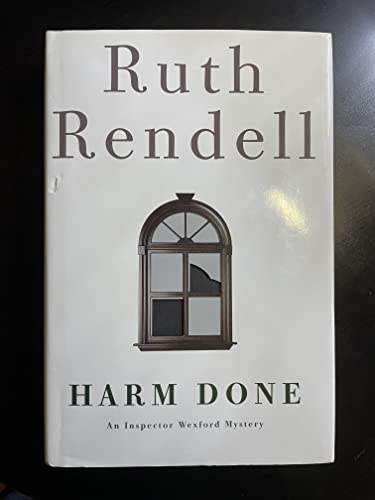
Items related to Harm Done
Synopsis
On the day Lizzie came back from the dead, the police and her family and neighbors had already begun to search for her body. She had been missing for three days. Never an articulate child, between her confusion and amnesia she could not plausibly describe where she'd been or why she'd been away. Soon after, a convicted pedophile is released back into the community, adding to the already heightened fears of parents in the Muriel Campden Estate where he lives. Then the child of a wealthy executive disappears, and not long after, a suspect in the kidnapping is found stabbed to death.
Chief Inspector Wexford is charged with solving the mysterious disappearances, protecting a pedophile, and catching a killer. As he searches for connections, he finds himself focusing on domestic violence. His daughter, Sylvia, a social worker, has come to work nearby in a refuge for battered women called The Hide. Her marriage is also strained, although her husband has never raised a hand to her. Others in Kingsmarkham are not so fortunate. As Wexford moves closer to the truth, he confronts the discomfiting lesson that when it comes to the inner life of families, justice is rarely as straightforward as the letter of the law.
"synopsis" may belong to another edition of this title.
About the Author
Ruth Rendell is the recipient of three Edgar awards, four Gold Daggers, the Commander of the British Empire Award, and the most prestigious Edgar of them all, the Grand Master Award. She lives in London.
From the Back Cover
"Ruth Rendell is unequivocally the most brilliant mystery writer of our time."
--Patricia Cornwell
"Rendell's clear, shapely prose casts the mesmerizing spell of the confessional."
--The New Yorker
"No one plays head games quite as well as Rendell."
--The Gazette (Montreal)
"Rendell writes with such elegance and restraint, with such a literate voice and an insightful mind, that she transcends the mystery genre and achieves something almost sublime."
--Los Angeles Times
"No one writes with more devastating accuracy about the world we live and commit sins in today. . . . She is one of our most important novelists."
--John Mortimer
"Rendell just seems to get sharper and sharper."
--The Ottawa Citizen
"British crime at its best can be found in the fiction of Ruth Rendell, for whom no superlative is sufficient."
--Chronicle-Herald (Halifax)
"Ruth Rendell has written some of the best novels of twentieth-century crime fiction."
--Frances Fyfield, author of Blind Date and Without Consent
"Ruth Rendell is surely one of the greatest novelists presently at work in our language. She is a writer whose work should be read by anyone who enjoys either brilliant mystery--or distinguished literature."
--Scott Turow
From the Inside Flap
izzie came back from the dead, the police and her family and neighbors had already begun to search for her body. She had been missing for three days. Never an articulate child, between her confusion and amnesia she could not plausibly describe where she'd been or why she'd been away. Soon after, a convicted pedophile is released back into the community, adding to the already heightened fears of parents in the Muriel Campden Estate where he lives. Then the child of a wealthy executive disappears, and not long after, a suspect in the kidnapping is found stabbed to death.<br><br>Chief Inspector Wexford is charged with solving the mysterious disappearances, protecting a pedophile, and catching a killer. As he searches for connections, he finds himself focusing on domestic violence. His daughter, Sylvia, a social worker, has come to work nearby in a refuge for battered women called The Hide. Her marriage is also strained, although her husband has never raised a hand to her. Others in Kingsmarkham are
Reviews
In her latest Inspector Wexford mystery (following Road Rage), the prolific Rendell shows that, like Wexford, she too is a master of indirection. Like a stout, aging British Columbo, Wexford hides his intuition and keen powers of observation behind a rumpled, grandfatherly facade. Three of the cases that he unravels in this satisfyingly complex work have to do with the abuse of women or children. The crimes range from the ridiculous (a petulant university girl and a mentally challenged girl from a low-income housing project are each kidnapped to do housework and returned for ineptitude) to the monstrous (Wexford and his men must protect a child molester who was released from prison while a rich man tortures his wife in the comfort of his spacious home). Rendell is too realistic a writer to link her crimes together in a sensational way. Instead, each offense galvanizes a slew of colorful characters of all classes who live in the suburban community of Kingsmarkham. Wexford's daughter Sylvia, a strident volunteer for a battered women's shelter, fills in her father on the signs of abuse and abusers, and it is a measure of Rendell's subtle skill that she manages to address a social blight without ever losing track of her plot or flattening her characterizations. Thanks to Rendell's steadfast devotion to what is real over what is mere theory, what comes through in her 47th book is the unique human mystery at the heart of a crime.
Copyright 1999 Reed Business Information, Inc.
Kingsmarkham, where Chief Inspector Wexford labors in the interests of law and order, is one of those small English towns that's picture-postcard placid on the surface, a cauldron underneath. On any given Saturday, for instance, there's enough sheer wickedness roiling and moiling to keep Satan smiling and honest cops hopping over the course of a long and distinguished series (Road Rage, 1997, etc.). On this particular Saturday, a young woman goes missing, but just before thinking the worst becomes inevitable, she turns up unharmed. Wexford breathes a sigh of relief. Exactly a week later, however, another young woman disappears. She, too, reappears no worse for wear, but neither returnee seems able to describe what happened to her very convincingly. Can't or won't? Wexford wonders. In the meantime, a notorious pedophile is released from prison. He's paid his debt to society, authorities insist, but the enraged citizens of Kingsmarkham refuse to see it that way. Angry residents threaten, harass, and, having converted themselves into a bloodcurdling mob, end by burning down ``the pedo's'' house. In the furor, a policeman is killed when someone in the crowd scores a direct, albeit accidental, hit with a homemade Molotov cocktail. Finally, a child from a well-to-do Kingsmarkham family is kidnapped, and the community finds itself facing three incendiary but seemingly unconnected situations. Except that they are connected, of courseby one of crime fiction's most prodigious talents. A little slow, a little labored, but crammed with solid Rendellian virtues; the Regulars will rally round. -- Copyright ©1999, Kirkus Associates, LP. All rights reserved.
In this latest Inspector Wexford mystery by the prolific, talented Rendell, two young women go missing successively, are held for several days by an older woman and a young, inarticulate man, and are released. Then the story moves on to the kidnapping of a three-year-old girl at the same time a pedophile has been released from prison; ultimately, two murders are committed. Much of the novel is tied together by the overriding issue of abuseAboth physical and emotional. Nevertheless, despite the reappearance of faces from the earlier cases, the disjointedness between the earlier investigation and the subsequent ones is jarring. Wexford's ruminations are always fascinating, and Rendell has lost none of her writing skill, but the multiple plots don't quite hang together. Still, fans will want this.AFrancine Fialkoff, "Library Journal"
Copyright 1999 Reed Business Information, Inc.
In the eighteenth Wexford tale, Rendell's forty-seventh published book, the well-known chief inspector is doubly frustrated by the limits of his profession. On the heels of the disappearance (and odd reappearance) of two teenage girls, Wexford receives news that a convicted pedophile is being released into the community. Fueled by newspaper articles, unrest among the man's neighbors ensues. When a three-year-old child vanishes from the home of her wealthy parents, the town rumor mill explodes--no matter that the pedophile had nothing to do with the crime. Ironically, the trail Wexford follows leads back to the door of the parents, who for all the world seem a happy couple. Nothing is further from the truth: the outwardly devoted husband is a deranged martinet who physically abuses his wife and terrorizes his children. Right-thinking Wexford grapples with his own moral conscience when the man is murdered. With characteristic irony and complexity, Rendell picks at the corners of British society, unearthing dark secrets among his Kingsmarkham fellows. Leave it to Wexford to get to the bottom of things, as he sees up close the cycle of shame and hopelessness that traps a family under siege by one of its own. Stephanie Zvirin
Excerpt. © Reprinted by permission. All rights reserved.
From Chapter 1
On the day Lizzie came back from the dead the police and her family and neighbors had already begun the search for her body. They worked on the open countryside between Kingsmarkham and Myringham, combing the hillsides and beating through the woods. It was April but cold and wet, and a sharp northeast wind was blowing. Their task was not a pleasant one; no one laughed or joked and there was little talking.
Lizzie's stepfather was among the searchers, but her mother was too upset to leave the house. The evening before, the two of them had appeared on television to appeal for Lizzie to come home, for her abductor or attacker, whatever he might be, to release her. Her mother said she was only sixteen, which was already known, and that she had learning difficulties, which was not. Her stepfather was a lot younger than her mother, perhaps ten years, and looked very young. He had long hair and a beard and wore several earrings, all in the same ear. After the television appearance several people phoned Kingsmarkham Police Station and opined that Colin Crowne had murdered his stepdaughter. One said Colin had buried her on the building site down York Street, a quarter of a mile down the road from where the Crownes and Lizzie lived on the Muriel Campden Estate. Another told Detective Sergeant Vine that she had heard Colin Crowne threaten to kill Lizzie "because she was as thick as two planks."
"Those folks as go on telly to talk about their missing kids," said a caller who refused to give her name, "they're always the guilty ones. It's always the dad. I've seen it time and time again. If you don't know that, you've no business being in the police."
Chief Inspector Wexford thought she was dead. Not because of what the anonymous caller said, but because all the evidence pointed that way. Lizzie had no boyfriend, she was not at all precocious, she had a low IQ and was rather slow and timid. Three evenings before, she had gone with some friends on the bus to the cinema in Myringham, but at the end of the film the other two girls had left her to come home alone. They had asked her to come clubbing with them but Lizzie had said her mother would be worried--the friends thought Lizzie herself was worried at the idea--and they left her at the bus stop. It was just before eight-thirty and getting dark. She should have been home in Kingsmarkham by nine-fifteen, but she didn't come home at all. At midnight her mother had phoned the police.
If she had been, well, a different sort of girl, Wexford wouldn't have paid so much attention. If she had been more like her friends. He hesitated about the phrase he used even in his own mind, for he liked to keep to his personal brand of political correctness in his thoughts as well as his speech. Not to be absurd about it, not to use ridiculous expressions like intellectually challenged, but not to be insensitive either and call a girl such as Lizzie Cromwell mentally handicapped or retarded. Besides, she wasn't either of those things, she could read and write, more or less, she had a certain measure of independence and went about on her own. In daylight, at any rate. But she wasn't fit just the same to be left alone after dark on a lonely road. Come to that, what girl was?
So he thought she was dead. Murdered by someone. What he had seen of Colin Crowne he hadn't much liked, but he had no reason to suspect him of killing his stepdaughter. True, some years before he married Debbie Cromwell, Crowne had been convicted of assault on a man outside a pub, and he had another conviction for taking and driving away--in other words, stealing--a car. But what did all that amount to? Not much. It was more likely that someone had stopped and offered Lizzie a lift.
"Would she accept a lift from a stranger?" Vine had asked Debbie Crowne.
"Sometimes it's hard to make her like understand things," Lizzie's mother had said. "She'll sort of say yes and no and smile--she smiles a lot, she's a happy kid--but you don't know if it's like sunk in. Do you, Col?"
"I've told her never talk to strangers," said Colin Crowne. "I've told her till I'm blue in the face, but what do I get? A smile and a nod and another smile, then she'll just say something else, something loony, like the sun's shining or what's for tea."
"Not loony, Col," said the mother, obviously hurt.
"You know what I mean."
So when she had been gone three nights and it was the morning of the third day, Colin Crowne and the neighbors on either side of the Crownes on the Muriel Campden Estate started searching for Lizzie. Wexford had already talked to her friends and the driver of the bus she should have been on but hadn't been on, and Inspector Burden and Sergeant Vine had talked to dozens of motorists who used that road daily around about that time. When the rain became torrential, which happened at about four in the afternoon, they called off the search for that day, but they were set to begin again at first light. Taking DC Lynn Fancourt with him, Wexford went over to Puck Road for another talk with Colin and Debbie Crowne.
When it was built in the sixties, on an open space that would now be called a "green field area," between the top of York Street and the western side of Glebe Road, the three streets and block of flats on a green in the midst of them, it had been called the York Estate. The then chairman of the housing committee, who had done A Midsummer Night's Dream for his school certificate and was proud of the knowledge thus gained, named the streets after characters in that comedy, Oberon, Titania, and Puck.
"About this title" may belong to another edition of this title.
Other Popular Editions of the Same Title

Search results for Harm Done

Stock Image
Harm Done (Chief Inspector Wexford)
Seller: World of Books (was SecondSale), Montgomery, IL, U.S.A.
Seller rating 5 out of 5 stars

Condition: Good. Item in good condition and has highlighting/writing on text. Used texts may not contain supplemental items such as CDs, info-trac etc. Seller Inventory # 00104614926
Stock Image
Harm Done
Seller: Gulf Coast Books, Cypress, TX, U.S.A.
Seller rating 5 out of 5 stars
hardcover. Condition: Very Good. Seller Inventory # 060960547X-2-33225970
Stock Image
Harm Done (Chief Inspector Wexford)
Seller: World of Books (was SecondSale), Montgomery, IL, U.S.A.
Seller rating 5 out of 5 stars
Condition: Acceptable. Item in acceptable condition! Textbooks may not include supplemental items i.e. CDs, access codes etc. Seller Inventory # 00095678899
Stock Image
Harm Done (Chief Inspector Wexford)
Seller: World of Books (was SecondSale), Montgomery, IL, U.S.A.
Seller rating 5 out of 5 stars
Condition: Good. Item in good condition. Textbooks may not include supplemental items i.e. CDs, access codes etc. Seller Inventory # 00101924742
Seller Image
Harm Done (Chief Inspector Wexford)
Seller: Books for Life, LAUREL, MD, U.S.A.
Seller rating 5 out of 5 stars
Condition: good. Book is in good condition. Minimal signs of wear. It May have markings or highlights, but kept to only a few pages. May not come with supplemental materials if applicable. Seller Inventory # LFM.8CBL
Stock Image
Harm Done (Chief Inspector Wexford)
Seller: Duru Media, Tallahassee, FL, U.S.A.
Seller rating 5 out of 5 stars
hardcover. Condition: Very Good. Seller Inventory # 01KVV7GK1Y35EPM
Stock Image
Harm Done (Chief Inspector Wexford)
Seller: Book Gurus, Tallahassee, FL, U.S.A.
Seller rating 5 out of 5 stars
hardcover. Condition: Good. Seller Inventory # 01KX3SMAMG6YREG
Seller Image
Harm Done
Seller: Greenworld Books, Arlington, TX, U.S.A.
Seller rating 5 out of 5 stars
Condition: very_good. Fast Free Shipping â" Very Good condition book with a firm cover and clean pages. Shows normal use and some light wear or limited notes markings. A solid, nice copy to enjoy. Seller Inventory # GWV.060960547X.VG
Stock Image
Harm Done
Published by
Crown Publishing Group, The, 1999
ISBN 10: 060960547X
ISBN 13: 9780609605479
Used
Hardcover
Seller: Better World Books, Mishawaka, IN, U.S.A.
Seller rating 5 out of 5 stars
Condition: Good. Former library copy. Pages intact with minimal writing/highlighting. The binding may be loose and creased. Dust jackets/supplements are not included. Includes library markings. Stock photo provided. Product includes identifying sticker. Better World Books: Buy Books. Do Good. Seller Inventory # 8715104-6
Stock Image
Harm Done
Published by
Crown Publishing Group, The, 1999
ISBN 10: 060960547X
ISBN 13: 9780609605479
Used
Hardcover
Seller: Better World Books, Mishawaka, IN, U.S.A.
Seller rating 5 out of 5 stars
Condition: Very Good. Pages intact with possible writing/highlighting. Binding strong with minor wear. Dust jackets/supplements may not be included. Stock photo provided. Product includes identifying sticker. Better World Books: Buy Books. Do Good. Seller Inventory # 38597358-6