Synopsis
The book about not just business but the meaning of life ... a guide for being the best at what you do and doing it with a sense of purpose that connects with something larger than yourself ...
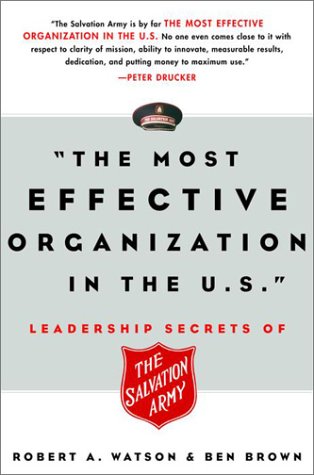
For many people, The Salvation Army is most visible between Thanksgiving and Christmas. That's when its officers, soldiers and volunteers, in the ubiquitous Kettle Campaign, make music and collect money for good works. Few realize, however, that the Army is much, much more than this one effort and is in fact a powerhouse of an organization. None other than Peter Drucker called it "the most effective organization in the U.S." Not the most effective nonprofit, but "the most effective organization." Quite a compliment from the world's most preeminent management thinker, especially when you consider that he is comparing The Salvation Army to world-class corporations like General Electric, IBM and Johnson &Johnson.
Now, Robert Watson, the Army's recently retired national commander, is ready to share the Army's secrets about organization, strategy, and acting with a sense of mission. With its 9,500 centers of operation, $2 billion in annual revenues, and 32 million clients served in every zip code in America, The Salvation Army is the model for doing business with a purpose. As Peter Drucker says, "no one even comes close to it with respect to clarity of mission, ability to innovate, measurable results, dedication and putting money to maximum use":
* Clarity of mission: What you can learn from the Army's laser-like focus of evaluating everything it does in terms of its mission of preaching the gospel and meeting human needs without discrimination.
* Ability to innovate: How The Salvation Army's investment in people gets incredible returns and why it as much venture capitalist as charity.
* Measurable results: Learn The Army's unique ways of setting, monitoring and celebrating the achievement of measurable goals so you, too, can say, "look, we promised we would do this and we delivered."
* Dedication: How the Army accomplishes so much with such a small cadre of officers.
* Putting Money to Maximum Use: What you can learn from The Army's bare skeleton of a national organization in terms of making the most of your resources and making all of your operations self-sufficient.
By demonstrating the power of a sense of purpose combined with organizational effectiveness, this remarkable book has something essential to say to all executives, entrepreneurs, managers, and anyone with the ambition to bring people together to reach a goal.
Free subscription to the Crown Business E-Newsletter just for signing up, email CrownBusiness@Randomhouse.com
"synopsis" may belong to another edition of this title.
About the Author
Robert A. Watson has served as a commissioned officer in The Salvation Army for forty-four years, four of them as National Commander, the highest-ranking officer in the United States. In his role as national commander, Commissioner Watson oversaw a vast non-profit operation reaching into every community in the country, generating over $2billion in revenues and involving some 3.2 million officers, employees and volunteers. Commissioner Watson has served on over twenty national and international boards, including the Vice President's Coalition on Welfare to Work. He has represented The Salvation Army in sessions before Congress, at the White House and with other world leaders in the business and the non-profit community.
Ben Brown, a veteran reporter and editor for more than two decades, was a founding staff member of USA Today and founding executive editor of Time, Inc's. Coastal Living magazine. This is his third book.
From the Inside Flap
The book about not just business but the meaning of life ... a guide for being the best at what you do and doing it with a sense of purpose that connects with something larger than yourself ...<br><br>For many people, The Salvation Army is most visible between Thanksgiving and Christmas. That's when its officers, soldiers and volunteers, in the ubiquitous Kettle Campaign, make music and collect money for good works. Few realize, however, that the Army is much, much more than this one effort and is in fact a powerhouse of an organization. None other than Peter Drucker called it "the most effective organization in the U.S." Not the most effective nonprofit, but "the most effective organization." Quite a compliment from the world's most preeminent management thinker, especially when you consider that he is comparing The Salvation Army to world-class corporations like General Electric, IBM and Johnson &Johnson. <br><br>Now, Robert Watson, the Army's recently retired national commander, is ready to share the Army's secrets about organization, strategy, and acting with a sense of mission. With its 9,500 centers of operation, $2 billion in annual revenues, and 32 million clients served in every zip code in America, The Salvation Army is the model for doing business with a purpose. As Peter Drucker says, "no one even comes close to it with respect to clarity of mission, ability to innovate, measurable results, dedication and putting money to maximum use":<br>* Clarity of mission: What you can learn from the Army's laser-like focus of evaluating everything it does in terms of its mission of preaching the gospel and meeting human needs without discrimination.<br>* Ability to innovate: How The Salvation Army's investment in people gets incredible returns and why it as much venture capitalist as charity.<br>* Measurable results: Learn The Army's unique ways of setting, monitoring and celebrating the achievement of measurable goals so you, too, can say, "look, we promised we would do this and we delivered."<br>* Dedication: How the Army accomplishes so much with such a small cadre of officers.<br>* Putting Money to Maximum Use: What you can learn from The Army's bare skeleton of a national organization in terms of making the most of your resources and making all of your operations self-sufficient.<br><br>By demonstrating the power of a sense of purpose combined with organizational effectiveness, this remarkable book has something essential to say to all executives, entrepreneurs, managers, and anyone with the ambition to bring people together to reach a goal.<br><br>Free subscription to the Crown Business E-Newsletter just for signing up, email CrownBusiness@Randomhouse.com
Reviews
A clear mission, innovative techniques, commitment, efficiency and visible outcomes are the name of the business game, and also happen to be exemplified by the Salvation Army. In "The Most Effective Organization in the U.S.": Leadership Secrets of the Salvation Army, Robert A. Watson, an officer in the Salvation Army for 44 years, and freelance writer Ben Brown mine the organizational riches of this familiar group and present them as a model for others in the nonprofit and for-profit worlds. Watson, who as a child was clothed, fed and kept busy by the Salvation Army, reveals the skills and principles he learned as an officer of a company that completes projects from top to bottom from conceiving an idea and building a site to designing the financial plan and hiring, training and inspiring employees. The organization famous for its big heart also has plenty of sense. Proceeds go to the Salvation Army.
Copyright 2001 Cahners Business Information, Inc.
Noted management expert Peter F. Drucker has called the Salvation Army "the most effective organization in the U.S." With 9,500 centers, $2 billion in annual revenue, 32 million clients served, and a skeleton paid staff of around 5,000 persons, the Salvation Army is doing something right. In this book, Watson, the army's recently retired national leader, shares (with the coauthor Brown) the organization's secrets for success. First and foremost, most employees and volunteers affiliated with the Salvation Army are not in it for the paycheck; they have a higher purpose: serving God and humanity. Because of this common goal, the army has the ability to keep employees and volunteers passionately focused on the tasks at hand, which accounts for their big results. Watson shows managers and executives how they can introduce a common sense of purpose to their employees while also emphasizing precise organizational management. Many CEOs will never have considered some of these ideas, but at its most basic this book provides helpful information and innovative tips for leaders of all types of organizations. Kathleen Hughes
Copyright © American Library Association. All rights reserved
Excerpt. © Reprinted by permission. All rights reserved.
Chapter 1
THE "BUSINESS" OF THE SALVATION ARMY
We want this to be one of the most important books you'll ever read. It's about the meaning of life.
That's a presumptuous thing to say. But given the mission of The Salvation Army and the needs we sense in the business community, we'd be wasting time if we pretended to be interested in anything less.
What are those needs?
We believe the most important one is for connection with a purpose that's bigger than one person's -- or one organization's -- material ambitions. It's the need for a set of guiding principles, an anchor when everything is in flux.
It's the only way the world makes sense. People cannot be truly happy or productive over the long haul without acknowledging an overarching purpose for their existence and without working to harmonize their lives' efforts toward realizing it.
People often talk about their work lives, their family lives, and their spiritual lives as if they are distinct sectors they must somehow keep in balance. But that way of looking at things doesn't match up with human experience. We cannot be one person at work, another with friends and family, yet another in our relationship with God.
We are, each of us, one person. We live in one world. We are happiest and most productive when we feel the fragments of our lives moving together toward some meaningful, transcendent purpose.
You don't have to think of yourself as a religious person to believe that. You know it intuitively. And the idea is confirmed by social science research and by clinical psychology, where the aims have long been to encourage a healthy reintegration of those fragments and to support reconnections with principles and with people that give meaning to our lives.
You can pretend this fundamental need for spiritual integration is somehow suspended when you go to work. But your heart tells you otherwise. Boundaries between "the business world" and other worlds in which humans strive are as artificial as the distinctions between our separate private selves.
All organizations are composed of people-people who are managers, partners, investors, workers, and clients-who don't abandon their individual needs and hopes when they come together in a group. You can have the fanciest title, the best salary, the most lavish perquisites. You can enjoy the highest esteem from colleagues and the respect of competitors. But if you don't feel as if your efforts are pointed at something bigger and more important than quarterly earnings or year-end bonuses, if you don't feel you're building a legacy beyond the money you've made or the possessions you've piled up, you're going to be haunted by what's missing in your life.
In our work with clients in Salvation Army programs, we see the pathological dimensions of this gap between what humans need and what they too frequently settle for. Many of those who come to us are lost, desperate. They've tried everything to fill the holes in their lives. And while we're committed to helping them face and overcome their problems with alcohol and drugs or with broken relationships, the real secret of our success is getting them to accept responsibility for integrating their hearts, their minds, their souls with transcendent purpose. We help them reconnect.
It's not just those who come to us from the streets, from lives of poverty and deprivation, who need to work through this process. Here, for instance, is how one of our former clients begins his story of re-integration:
At 3:30 on a Saturday afternoon, Marine One, the military helicopter which carries the President of the United States, lifted off the White House south lawn and headed west over the congested Virginia sprawl. Following Route 236, the chopper passed over The Salvation Army Adult Rehabilitation Center, a dormitory for men who could not, or would not, deal with their addiction to alcohol or drugs.
At that precise moment, I was crossing the highway to reach the ARC, where I was a resident. When I heard the familiar sound above, I stopped to absorb the sight and immediately felt deeply ashamed of what I had allowed alcohol to do to my life. After all, I had been an occasional passenger on that very chopper and its larger cousin Air Force One. That heady life of official White House travel and all the perks that went with it rushed to my mind. "How the mighty have fallen," I thought.
This is Bill Rhatican, a former White House official in the Nixon and Ford administrations. After 15 years in and out of various alcohol treatment centers, Rhatican ended up at our residence center in Annandale, Virginia, in 1996.
"When my counselor told me I needed long-term help," he says, "I did not expect the facility to be run by The Salvation Army. That organization, I knew, was for the homeless and the helpless, the roadside wreckage I had passed so many times on my way to some important meeting. And I still wasn't that sick, or so I thought."
From the other beneficiaries' viewpoints, Rhatican had everything-the high-profile job, the money, the house, the adoring family. They had nothing. Yet there they were, together, going through the same program, suffering the same pains of transition and coming to the same conclusions about what was missing in their lives.
It wasn't any easier an experience for Rhatican than it is for clients who come to us from prisons or homeless shelters. He slipped once, violating the rules of total sobriety while he was in the program, and had to wait for the chance to be readmitted. Yet he stuck it out and was ultimately able to achieve what had been impossible for him in all the other programs he'd tried. He stayed clean and sober.
What he found among the other men in the program, the men who were ahead of him in recognizing and developing their spiritual connection, "was serenity and inner peace," says Rhatican. "What they had, I wanted."
You don't have to be at the end of your rope to want that feeling or to recognize when it's missing in your life. Even if you're living out your dreams of professional achievement and material success, even if you've avoided the most dangerous distractions that threaten health and wreck families, you know when you're not paying enough attention to your spiritual needs. Those needs don't wait on the sidelines while you attend to other business. They demand attention.
The Salvation Army is fueled with the energy generated by this fundamental human drive for spiritual connection. Not only do we get our "customers" that way, we also get our officers, our lay people, our employees, our investors, and our volunteers because of the pull of this need to align ourselves with divine purpose and because of the intrinsic rewards that come with that alignment. We all seek serenity and inner peace.
In the coming pages, we're going to explain how we run a $2 billion-a-year, transcontinental organization that serves 30 million customers with a workforce that, by material standards, is vastly underpaid and overworked. The rewards we offer are spiritual ones. Our "pay" is weighted by opportunities for meaningful engagement in challenging arenas and for soul-satisfying service of people in need. And, as we'll demonstrate, that kind of compensation package turns out to be one of the most important ingredients-if not the most important ingredient-in building an effective organization.
Can a charity really teach leaders who have to operate in the "real world" of business?
If we truly believe that we all aspire to achieve our best selves beyond mere material concerns and that the organizations we build are simply extensions of our aspirations, then the difference between for-profit organizations and nonprofit ones is about accounting policies, not about proficiency and effectiveness. The bottom line is this: An organization is an organization is an organization.
The Salvation Army assumes principle-centered, people-serving approaches as natural extensions of our faith. We believe that's the way God wants us to live our lives and to relate to others. So that's the way we organize ourselves. But you don't have to take just our word that it will work for any organization. Business consultants and professors who write the most popular books and lead the most influential leadership seminars have come to some of the same conclusions from another direction-by studying what the most successful executives and companies have in common and then converting those commonalities into principles of effectiveness. Prominent among the findings in all those analyses is a correlation between high levels of success and company-wide commitments to purposes that transcend the mere material.
Among the "shattered myths" exposed by their study, write James C. Collins and Jerry I. Porras in Built to Last: Successful Habits of Visionary Companies, is that "the most successful companies exist first and foremost to maximize profits.
"Contrary to business school doctrine, 'maximizing shareholder wealth' or 'profit maximization' has not been the dominant driving force or primary objective through the history of visionary companies. . . . Yes, they seek profits, but they're equally guided by a core ideology-core values and sense of purpose beyond just making money."
This is why Collins and Porras say they see "little difference between for-profit visionary companies and nonprofit visionary organizations. . . . [The] essence of what it takes to build an enduring, great institution does not vary."
Why should anyone be surprised when the principles of high-achieving people and organizations turn out to be so similar regardless of how they measure their profits? In the one world in which we all live connected to God and other humans by our common spiritual aspirations, why would we think we'd have to sacrifice our spiritual needs in order to live and work effectively? ...
"About this title" may belong to another edition of this title.
Other Popular Editions of the Same Title

Search results for The Most Effective Organization in the U.S.: Leadership...

Stock Image
The Most Effective Organizatio
Seller: World of Books (was SecondSale), Montgomery, IL, U.S.A.
Seller rating 5 out of 5 stars

Condition: Good. Item in good condition. Textbooks may not include supplemental items i.e. CDs, access codes etc. Seller Inventory # 00081160936
Stock Image
The Most Effective Organization in the U.S.: Leadership Secrets of the Salvation Army
Seller: Jenson Books Inc, Logan, UT, U.S.A.
Seller rating 5 out of 5 stars
hardcover. Condition: Very Good. A clean, cared for item that is unmarked and shows limited shelf wear. Seller Inventory # 4BQGBJ010URO
Seller Image
The Most Effective Organization in the U.S.: Leadership Secrets of the Salvation Army
Seller: Greenworld Books, Arlington, TX, U.S.A.
Seller rating 5 out of 5 stars
Condition: good. Fast Free Shipping â" Good condition book with a firm cover and clean, readable pages. Shows normal use, including some light wear or limited notes highlighting, yet remains a dependable copy overall. Supplemental items like CDs or access codes may not be included. Seller Inventory # GWV.060960869X.G
Stock Image
The Most Effective Organization in the U.S.: Leadership Secrets of the Salvation Army
Seller: Wonder Book, Frederick, MD, U.S.A.
Seller rating 5 out of 5 stars
Condition: Very Good. Very Good condition. Very Good dust jacket. A copy that may have a few cosmetic defects. May also contain light spine creasing or a few markings such as an owner's name, short gifter's inscription or light stamp. Bundled media such as CDs, DVDs, floppy disks or access codes may not be included. Seller Inventory # P04K-00358
Stock Image
The Most Effective Organization in the U.S.: Leadership Secrets of the Salvation Army
Seller: HPB Inc., Dallas, TX, U.S.A.
Seller rating 5 out of 5 stars
hardcover. Condition: Very Good. Connecting readers with great books since 1972! Used books may not include companion materials, and may have some shelf wear or limited writing. We ship orders daily and Customer Service is our top priority! Seller Inventory # S_415701678
Stock Image
The Most Effective Organization in the U. S. : Leadership Secrets of the Salvation Army
Published by
Crown Publishing Group, The, 2001
ISBN 10: 060960869X
ISBN 13: 9780609608692
Used
Hardcover
First Edition
Seller: Better World Books, Mishawaka, IN, U.S.A.
Seller rating 5 out of 5 stars
Condition: Very Good. 1st Edition. Used book that is in excellent condition. May show signs of wear or have minor defects. Seller Inventory # 10498795-6
Stock Image
The Most Effective Organization in the U.S.: Leadership Secrets of the Salvation Army
Seller: ThriftBooks-Dallas, Dallas, TX, U.S.A.
Seller rating 5 out of 5 stars
Hardcover. Condition: Very Good. No Jacket. Former library book; May have limited writing in cover pages. Pages are unmarked. ~ ThriftBooks: Read More, Spend Less. Seller Inventory # G060960869XI4N10
Stock Image
The Most Effective Organization in the U.S.: Leadership Secrets of the Salvation Army
Seller: ThriftBooks-Atlanta, AUSTELL, GA, U.S.A.
Seller rating 5 out of 5 stars
Hardcover. Condition: Very Good. No Jacket. May have limited writing in cover pages. Pages are unmarked. ~ ThriftBooks: Read More, Spend Less. Seller Inventory # G060960869XI4N00
Stock Image
The Most Effective Organization in the U.S.: Leadership Secrets of the Salvation Army
Seller: ThriftBooks-Reno, Reno, NV, U.S.A.
Seller rating 5 out of 5 stars
Hardcover. Condition: Very Good. No Jacket. May have limited writing in cover pages. Pages are unmarked. ~ ThriftBooks: Read More, Spend Less. Seller Inventory # G060960869XI4N00
Stock Image
The Most Effective Organization in the U.S.: Leadership Secrets of the Salvation Army
Seller: ThriftBooks-Dallas, Dallas, TX, U.S.A.
Seller rating 5 out of 5 stars
Hardcover. Condition: Very Good. No Jacket. May have limited writing in cover pages. Pages are unmarked. ~ ThriftBooks: Read More, Spend Less. Seller Inventory # G060960869XI4N00