
Items related to The Economics of Innocent Fraud: Truth for Our Time
Synopsis
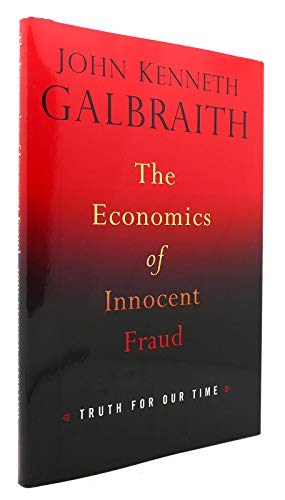
John Kenneth Galbraith has long been at the center of American economics, in key positions of responsibility during the New Deal, World War II, and since, guiding policy and debate. His trenchant new book distills this lifetime of experience in the public and private sectors; it is a scathing critique of matters as they stand today.
Sounding the alarm about the increasing gap between reality and "conventional wisdom" -- a phrase he coined -- Galbraith tells, along with much else, how we have reached a point where the private sector has unprecedented control over the public sector. We have given ourselves over to self-serving belief and "contrived nonsense" or, more simply, fraud. This has come at the expense of the economy, effective government, and the business world.
Particularly noted is the central power of the corporation and the shift in authority from shareholders and board members to management. In an intense exercise of fraud, the pretense of shareholder power is still maintained, even with the immediate participants. In fact, because of the scale and complexity of the modern corporation, decisive power must go to management. From management and its own inevitable self-interest, power extends deeply into government -- the so-called public sector. This is particularly and dangerously the case in such matters as military policy, the environment, and, needless to say, taxation. Nevertheless, there remains the firm reference to the public sector.
How can fraud be innocent? In his inimitable style, Galbraith offers the answer. His taut, wry, and severe comment is essential reading for everyone who cares about America's future. This book is especially relevant in an election year, but it deeply concerns the much longer future.
Sounding the alarm about the increasing gap between reality and "conventional wisdom" -- a phrase he coined -- Galbraith tells, along with much else, how we have reached a point where the private sector has unprecedented control over the public sector. We have given ourselves over to self-serving belief and "contrived nonsense" or, more simply, fraud. This has come at the expense of the economy, effective government, and the business world.
Particularly noted is the central power of the corporation and the shift in authority from shareholders and board members to management. In an intense exercise of fraud, the pretense of shareholder power is still maintained, even with the immediate participants. In fact, because of the scale and complexity of the modern corporation, decisive power must go to management. From management and its own inevitable self-interest, power extends deeply into government -- the so-called public sector. This is particularly and dangerously the case in such matters as military policy, the environment, and, needless to say, taxation. Nevertheless, there remains the firm reference to the public sector.
How can fraud be innocent? In his inimitable style, Galbraith offers the answer. His taut, wry, and severe comment is essential reading for everyone who cares about America's future. This book is especially relevant in an election year, but it deeply concerns the much longer future.
"synopsis" may belong to another edition of this title.
About the Author
John Kenneth Galbraith who was born in 1908, is the Paul M. Warburg Professor of Economics Emeritus at Harvard University and a past president of the American Academy of Arts and Letters. He is the distinguished author of thirty-one books spanning three decades, including The Affluent Society, The Good Society, and The Great Crash. He has been awarded honorary degrees from Harvard, Oxford, the University of Paris, and Moscow University, and in 1997 he was inducted into the Order of Canada and received the Robert F. Kennedy Book Award for Lifetime Achievement. In 2000, at a White House ceremony, he was given the Presidential Medal of Freedom. He lives in Cambridge, Massachusetts.
Reviews
In this thin volume, Galbraith, the noted economist and presidential adviser, serves up a pessimistic view of today's U.S. economy. Drawing on the omnipresent headlines of corporate scandal and greed, Galbraith explains that as the economy suffers, the overall state of American society declines as well. He points to a number of cases of "innocent fraud," or the gap between reality and conventional wisdom. The author bemoans the emphasis on gross domestic production, or GDP, rather than cultural or artistic advances. Companies, not the public, decide what products to make. Galbraith believes that decisions in various corporate arenas are made based on profits, rather than sound business strategies. Furthermore, he says that shareholder meetings, with a few rare exceptions, are pointless because "Shareholders-owners-and their alleged directors in any sizeable enterprise are fully subordinate to the management.... An accepted fraud." He also calls the rapid Internet growth and subsequent bubble another example of fraud as millions of analysts predicted rapid growth for so many companies, but ultimately many employees were laid off. Even more dismaying to Galbraith is the power of the Federal Reserve, which is credited with prompting economic resurgence when, in his view, the institution has limited real power. This brief treatise is a well-written, logical argument about the state of the economy. However, readers may be disappointed because the short concluding chapter offers few realistic solutions.
Copyright © Reed Business Information, a division of Reed Elsevier Inc. All rights reserved.
Galbraith, renowned economist, explains how economics and larger economic and political systems cultivate their own version of the truth. These "frauds" do not connect to reality, and although legal and not criminal, they reflect social and personal beliefs run amuck. He observes the notion that shareholders rule corporations when the power is now with managers. Labeling capitalism a market system makes the consumer appear to have sovereignty, yet the reality is that the market is subject to well-financed, skilled, and comprehensive management of the public response both in politics and consumerism. The economic and social dominance of big business is accepted, and the distinction between the public and private sectors has no meaning as corporate power extends to politics and government. In reality, corporations dominate our military, public finance, and the environment. As a prominent antiwar advocate, Galbraith believes war is a decisive human failure. This thought-provoking book will have wide appeal, including those whose politics and views differ from the author's. Mary Whaley
Copyright © American Library Association. All rights reserved
Excerpt. © Reprinted by permission. All rights reserved.
Introduction and a Personal Note
For some seventy years my working life has been concerned with economics, along with not infrequent departures to public and political service that had an economic aspect and one tour in journalism. During that time I have learned that to be right and useful, one must accept a continuing divergence between approved belief—what I have elsewhere called conventional wisdom —and the reality. And in the end, not surprisingly, it is the reality that counts. This small book is the result of many years of encountering, valuing and using this distinction, and it is my conclusion that reality is more obscured by social or habitual preference and personal or group pecuniary advantage in economics and politics than in any other subject. Nothing has more captured my thought, and what follows is a considered view of this difference.
A lesser point: Central to my argument here is the dominant role in the modern economic society of the corporation and of the passage of power in that entity from its owners, the stockholders, now more graciously called investors, to the management. Such is the dynamic of corporate life. Management must prevail.
As I was working on these pages, there came the great breakout in corporate power and theft with the unanticipated support of cooperative and corrupt accounting. Enron I had noticed as an example of my case; there were to be more in the headlines. Perhaps I should have been grateful; there are few times when an author can have such affirmation of what he or she has written. The corporate scandals, as they are now called, dominated the news because of exceptionally competent and detailed reporting. I forgo repetition here. I do, however, make reference to the restraints to which managerial authority must now be subject, but these are a small part of the story. More to be told is of the longer and larger departure from reality of approved and conditioned belief in the economic world.
Dealt with in this essay is how, out of the pecuniary and political pressures and fashions of the time, economics and larger economic and political systems cultivate their own version of truth. This last has no necessary relation to reality. No one is especially at fault; what it is convenient to believe is greatly preferred. This is something of which all who have studied economics, all who are now students and all who have some interest in economic and political life should be aware. It is what serves, or is not adverse to, influential economic, political and social interest.
Most progenitors of what I here intend to identify as innocent fraud are not deliberately in its service. They are unaware of how their views are shaped, how they are had. No clear legal question is involved. Response comes not from violation of law but from personal and social belief. There is no serious sense of guilt; more likely, there is self-approval.
This essay is not a totally solemn exercise. A marked enjoyment can be found in identifying self-serving belief and contrived nonsense. So it has been for the author and so he hopes it will be for the reader.
Copyright © 2004 by John Kenneth Galbraith. Reprinted by permission of Houghton Mifflin Company.
For some seventy years my working life has been concerned with economics, along with not infrequent departures to public and political service that had an economic aspect and one tour in journalism. During that time I have learned that to be right and useful, one must accept a continuing divergence between approved belief—what I have elsewhere called conventional wisdom —and the reality. And in the end, not surprisingly, it is the reality that counts. This small book is the result of many years of encountering, valuing and using this distinction, and it is my conclusion that reality is more obscured by social or habitual preference and personal or group pecuniary advantage in economics and politics than in any other subject. Nothing has more captured my thought, and what follows is a considered view of this difference.
A lesser point: Central to my argument here is the dominant role in the modern economic society of the corporation and of the passage of power in that entity from its owners, the stockholders, now more graciously called investors, to the management. Such is the dynamic of corporate life. Management must prevail.
As I was working on these pages, there came the great breakout in corporate power and theft with the unanticipated support of cooperative and corrupt accounting. Enron I had noticed as an example of my case; there were to be more in the headlines. Perhaps I should have been grateful; there are few times when an author can have such affirmation of what he or she has written. The corporate scandals, as they are now called, dominated the news because of exceptionally competent and detailed reporting. I forgo repetition here. I do, however, make reference to the restraints to which managerial authority must now be subject, but these are a small part of the story. More to be told is of the longer and larger departure from reality of approved and conditioned belief in the economic world.
Dealt with in this essay is how, out of the pecuniary and political pressures and fashions of the time, economics and larger economic and political systems cultivate their own version of truth. This last has no necessary relation to reality. No one is especially at fault; what it is convenient to believe is greatly preferred. This is something of which all who have studied economics, all who are now students and all who have some interest in economic and political life should be aware. It is what serves, or is not adverse to, influential economic, political and social interest.
Most progenitors of what I here intend to identify as innocent fraud are not deliberately in its service. They are unaware of how their views are shaped, how they are had. No clear legal question is involved. Response comes not from violation of law but from personal and social belief. There is no serious sense of guilt; more likely, there is self-approval.
This essay is not a totally solemn exercise. A marked enjoyment can be found in identifying self-serving belief and contrived nonsense. So it has been for the author and so he hopes it will be for the reader.
Copyright © 2004 by John Kenneth Galbraith. Reprinted by permission of Houghton Mifflin Company.
"About this title" may belong to another edition of this title.
Search results for The Economics of Innocent Fraud: Truth for Our Time

Stock Image
The Economics of Innocent Fraud: Truth for Our Time
Seller: World of Books (was SecondSale), Montgomery, IL, U.S.A.
Seller rating 5 out of 5 stars

Hardback. Condition: Good. The primary aspect of the "fraud" of the American economy that Galbraith (emeritus, economics, Harvard U.) criticizes is the false pretense of shareholder control over corporations, when in fact all real power has shifted to corporate managers. Contradicting conventional wisdom, or "approved belief" in his words, he denies the distinction between t. Seller Inventory # 00092665728
Stock Image
The Economics of Innocent Fraud: Truth for Our Time
Published by
Mariner Books (edition First Edition), 2004
ISBN 10: 0618013245
ISBN 13: 9780618013241
Used
Hardcover
First Edition
Seller: BooksRun, Philadelphia, PA, U.S.A.
Seller rating 5 out of 5 stars
Hardcover. Condition: Fair. First Edition. With dust jacket. The item might be beaten up but readable. May contain markings or highlighting, as well as stains, bent corners, or any other major defect, but the text is not obscured in any way. Seller Inventory # 0618013245-7-1-29
Stock Image
The Economics of Innocent Fraud: Truth for Our Time
Published by
Mariner Books (edition First Edition), 2004
ISBN 10: 0618013245
ISBN 13: 9780618013241
Used
Hardcover
First Edition
Seller: BooksRun, Philadelphia, PA, U.S.A.
Seller rating 5 out of 5 stars
Hardcover. Condition: Fair. First Edition. The item might be beaten up but readable. May contain markings or highlighting, as well as stains, bent corners, or any other major defect, but the text is not obscured in any way. Seller Inventory # 0618013245-7-1-13
Seller Image
The Economics of Innocent Fraud: Truth for Our Time
Seller: Greenworld Books, Arlington, TX, U.S.A.
Seller rating 5 out of 5 stars
Condition: very_good. Fast Free Shipping â" Very Good condition book with a firm cover and clean pages. Shows normal use and some light wear or limited notes markings. A solid, nice copy to enjoy. Seller Inventory # GWV.0618013245.VG
Stock Image
The Economics of Innocent Fraud: Truth for Our Time
Seller: Evergreen Goodwill, Seattle, WA, U.S.A.
Seller rating 5 out of 5 stars
hardcover. Condition: Good. Seller Inventory # mon0000815632
Stock Image
The Economics of Innocent Fraud: Truth for Our Time
Seller: Evergreen Goodwill, Seattle, WA, U.S.A.
Seller rating 5 out of 5 stars
hardcover. Condition: Acceptable. Pages include notes, underlining, or highlighting. Seller Inventory # mon0000762647
Stock Image
The Economics of Innocent Fraud: Truth for Our Time
Seller: World of Books Inc, Montgomery, IL, U.S.A.
Seller rating 4 out of 5 stars

Hardback. Condition: Good. The primary aspect of the "fraud" of the American economy that Galbraith (emeritus, economics, Harvard U.) criticizes is the false pretense of shareholder control over corporations, when in fact all real power has shifted to corporate managers. Contradicting conventional wisdom, or "approved belief" in his words, he denies the distinction between t. Seller Inventory # CIN0618013245G
Stock Image
The Economics of Innocent Fraud: Truth For Our Time
Seller: Wonder Book, Frederick, MD, U.S.A.
Seller rating 5 out of 5 stars
Condition: Very Good. Very Good condition. Good dust jacket. A copy that may have a few cosmetic defects. May also contain light spine creasing or a few markings such as an owner's name, short gifter's inscription or light stamp. Seller Inventory # K02A-02182
Stock Image
The Economics of Innocent Fraud: Truth For Our Time
Seller: Wonder Book, Frederick, MD, U.S.A.
Seller rating 5 out of 5 stars
Condition: Good. Good condition. Good dust jacket. A copy that has been read but remains intact. May contain markings such as bookplates, stamps, limited notes and highlighting, or a few light stains. Seller Inventory # D12O-01432
Stock Image
The Economics of Innocent Fraud : Truth for Our Time
Published by
Houghton Mifflin Harcourt Publishing Company, 2004
ISBN 10: 0618013245
ISBN 13: 9780618013241
Used
Hardcover
Seller: Better World Books, Mishawaka, IN, U.S.A.
Seller rating 5 out of 5 stars
Condition: Good. Former library copy. Pages intact with minimal writing/highlighting. The binding may be loose and creased. Dust jackets/supplements are not included. Includes library markings. Stock photo provided. Product includes identifying sticker. Better World Books: Buy Books. Do Good. Seller Inventory # 3359509-75