
Items related to Notes from Madoo: Making a Garden in the Hamptons
Synopsis
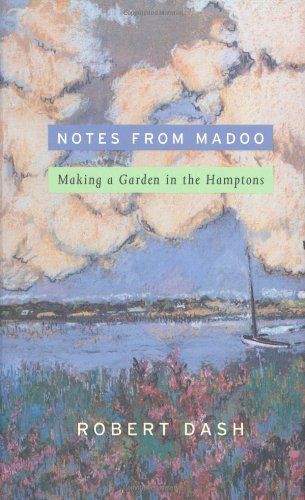
The creator of the Madoo Conservancy presents a collection of essays and articles based on his biweekly gardening columns from the East Hampton Star, in which he shares his hard-won wisdom on gardening techniques, planning, plant care, and more, in such pieces as "Fairies," "The Name of the Rose," "The Garden Tour," and "Manuring."
"synopsis" may belong to another edition of this title.
About the Author
Robert Dash's garden, now the Madoo Conservancy, has appeared in many books and magazine articles and is visited each summer by world-famous horticulturists as well as thousands of garden tourists. Dash is also a popular lecturer. He resides in New York.
Reviews
Extracted from the author's gardening columns in the East Hampton Star, these short, exuberant essays tell of 1.98 acres on the far eastern end of Long Island, where Dash has made a garden he calls Madoo, "My Dove" in an old Scots dialect. Dash is a painter, and it shows in every line as he takes readers through a year in a garden characterized by "continuous involvement with the patterns of abstract expressionism." There are descriptions of his favorite plants, bits of garden history, some gardening advice (suited mainly to his area of Long Island) and, in pieces on garden fairies and the tribulations of Adam and Eve in Eden, a few amazing flights of fancy. Opinionated and eccentric, Dash doesn't mince words about his dislikes--the loss of a neighboring field to a housing development, weather forecasters, forsythia ("an absolute ass of a color")--and he freely admits that the hues of his garden's fences would "make indoor eyeballs wince." Dash's lush prose is best taken in small doses, like an over-rich dessert, but he has a gift for evoking what he sees, as when he speaks of wild daisies "making marvelous stops and explosions throughout the garden and in the fields." His observations about the after-colors of winter's withered perennials, the "smell of nameless turnings in the woods" and the taste of a good lettuce, "like dew," should refresh any garden reader. (June) FYI: Since 1994, Madoo has been an independent charitable trust, the Madoo Conservancy.
Copyright 2000 Reed Business Information, Inc.
Writing as expressively as he paints, artist Robert Dash recounts the making of Madoo, his Long Island garden. The essays collected here, which were taken from gardening columns written for the East Hampton Star, serve to illuminate Madoo's much photographed landscape in vivid detail. And following in the best tradition of garden writing, Dash's well-crafted words extend to a range of appealing themes that other gardeners will relish--favored plants, special achievements, losses from storms, and the like. Refreshingly opinionated and astutely observant, Dash can also be delightfully comic. A gardener of considerable renown, Dash promises stimulating companionship when the garden is at rest. Alice Joyce
Copyright © American Library Association. All rights reserved
Excerpt. © Reprinted by permission. All rights reserved.
INTRODUCTION
English Bones, American Flesh
My garden is at the far eastern end of Long Island, in New York
State, in a town settled in 1656. It is set amidst fields continually
farmed since that time, and one would need a maul to separate it from
its profoundly English
influences. Yet it might take a wedge struck with equal force to pry
it from its continuous involvement with the patterns of abstract
expressionism, a largely American form of painting.
Within that pattern much else went toward the making of my garden: a
love of Indian paths, rather like the secret walks small children
make (which counts a lot for how one moves through my garden); an
admiration of the roan beauties of abandoned farmland pierced by red
cedars laced and tied by dog roses, honeysuckle, and brown, dry
grass; the memory of a meadow of a single species of short, gray-
leaved, flat-topped, open-flowered goldenrod, whose October display
was feathered by hundreds of monarch butterflies. I have a stubborn
Calvinist belief in utility, which causes me to plant vegetables
among flowers, use herbs as borders and berry bushes as ornamentals.
The brutish littoral climate leads me to choose only such plants as
have infinite stamina. There are recollections of an ancestor who
planted hollyhocks at the gate and lilacs out back-but all gardens
are a form of autobiography. Moreover, as a painter, I am predelicted
toward shape, mass, and form and have learned that the predominant
color of all gardens is green and all the rest is secondary
bedeckment. Finally, there is something else-a fierce addiction to
privacy, which is why my windbreak is thicker than it need be.
Madoo, which in an old Scots dialect means "My Dove," is the
name of my garden of 1.98 acres, and I have been at it now since
1967. I have gone about it as I would a painting, searching for form
rather than prefiguring it, putting it through a process more
intuitive than intellectual. The blunders are there to learn from;
the successes, more often than not, are the result of bold throws. I
started from the house and went out toward the edges, often revising
solid achievements until they seemed made of finer matter, like marks
and erasures of work on paper, which sometimes may be torn and fitted
again in collage.
Although I like white on white (the 'Duchess of Edinburgh'
clematis on a white fence over Rosa 'Blanc Double de Coubert'), and I
like to whiten white by throwing autumn clematis (C. terniflora) over
yew, 'Huldine' over holly, the major push is for green on green. I
have never cared much for all-gray gardens or all-blue gardens;
indeed, I am not certain that they are ever successful, color being
too quixotic to control in that fashion, full of lurking betrayals,
so that sky blue becomes sea blue or slate blue and then not blue at
all. The air over my garden, from whose several points I can see the
Atlantic surf, is full of a most peculiar double light, rising and
falling, and is itself one of the heroes of my landscape, kinder to
foliage and bark than to flowers. Wild air will always do the
painting. I have increased the atmosphere's multiple shimmer by
putting in three small ponds, above whose surfaces small mists
sometimes gather. In contrast I have made darkness with a copse of
twisted, pruned arctic willows and another of a spinney of fastigiate
ginkgoes, the former underplanted with a mix of epimedium, woodruff,
Japanese wood anemones, and ferns, and both washed with the littlest
of spring bulbs. Paths are of brick, pebbles, or setts, or disks of
telephone pole, or grass. Curves alternate with strict, straight
geometries, the better to bound, heighten, and confine the
predominantly relaxed, semiwild, superabundant atmosphere I like.
A meadow garden has been quite successful. Formerly, it was
lawn giving a rather dull view from the dining table, made duller by
summer heat and inevitable drought. America is no climate for lawns.
I did not starve the soil to make the meadow but plunged robust,
thrusty perennials through the grass into pits carefully nourished
with well-rotted manure and much peat moss. It is roughly oval with a
backing of Nootka cypress, cryptomeria, and rhododendron, whose darks
perfectly outline the brighter foil of foliage.
To my way of seeing, a garden is not a succession of small
rooms or little effects but one large tableau, whose elements are
inextricably linked to the accomplishment of the entire garden, just
as in painting all passages conduce to the effect of the whole. Lack
of keyed strength in any one of them may lower the pitch and thrust
of the finished canvas.
A muting of a too-perfect area is often in order, no matter
how lovely it might be. Just so I have found 'Silver Moon' clematises
are too huge a cynosure to be acceptable to the general garden, and I
have taken them out. One can very definitely have too much of a good
thing, unless it be some grand groundcover like Lamium 'Nancy', whose
very modest performance excludes it from the egregious. Subtlety is
always more alluring. The quieter painting enters the heart and
stays, when one of tremendous impact has long since faded away.
I do not paint in the way that I garden or garden as I would
employ the brush, although the process is often the same-both are
arts of the wrist, the broadest, largest sort of signature, if you
will, highly idiosyncratic, the result of much doing, much stumbling,
and highly intuited turns and twists before everything fits and
adheres to the scale of one's intention. A good tree must often be
moved to a more reticent spot when it begins to dominate and thus
ruin the total orchestration. Beautiful tunes don't end up as
symphonies, nor do witticisms write books. Certain flowers may
emblazon a room but be abusive to a fine garden. For that reason and
that of stamina and the ability to take the brunt of the climate (I
am in Zone 7a, whose average lowest temperature is five to zero
degrees Fahrenheit), I choose older varieties of the plant kingdom,
whose foliage and blossom are, more often than not, circumspect and
discreet.
I am now becoming more geometric. In front of the winter
house and winter studio I have just installed a brick path I call a
view-swiper. It is 120 feet long (flying out to the potato fields and
to the ocean, bringing all that fine view inside the purview of the
garden as if it were mine), 8 feet wide at the near end, 6 at the
far, with 80 roses ('Fru Dagmar Hastrup') on the sides. The far
border will have other, taller rugosa roses and daylilies mixed with
teasels. The site is but a narrow spur attached to my property,
surrounded by changing crops whose patterns of growth and tilling are
overwhelmingly seductive, requiring only the simplest sort of anchor
to moor the peninsula.
My canvases now have changed, too, and are rather like
foliant form held very close to the eye. Both gestures, then, are new
for me, and the feeling from both is a bit scary, akin to that of
someone in the middle of a new high-wire act performing over a slowly
withdrawing net. The air of gardens and paintings now seems to me to
be filled with a wild, deliciously cold oxygen through which I can
still see the first plain view of the working barns I converted three
decades ago, gray above a blowing field of grass. That verdure, it
seems to me, was the very soul of the place "working backwards, year
by year," as John Koethe wrote in "The Near Future," until
it "reached the center of a landscape."
The English bones with which I began now seem entirely
covered by what I have done, but that is the way of flesh.
The Death of a Field
Spiritual equanimity is so finely worked that all wild, wounding, or
awesome events fire the brain but briefly. "Take heart," said
Aeschylus, "for suffering, when it occurs at its highest, lasts but a
little time." Longer, one's whole being might implode. Of the many
mercies of spring, one is that we perceive its huge regeneration in a
small quantum, as symbol rather than distributed occurrence. A sin-
gle spear of a daffodil strap blue above yellow straw does nicely for
the whole. Or it may be the moment we smell odors again and know that
the great uncorking has begun once more.
Just so, the moment when roses are high, June becomes summer.
And so the day late in autumn when the sky contracts and seems made
of stone and one thinks one sees the diagonal zip of a snowflake
cutting across the cedars. A moment as cold as the moment you are no
longer loved and it is hard to breathe.
In the open fields of Sagaponack, spring is the first brown
throw of earth falling over rye cover as a tractor cuts broadly, Sagg
Main Street to Sagg Pond and then, engine regeared, pond back to
street. Directly to the south this is, in Foster's fields, the
widening brown finally meeting a horizon of sand where brown stops
and Atlantic flats begin and skies begin to rise wet once more.
But not in the field to my west, not any year ever again. Ink
started wounding it on a first bill of sale in 1968, and then more
ink on more bills (three times in one year once), while profits
bloomed from the contracts and rolled over in a mulch of lawyers,
agents, and speculators. Each year the large question as to whether
it would be farmed went up and down Main Street.
And then one winter in the mid-seventies large, bright rented
cars rolled through the field, randomly scattering wintering geese.
Strangers sat fogging the glass or got out dressed in the most
improbable clothes and pointed. Day after day, up and down my drive,
the dark blue and the black cars with whitewalls, doors slamming.
Agents, brimming with good will, made the most flourishing gestures
(rather like sweeps of the cavalier introducing audience to players,
singers to orchestra), their gloved hands flashing above the empty
winter stubble as if gathering all of the homes and the lands and the
gardens of Sagaponack, which too were part of the vibrant tableau
offered for sale.
The field was done in. Wooden sticks sprayed Day-Glo orange
gored the earth, and red rags and flags were tied to the branches of
the hedgerow. Concrete columns called "monuments" were slipped into
the outlines of the plats. An eighteenth-century English oast house
was disassembled, beams numbered and stacked for shipment to the lot
immediately adjoining mine. The profile of any oast house is eerily
similar to the stacks of Three Mile Island.
All was surveyed in the bright light of plane geometry, as
was all of America, a much-abused idea from the Age of Enlightenment
that has been swallowed whole. Everything had to have a right angle.
Everything had to be logical and orderly-which is why the view of the
Great Plains is so right from on high and so utterly dismal on the
ground. One drives a hundred miles on impeccably straight roads to
reach and cross other roads at precise right angles where nothing is,
neither name nor house nor tree nor stone.
The road connecting Sagg Main Street with the newly charted
Territory of the Field took fifteen feet of my own right of way in
order to complete a mandatory fifty-foot width (to accommodate only
four houses) and was straight-lined and then made two right-angle
turns around my property. The corners were smoothed a bit in pale
polite rural amenity. The road was asphalted, mounded for runoff; its
abominable cobblestone curbs have drains, and slightly sloped
embankments frame it, either side.
And then the trucks came and the cesspools and the leaching
pits and the foundations and the underground wires and all the
internal driveways on the little plots. One house is so close to Sagg
Pond that its cesspool pours nitrogenous effluent into the water.
Algae bloom, and the eventual eutrophication of Sagg Pond earnestly
has begun. Dead water is, after all, compatible with dead earth.
I built a fence. The road turns directly in front of the
glass of my winter studio. Headlights would shine on the walls where
I paint. I stripped the lower branches of the two thousand black
pines I planted over a period of five days some years ago, cutting
down some entirely, to put the timber planks in the middle of the
rows, relinquishing a good eight feet of my land in order to have the
height I needed. Later I planted privet on both sides of the fence,
for the black pines were dying.
I lost my daily walk through the field to the pond and the
sight of the steeple of the Bridgehampton Presbyterian church. I can
no longer see my first studio across the pond. A house blocks it out.
My street address changed, for I was, of course, no longer on a dirt
spur off Sagg Main Street but on a macadam road.
Of course, there are the paintings of the field, but I am not
interested much in paintings of vanished landscapes, and I loathe
nostalgia. What I had to do was cope with the extraordinary sense of
dislodgment, the feeling that kilter was gone. A hole as black as any
in outer space still rises in my throat when I roam through this
vandalism.
Any object of worth has its little history, be it only one of
provenance. The history of this field is invisible, although for
centuries it had been a marvel of fertility, from Indian to colonist
by royal patent, and was farmed by the same family from colonial
times to that dreadful May of 1967 when the last of the line went
south. The field was tended and cherished like any object of vertu.
Unlike porcelain, however, whose pieces may be glued, the field is
valueless and irreclaimable, the light of centuries of harvest
snuffed.
Copyright (c) 2000 by Robert Dash. Reprinted by permission of
Houghton Mifflin Company.
"About this title" may belong to another edition of this title.
Search results for Notes from Madoo: Making a Garden in the Hamptons

Stock Image
Notes from Madoo: Making a Garden in the Hamptons
Published by
Houghton Mifflin Harcourt (edition First Edition), 2000
ISBN 10: 0618016929
ISBN 13: 9780618016921
Used
Hardcover
First Edition
Seller: BooksRun, Philadelphia, PA, U.S.A.
Seller rating 5 out of 5 stars

Hardcover. Condition: Very Good. First Edition. With dust jacket. It's a well-cared-for item that has seen limited use. The item may show minor signs of wear. All the text is legible, with all pages included. It may have slight markings and/or highlighting. Seller Inventory # 0618016929-11-1-29
Stock Image
Notes from Madoo: Making a Garden in the Hamptons
Seller: World of Books (was SecondSale), Montgomery, IL, U.S.A.
Seller rating 5 out of 5 stars
Hardback. Condition: Good. Seller Inventory # 00110801561
Stock Image
Notes from Madoo: Making a Garden in the Hamptons
Seller: World of Books Inc, Montgomery, IL, U.S.A.
Seller rating 4 out of 5 stars

Hardback. Condition: Good. Seller Inventory # CIN0618016929G
Stock Image
Notes from Madoo: Making a Garden in the Hamptons
Published by
Houghton Mifflin Harcourt, 2000
ISBN 10: 0618016929
ISBN 13: 9780618016921
Used
Hardcover
Seller: ThriftBooks-Atlanta, AUSTELL, GA, U.S.A.
Seller rating 5 out of 5 stars
Hardcover. Condition: Very Good. No Jacket. May have limited writing in cover pages. Pages are unmarked. ~ ThriftBooks: Read More, Spend Less. Seller Inventory # G0618016929I4N00
Seller Image
Notes from Madoo Making a Garden in the Hamptons
Published by
Houghton Mifflin Harcourt, 2000
ISBN 10: 0618016929
ISBN 13: 9780618016921
Used
Hardcover
Seller: Squeaky Trees Books, Greenfield TWP, ME, U.S.A.
Seller rating 4 out of 5 stars
Hardcover. Condition: As New. Dust Jacket Condition: Very Good+. Dustcover has light foxing on back side (facing towards book) ; No real wear to either hardboards or dustcover, very clean, no markings, very tight; 5.75 X 1 X 9.75 inches; 288 pages. Seller Inventory # 25108
Seller Image
Notes from Madoo: Making a Garden in the Hamptons
Published by
Houghton Mifflin Harcourt, 2000
ISBN 10: 0618016929
ISBN 13: 9780618016921
Used
Hardcover
First Edition
Seller: Southampton Books, Sag Harbor, NY, U.S.A.
Seller rating 5 out of 5 stars
Hardcover. Condition: Like New. First Edition. First Edition, First Printing. Published by Houghton Mifflin Harcourt, 2000. Octavo. Hardcover. Book is like new. Dust jacket is like new. Spotting along page ends. Seller Inventory # 571621
Stock Image
Notes from Madoo: Making a Garden in the Hamptons
Published by
Houghton Mifflin Harcourt, 2000, 2000
ISBN 10: 0618016929
ISBN 13: 9780618016921
Used
Hardcover
Seller: Sutton Books, Norwich, VT, U.S.A.
Seller rating 4 out of 5 stars
Condition: as new. Dust Jacket Condition: near fine. Hbk 242pp, slight roughening to top of dj spine but otherwise dj is fine and unclipped and now in protective sleeve, otherwise an unread copy, excellent clean tight unmarked as new. Seller Inventory # Gar87
Stock Image
Notes from Madoo: Making a Garden in the Hamptons
Published by
Houghton Mifflin Harcourt, 2000
ISBN 10: 0618016929
ISBN 13: 9780618016921
Used
Hardcover
First Edition
Signed
Seller: Black Cat Books, Shelter Island, NY, U.S.A.
Seller rating 4 out of 5 stars
Hardcover. Condition: Very Good. Dust Jacket Condition: Very Good. 1st Edition. Inscribed by Robert Dash to the previous owner on the title page. 1st edition. Hardbound in dust jacket. Inscribed by Author(s). Seller Inventory # 82914
Stock Image
Notes from Madoo: Making a Garden in the Hamptons
Published by
Houghton Mifflin Harcourt, 2000
ISBN 10: 0618016929
ISBN 13: 9780618016921
Used
Hardcover
First Edition
Signed
Seller: Black Cat Books, Shelter Island, NY, U.S.A.
Seller rating 4 out of 5 stars
Hardcover. Condition: Very Good. Dust Jacket Condition: Very Good. 1st Edition. Signed & inscribed by Robert Dash to the previous owner on the half title page. 1st edition. Hardbound in dust jacket. Signed by Author(s). Seller Inventory # 90910
Stock Image
Notes from Madoo: Making a Garden in the Hamptons
Published by
Houghton Mifflin Harcourt, 2000
ISBN 10: 0618016929
ISBN 13: 9780618016921
Used
Hardcover
First Edition
Signed
Seller: Black Cat Books, Shelter Island, NY, U.S.A.
Seller rating 4 out of 5 stars
Hardcover. Condition: Very Good. Dust Jacket Condition: Very Good. 1st Edition. Hardbound in dust jacket. Signed & inscribed by Robert Dash to the previous owner on the front free end page. 1st edition. Signed by Author(s). Seller Inventory # 72962