
Items related to The Company of Crows: A Book of Poems
Synopsis
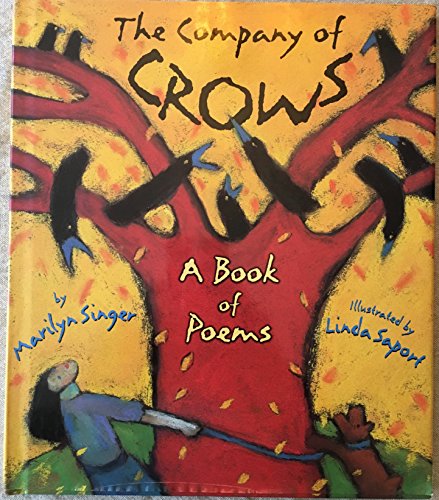
As a group of crows travels through a small town, twenty-three poems, in the voices of humans, animals, crows, and other birds, offer a unique perspective on the American crow, a bird commonly thought of as a symbol of bad luck.
"synopsis" may belong to another edition of this title.
About the Author
Marilyn Singer has written over 60 books for young readers, including both poetry and nonfiction about animal behavior and the natural world, such as Tough Beginnings: How Baby Animals Survive and A Pair of Wings. Her picture book Didi and Daddy on the Promenade was hailed as "a buoyant look at a family's typical Sunday outing." Marilyn lives in Brooklyn, New York, and Washington Depot, Connecticut.
Linda Saport has illustrated many distinctive picture books, amoung them Subira Subira by Tololwa M. Mollel and All the Pretty Little Horses: A Lullaby. She lives in Boulder, Colorado.
Reviews
Grade 2-5-Through the eyes of children, parents, a bird-watcher, and a dog and other animals, readers are treated to a poetic introduction to the crow's world. "The Painter" points out how colorful the creature is-"-From the blackest wings/an unexpected rainbow springs,/A sheen of green, purple, blue./My art is to reveal each elusive hue./The crow's art is/to glow." "The Pig" describes the feathered animal as "annOYING" while "The Poet" finds winter "-a quiet crow/stepping stately, sedately/across a frozen lake." Large spreads featuring brilliant colors evoke and interpret the poems successfully. The bold pastels are simply rendered yet engaging. In the illustration for "The Farmer," a large scarecrow leans to one side in a most stylish and unusual red blazer and lime tie, with royal blue pantaloons atop smart white stockings and black shoes. He is covered with loudly cawing black crows whose beaks match his pantaloons. This scene rests on a vibrant green hill with a vivid mustard sky. Children will enjoy the illustrations and language and take pleasure in the thoughts posed in these selections.
Linda M. Kenton, San Rafael Public Library, CA
Copyright 2002 Reed Business Information, Inc.
Despite the striking full-bleed art and the author's enthusiasm for her subject, this collection of poems about crows may not fly with the target audience. For starters, youngsters may have trouble reading the poems, printed as they are in thin font against deep-colored backgrounds. Ostensibly each poem has a different narrator, but because Singer's (Quiet Night) voice varies relatively little, readers will have trouble distinguishing one character from another. For example, the speaker in "The Boy" refers formally to "those merry, scolding crows" as if he were an adult birdwatcher; "The Birdwatcher," meanwhile, indulges in childlike questions ("Does a crow have a choice/ how to think, how to be?"). The design compounds the problems sometimes the titles, contained within the art, appear below the poem, so that readers may not recognize that a new poem has begun. Saport's (All the Pretty Horses) arresting, bold pastel illustrations adopt an imaginative array of perspectives, and her colors seem almost to glow. However, the slightly abstract quality of her compositions makes them best viewed from a slight distance, whereas close proximity is needed to make out the text. Ages 5-9.
Copyright 2002 Reed Business Information, Inc.
Gr. 2-4, younger for reading aloud. Poet Wallace Stevens had "Thirteen Ways of Looking at a Blackbird"; here Singer doubles the number, inviting readers to see these noisy, gregarious, intelligent tricksters through the eyes of other birds, children, a poet, a farmer, even a pig with an itchy back ("They're / always tOYING / with friends and foes alike / Yet, when it comes to emplOYING / their cheeky beaks / no one's better than / these back-scratching bug-snatching / itch-pleasing twitch-easing / swindlers / whose visit I'm enjOYING." Saport's pictures here are reminiscent of Denise Fleming's art. Her layered pastels create brightly colored, eye-filling outdoor scenes, with slightly indistinct but easily recognizable figures. In a deft mix of rhymed and free verse, philosophy and scientific detail, Singer convincingly demonstrates that crows are "easy to classify . . . hard to understand," and well worth the time spent observing them. Pair this with veteran naturalist Laurence Pringle's new, equally engaging Crows! Strange and Wonderful [BKL N 1 02]. John Peters
Copyright © American Library Association. All rights reserved
"About this title" may belong to another edition of this title.
Search results for The Company of Crows: A Book of Poems

Stock Image
Company of Crows
Seller: World of Books (was SecondSale), Montgomery, IL, U.S.A.
Seller rating 5 out of 5 stars

Hardback. Condition: Good. Saport, Linda (illustrator). Seller Inventory # 00085396939
Seller Image
The Company of Crows: A Book of Poems
Seller: -OnTimeBooks-, Phoenix, AZ, U.S.A.
Seller rating 5 out of 5 stars
Condition: good. Saport, Linda (illustrator). A copy that has been read, remains in good condition. All pages are intact, and the cover is intact. The spine and cover show signs of wear. Pages can include notes and highlighting and show signs of wear, and the copy can include "From the library of" labels or previous owner inscriptions. 100% GUARANTEE! Shipped with delivery confirmation, if you're not satisfied with purchase please return item! Ships via media mail. Seller Inventory # OTV.0618083405.G
Stock Image
The Company of Crows : A Book of Poems
Published by
Houghton Mifflin Harcourt Publishing Company, 2002
ISBN 10: 0618083405
ISBN 13: 9780618083404
Used
Hardcover
Seller: Better World Books, Mishawaka, IN, U.S.A.
Seller rating 5 out of 5 stars
Condition: Good. Saport, Linda (illustrator). Pages intact with minimal writing/highlighting. The binding may be loose and creased. Dust jackets/supplements are not included. Stock photo provided. Product includes identifying sticker. Better World Books: Buy Books. Do Good. Seller Inventory # 3360321-6
Stock Image
The Company of Crows : A Book of Poems
Published by
Houghton Mifflin Harcourt Publishing Company, 2002
ISBN 10: 0618083405
ISBN 13: 9780618083404
Used
Hardcover
Seller: Better World Books, Mishawaka, IN, U.S.A.
Seller rating 5 out of 5 stars
Condition: Very Good. Saport, Linda (illustrator). Former library copy. Pages intact with possible writing/highlighting. Binding strong with minor wear. Dust jackets/supplements may not be included. Includes library markings. Stock photo provided. Product includes identifying sticker. Better World Books: Buy Books. Do Good. Seller Inventory # 3360323-6
Stock Image
The Company of Crows: A Book of Poems
Seller: ThriftBooks-Atlanta, AUSTELL, GA, U.S.A.
Seller rating 5 out of 5 stars
Hardcover. Condition: Very Good. No Jacket. Saport, Linda (illustrator). May have limited writing in cover pages. Pages are unmarked. ~ ThriftBooks: Read More, Spend Less. Seller Inventory # G0618083405I4N00
Stock Image
The Company of Crows: A Book of Poems
Seller: ThriftBooks-Dallas, Dallas, TX, U.S.A.
Seller rating 5 out of 5 stars
Hardcover. Condition: Very Good. No Jacket. Saport, Linda (illustrator). May have limited writing in cover pages. Pages are unmarked. ~ ThriftBooks: Read More, Spend Less. Seller Inventory # G0618083405I4N00
Stock Image
Company of Crows
Seller: World of Books Inc, Montgomery, IL, U.S.A.
Seller rating 4 out of 5 stars

Hardback. Condition: Good. Saport, Linda (illustrator). Seller Inventory # CIN0618083405G
Stock Image
The Company of Crows: A Book of Poems
Published by
Clarion Books, Boston, Massachusetts, U.S.A., 2002
ISBN 10: 0618083405
ISBN 13: 9780618083404
Used
Hardcover
Seller: The Yard Sale Store, Narrowsburg, NY, U.S.A.
Seller rating 5 out of 5 stars
Hardcover. Condition: Good. Saport, Linda (illustrator). Reasonable and presentable library withdrawal. Full dust jacket under the plastic protective covers.Some scuff marks to the plastic protective cover. Stamped in places by the library. Card pocket pasted on the inside back cover page. Seller Inventory # BPBK85101010131
Stock Image
The Company of Crows: A Book of Poems.
Published by
New York, Clarion Books., 2002
ISBN 10: 0618083405
ISBN 13: 9780618083404
Used
Hardcover
First Edition
Seller: Bucks County Bookshop IOBA, Doylestown, PA, U.S.A.
Seller rating 5 out of 5 stars
Saport, Linda (illustrator). First Edition, First Printing. -- The previous owner has left some whimsical ephemera in this book. -- Hardcover. Condition: near fine, with near fine, price-clipped dust jacket. ISBN 0618083405. Seller Inventory # 32755
Stock Image
THE COMPANY OF CROWS (A BOOK OF POEMS) 1ST PRT- SIGNED
Published by
Clarion Books, Boston, 2002
ISBN 10: 0618083405
ISBN 13: 9780618083404
Used
Hardcover
First Edition
Signed
Seller: Elaine Woodford, Bookseller, Durham, NC, U.S.A.
Seller rating 4 out of 5 stars
Hardcover. Condition: Fine. Dust Jacket Condition: Fine. Saport, Linda (illustrator). 1st Ed, 1st Prt. SIGNED PRESENTATION COPY TO WELL-KNOWN CHILDREN'S BOOK REVIEWER: "To Michael (Cart) Caw! Love, Marilyn, 3/03". Delightful poetry for all ages which features the voices of humans & animals- revealing true nature of crows. Wonderful vivid art. Signed by Author(s). Seller Inventory # 000856