Items related to Song and Dance: Poems
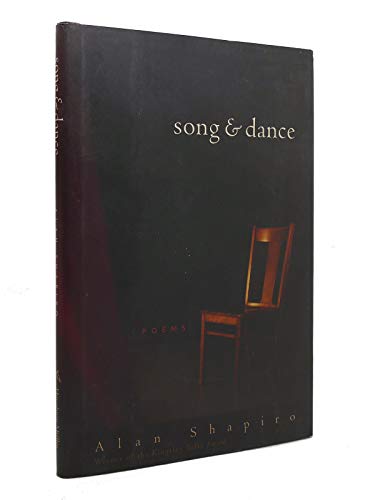

Alan Shapiro's seventh collection celebrates art as a woefully inadequate yet necessary source of comfort. "Amazingly sensitive and tough-minded" (Tom Sleigh), the poems in Song and Dance intimately describe the complicated feelings that attend the catastrophic loss of a loved one. In 1998, Shapiro's brother, David, an actor on Broadway, was diagnosed with an incurable form of brain cancer. Song and Dance recounts the poet's emotional journey through the last months of his brother's life, exploring feelings too often ignored in official accounts of grief: horror, relief, impatience, exhaustion, exhilaration, fear, self-criticism, fulfillment.
"synopsis" may belong to another edition of this title.
About the Author:
Alan Shapiro is the William R. Kenan Jr. Distinguished Professor of English and Creative Writing at the University of North Carolina, Chapel Hill. He is the author of nine acclaimed books of poetry. He is a former recipient of the Kingsley Tufts Award and the Los Angeles Book Prize and was a finalist for the National Book Critics Circle Award. He was recently elected as a fellow in the American Academy of Arts and Sciences.
Excerpt. © Reprinted by permission. All rights reserved.:
Everything the Traffic Will Allow The two boys don't suspect
they don't exist. And Ethel Merman is
the shade of a shade -- what Plato says
all poetry is --
a record spinning beneath
a needle
as the boys lip-sync into
imaginary mikes her glottal swagger,
brassy, large,
streetwise and from their mouths
so touchingly naive for being so . . .
There's no
people
like show
people . . . Their parents clap
and whistle
from the bed, propped up
on pillows . . .
Everything about it is appealing . . .
They are shouting Encore! Bravo!
when the boys,
like chorus girls, arms on each other's shoulders,
step-kick their way across the room
and out of it,
then back . . . stealing that extra bow . . .
Shades of a shade. What poetry is.
Because there's nowhere else for them to be
except
inside the room in which it isn't
when it is,
in which there is no room
unless I think of it -- the boys
their arms flung wide
on one knee mouthing the last words
before the needle slides off into silence,
the parents propped up
on pillows, half laughing, half
shouting Bravo!
Encore!
All now just the shade
of a shade --
like no
people
I know . . .
"About this title" may belong to another edition of this title.
- PublisherHoughton Mifflin Harcourt
- Publication date2002
- ISBN 10 0618152857
- ISBN 13 9780618152858
- BindingHardcover
- Edition number1
- Number of pages59
- Rating
Buy New
Learn more about this copy
US$ 5.05
Shipping:
FREE
Within U.S.A.
Top Search Results from the AbeBooks Marketplace
Stock Image
Song and Dance: Poems
Published by
Houghton Mifflin Harcourt
(2002)
ISBN 10: 0618152857
ISBN 13: 9780618152858
New
Hardcover
Quantity: 5
Seller:
Rating

Book Description Condition: New. Song and Dance: Poems 0.7. Seller Inventory # BBS-9780618152858
Buy New
US$ 5.05
Convert currency
Stock Image
Song and Dance: Poems
Published by
Houghton Mifflin Harcourt
(2002)
ISBN 10: 0618152857
ISBN 13: 9780618152858
New
Hardcover
Quantity: 1
Seller:
Rating

Book Description Condition: New. . Seller Inventory # 52GZZZ00YCG1_ns
Buy New
US$ 14.58
Convert currency
Stock Image
Song and Dance: Poems
Published by
Houghton Mifflin Harcourt
(2002)
ISBN 10: 0618152857
ISBN 13: 9780618152858
New
Hardcover
Quantity: 1
Seller:
Rating
Book Description Hardcover. Condition: new. New Copy. Customer Service Guaranteed. Seller Inventory # think0618152857
Buy New
US$ 28.60
Convert currency
Stock Image
Song and Dance: Poems
Published by
Houghton Mifflin Harcourt
(2002)
ISBN 10: 0618152857
ISBN 13: 9780618152858
New
Hardcover
Quantity: 1
Seller:
Rating
Book Description Hardcover. Condition: New. Seller Inventory # Abebooks177304
Buy New
US$ 59.00
Convert currency
Stock Image
SONG AND DANCE: POEMS
Published by
Houghton Mifflin Harcourt
(2002)
ISBN 10: 0618152857
ISBN 13: 9780618152858
New
Hardcover
Quantity: 1
Seller:
Rating

Book Description Condition: New. New. In shrink wrap. Looks like an interesting title! 0.55. Seller Inventory # Q-0618152857
Buy New
US$ 60.89
Convert currency