
Items related to Pink Brain, Blue Brain: How Small Differences Grow...
Pink Brain, Blue Brain: How Small Differences Grow into Troublesome Gaps- and What We Can Do About It - Hardcover
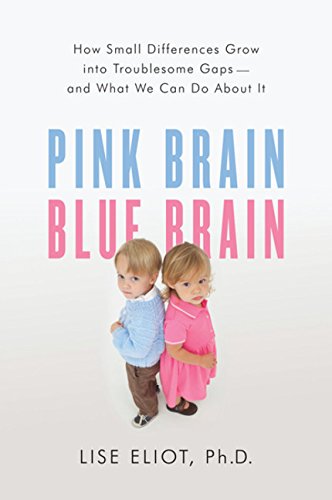
Synopsis
A precise scientific exploration of the differences between boys and girls that breaks down damaging gender stereotypes and offers practical guidance for parents and educators.
In the past decade, we've come to accept certain ideas about the differences between males and females—that boys can't focus in a classroom, for instance, and that girls are obsessed with relationships. In Pink Brain, Blue Brain, neuroscientist Lise Eliot turns that thinking on its head. Calling on years of exhaustive research and her own work in the field of neuroplasticity, Eliot argues that infant brains are so malleable that small differences at birth become amplified over time, as parents and teachers—and the culture at large—unwittingly reinforce gender stereotypes. Children themselves intensify the differences by playing to their modest strengths. They constantly exercise those “ball-throwing” or “doll-cuddling” circuits, rarely straying from their comfort zones. But this, says Eliot, is just what they need to do, and she offers parents and teachers concrete ways to help. Boys are not, in fact, “better at math” but at certain kinds of spatial reasoning. Girls are not naturally more empathetic; they’re allowed to express their feelings. By appreciating how sex differences emerge—rather than assuming them to be fixed biological facts—we can help all children reach their fullest potential, close the troubling gaps between boys and girls, and ultimately end the gender wars that currently divide us.
"synopsis" may belong to another edition of this title.
About the Author
Lise Eliot, a graduate of Harvard, received her Ph.D. from Columbia University. She is Associate Professor of Neuroscience at The Chicago Medical School of Rosalind Franklin University of Medicine and Science. The mother of two sons and a daughter, she is also the author of What’s Going on in There? How the Brain and Mind Develop in the First Five Years of Life.
Reviews
From The Washington Post's Book World/washingtonpost.com Reviewed by Emily Bazelon In one of the eye-opening studies cited in Lise Eliot's masterful new book on gender and the brain, mothers brought their 11-month-olds to a lab so the babies could crawl down a carpeted slope. The moms pushed a button to change the slope's angle based on what they thought their children could handle. And then the babies were tested to see how steep a slope they could navigate. The results? Girls and boys proved equally adept at crawling and risk-taking: On their own, they tried and conquered the same slopes. But the mothers of the girls -- unlike the mothers of the boys -- underestimated their daughters' aptitude by a significant margin. "Sex differences in the brain are sexy," Eliot writes. And so we tend to notice them everywhere. "But there's enormous danger," she says, in our exaggeration. It leads us to see gender, beginning at an early age, only in terms of what we expect to see, and to assume that sex differences are innate and immutable. We forget that the differences within each sex -- among girls and among boys -- are usually greater than the gaps between the two. Our assumptions "crystallize into children's self-perceptions and self-fulfilling prophecies." Girls' slightly lesser interest in puzzles and building toys is reinforced instead of challenged, and it turns into a gap in spatial skills and map reading. Parents and teachers see a boy lagging in reading and verbal skills and shrug it off with, "But of course, he's a boy." Eliot's contribution in "Pink Brain, Blue Brain" is to explain, clearly and authoritatively, what the research on brain-based sex difference actually shows, and to offer helpful suggestions about how we can erase the small gaps for our children instead of turning them into larger ones. "How can we help boys express their feelings, learn to read and write better, and feel at home in the school classroom?" she asks. "How can we help girls stay confident in math, learn how to read a map, and embrace technology and competition?" If you are interested in the latest smart thinking about these crucial topics, Eliot, a neuroscientist at Rosalind Franklin University of Medicine and Science in Chicago, will be your new favorite expert. Her approach is especially welcome because the exaggeration of brain-based sex differences has launched a publishing flurry in the past few years from credentialed authors who should know better. Eliot calls them out by name -- the prime culprits are Louann Brizendine, Leonard Sax and Michael Gurian -- and hacks away at their groundless claims. She's not in ideological denial: "There's a good reason why parents so often comment on boys' and girls' different toy preferences," she writes. "This is one of the largest differences between the sexes that psychologists have uncovered." But Eliot's trump card is the brain's plasticity. Our brains are works in progress. They change based on experience, especially in early childhood. So a child's environment matters in terms of the skills and interests he or she develops. That doesn't mean pushing trucks on the 3-year-old girl who wants dolls -- we've all seen that experiment fail. But how about giving her a Lego set, sidewalk chalk or even a doll stroller, to encourage her to move around and think in spatial terms? Eliot also shows that the brain-based differences that seem so immovable in childhood can lessen with age. She gives us a pair of graphs, side by side. In the first, which shows the height distribution of men and women, the two curves show little overlap. You can see at a glance that most men are taller than most women. The second graph shows the "difference value" for sex in scores on science and verbal fluency tests. This time, the curves are closely aligned. In contrast to height, the picture of male and female difference in most psychological and cognitive measures is really one of similarity. In an era when advocates for boys and girls shrilly compete over which sex has it worse in school, Eliot is remarkably even-handed. She weaves in anecdotes about her two sons and daughter, sympathizing in a way that doesn't feel contrived. My only real criticism of this book is the title, "Pink Brain, Blue Brain," which falls for the temptation to sell sex difference as sexy. But Eliot makes up for this on every page. Reading this book made me see my kids and their world differently. Shed of the usual stereotypes, I can pick up on the far subtler interplay of sex-based similarity and difference that is real and profound.
Copyright 2009, The Washington Post. All Rights Reserved.
Professor of neuroscience at Rosalind Franklin University, Eliot (What's Going On in There?) offers a refreshingly reasonable and reassuring look at recent alarming studies about sex differences in determining the behavior of children. Her levelheaded approach recognizes assertions by the nature versus nurture advocates such as Michael Gurian, Leonard Sax, Louann Brizendine—e.g., boys lag behind girls in early development, are more risk taking and spatially adept, while girls are hardwired for verbal communication and feeling empathy—yet underscores how small the differences really are and what parents can do to resist the harmful stereotyping that grows more entrenched over time. Eliot revisits much of the data showing subtle differences in boy-girl sensory processing, memory and language circuits, brain functioning, and neural speed and efficiency, using clever charts and graphs of her own. However, she emphasizes most convincingly that the brain is marvelously plastic and can remodel itself continually to new experiences, meaning that the child comes into the world with its genetic makeup, but actually growing a boy from those XY cells or a girl from XX cells requires constant interaction with the environment. At the end of each chapter, she lists ways to nip early troubles in the bud—i.e., for boys, language and literacy enrichment; for girls, stimulating movement, visual and spatial awareness. Dense, scholarly but accessible, Eliot's work demonstrates a remarkable clarity of purpose. (Oct.)
Copyright © Reed Business Information, a division of Reed Elsevier Inc. All rights reserved.
Excerpt. © Reprinted by permission. All rights reserved.
You’re finally getting to know the new neighbors. They moved in a week ago, but you’ve had no chance to chat, which is surely why you didn’t notice sooner that the woman is pregnant. Very pregnant, by the looks of it.
“How wonderful!” you croon over your common fence. “Do you know if you’re having a boy or girl?”
Why is this always the first question we ask when learning about a new baby? The answer is simple: because sex is a big deal. Not just the act of it, but the fact of it. Of all the characteristics a child brings into the world, being male or female still has the greatest impact — on future relationships, personality, skills, career, hobbies, health, and even the kind of parent the child is likely to become. That’s why 68 percent of expectant parents learn the sex of their child before birth and why you know your neighbor is naive to answer, “We really don’t care, as long as the baby is healthy!”
Most American parents hope to have at least one child of each sex. We enjoy the differences between them, even as we worry about their consequences. Will this little boy, now so active and exuberantly affectionate, settle down enough to begin school? Will he form meaningful relationships with his friends and teachers? Will he still express his feelings or, for that matter, communicate with us at all when he grows up?
For parents of girls, the fears run in the opposite direction. Here she is, so confident and full of life. Will she still dig for worms and wonder about the planets when she’s in middle school? Will she be assertive enough when she lands her first job out of college? Will it be any easier for her generation to juggle career and family when she grows up?
Boys and girls are different. This fact, obvious to every previous generation, comes as a bewildering revelation to many parents today. Raised in an era of equal rights, we assume — or at least hope — that differences between the sexes are made, not inborn. We mingle comfortably with members of the opposite sex, harangue as easily about sports as cooking, and cheerfully compete in the workplace — all the while pretending the two sexes are more or less the same.
Until we have kids of our own, at which point the differences are impossible to ignore.
Like many parents, I could cite endless examples of the differences between our daughter and two sons: Julia loves shopping, while Sam and Toby can barely be persuaded to try on jeans at the mall. Then there was the evening not so long ago that Julia spent drawing pictures of fairies while Sam and Toby raced around the house having a light-saber battle. Even as a young toddler, Julia would lay all our kitchen towels on the floor and then put a stuffed animal on each one for “nappy time.” The only thing that absorbed Sam and Toby as much at that age was seeing how many objects they could jam inside a VCR.
Also, like other parents today, I feel compelled to excuse this gender-typical play with the obligatory “We certainly didn’t encourage Julia to play only with girl toys and Sam and Toby to play only with boy toys.” On the contrary, many of our kids’ building toys — the wooden blocks, Duplos, and Lincoln Logs — were originally purchased for Julia, our oldest child. I try to make a point of praising the boys’ nurturing behavior — like when Sam hugs Toby or cuddles his pet gerbil — and never stand in the way of their attempts to help me cook.
Of course, parents are never truly neutral about gender. Regardless of which toys or clothes we buy them, we cannot help but react in different ways to our sons and daughters — if only because of our own long experience of “male” and “female.” But still, I had thought our kids would be different. As a neuroscientist and Martha Stewart dropout, I am hardly the typical female role model. My husband, also a scientist, fits the male type in many ways (he can fix almost anything around the house — as long as it doesn’t interfere with Monday Night Football) but is kinder and gentler than many of the women I know.
And yet, there they are: Julia quietly makes paper flowers or sets up her Playmobil house while Sammy launches cars off his Hot Wheels track or begs me to pitch Wiffle balls to him outside. Even little Toby, with his clear, high-pitched voice, started steering the boy course early, judging from his toddler fascination with trucks, airplanes, balls, and any kind of electrical appliance.
Yes, boys and girls are different. They have different interests, activity levels, sensory thresholds, physical strengths, emotional reactions, relational styles, attention spans, and intellectual aptitudes. The differences are not huge and, in many cases, are far smaller than the gaps that separate adult men and women. Little boys still cry, little girls kick and shove. But boy-girl differences do add up, leading to some of the more alarming statistics that shape the way we think about raising our children.
Here’s a stark one: Boys are at greater risk than girls for most of the major learning and developmental disorders — as much as four times more likely to suffer from autism, attention deficit disorder, and dyslexia. Girls, for their part, are at least twice as likely as boys to suffer from depression, anxiety, and eating disorders. Boys are 73 percent more likely to die in accidents and more than twice as likely to be the victims of violent crimes (other than sexual assault). Girls are twice as likely as boys to attempt suicide, but boys are three times likelier to succeed at it.
On the academic side, girls of all ages get better grades than boys. Women now constitute the majority of U.S. college students — a startling 57 percent. And yet males continue to score some twenty-five points higher on the SAT exam and outnumber females four to one in college engineering degrees. In spite of their educational gains, women earn less than eighty cents for every dollar earned by men.
Sex matters. As much as we may strive to treat them equally, boys and girls have different strengths and weaknesses and face very different challenges while growing up. Boys are more vulnerable early in life: they mature more slowly, get sick more often, and are less likely to have mastered the language, self-control, and fine motor skills necessary for a successful start in school. In recent years, as academic expectations have intensified, boys’ slower start is stretching into a significant handicap even into the middle-school and high-school years, where they trail girls in graduation rates, academic performance, and extracurricular leadership positions.
Girls pull through the early years more easily than boys, hitting their vulnerable phase around puberty, when their confidence slips, their math and science interests wane, and young womanhood comes to be defined by beauty and submissiveness. Then, after girls navigate the minefield of adolescence, they face even greater challenges out in the real world, where they struggle with the contradictions of ambition and femininity and the conflicting values of the workplace and child rearing.
These differences between the sexes have real consequences and create enormous challenges for parents. How can we support both our sons and daughters, protect them, and still treat them fairly when their needs are so very different?
I study the brain and believe we can’t even hope to tackle these issues until we know where the differences come from. What is going on inside boys’ and girls’ heads that triggers such different interests, emotional reactions, and mental abilities? Are male and female brains fundamentally different from each other? Are boys and girls wired differently from birth?
"About this title" may belong to another edition of this title.
Search results for Pink Brain, Blue Brain: How Small Differences Grow...

Stock Image
Pink Brain, Blue Brain: How Small Differences Grow Into Troublesome Gaps--And What We Can Do about It
Seller: World of Books (was SecondSale), Montgomery, IL, U.S.A.
Seller rating 5 out of 5 stars

Hardback. Condition: Good. A precise scientific exploration of the differences between boys and girls that breaks down damaging gender stereotypes and offers practical guidance for parents and educators. In the past decade, we've come to accept certain ideas about the differences between males and females--that boys can't focus in a classroom, for instance, and that girls are obsessed with relationships. In Pink Brain, Blue Brain, neuroscientist Lise Eliot turns that thinking on its head. Calling on years of exhaustive research and her own work in the field of neuroplasticity, Eliot argues that infant brains are so malleable that small differences at birth become amplified over time, as parents and teachers--and the culture at large--unwittingly reinforce gender stereotypes. Children themselves intensify the differences by playing to their modest strengths. They constantly exercise those ball-throwing or doll-cuddling circuits, rarely straying from their comfort zones. But this, says Eliot, is just what they need to do, and she offers parents and teachers concrete ways to help. Boys are not, in fact, better at math but at certain kinds of spatial reasoning. Girls are not naturally more empathetic; they're allowed to express their feelings. By appreciating how sex differences emerge--rather than assuming them to be fixed biological facts--we can help all children reach their fullest potential, close the troubling gaps between boys and girls, and ultimately end the gender wars that currently divide us. Seller Inventory # 00087912242
Stock Image
Pink Brain, Blue Brain: How Small Differences Grow into Troublesome Gaps- and What We Can Do About It
Published by
Houghton Mifflin Harcourt, 2009
ISBN 10: 0618393110
ISBN 13: 9780618393114
Used
Hardcover
Seller: Wonder Book, Frederick, MD, U.S.A.
Seller rating 5 out of 5 stars
Condition: Very Good. Very Good condition. Very Good dust jacket. A copy that may have a few cosmetic defects. May also contain a few markings such as an owner's name, short gifter's inscription or light stamp. Seller Inventory # Z05K-00788
Stock Image
Pink Brain, Blue Brain: How Small Differences Grow Into Troublesome Gaps And What We Can Do About It
Published by
Houghton Mifflin Harcourt, 2009
ISBN 10: 0618393110
ISBN 13: 9780618393114
Used
Hardcover
Seller: BookHolders, Towson, MD, U.S.A.
Seller rating 5 out of 5 stars
Condition: Good. [ No Hassle 30 Day Returns ][ Ships Daily ] [ Underlining/Highlighting: NONE ] [ Writing: NONE ] [ Edition: first ] Publisher: Houghton Mifflin Harcourt Pub Date: 9/14/2009 Binding: Hardcover Pages: 432 first edition. Seller Inventory # 5733571
Stock Image
Pink Brain, Blue Brain: How Small Differences Grow Into Troublesome Gaps And What We Can Do About It
Published by
Houghton Mifflin Harcourt, 2009
ISBN 10: 0618393110
ISBN 13: 9780618393114
Used
Hardcover
Seller: BookHolders, Towson, MD, U.S.A.
Seller rating 5 out of 5 stars
Condition: Good. [ No Hassle 30 Day Returns ][ Ships Daily ] [ Underlining/Highlighting: SOME ] [ Writing: NONE ] [ Edition: first ] no book jacket Publisher: Houghton Mifflin Harcourt Pub Date: 9/14/2009 Binding: Hardcover Pages: 432 first edition. Seller Inventory # 5727786
Stock Image
Pink Brain, Blue Brain: How Small Differences Grow into Troublesome Gaps- and What We Can Do About It
Published by
Houghton Mifflin Harcourt, 2009
ISBN 10: 0618393110
ISBN 13: 9780618393114
Used
Hardcover
Seller: Evergreen Goodwill, Seattle, WA, U.S.A.
Seller rating 5 out of 5 stars
hardcover. Condition: Acceptable. Seller Inventory # mon0000811799
Stock Image
Pink Brain, Blue Brain: How Small Differences Grow into Troublesome Gaps- and What We Can Do About It
Published by
Houghton Mifflin Harcourt, 2009
ISBN 10: 0618393110
ISBN 13: 9780618393114
Used
Hardcover
Seller: ThriftBooks-Dallas, Dallas, TX, U.S.A.
Seller rating 5 out of 5 stars
Hardcover. Condition: Very Good. No Jacket. May have limited writing in cover pages. Pages are unmarked. ~ ThriftBooks: Read More, Spend Less. Seller Inventory # G0618393110I4N00
Stock Image
Pink Brain, Blue Brain: How Small Differences Grow into Troublesome Gaps- and What We Can Do About It
Published by
Houghton Mifflin Harcourt, 2009
ISBN 10: 0618393110
ISBN 13: 9780618393114
Used
Hardcover
Seller: ThriftBooks-Atlanta, AUSTELL, GA, U.S.A.
Seller rating 5 out of 5 stars
Hardcover. Condition: Very Good. No Jacket. May have limited writing in cover pages. Pages are unmarked. ~ ThriftBooks: Read More, Spend Less. Seller Inventory # G0618393110I4N00
Stock Image
Pink Brain, Blue Brain: How Small Differences Grow into Troublesome Gaps- and What We Can Do About It
Published by
Houghton Mifflin Harcourt, 2009
ISBN 10: 0618393110
ISBN 13: 9780618393114
Used
Hardcover
Seller: ThriftBooks-Dallas, Dallas, TX, U.S.A.
Seller rating 5 out of 5 stars
Hardcover. Condition: Very Good. No Jacket. Former library book; May have limited writing in cover pages. Pages are unmarked. ~ ThriftBooks: Read More, Spend Less. Seller Inventory # G0618393110I4N10
Stock Image
Pink Brain, Blue Brain: How Small Differences Grow into Troublesome Gaps- and What We Can Do About It
Published by
Houghton Mifflin Harcourt (edition 1), 2009
ISBN 10: 0618393110
ISBN 13: 9780618393114
Used
Hardcover
Seller: BooksRun, Philadelphia, PA, U.S.A.
Seller rating 5 out of 5 stars
Hardcover. Condition: Very Good. 1. It's a well-cared-for item that has seen limited use. The item may show minor signs of wear. All the text is legible, with all pages included. It may have slight markings and/or highlighting. Seller Inventory # 0618393110-11-18
Stock Image
Pink Brain, Blue Brain : How Small Differences Grow into Troublesome Gaps - And What We Can Do about It
Published by
Houghton Mifflin Harcourt Publishing Company, 2009
ISBN 10: 0618393110
ISBN 13: 9780618393114
Used
Hardcover
First Edition
Seller: Better World Books, Mishawaka, IN, U.S.A.
Seller rating 5 out of 5 stars
Condition: Good. 1st Edition. Former library copy. Pages intact with minimal writing/highlighting. The binding may be loose and creased. Dust jackets/supplements are not included. Includes library markings. Stock photo provided. Product includes identifying sticker. Better World Books: Buy Books. Do Good. Seller Inventory # 4242896-6