
Items related to The Headmaster Ritual: A Powerful Literary Coming-of-Age...
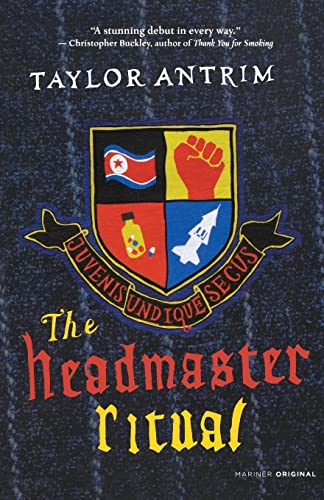
The Headmaster Ritual: A Powerful Literary Coming-of-Age Thriller About Breaking Free from Fathers at a Boarding School - Softcover
Synopsis
Taylor Antrim’s novel is a darkly comic, clear-eyed look at hidden worlds whose complexities and rules can be understood only from inside: the insular hothouse of boarding school, the thorny dynamics between father and son, and the self-delusion of blind ideological commitment.
Dyer Martin, a new history teacher at the prestigious Britton School, arrives in the fall ready to close the door on the failures and disappointments of his past: a disastrous first job, a broken relationship, and acute uncertainty about his future. James, a lonely senior, just wants to make it through his last year unscathed, avoiding both the brutal hazing of dorm life and the stern and unforgiving eye of his father, the school’s politically radical headmaster, Edward Wolfe.
Soon, however, both Dyer and James are inescapably drawn into Wolfe’s hidden agenda for Britton, as the headmaster orders Dyer to set up and run a Model UN Club for students. As the United States moves steadily toward a conflict with an increasingly hostile North Korea—whose pursuit of nuclear technology is pushing the world to the brink of nuclear Armageddon—Wolfe’s political fervor begins to consume him, and he sets in motion a plan that will jeopardize his job, his school, and even the life of his own son.
With precisely controlled, deceptively subtle storytelling, The Headmaster Ritual is an insightful and captivating examination of the halting, complicated course young men must chart to shake off the influence of fathers—and father figures—while refining their convictions about the world and their place in it.
"synopsis" may belong to another edition of this title.
About the Author
TAYLOR ANTRIM is an editor at ForbesLife and a regular contributor to the New York Times and Vogue. His work has appeared in Esquire, the San Francisco Chronicle, the Village Voice, and other magazines and journals. A graduate of Stanford and of Oxford, Antrim earned his MFA from Virginia, where he held the Poe-Faulkner Fellowship.
Reviews
Set at an exclusive Massachusetts private school, this début novel addresses the angst—both teen-age and adult—that percolates on a prep-school campus. Dyer Martin, in crisis after a disastrous foray into real estate, has taken a position in the history department; one of his pupils, James, is the timid son of the formidable headmaster, once tenured at Harvard and now determined to shake up the conservative and complacent privilege of his new domain. James and Dyer, beset by the outrages of bullies and the bewildering behavior of women, triumph, inevitably, over both. Like Curtis Sittenfeld in her novel "Prep," Antrim dwells on the rituals of boarding-school life—the rigid hierarchies, the code of silence that allows hazing to flourish—but he does not entirely succeed in illuminating the resonance of all this for his characters’ interior lives
Copyright © 2007 Click here to subscribe to The New Yorker
Reviewed by Ron Charles
The only good thing about the first year of teaching is that it can happen to you only once. Through a haze of cringing horror, I remember when I insisted that Ring Lardner was a fictional character, made fun of a deaf student, reduced a recently orphaned girl to tears, and, while swaying dramatically behind a wooden lectern, drove a long splinter through my pants and into my groin.
But Dyer Martin, the hero of The Headmaster Ritual, has it even worse. Fleeing a dead-end relationship and a disastrous stint as a real estate developer, he signs on as a history teacher at the prestigious Britton school -- "a game preserve for New England Wasps." His first year involves fights, cheating, embezzlement and international terrorism. This is Taylor Antrim's first novel, and, like a promising new teacher, he tries some clever things, borrows from his colleagues and makes a couple of notable missteps.
The story follows young Dyer from his buoyant arrival in the fall to his exhausted and chastened finish nine months later. From the start, he's not sure why he was hired by Dr. Edward Wolfe, Britton's fanatical new headmaster. The dean assures Dyer that they "want young, less traditionally trained teachers," but there's something unnerving, even sinister about Wolfe, who boasts about his SDS membership and his appearance on J. Edgar Hoover's enemies list. Although he says he's determined to "create a school hostile to orthodoxy and friendly to dissent," he seems to want teachers he can mold and control.
At their first meeting, rather than classes, textbooks or students, Wolfe talks to Dyer about North Korea and the United States' belligerent provocation of that brave little country. "Don't capitalist nations tend inevitably toward war?" the headmaster asks. When they move on to his duties in the dorm, Wolfe keeps on the same Maoist theme: "Discipline is a question for the collective." And just as Dyer finally escapes from the office, the headmaster asks him to attend his Korean exercises in the morning. All this would excite anybody's spider sense, but first-year teachers are a mess of anxieties, and Dyer has classes to prepare for, papers to grade, more than enough to keep him off guard about the intentions of his commie headmaster.
There are good opportunities for a satire here or even a prep school thriller. Why does Dr. Wolfe insist that Dyer take a group of students to the United Nations? Who is that Asian man meeting with him late at night? But those angles never evolve in a very interesting way. Besides, Antrim wants to write a separate piece about an alienated young student at this prestigious boarding school, and so a parallel (and better) story develops about the headmaster's son, James. He's a sharp student who just wants to finish up and graduate without attracting too much attention, but he endures a steady stream of brutal and scatological assaults from the other boys in the dorm. He wouldn't dream of ratting them out, and he knows his father wants to toughen him up anyhow. It's a sensitive portrait of a smart young man essentially abandoned by both his parents, who are either too busy or too ideologically blinded to see what's happening.
Powerless and friendless, James wonders if the erratic behavior of North Korea's leader, Kim Jong-il, might serve as a model to earn some kind of respect. "All his life," Antrim writes, "James had been predictable -- polite, studious, adaptable -- and where had it gotten him? Isolated from his parents and manipulated by [other students]. There was freedom in invisibility, but if James couldn't be invisible, he could be volatile." This insightful blending of geopolitical conflict and teenage angst gives the novel real emotional depth.
Unfortunately, the other students in The Headmaster Ritual remain entirely one-dimensional, straight from those corny movies that pit geeks against jocks. And that calls into question the novel's setting: "the oldest, most selective prep school in the country." Puleeze, that's enough to curl the ivy on Groton's walls. Antrim attended Andover as a boy, but here he doesn't begin to convey the complex social, political and intellectual culture of such a place. He throws in some crown molding and a senator's son, but those shorthand details are meager, and they're contradicted by a number of annoying incongruities: The students in Dyer's classes sound lazy and inarticulate (they should be making fun of him in Latin); the athletic program looks lax and undisciplined; the school's fundraising program is haphazard and disorganized.
In short, there's nothing about this weird little school to suggest that it enjoys the kind of national prominence of, say, Phillips Exeter, which is what's necessary for the novel's outrageous conclusion to work. By the end, we're left with two or three interesting parts that don't cohere in a very satisfying way. Impressive for a first-year effort, but it won't make the required reading list.
Copyright 2007, The Washington Post. All Rights Reserved.
Political radicalism, boarding school cruelty and the specter of a showdown with a nuclear North Korea fuel Antrim's debut novel with mostly winning results. Fleeing job and girlfriend disasters, Dyer Martin takes a job as a history teacher at the tony Britton School, an Andover-like boarding school run by Headmaster Wolfe, a 1960s radical–turned– preppy–fundraiser whose paranoia is displayed early and often. Wolfe's son, James, meanwhile, has been quietly attending Britton, but after his father forces him to move into the student dorm for his senior year, his fellow students haze the brainy and socially awkward young man. While James negotiates the stormy waters of adolescence (the centerpiece is his crush on a girl who may be romantically involved with a bully), an increasingly erratic Wolfe orders Dyer to take a team of students to the Model U.N. conference as representatives of North Korea. Dyer, however, is suspicious of Wolfe's motives, especially after he sees Wolfe covertly meet in the middle of the night with a mysterious Asian man. All is revealed at the conference, though the climax is marred by a chain of events that defies reason. Well-drawn characters and tight dialogue add appeal to Antrim's keenly observed satire. (July)
Copyright © Reed Business Information, a division of Reed Elsevier Inc. All rights reserved.
*Starred Review* A schadenfreude-inducing downbeat opens Antrim's bitingly funny first novel: in a reluctant stint at a commercial real-estate firm, history PhD Dyer Martin makes "a bad blunder, a job-ending blunder," signing a bum contract that costs his mentor half a million dollars. Sour luck or a subconscious urge to stick it to a father figure? Martin finds ample opportunity to explore the question in his relationship with his next boss, the capitalism-bashing headmaster at elite Britton Prep. With immediate plans to destabilize the culture of privilege from within, and more extreme ideas in the hopper, Headmaster Wolfe assigns Martin to supervise Britton's representation at a model UN conference--as North Korea. Alternating between Martin's point of view and that of the headmaster's son, James, a beleaguered Britton student, the novel sets up a triangle of tensions that mount against an equally volatile geopolitical backdrop. The mix of self-consciously broad satire with characters' personal struggles isn't entirely smooth, but, to use a boarding-school metaphor, it's hard to assign too many demerits. Antrim's natural writing style comes judiciously adorned with striking figurative gestures (a postdivorce household features "bookshelves with their teeth knocked out"); his ruthless study of characters' inner lives will draw fans of Jonathan Franzen and other scions of the hapless contemporary male; and the prep-school setting, with its gladiatorial social interactions, holds perennial appeal. Jennifer Mattson
Copyright © American Library Association. All rights reserved
Excerpt. © Reprinted by permission. All rights reserved.
Prologue July
Dyer martin curled his fingers through the chainlink and stared at the empty field of shrub. Riverside County sunlight found shards of glass among scattered rocks and twinkled in his direction. Tufts of foot-high desert grass waved gentle hellos in the Santa Ana's hot breath. Jim Simon, Dyer's boss at Virgenes Development Corporation, had ordered him to take a look at the twenty-five acres he'd claimed for the company, to look at the stalled housing developments that surrounded it, to crouch down and sniff the chromium VI' and perchlorate-saturated soil. So Dyer had taken the 91 east, driving through a desert landscape of malls with empty parking lots, vacant glass-and-steel office parks, and windmill farms stretching to the Santa Ana mountains. Off the freeway exit just west of Perris, Dyer passed Palm Crest, a checkerboard of exposed foundations and roofless homes. 'that's a slice of wasteland you bought us," Jim Simon had said with something like satisfaction, guiding Dyer out the glass office doors and into the parking lot, squeezing his shoulder in a kind, fatherly way. They both stood beside Dyer's car, and Dyer enjoyed the weight and warmth of Simon's hand. "But don't worry," Simon had said, smiling and letting him go. 'this is why we have lawyers.' From the time Dyer came on as a junior associate, Jim Simon had told him to be aggressive and creative in exploring opportunities ' and to liaise only with him, not any other partner at Virgenes. So on a week when Simon was golfing in Maui, a broker named Jimmy Veltramo rung his extension, and Dyer took the call. Veltramo had described the Inland Empire plot's proximity to Palm Crest, a community of luxury homes, median price 500K, average owner age 29.9, average income high 80s. There was a dearth of shopping in the area, Veltramo said; perfect opportunity for a commercial developer like Virgenes. Timing was a problem; Dyer didn't want to call Simon on his vacation, and Veltramo needed a letter of intent signed by Friday, or he'd take the offer to another company. LOIs were standard practice ' and nonbinding; Simon signed them all the time. A signature would pull the property off the market for thirty days. Veltramo could courier the LOI right then; Dyer could always let the period expire without a deal. But Dyer hadn't caught the clause nestled in a block of type on the back side of page three. The $500,000 Veltramo required for failure to negotiate a purchase and sale agreement. Nor had he checked a Phase 1 environmental report on the land. Nor had he checked the zoning. Now there was half a million due on a zonedresidential plot with groundwater contamination in the middle of nowhere. A bad blunder, a job-ending blunder. Dyer stood at the chainlink fence that surrounded the property, his ulcer throbbing deep within him, his mouth dry and sour, and he felt the guilt and embarrassment he'd been carrying around all week. He counted the things he could call his own ' a dirt-colored Honda, a suitcase's worth of clothes, the rising knowledge that he had never really wanted to work in real estate for his girlfriend's father anyway. Escape would be natural, a matter of Dyer's patrimony, of DNA, of blood-borne instinct. And there was his Honda, parked behind him, the driver's door ajar, the key-in-ignition tone pinging. But Dyer was determined to stay in California and make it up to Jim Simon. He told himself that he loved Alice and didn't want to lose her. Dyer put a foot in the chainlink and began to climb. The spiked top raked his thigh, tearing his suit pants as he swung a leg over. His knees buckled on the hard-packed sand. Stepping over bent lengths of rebar and miniature, thorny cacti, Dyer began to walk the boundary. The air wobbled with heat. Jim Simon had said wasteland, and yet with a little optimism, Dyer thought, with an eye for potential, you could imagine the sturdy geometry of a multilevel parking garage out here, or a retirement community of fountains and palm groves. He blinked hard, then blinked again, playing peekaboo with the view. The visions kept coming: a twenty-five-screen cineplex, blink, a petting zoo. He knew his ideas were impractical ' there wasn't another person for miles. And yet to Dyer they felt like guy wires streaming off his body, digging into the earth, steadying him. A black snake, like a discarded bicycle tube, lay down the fence line. He felt behind him for the fence, for its reassuring grid of hot steel. Dyer took a long breath, more visions flaring within him. He thought of < Alice at her desk, lit by her laptop screen ' her thick auburn hair, her gently curving upper lip, her little belly, those things that made his heart race. Sunlight blinded him, bulleting off a broken bottttttle of Miller Lite. He ffffelt his hot ulcer prodding him in thhe stomach. HHe felt the half-million dollars clinging to his back. He felt the wires fray and snap. 1 September
We were supposed to meet this morning?' asked Dyer, standing in the shaded portico of Headmaster Wolfe's residence, the humid Massachusetts air on him like a quilt. 'Agreed," said Edward Wolfe with his hand on the door's brass knob. He moved out of the way. "Come in.' Dyer dipped his head and passed inside. The air had a still, musty smell, as if the windows hadn't been opened all summer. The hardwood floor in the wide foyer was bare except for a coarse straw mat and an Oriental rug rolled up like a sausage along the wall. Muddy running shoes sat on a radiator; a loose stack of mail covered a table by the door. An ornately framed portrait ' old, Dyer thought, the paint webbed with cracks ' of a black-suited couple in twin wooden chairs was propped against the wall. In its place hung a framed sheet of yellow paper with a typed list of names. Curious, Dyer took a closer look. Halfway down the page, he stopped: 'Edward Wolfe; Boston, MA; Harvard; SDS.' Dyer felt Wolfe at his side and realized the headmaster had him by a good half inch. His jaw was block-shaped beneath coarse gray stubble, his lips, fish-white and thin. Body heat came off him in waves, mingled with a clean, soapy smell. Dyer told himself to look at Wolfe directly, to find his eyes in their deep-set sockets. Even though Roberta O'Brien, dean of faculty, had offered him the job, even though he'd signed tax forms, even though there'd been a welcome letter for him in his Bailey House faculty apartment, this morning could still be some sort of final interview, a chance for Wolfe to make up his own mind. In late July during his interview with O'Brien, she'd said that Britton's headmaster had left a tenured post in Harvard's History Department to run the school. "He was looking for a more institutional role. To bring a progressive approach to the classroom," she'd said. 'so he wants young, less traditionally trained teachers, candidates with higher academic degrees, not graduates of education programs.' Dyer, with no prior teaching experience, with his Oxford M.Phil. in History, was 'just the sort of candidate he's looking for," she'd said. A reassuring memory ' but Headmaster Wolfe had never met Dyer. And there had to have been more qualified candidates vying for the position. Lots of them. A teaching post at Britton was something of a coup, and they could probably get a
"About this title" may belong to another edition of this title.
Search results for The Headmaster Ritual: A Powerful Literary Coming-of-Age...

Stock Image
The Headmaster Ritual
Seller: World of Books (was SecondSale), Montgomery, IL, U.S.A.
Seller rating 5 out of 5 stars

Condition: Good. Item in good condition. Textbooks may not include supplemental items i.e. CDs, access codes etc. Seller Inventory # 00082544480
Stock Image
The Headmaster Ritual
Seller: World of Books (was SecondSale), Montgomery, IL, U.S.A.
Seller rating 5 out of 5 stars
Condition: Very Good. Item in very good condition! Textbooks may not include supplemental items i.e. CDs, access codes etc. Seller Inventory # 00104168126
Seller Image
The Headmaster Ritual: A Powerful Literary Coming-of-Age Thriller About Breaking Free from Fathers at a Boarding School
Seller: 3Brothers Bookstore, Egg harbor township, NJ, U.S.A.
Seller rating 5 out of 5 stars
Condition: very_good. Cover may have light wear, pages in very good condition and binding is sturdy; may have other light shelf wear or creases. May have notes or highlighting. Seller Inventory # EVV.0618756825.VG
Stock Image
The Headmaster Ritual
Seller: More Than Words, Waltham, MA, U.S.A.
Seller rating 5 out of 5 stars
Condition: Very Good. A bright, square, and overall a nice copy. Seller Inventory # BOS-D-08e-2338
Stock Image
The Headmaster Ritual: A Powerful Literary Coming-of-Age Thriller About Breaking Free from Fathers at a Boarding School
Published by
Harper Perennial (edition First Edition), 2007
ISBN 10: 0618756825
ISBN 13: 9780618756827
Used
Paperback
First Edition
Seller: BooksRun, Philadelphia, PA, U.S.A.
Seller rating 5 out of 5 stars
Paperback. Condition: Very Good. First Edition. It's a well-cared-for item that has seen limited use. The item may show minor signs of wear. All the text is legible, with all pages included. It may have slight markings and/or highlighting. Seller Inventory # 0618756825-11-6
Stock Image
The Headmaster Ritual
Seller: Bookmans, Tucson, AZ, U.S.A.
Seller rating 5 out of 5 stars
Paperback. Condition: Good. Satisfaction 100% guaranteed. Seller Inventory # mon0002382864
Stock Image
The Headmaster Ritual
Seller: World of Books Inc, Montgomery, IL, U.S.A.
Seller rating 4 out of 5 stars

Paperback. Condition: Very Good. Taylor Antrim's novel is a darkly comic, clear-eyed look at hidden worlds whose complexities and rules can be understood only from inside: the insular hothouse of boarding school, the thorny dynamics between father and son, and the self-delusion of blind ideological commitment. Dyer Martin, a new history teacher at the prestigious Britton School, arrives in the fall ready to close the door on the failures and disappointments of his past: a disastrous first job, a broken relationship, and acute uncertainty about his future. James, a lonely senior, just wants to make it through his last year unscathed, avoiding both the brutal hazing of dorm life and the stern and unforgiving eye of his father, the school's politically radical headmaster, Edward Wolfe. Soon, however, both Dyer and James are inescapably drawn into Wolfe's hidden agenda for Britton, as the headmaster orders Dyer to set up and run a Model UN Club for students. As the United States moves steadily toward a conflict with an increasingly hostile North Korea--whose pursuit of nuclear technology is pushing the world to the brink of nuclear Armageddon--Wolfe's political fervor begins to consume him, and he sets in motion a plan that will jeopardize his job, his school, and even the life of his own son. With precisely controlled, deceptively subtle storytelling, The Headmaster Ritual is an insightful and captivating examination of the halting, complicated course young men must chart to shake off the influence of fathers--and father figures--while refining their convictions about the world and their place in it. Seller Inventory # CIN0618756825VG
Stock Image
The Headmaster Ritual
Seller: World of Books Inc, Montgomery, IL, U.S.A.
Seller rating 4 out of 5 stars
Paperback. Condition: Good. Taylor Antrim's novel is a darkly comic, clear-eyed look at hidden worlds whose complexities and rules can be understood only from inside: the insular hothouse of boarding school, the thorny dynamics between father and son, and the self-delusion of blind ideological commitment. Dyer Martin, a new history teacher at the prestigious Britton School, arrives in the fall ready to close the door on the failures and disappointments of his past: a disastrous first job, a broken relationship, and acute uncertainty about his future. James, a lonely senior, just wants to make it through his last year unscathed, avoiding both the brutal hazing of dorm life and the stern and unforgiving eye of his father, the school's politically radical headmaster, Edward Wolfe. Soon, however, both Dyer and James are inescapably drawn into Wolfe's hidden agenda for Britton, as the headmaster orders Dyer to set up and run a Model UN Club for students. As the United States moves steadily toward a conflict with an increasingly hostile North Korea--whose pursuit of nuclear technology is pushing the world to the brink of nuclear Armageddon--Wolfe's political fervor begins to consume him, and he sets in motion a plan that will jeopardize his job, his school, and even the life of his own son. With precisely controlled, deceptively subtle storytelling, The Headmaster Ritual is an insightful and captivating examination of the halting, complicated course young men must chart to shake off the influence of fathers--and father figures--while refining their convictions about the world and their place in it. Seller Inventory # CIN0618756825G
Stock Image
The Headmaster Ritual
Published by
HarperCollins Publishers, 2007
ISBN 10: 0618756825
ISBN 13: 9780618756827
Used
Softcover
Seller: Better World Books, Mishawaka, IN, U.S.A.
Seller rating 5 out of 5 stars
Condition: Very Good. Pages intact with possible writing/highlighting. Binding strong with minor wear. Dust jackets/supplements may not be included. Stock photo provided. Product includes identifying sticker. Better World Books: Buy Books. Do Good. Seller Inventory # 38583885-6
Stock Image
The Headmaster Ritual
Seller: Wonder Book, Frederick, MD, U.S.A.
Seller rating 5 out of 5 stars
Condition: Very Good. Very Good condition. A copy that may have a few cosmetic defects. May also contain light spine creasing or a few markings such as an owner's name, short gifter's inscription or light stamp. Seller Inventory # A14A-05535