
Items related to Thinking Animals
Synopsis
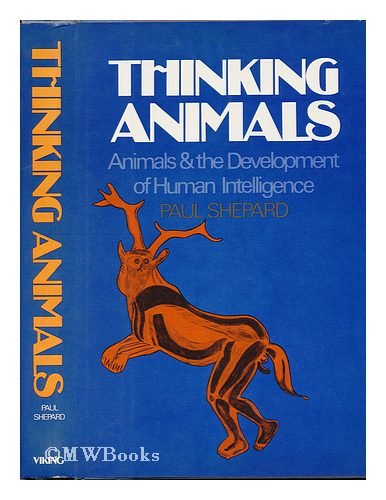
In a world increasingly dominated by human beings, the survival of other species becomes more and more questionable. In this brilliant book, Paul Shepard offers a provocative alternative to an "us or them" mentality, proposing that other species are integral to humanity's evolution and exist at the core of our imagination. This trait, he argues, compels us to think of animals in order to be human. Without other living species by which to measure ourselves, Shepard warns, we would be less mature, care less for and be more careless of all life, including our own kind.
"synopsis" may belong to another edition of this title.
Review
What can animals teach humans? Everything, writes the environmental philosopher Paul Shepard, and he's not being hyperbolic. In Shepard's view, it was through the observation and emulation of animals that humans developed their abilities to communicate. The development of the brain and larynx depended on accidents of biology, on bipedalism and upright posture. But more, their development both hinged on and reinforced the desire of humans to communicate with each other, and to members of other species, about their existence in the world; as Shepard writes of one particular human mental skill, "grouping and categorizing is not something done by children simply because their biology requires it, but because the real animal world of each child is to be his concrete model of reality." The natural world, in other words, teaches us to think.
All human culture, in Shepard's view, rests on our natural history, and the separation that has occurred over the generations between humans and the natural environment is to our detriment. Shepard imagines a future in which animals no longer have a place, their role in the world having been assumed by human inventions. Scholarly without ever being pedantic, Shepard offers a powerful argument for conservation and preservation. Thinking Animals, like many of Shepard's books, has come to be a key text in the literature of the animal rights movement and of environmentalism generally, and it is endlessly stimulating. --Gregory McNamee
About the Author
Paul Shepard (1925-1996) was Avery Professor of Natural Philosophy and Human Ecology at Pitzer College in Claremont, California. He is the author of twelve books, a number of which are available from the University of Georgia Press.
"About this title" may belong to another edition of this title.
Search results for Thinking Animals

Seller Image
Thinking Animals
Seller: Reliant Bookstore, El Dorado, KS, U.S.A.
Seller rating 5 out of 5 stars

Condition: acceptable. This book is a well used but readable copy. Integrity of the book is still intact with no missing pages. May have notes or highlighting. Cover image on the book may vary from photo. Ships out quickly in a secure plastic mailer. Seller Inventory # RDV.0670700614.A
Stock Image
Thinking Animals
Seller: HPB Inc., Dallas, TX, U.S.A.
Seller rating 5 out of 5 stars
hardcover. Condition: Very Good. Connecting readers with great books since 1972! Used books may not include companion materials, and may have some shelf wear or limited writing. We ship orders daily and Customer Service is our top priority! Seller Inventory # S_471383608
Stock Image
Thinking Animals
Seller: ThriftBooks-Atlanta, AUSTELL, GA, U.S.A.
Seller rating 5 out of 5 stars
Hardcover. Condition: Fair. No Jacket. Readable copy. Pages may have considerable notes/highlighting. ~ ThriftBooks: Read More, Spend Less. Seller Inventory # G0670700614I5N00
Stock Image
Thinking Animals
Seller: Smokey, York, NE, U.S.A.
Seller rating 5 out of 5 stars
Hardcover. Condition: Fair. Dust Jacket Condition: Good. 1st Edition. ANIMALS AND THE DEVELOPMENT OF HUMAN INTELLIGENCE. ALSO, HOW ANIMALS HAVE BEEN PARTS OF OUR THINKING AND MINDS. Seller Inventory # ABE-1768256809382
Stock Image
Thinking Animals
Seller: Under Charlie's Covers, Bernalillo, NM, U.S.A.
Seller rating 5 out of 5 stars
Hardcover. Condition: Very Good. Dust Jacket Condition: Very Good. Very good blue boards in a very good dust jacket, not price-clipped, in a protective cover. Animals and the development of human intelligence. Remainder mark on side text block. Seller Inventory # 002596
Stock Image
Thinking Animals
Seller: SHIMEDIA, Brooklyn, NY, U.S.A.
Seller rating 4 out of 5 stars

Condition: New. Satisfaction Guaranteed or your money back. Seller Inventory # 0670700614