
Items related to Thinks . . .
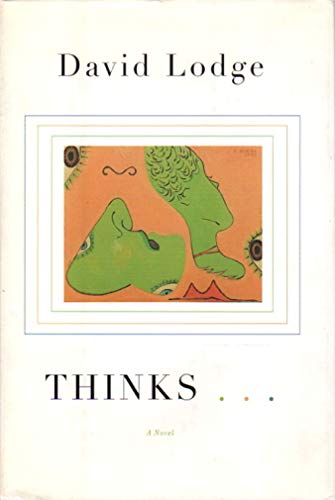
Synopsis
The growing relationship between two very different individuals--Ralph Messenger, the director of the Holt Belling Center for Cognitive Science and expert on artificial intelligence, and Helen Reed, a recently widowed novelist--is chronicled in the alternating voices of the two characters. By the author of Therapy. 100,000 first printing.
"synopsis" may belong to another edition of this title.
About the Author
David Lodge is the author of twelve novels and a novella, including the Booker Prize finalists Small World and Nice Work. He is also the author of many works of literary criticism, including The Art of Fiction and Consciousness and the Novel.
Reviews
Inimitable British writer Lodge (Small World; The Art of Fiction) is at his best in another of his comedies of manners set in the academic world. His 10th novel is distinguished by gentle satire, vigorous intelligence, sometimes ribald humor and a perspicacious understanding of the human condition. At the fictitious University of Gloucester, science and literature collide in the persons of 40-something Ralph Messenger and Helen Reed. Ralph's research as the director of cognitive science and his wit and charisma as an explicator of artificial intelligence make him a bit of a star in Britain, and with the ladies. He delights in opportunities for extramarital activities within the confines of the don't-ask-don't-tell arrangement he's established with his wife. Ralph's worthy opponent, newly widowed Helen, a novelist and Henry James devotee, has come to the university to teach creative writing. Helen represents the religious conflict common to Lodge's characters. She has nostalgic respect for her Catholic upbringing, but she's enduring a crisis of faith. Because of her strong moral conscience, she disapproves of Ralph's infidelities. Yet sparks fly during their heated debates, and they share an undeniable attraction and mutual respect. Ralph argues convincingly for artificial intelligence as the next rung on the evolutionary ladder, but Lodge's own opinion clearly corresponds to Helen's: she's dubious of a machine that could embody human consciousness, "a computer that has hangovers and falls in love and suffers bereavement." The perfectly paced story unfolds alternately via Helen's diary, Ralph's audio-dictated journal and an omniscient narrator. Although still politically aware, Lodge is arguably less concerned with social commentary (as in his Booker-nominated Nice Work) than with human nature, and he digs deeper here than in Therapy into the universal mysteries of death and the soul. Readers and booksellers will be more than pleased by this entertaining and appropriately thought-provoking novel. 6-city author tour.
Copyright 2001 Cahners Business Information, Inc.
Much of the pleasure of Lodge's sparkling novels is derived from his playful yet shrewd use of fiction as a laboratory, a controlled space within which the workings of the human heart and mind--the battle between emotion and rationality, desire and morality--can be put in motion and analyzed. It makes perfect sense, therefore, that Lodge would write a tale that pits art against science. Using a favorite setting, the academy, and a favorite form, the farce, he pairs a highly responsible novelist, Helen Reed, an admirer of Henry James, no less, with an egotistical scientist, Ralph Messenger, who not only heads up the prestigious cognitive sciences department at the University of Gloucester but also disseminates his mechanistic view of consciousness on television. Helen, whose handsome husband has abruptly died, has sought refuge from her memory-laden London flat by moving on campus as the university's writer-in-residence. Ralph, quite the womanizer (an indulgence his wealthy American wife seems to accept), attempts to seduce Helen, but darned if she doesn't have scruples. Mutually attracted, however, they spar in witty discussions about the value of literature's depictions of consciousness versus science's more material approach, then retreat to confide in their journals. Helen takes a traditional approach to recording her thoughts and feelings, while Ralph, talking into a tape recorder, attempts to record verbatim the flow of his random and randy thoughts to comic effect. Events soon conspire to deepen their involvement, and as things reach a madcap crescendo during an international conference on the workings of the brain, Lodge revels in the absurdities and poignancy of the creative drive, ambition, eroticism, infidelity, mortality, and love--the lifeblood of literature, the ghost in the machine, the force no computer can measure or emulate. Donna Seaman
Copyright © American Library Association. All rights reserved
Lodge has a fondness for penning novels in which the lives of his central characters are comically juxtaposed, either geographically (Changing Places, Small World) or professionally (Nice Work), and in this latest outing he pits literature against science. Newly widowed Helen Reed has accepted a post as writer-in-residence at the University of Gloucester, one of England's recently converted polytechnical institutes, where she finds herself drawn to Ralph Messenger, director of the school's Center for Cognitive Science and one of its leading lights. And although the attraction is mutual, they diverge markedly in their views on adultery. Ralph has long enjoyed a quasi-open marriage to an American wife who turns a blind eye to his philandering, as long as he doesn't embarrass her in public, while Helen is still mourning her faithful husband, Martin. Through Helen's diaries and Ralph's voice transmissions, the reader is taken inside their conscious minds as they explore their feelings for each other, as if, as Helen herself observes, they could see inside a cartoon bubble over their heads reading, "Thinks.-" Once again, Lodge splendidly succeeds in delivering a lively novel full of insight and wit. Recommended for public and academic libraries.
- Barbara Love, Kingston Frontenac P.L., Ont.
Copyright 2001 Reed Business Information, Inc.
"About this title" may belong to another edition of this title.
Search results for Thinks . . .

Stock Image
Thinks.
Seller: World of Books (was SecondSale), Montgomery, IL, U.S.A.
Seller rating 5 out of 5 stars

Hardback. Condition: Good. David Lodge's novels have earned comparisons to those of John Updike and Philip Roth and established him as a cult figure on both sides of the Atlantic (The New York Times). Thinks . . . , his witty new novel about secret infidelities and the nature of consciousness, unfolds in the alternating voices of Ralph Messenger, director of the Centre for Cognitive Science at the University of Gloucester, and Helen Reed, a novelist and writer in residence at the university. Mutually attracted, the two end up in a moral standoff that is shattered by events that dramatically confirm the truth of Ralph's dictum: we can never know for certain what another person is thinking. Seller Inventory # 00097682295
Seller Image
Thinks . . .
Seller: 3Brothers Bookstore, Egg harbor township, NJ, U.S.A.
Seller rating 5 out of 5 stars
Condition: like_new. Book is in like new condition with only potential shelf wear. No marking or highlighting. Seller Inventory # EVV.0670899844.LN
Stock Image
Thinks . . .
Published by
Viking Adult (edition First Edition), 2001
ISBN 10: 0670899844
ISBN 13: 9780670899845
Used
Hardcover
First Edition
Seller: BooksRun, Philadelphia, PA, U.S.A.
Seller rating 5 out of 5 stars
Hardcover. Condition: Very Good. First Edition. It's a well-cared-for item that has seen limited use. The item may show minor signs of wear. All the text is legible, with all pages included. It may have slight markings and/or highlighting. Seller Inventory # 0670899844-11-6
Stock Image
Thinks . . .
Seller: Wonder Book, Frederick, MD, U.S.A.
Seller rating 5 out of 5 stars
Condition: Very Good. Very Good condition. Very Good dust jacket. With remainder mark. A copy that may have a few cosmetic defects. May also contain light spine creasing or a few markings such as an owner's name, short gifter's inscription or light stamp. Seller Inventory # Y12B-02899
Stock Image
Thinks . . .
Seller: Wonder Book, Frederick, MD, U.S.A.
Seller rating 5 out of 5 stars
Condition: Good. Good condition. Good dust jacket. A copy that has been read but remains intact. May contain markings such as bookplates, stamps, limited notes and highlighting, or a few light stains. Seller Inventory # F02D-05649
Stock Image
Thinks . . .
Seller: ThriftBooks-Dallas, Dallas, TX, U.S.A.
Seller rating 5 out of 5 stars
Hardcover. Condition: Very Good. No Jacket. Former library book; May have limited writing in cover pages. Pages are unmarked. ~ ThriftBooks: Read More, Spend Less. Seller Inventory # G0670899844I4N10
Stock Image
Thinks . . .
Seller: ThriftBooks-Atlanta, AUSTELL, GA, U.S.A.
Seller rating 5 out of 5 stars
Hardcover. Condition: As New. No Jacket. Pages are clean and are not marred by notes or folds of any kind. ~ ThriftBooks: Read More, Spend Less. Seller Inventory # G0670899844I2N00
Stock Image
Thinks.
Seller: World of Books Inc, Montgomery, IL, U.S.A.
Seller rating 4 out of 5 stars

Hardback. Condition: Good. David Lodge's novels have earned comparisons to those of John Updike and Philip Roth and established him as a cult figure on both sides of the Atlantic (The New York Times). Thinks . . . , his witty new novel about secret infidelities and the nature of consciousness, unfolds in the alternating voices of Ralph Messenger, director of the Centre for Cognitive Science at the University of Gloucester, and Helen Reed, a novelist and writer in residence at the university. Mutually attracted, the two end up in a moral standoff that is shattered by events that dramatically confirm the truth of Ralph's dictum: we can never know for certain what another person is thinking. Seller Inventory # CIN0670899844G
Stock Image
Set in Darkness
Seller: Better World Books, Mishawaka, IN, U.S.A.
Seller rating 5 out of 5 stars
Condition: Very Good. 1st American ed. Former library copy. Pages intact with possible writing/highlighting. Binding strong with minor wear. Dust jackets/supplements may not be included. Includes library markings. Stock photo provided. Product includes identifying sticker. Better World Books: Buy Books. Do Good. Seller Inventory # 3372339-6
Stock Image
Set in Darkness
Seller: Better World Books: West, Reno, NV, U.S.A.
Seller rating 5 out of 5 stars
Condition: Good. 1st American ed. Former library copy. Pages intact with minimal writing/highlighting. The binding may be loose and creased. Dust jackets/supplements are not included. Includes library markings. Stock photo provided. Product includes identifying sticker. Better World Books: Buy Books. Do Good. Seller Inventory # GRP23733517