
Items related to FOR THE LIFE OF YOUR DOG: A Complete Guide to Having...
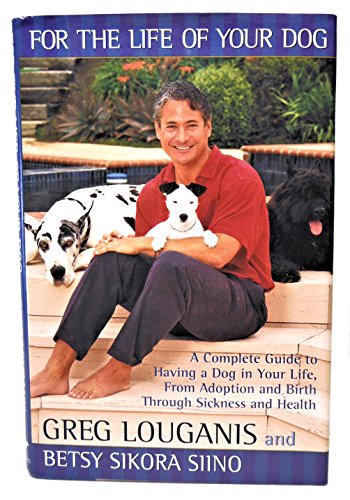
FOR THE LIFE OF YOUR DOG: A Complete Guide to Having a Dog From Adoption and Birth Through Sickness and Health - Hardcover
Synopsis
The authors present a philosophy of dog ownership, from the challenges of raising a puppy through the rewards of living with an older dog
"synopsis" may belong to another edition of this title.
About the Author
Greg Louganis is a four-time Olympic gold-medal diving champion. He lives in Malibu, California, where he raises and trains Harlequin Great Danes, a championship Jack Russell Terrier, and a best-in-breed Rhodesian Ridgeback.
Reviews
Stressing positive reinforcement instead of punishment, these three new titles are very different from pet-training books of the past that emphasized domination training methods. Diller's Dogs and Their People is perhaps the most readable, with the most logical presentation. Diller, president of the Society of North American Dog Trainers, believes that dogs are as individual as people and that training comprises two aspectsAthe teaching of specific behaviors and the prevention of problems. His approach is a blend of positive motivation and properly applied corrections. Diller presents the basics of learning theory, discusses common behavioral problems, and clarifies the pluses and minuses of the wide variety of collars, leashes, and training tools available. He gives specific recommendations for teaching doggy "etiquette" as well as practical obedience exercises. One of the most valuable chapters is on building relationships, particularly when there are other pets or children in the household. Marlo's training method is similar to Diller's, blending love and understanding with discipline. The "dog trainer to the stars" (her clients include Jamie Lee Curtis and Bridget Fonda) believes that "training is more than just sit and stay. It's also learning about dog behavior and the canine-human relationship." Her book covers myths and realities about dogs, choosing a breed, building a leadership relationship, socialization, and puppy-proofing your home. She includes extensive but comprehensible discussions of housebreaking (including the importance of feeding and watering schedules) and common behavior problems. Olympic gold medalist Louganis's For the Life of Your Dog is not so much a training manual as a book about caring for your dog from puppyhood to old age. The four main sections take the reader from the commitment required to own a dog, through puppyhood, into the prime adult years, and finally to old age. Throughout, there is never any doubt that the author is celebrating the human-animal bond. Like Diller and Marlo, Louganis, who now breeds and trains dogs, covers responsible ownership, socialization, housebreaking, basic training, and problem solving/prevention. However, the use of stories and vignettes to deliver his message sometimes makes his book seem disorganized and rambling. All three books are highly recommended for public libraries where pet books are popular. Diller has the edge for his understandable presentation on learning theory and organization, and Marlo gets extra points for her focus on building relationships and taking training beyond "sit and stay." Louganis is recommended for the intensity of his feelings and his celebration of the canine's place in the human world. [Louganis's book was previewed in Prepub Alert, LJ 9/15/98.]AEdell Marie Schaefer, Brookfield P.L., Milwauke.
-AEdell Marie Schaefer, Brookfield P.L., Milwaukee
Copyright 1999 Reed Business Information, Inc.
Excerpt. © Reprinted by permission. All rights reserved.
CHAPTER ONE: A MEMBER OF THE FAMILY
People used to accuse me of hiding behind my dogs. There was probably some truth in that. When I'm standing next to a harlequin or white Great Dane -- they're pretty impressive animals -- people don't notice me so much.
The first dog I remember was my grandparents' farm dog, a mutt named Curly, whom I met when I was around three years old. I would hang out with him, and even at that young age I realized I was more comfortable with Curly than with the adults. Then when I was about four or five, my family adopted Hercules, another little mutt. I felt more comfortable around him, too, because by the age of three, I was already performing onstage. In a sense, I was a trained seal having to perform, and it was nice being with someone, a quiet, friendly dog, who didn't demand that from me. My dogs have never thought of me as a performer, and I love them for that, among many other things.
Despite the fact that much of my life has been played out in the spotlight, I am by nature pretty shy. Through my work I go to a lot of social events, and I'm usually pretty nervous about them. I worry about what I'll talk about and what I'll have in common with the people there. Everyone asks what I'm up to, but I'm tired of talking about myself. I love to turn the conversation in the direction of dogs. Other people's dogs and my own. When that happens, I'm immediately more comfortable. Dogs are the perfect icebreaker, and I am most comfortable with them around -- or just talking about them.
I always refer to my dogs as "the kids." It's not unusual for people to want to talk on and on about their kids, and I'm no different with mine. The idea of dogs as surrogate kids is controversial. People will say, "Only people who don't have kids dote on their dogs so much." Well, all that counts in life is that you feel love and you give love. That's what my mom taught me, and she's proud of how I treat my kids. "When I come back in my next life," she always says, "I want to be one of Greg's dogs."
I also know what it feels like to be really proud of my "kids," and not for the reasons most people might think. When I was showing my dogs regularly, I was always so flattered when I was around the show ring and everybody would say, "Oh, your dogs are so well-behaved." As far as my dogs' conformation and my handling skills, well, they may have been saying something else about that, but it was the comments about my dogs' good manners that meant the most to me. I worked long and hard to get them into that condition. That's the highest compliment someone can give me. Compliment my dogs and you're complimenting my family.
The highest compliment my dogs can give me is to let me know that they consider me to be their family, too. Dogs know when someone in the family is hurting. I often think of when I was taking care of my dad during the last weeks of his life during his struggle with cancer. One day, I took him for a walk in his wheelchair with my Great Dane, Freeway. Freeway stayed with my dad, not at my side as he usually would. He stayed at my dad's side. When we stopped, he sat down and put his head over my father's arm, which is the dog equivalent of putting a hand on your shoulder. He knew my dad needed him. My dad reached out and petted him and said, "I wish I was more mobile so I could have a dog." I said, "Dad, we're here. He's our dog." Freeway knew we were all family. He knew he was comforting my father.
Anyone who has had a dog as a companion knows moments like that. It's all part of the human/animal bond, which is one of the most wonderful connections we can have. My bond with dogs has definitely had a therapeutic effect on me. Some of the treatments I've had to go through are pretty harsh. When I feel most scared and insecure, my dogs have been there for me. They sense this and stay closer to me. When my treatments or their side effects are most debilitating, we stay in, snuggle into bed, and watch TV, and the dogs don't leave my side. Tell me dogs aren't family.
Dogs are family to millions of people around the world, but this amazing relationship doesn't happen by magic. We have to work at it. We have to learn the canine language and develop the sensitivity to think and anticipate so that we can keep ourselves and our dogs out of trouble. We have to learn to be consistent when we communicate with our dogs, and we have to help them learn their manners. There's nothing better -- and I'm sure veterinarians appreciate this, as well -- than a well-mannered dog.
In the pages that follow, you will meet my family, the dogs I live with now, the dogs I have lived with in the past, the dogs I've met through friends, the dogs I've met during my periodic visits to the animal shelter, and the dogs I've rescued off the street. They all have a special place in my heart. They are all part of the family. Each and every one of them has helped to make me a better companion to the canine species, as well as a better person.
A BIG DECISION
A successful relationship between your dog and you begins before you purchase or adopt your new dog. You have to get educated. Read books. Talk to breeders and shelter workers and veterinarians. You have to know what you're doing when you're choosing this new member of your family. You have to prepare yourself and know what you're getting into. It's only fair to the dog, and it's the only way that you can make sure that this relationship will last.
My situation is complicated because I choose to live with several dogs at the same time and is further complicated because I am actually allergic to some dogs. Too many people learn the hard way that having several dogs is not necessarily the best option for everyone. They ignore the research and forethought and just keep adding more dogs. They end up in a house with a bunch of dogs, and it's a disaster.
More is not necessarily merrier. It's more expensive, it's more challenging, and it can be unfair to both the new dog and to the dogs that already live with you. Someone who takes in too many dogs is called a collector, which is not a good thing to be. Many dogs out there need homes -- and many need better homes. I see homeless and lost dogs every day. I've picked up dogs running loose along Pacific Coast Highway or in the hills near my house. I've even had them show up at my doorstep. When I find lost dogs -- or they find me -- I bring them home, get them fed and cleaned up, and then either take them to the shelter or track down their owners myself.
Even though I always have several dogs living in my house at a time, a lot of thought and planning goes into choosing each one and managing the place once they're there. For the most part, it's a situation that works for me. I have the time and the resources to invest, and I know how to rely on my dogs' help and input. We all work together to figure things out.
When I was diving, I used to visualize each new dive in my mind before I'd try it. Now I do the same thing with my dogs. First I visualize what the situation will be like if this particular dog comes to live with us, how I will manage the whole thing, feeding, training, exercise, play, and all that. Then I try to see the situation through the eyes of each of my existing dogs. They're all individuals, and each one will have a different take on the situation.
Freeway, the old patriarch, would just as soon be an only dog. He'll tolerate the others, and he has for years. He'll just hang back patiently, knowing that eventually he'll get the attention. As for Ryan, he's gone now, but he was always accepting of anything and anyone so that nothing new really bothered him -- unless, of course, it was a dog with aggression on his mind. Some of my other dogs, though, haven't been so flexible. Males usually fight over food and females in heat and then get over it. But females can fig
"About this title" may belong to another edition of this title.
Search results for FOR THE LIFE OF YOUR DOG: A Complete Guide to Having...

Stock Image
FOR THE LIFE OF YOUR DOG: A Complete Guide to Having a Dog From Adoption and Birth Through Sickness and Health
Seller: Once Upon A Time Books, Siloam Springs, AR, U.S.A.
Seller rating 4 out of 5 stars

hardcover. Condition: Good. This is a used book in good condition and may show some signs of use or wear . This is a used book in good condition and may show some signs of use or wear . Seller Inventory # mon0001090042
Stock Image
For the Life of Your Dog: A Complete Guide to Having a Dog in Your Life, from Adoption and Birth through Sickness and Health
Seller: World of Books (was SecondSale), Montgomery, IL, U.S.A.
Seller rating 5 out of 5 stars

Hardback. Condition: Good. This extraordinary guide presents Olympic gold medalist Greg Louganis' philosophy of dog ownership, from the challenges of puppyhood through the incomparable rewards of living with an older dog. Seller Inventory # 00087863638
Stock Image
For the Life of Your Dog: A Complete Guide to Having a Dog in Your Life, from Adoption and Birth through Sickness and Health
Seller: World of Books (was SecondSale), Montgomery, IL, U.S.A.
Seller rating 5 out of 5 stars
Hardback. Condition: Very Good. This extraordinary guide presents Olympic gold medalist Greg Louganis' philosophy of dog ownership, from the challenges of puppyhood through the incomparable rewards of living with an older dog. Seller Inventory # 00090677904
Stock Image
FOR THE LIFE OF YOUR DOG: A Complete Guide to Having a Dog From Adoption and Birth Through Sickness and Health
Seller: HPB-Diamond, Dallas, TX, U.S.A.
Seller rating 5 out of 5 stars
hardcover. Condition: Very Good. Connecting readers with great books since 1972! Used books may not include companion materials, and may have some shelf wear or limited writing. We ship orders daily and Customer Service is our top priority! Seller Inventory # S_406103292
Stock Image
FOR THE LIFE OF YOUR DOG: A Complete Guide to Having a Dog From Adoption and Birth Through Sickness and Health
Published by
Pocket (edition First Edition), 1999
ISBN 10: 0671024507
ISBN 13: 9780671024505
Used
Hardcover
First Edition
Seller: BooksRun, Philadelphia, PA, U.S.A.
Seller rating 5 out of 5 stars
Hardcover. Condition: Fair. First Edition. With dust jacket. The item might be beaten up but readable. May contain markings or highlighting, as well as stains, bent corners, or any other major defect, but the text is not obscured in any way. Seller Inventory # 0671024507-7-18-29
Stock Image
FOR THE LIFE OF YOUR DOG: A Complete Guide to Having a Dog From Adoption and Birth Through Sickness and Health
Seller: Wonder Book, Frederick, MD, U.S.A.
Seller rating 5 out of 5 stars
Condition: Very Good. Very Good condition. Like New dust jacket. A copy that may have a few cosmetic defects. May also contain light spine creasing or a few markings such as an owner's name, short gifter's inscription or light stamp. Seller Inventory # X12A-04168
Stock Image
For the Life of Your Dog : A Complete Guide to Having a Dog in Your Life, from Adoption and Birth Through Sickness and Health
Published by
Atria Books, 1999
ISBN 10: 0671024507
ISBN 13: 9780671024505
Used
Hardcover
First Edition
Seller: Better World Books, Mishawaka, IN, U.S.A.
Seller rating 5 out of 5 stars
Condition: Good. First Edition. Former library copy. Pages intact with minimal writing/highlighting. The binding may be loose and creased. Dust jackets/supplements are not included. Includes library markings. Stock photo provided. Product includes identifying sticker. Better World Books: Buy Books. Do Good. Seller Inventory # 8391830-6
Stock Image
For the Life of Your Dog : A Complete Guide to Having a Dog in Your Life, from Adoption and Birth Through Sickness and Health
Published by
Atria Books, 1999
ISBN 10: 0671024507
ISBN 13: 9780671024505
Used
Hardcover
First Edition
Seller: Better World Books, Mishawaka, IN, U.S.A.
Seller rating 5 out of 5 stars
Condition: Good. First Edition. Pages intact with minimal writing/highlighting. The binding may be loose and creased. Dust jackets/supplements are not included. Stock photo provided. Product includes identifying sticker. Better World Books: Buy Books. Do Good. Seller Inventory # 7583868-75
Stock Image
FOR THE LIFE OF YOUR DOG: A Complete Guide to Having a Dog From Adoption and Birth Through Sickness and Health
Seller: ThriftBooks-Dallas, Dallas, TX, U.S.A.
Seller rating 5 out of 5 stars
Hardcover. Condition: As New. No Jacket. Pages are clean and are not marred by notes or folds of any kind. ~ ThriftBooks: Read More, Spend Less. Seller Inventory # G0671024507I2N00
Stock Image
For the Life of Your Dog: A Complete Guide to Having a Dog in Your Life, from Adoption and Birth through Sickness and Health
Seller: World of Books Inc, Montgomery, IL, U.S.A.
Seller rating 4 out of 5 stars
Hardback. Condition: Good. This extraordinary guide presents Olympic gold medalist Greg Louganis' philosophy of dog ownership, from the challenges of puppyhood through the incomparable rewards of living with an older dog. Seller Inventory # CIN0671024507G