
Items related to Quick Silver
Synopsis
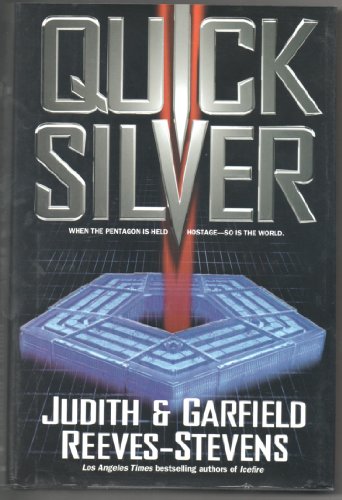
When a gang of ruthless terrorists invades the Pentagon and takes hostage the top military officials of more than twenty European nations and America's senior military commanders, one man and one woman must join forces to protect America's super-weapon satellite Quick Silver
"synopsis" may belong to another edition of this title.
About the Author
Judith and Garfield Reeves-Stevens are the including bestselling authors of nineteen novels, including the epic thriller of military disaster in the the Antarctic, Icefire, now available in paperback from Pocket Books. They have also collaborated with William Shatner on such New York Times bestsellers as The Return and Avenger.
Reviews
Terrorists take over the Pentagon and gain control of the ultimate satellite superweapon, called Quicksilver, in this warp-speed techno-thriller with the most engaging underdog protagonists since Jurassic Park. A cadre of multinational terrorists murder a busload of Annapolis midshipmen headed for a NATO ceremony at the Pentagon, and then use their victims identities to clear security, taking VIP hostages and gaining control of the building. The president barely escapes, but he loses his security force and leaves most of his cabinet, and the First Lady, behind. Midshipman Amy Nuke Bethune happened to miss her ill-fated bus, but made it to the Pentagon just in time to get trapped inside, bad news for the commandos who offed her classmates. She joins up with Tom Chase, an irreverent ex-FBI electronics whiz and consultant to General Vanovich, the developer of Quicksilver, now held hostage. Meanwhile, the terrorists take satellites out of orbit and wipe out a Colorado base with Quicksilver while making impossible demands. Major Margaret Sinclair (a former Delta Force commando, Toms ex-wife and Vanovichs second-in-command) persuades the White House to send her in instead of nuking the buildingand all the hostageswith a deep penetration bomb. Amys guerrilla skills and Toms smarts plow through defenders as they aim for the terrorist stronghold, unaware of the enemys level of access to Quicksilver codes. Although the disaster formula is familiar, and the terrorists motivation is not entirely credible, the hair-trigger plot and heroics are gripping, and the mix of formidable but feminine heroines and reluctant heroes adds a new twist to the scenario. This followup to the Reeves-Stevenses bestselling Icefire insures their entre to the techno-thriller elite. 75,000-copy first printing; major ad/promo; author tour. (May) FYI: The authors also co-write a Star Trek series with William Shatner.
Copyright 1999 Reed Business Information, Inc.
Disaster looms again in the Reeves-Stevens's latest thriller, following the threat of asteroid impact and superviruses of 1998's Icefire. This time out, its the utterly secure Pentagon that comes under threat as terrorist commandos take over the world's most highly protected building on the event of the US welcoming new NATO partners from the former USSR. Not only the Joint Chiefs of Staff and the Vice President are taken prisoners, but the cherry on top is that the terrorists have come in control of Quicksilver, a marvel of weaponry far superior to the atomic bomb in fearsomeness. Protecting the savaged US is the National Infrastructure Agency, whose ultrasecret activities ask for skills never before required from American agents. Leading NIA is Air Force Major General Milo Vanovich, aided ably by Army Major Margaret Sinclair. What is this Quicksilver they must protect at all costs? An electromagnetically invisible platform orbiting the planet at 200 miles, and directed by a satellite system controlled by a command facility in the Pentagon. But when the weapon is first tested at sea on the Shiloh with its 364 men aboard, it seems a failurethen a huge shimmering molten sheet lifts the Shiloh 20 feet out of the water before evaporating it into incandescent mist. If a weapon like that in the hands of terrorists grabs you, so should the rest of this hostage suspenser. (First printing of 75,000; author tour) -- Copyright ©1999, Kirkus Associates, LP. All rights reserved.
One day a few years into the next millennium, the testing of a new superweapon that is supposed only to disrupt electronics goes awry and a U.S. Navy cruiser with nearly 400 personnel aboard is vaporized. Woops. A few months later, a superconscientious Naval Academy midshipman, assigned with her company to special duty at the Pentagon when Russia is to be inducted into NATO, oversleeps because of a prank played against her and misses the bus. Woops, again. But it doesn't seem so bad, after all, when terrorists board the bus and kill everybody on it, replacing them with commandos in dress whites. That leaves one determined, duty-bound midshipman to get into the Pentagon after the terrorists, who call themselves the Sons of Liberty, have seized the place (apparently to force election reform), and help Tom Chase, a civilian who has top-level clearance because of his cyberskills, prowl around and find out what the terrorists' agenda really is. (Psst! Remember that superweapon?) The Reeves-Stevenses blend elements of Seven Days in May and the Die Hard movies with lots of techno-detail ala Tom Clancy to produce pretty good fodder for Bruce Willis' next shoot-'em-up. That it has enough cardboard additional characters for cameos by stars who have gone a bit beyond their expiration dates and that it concludes with a family reunification ought to help it onto celluloid, too. Oh, yes, it is also fun enough reading. Ray Olson
Excerpt. © Reprinted by permission. All rights reserved.
CHAPTER ONE
UNITED STATES NAVAL ACADEMY/ANNAPOLIS, MARYLAND
They had stolen her underwear.
Again.
Amy "Nuke" Bethune cursed like the sailor she hoped one day to become as she charged down the empty corridor on the third floor of Wing Three of Bancroft Hall, the hem of her tightly clutched b-robe flying behind her. Three years at the United States Naval Academy and everything she had done to earn her place as an equal among her classmates had come to nothing. She was still treated this way.
Not by the men. But by the other women.
Amy skidded to a stop on the slickly polished linoleum outside Midshipman Annika Marsh's dorm room. Marsh's name and graduating year were cut into the white plastic ID plate on the door, the color to alert other mids that this was a room for females. Male mids had their names cut into black plates.
Amy had targeted this room for two reasons, the most important being that Marsh was about her size. She knew that some might think she was about to take a strong initiative that would violate the Academy's honor concept, the solemn vow to never lie, cheat, or steal. But it was the only way she could complete her duty for today. Besides, the honor concept also stated that midshipmen were to ensure that others were able to benefit from the use of their own property. So it's not stealing, Amy told herself, it's emergency borrowing. The distinction made what she had to do a bit easier to justify. But not by much.
Amy pushed hard against the metal doorplate and the oversized, heavy door swung open as she knew it would. The level of trust among the Academy's 4,000-strong brigade of midshipmen meant that virtually none of the dorm-room doors was ever locked, except during long absences over holiday and vacation breaks. Considering that Marsh was more than likely one of the masterminds behind the disappearing underwear, though, Amy was surprised that her classmate seemed unprepared for retaliation.
Marsh's dorm room was the size of a small and spartan studio apartment, identical to Amy's and typical of the Hall. There were two narrow bunk beds, one to either side, with a built-in desk beneath each, and two closets along the wall. In one corner was a shower and sink -- an absolute timesaving necessity when 4,000 midshipmen had to follow identical schedules.
But Amy took no time to study the room. She headed straight for the cupboard unit built in against the end of Marsh's bunk, trying not to think what might happen to 12th Company's status if she were caught in the act.
Twelfth Company was Amy's cadre of 124 fellow mids from plebes to Firsties, one of the 36 companies making up the Academy's brigade of midshipmen. It was also the Academy's current Color Company, an honor it had earned for the past three years. Amy considered it no coincidence that 12th Company's ascendancy had begun when she had joined it. Points in an Academy-wide competition were awarded for academic, athletic, and professional excellence. Her performance in the classroom and on the diving team had added significantly to 12th Company's point score. This past year, she and her cadre had accumulated 320.6 out of a possible 360. Her accomplishments had also, obviously, raised her profile among the company to the point where her textbooks had begun disappearing, her e-mail account was regularly acquiring new passwords, and -- as had happened this morning -- her alarm clock could no longer be trusted.
For all that the Academy made a point of searching out young men and women who would excel in the Navy and Marine Corps, Amy was painfully learning that it also hewed to a military culture which valued team solidarity over individual achievement. Somewhere, unofficially, there existed an invisible boundary between excellence and independence. Marsh, among others, apparently thought Amy Bethune had crossed it.
But as Amy quickly searched through the stack of drawers in Marsh's cupboard, trying to find the midshipman's underwear, she rebelliously thought again that it was not her obligation to hold herself back in her quest for the controversial career goal that had earned her her nickname. Rather, it was her classmates' obligation to raise themselves to her standards.
Some might call -- and had called -- her attitude arrogant. To which Amy always replied, Welcome to the real world. If people didn't like her being the best at what she set out to do, then it was their mission to try to do even better. If they weren't prepared for that challenge, they'd soon find out that their only other choice was to get out of her way.
She hit pay dirt in the third drawer down. A sports bra and briefs, both, fortunately, still folded from the laundry. She quickly rifled through the remaining stack to see if she had the luxury of a choice in what she appropriated, but the only other option, crammed out of sight at the bottom of the stack, was a flaming-pink combo: transparent above and little more than a G-string below. Definitely not regulation.
As a calling card, Amy draped Marsh's racy weekend underwear over the green shade of the lamp beside the desktop computer, confident that even such flagrant disorder would be unlikely to cost Marsh a demerit. Commissioning week, when the latest class had graduated and all other classes moved up one year, had come and gone three weeks ago, putting the Academy into summer-leave and summer-training mode. That meant the Yard was noticeably less populated, especially on weekends, when not even the high-school students brought in for one of three introductory summer seminars were present. Room inspections, a frequent fact of life during the other semesters, especially for plebes, were almost nonexistent.
In fact, there were no plebes at the Academy right now. Most mids who had completed their plebe year, and were now officially Youngsters, were off patrolling New England ports on the Academy's unarmed Yard Patrol craft, training on the Academy's forty-four-foot sailing sloops, or taking part in joint maneuvers that simulated SEAL and Marines Corps exercises. The second-class students, those entering their third year, were getting firsthand introductions to naval aviation at Pensacola or to submarine operations off Florida, or fighting war games with Marines in the wilds of Virginia. And most new Firsties, like Amy -- those midshipmen who had been raised to their fourth and final year -- were serving as junior officers in operational fleet squadrons around the world. Except for the volunteers from 12th Company.
As the Academy's Color Company, they had earned special privileges and duties for the academic year, including the honor of representing the Academy at official government functions. And few events in recent memory were as official or as historic as today's at the Pentagon. Which was why forty-two second-, third-, and fourth-year midshipmen had responded to Commandant Rigby's invitation to give up part of their precious three-week summer leave to volunteer for a special honor detail: attending the President's NATO ceremony.
Every mid knew that even if they were to do little more than seat dignitaries and help set tables, their participation in what was surely to become one of the defining moments of the new century would forever mark their service records apart from others. To say nothing of the opportunity to clock face-time with the top brass.
But it was equally clear that there were those in the company, besides Marsh, who didn't want Amy to be able to share in that distinction and opportunity. Unfortunately for them, they obviously hadn't yet learned that Nuke Bethune was impossible to stop. She'd make it the way she always did -- on her own. Determinedly clutching the borrowed underwear, Amy flew out of Marsh's room, bare feet slapping the floor.
Back in her own room, she slammed the door behind her and checked
"About this title" may belong to another edition of this title.
Search results for Quick Silver

Stock Image
Quicksilver
Seller: World of Books (was SecondSale), Montgomery, IL, U.S.A.
Seller rating 5 out of 5 stars

Hardback. Condition: Very Good. Seller Inventory # 00100649353
Stock Image
Quicksilver
Seller: World of Books (was SecondSale), Montgomery, IL, U.S.A.
Seller rating 5 out of 5 stars
Hardback. Condition: Good. Seller Inventory # 00094820467
Stock Image
Quick Silver
Seller: Your Online Bookstore, Houston, TX, U.S.A.
Seller rating 5 out of 5 stars
hardcover. Condition: Very Good. Seller Inventory # 0671028537-2-35504859
Seller Image
Quick Silver
Seller: Used Book Company, Egg Harbor Township, NJ, U.S.A.
Seller rating 5 out of 5 stars
Condition: Very Good. Shows minimal signs of wear and previous use. Can include minimal notes/highlighting. A portion of your purchase benefits nonprofits! - Note: Edition & format may differ from what is shown in stock photo & item details. May not include supplementary material (toys, access code, dvds, etc). Seller Inventory # 584ZSU000MAP_ns
Stock Image
Quicksilver
Seller: World of Books Inc, Montgomery, IL, U.S.A.
Seller rating 4 out of 5 stars

Hardback. Condition: Very Good. Seller Inventory # CIN0671028537VG
Stock Image
Quicksilver
Seller: World of Books Inc, Montgomery, IL, U.S.A.
Seller rating 4 out of 5 stars
Hardback. Condition: Good. Seller Inventory # CIN0671028537G
Stock Image
Quick Silver
Seller: BooksRun, Philadelphia, PA, U.S.A.
Seller rating 5 out of 5 stars
Hardcover. Condition: Very Good. With dust jacket. It's a well-cared-for item that has seen limited use. The item may show minor signs of wear. All the text is legible, with all pages included. It may have slight markings and/or highlighting. Seller Inventory # 0671028537-11-6-29
Stock Image
Quick Silver
Seller: ThriftBooks-Atlanta, AUSTELL, GA, U.S.A.
Seller rating 5 out of 5 stars
Hardcover. Condition: As New. No Jacket. Pages are clean and are not marred by notes or folds of any kind. ~ ThriftBooks: Read More, Spend Less. Seller Inventory # G0671028537I2N00
Stock Image
Quick Silver
Seller: ThriftBooks-Dallas, Dallas, TX, U.S.A.
Seller rating 5 out of 5 stars
Hardcover. Condition: Very Good. No Jacket. Former library book; May have limited writing in cover pages. Pages are unmarked. ~ ThriftBooks: Read More, Spend Less. Seller Inventory # G0671028537I4N10
Stock Image
Quick Silver
Published by
Atria Books, 1999
ISBN 10: 0671028537
ISBN 13: 9780671028534
Used
Hardcover
First Edition
Seller: Better World Books, Mishawaka, IN, U.S.A.
Seller rating 5 out of 5 stars
Condition: Good. First Edition. Pages intact with minimal writing/highlighting. The binding may be loose and creased. Dust jackets/supplements are not included. Stock photo provided. Product includes identifying sticker. Better World Books: Buy Books. Do Good. Seller Inventory # 9919635-6