
Items related to A Piece of the Action : How the Middle Class Joined...
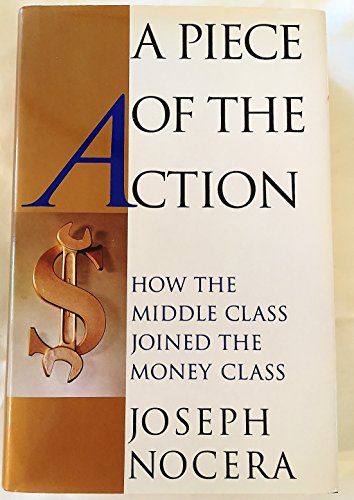
Synopsis
Discusses the impact of credit cards and mutual funds on middle class personal finance, and looks at the individuals responsible for these innovations
"synopsis" may belong to another edition of this title.
Reviews
In an entertaining and edifying history of personal finance, GQ columnist Nocera charts the transformation of the habits of middle-class Americans. The raging inflation of the late 1970s and early '80s, he argues, led many people to abandon thrift and their aversion to risk, attitudes acquired during the Depression. Faced with double-digit inflation, wildly gyrating interest rates and a sinking standard of living, consumers displayed a great willingness to take on debt. The emergence of two-income couples, adjustable-rate mortgages, credit cards and the middle class's growing participation in stocks, mutual funds and money-market accounts define what the author terms the "money revolution" of the past two decades. Nocera, who believes credit overall has been a force for good in American life, fleshes out this colorful chronicle with profiles of finance wizards Charles Merrill of Merrill Lynch; Dee Hock, creator of Visa; and investment broker Charles Schwab. Author tour.
Copyright 1994 Reed Business Information, Inc.
A wonderful pudding of a book that serves up large helpings of US socioeconomic history over the past 35 years or so. The title and subtitle notwithstanding, GQ columnist Nocera never makes clear precisely what he means by the middle class. Nor does he provide a systematic reckoning on the financial times since 1958 (when BankAmerica launched what became the Visa credit card). What he does offer, though, are thoroughly engrossing takes on the breakthrough innovations that democratized America's monetary life. There are tellingly detailed briefings on the largely unsung creators of money-market mutual funds (including the first to give investors check-writing privileges), NOW accounts, negotiable CDs, no-load mutual funds, and other financial services that an affluent society now takes for granted. The author also profiles the bankers, Wall Streeters, and others who played leading roles in a revolution that profoundly altered Main Street's attitudes toward credit, debt, investment, and savings. Cases in point range from Peter Lynch (Fidelity's star portfolio manager until his 1990 retirement) through Charles Schwab (of discount brokerage fame), Citicorp's Walter Wriston, and Marshall Loeb (former editor of Money, which continues to overstate the rewards while minimizing the risks of do-it-yourself capitalism). Assessed as well are the convulsive consequences of Paul Volcker's conquest of inflation, deregulation of depository institutions, the stock market's 1987 crash, and the low interest rates that channeled increasing amounts of money into equities during the early 1990s. Conspicuous by its absence, though, is any sustained coverage of the S&L scandals, insider trading, the takeover boom, junk bonds, the assets controlled by insurance companies, derivative securities products, exchange-listed options, futures contracts, and allied aspects of the domestic financial scene. Even so, Nocera delivers a savvy rundown on the landmark developments that in less than four decades have made consumer finance a multilateral bazaar in which beating the markets is a populist pastime. -- Copyright ©1994, Kirkus Associates, LP. All rights reserved.
The business writer of "The Profit Motive" column for GQ magazine, Nocera presents a fascinating and comprehensive history of the evolution of the personal financial products accessible to most Americans today. His story begins with the birth of the credit card 35 years ago and documents the rise of NOW accounts, mutual funds, cut-rate commissions on stock purchases, IRAs, and ATMs. Drawing upon interviews and business news reports, Nocera also includes the stories of the entrepreneurs behind these products-Giannini, founder of Bank of America; Hock, creator of Visa; Kahr, creator of Cash Management Accounts; Merrill, founder of Merrill Lynch; discount broker Schwab; and fund manager Lynch. This book is also a social history of changing American attitudes about money, investing, and the use of credit. Highly recommended for business collections.
Jane M. Kathman, Coll. of St. Benedict, St. Joseph, Minn.
Copyright 1994 Reed Business Information, Inc.
Nocera is an award-winning journalist who writes a personal finance column for GQ magazine. He shows how, in barely more than one generation, the way we think about money and credit and investing and saving has changed forever. Two major events caused this shift. The first was the advent of the credit card and the second was the popularization of the mutual fund. In a series of profiles, beginning with the Bank of America's original distribution of 60,000 credit cards in Fresno, California, in 1958, Nocera chronicles how middle-income Americans changed their financial lives and habits. He demonstrates that a fear of inflation created a "buy-now" mentality and desire to move money out of savings accounts into alternatives. Colorfully portraying such people and institutions that helped bring about these changes as Charles Schwab (discount brokerage), Charles Edward Merrill (Merrill Lynch), Peter Lynch (Fidelity Funds), Money magazine, and individual retirement accounts, Nocera provides a wonderfully readable history--one that is more cultural than economic--of the recent past. David Rouse
"About this title" may belong to another edition of this title.
Search results for A Piece of the Action : How the Middle Class Joined...

Stock Image
A Piece of the Action: How the Middle Class Joined the Money Class
Seller: World of Books (was SecondSale), Montgomery, IL, U.S.A.
Seller rating 5 out of 5 stars

Hardback. Condition: Good. Now with a new introduction describing the fallout of America's consumer credit boom, 1994's wildly acclaimed bestseller A Piece of the Action tells the story of how millions of middle class Americans went from being savers to borrowers and investors through the invention of credit cards, mutual funds, and IRAs--resulting in profound societal change. America began to change on a mid-September day in 1958, when the Bank of America dropped its first 60,000 credit cards on the unassuming city of Fresno, California. So begins Joe Nocera's riveting account of one of the most astonishing revolutions in modern American life--what Nocera labels the money revolution. In the decades since, the middle class has gained access to credit cards, to mutual funds, to retirement accounts--and to hundreds of other financial vehicles that have allowed everyone to get a piece of the action. In this lively, engaging book, some of the great financial characters of modern times--from Charles Merrill to Charles Schwab to Peter Lynch--strut across the stage as the course of this great financial shift is charted. In an all-new introduction, Nocera takes a look back at the consequences of the money revolution. Were members of the middle class as prepared as the innovators claimed to take control of their financial lives? Or did events like the dot-com and the housing bubbles suggest something else: that far too many of us lacked the wherewithal to make sound investment decisions? Seller Inventory # 00109252611
Stock Image
A Piece of the Action : How the Middle Class Joined the Money Cla
Seller: Hawking Books, Edgewood, TX, U.S.A.
Seller rating 4 out of 5 stars

Condition: Good. Good Condition. Has writing on inside cover. Five star seller - Buy with confidence! Seller Inventory # X0671667564X3
Seller Image
A Piece of the Action : How the Middle Class Joined the Money Class
Seller: Windflower Bookstore, Rockford, IL, U.S.A.
Seller rating 4 out of 5 stars
Condition: good. Seller Inventory # WFBV.0671667564.G
Stock Image
A Piece of the Action : How the Middle Class Joined the Money Class
Seller: More Than Words, Waltham, MA, U.S.A.
Seller rating 5 out of 5 stars
Condition: Very Good. A bright, square, and overall a nice copy. Seller Inventory # BOS-A-05j-01744
Seller Image
A Piece of the Action : How the Middle Class Joined the Money Class
Seller: Goodwill Books, Hillsboro, OR, U.S.A.
Seller rating 5 out of 5 stars
Condition: acceptable. Fairly worn, but readable and intact. If applicable: Dust jacket, disc or access code may not be included. Seller Inventory # GICWV.0671667564.A
Stock Image
A Piece of the Action : How the Middle Class Joined the Money Class
Seller: ThriftBooks-Atlanta, AUSTELL, GA, U.S.A.
Seller rating 5 out of 5 stars
Hardcover. Condition: Good. No Jacket. Pages can have notes/highlighting. Spine may show signs of wear. ~ ThriftBooks: Read More, Spend Less. Seller Inventory # G0671667564I3N00
Stock Image
A Piece of the Action : How the Middle Class Joined the Money Class
Seller: ThriftBooks-Dallas, Dallas, TX, U.S.A.
Seller rating 5 out of 5 stars
Hardcover. Condition: Very Good. No Jacket. May have limited writing in cover pages. Pages are unmarked. ~ ThriftBooks: Read More, Spend Less. Seller Inventory # G0671667564I4N00
Stock Image
A Piece of the Action : How the Middle Class Joined the Money Class
Seller: ThriftBooks-Dallas, Dallas, TX, U.S.A.
Seller rating 5 out of 5 stars
Hardcover. Condition: Good. No Jacket. Former library book; Pages can have notes/highlighting. Spine may show signs of wear. ~ ThriftBooks: Read More, Spend Less. Seller Inventory # G0671667564I3N10
Stock Image
A Piece of the Action : How the Middle Class Joined the Money Class
Seller: ThriftBooks-Reno, Reno, NV, U.S.A.
Seller rating 5 out of 5 stars
Hardcover. Condition: Fair. No Jacket. Readable copy. Pages may have considerable notes/highlighting. ~ ThriftBooks: Read More, Spend Less. Seller Inventory # G0671667564I5N00
Stock Image
A Piece of the Action : How the Middle Class Joined the Money Class
Seller: ThriftBooks-Reno, Reno, NV, U.S.A.
Seller rating 5 out of 5 stars
Hardcover. Condition: Very Good. No Jacket. May have limited writing in cover pages. Pages are unmarked. ~ ThriftBooks: Read More, Spend Less. Seller Inventory # G0671667564I4N00