
Items related to Simon & Schuster's Beginner's Guide to Understanding...
Synopsis
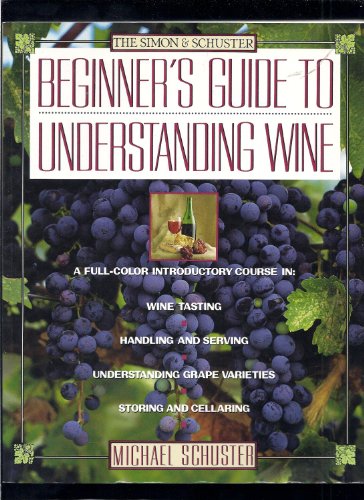
An introductory course in wine covering wine tasting techniques, wine making, the major grapes and wines made from them, and methods of storing and serving
"synopsis" may belong to another edition of this title.
About the Author
Michael Schuster studied tasting in Bordeaux, gaining the Bordeaux University Tasting Diploma. In 1983 he won the top scholarship in the U.K. wine trade Diploma examinations. After creating an award-winning wine retail business, he now works independently as a writer and lecturer, and he offers a series of wine courses and tastings at his own tasting school. He has written for Wine & Spirit, Which? Wine Guide, Decanter, and Wine, and he is the wine correspondent for London Portrait Living.
Excerpt. © Reprinted by permission. All rights reserved.
Chapter 1
GLASSES
Why do winetasters make such a fuss about glasses? The answer is that when "tasting" consciously as opposed to just "drinking", one is trying to experience as many as possible of the sight, smell and taste sensations that a wine has to offer. Smell especially, because it is so central to the pleasure a wine gives and because it conveys so much information. The extent to which one can experience a wine's visual aspect and its smell in particular, is influenced respectively by the quality of the glass it is made from and by the shape of the glass.
Try comparing a line up of different glasses like those illustrated.
All of these glasses are perfectly good as drinking vessels. Only a couple are good for both seeing the wine clearly and smelling it effectively; most do neither very well, Why so?
DEPTH AND CLARITY (viewed from above) When each glass is filled with what would be an average tasting sample of about 35ml of the same wine, and the wine is viewed from directly above to assess its depth and clarity, only in glasses 1 and 2, both with a high lead crystal content, can you really see the wine well. In the cut glass (6), the reflected highlights are splendid but make it difficult to judge the wine's depth. The Paris goblet's breadth dilutes the colour, the sherry copita's narrowness exaggerates it, and in both of these, as well as in glasses 3 and 7, the combination of design and quality of the glass material makes the colour appear flat and uniform. As the photograph shows, the International Standards Organization (ISO) glass gives much the best view of both depth and clarity, though the Classic glass is a close second.
HUE AND NUANCE (viewed with the glass tilted) Tilting the glass "spreads" the wine so that its overall hue can be seen more clearly (particularly in red wines), as well as the nuances of colour as they change from the centre or "eye" to a watery rim. For this to be practical one must be able to tilt the glass substantially without fear of the wine spilling, and without the rim of the glass then interfering with one's vision. With the flared glasses (6 and 7), the danger of Spillage is obvious when tilting to examine colour, or when swirling in order to look at the wine's viscosity or to encourage its bouquet. With the shorter glasses (4 and 5) there simply isn't much room to either tilt or swirl before the liquid reaches the rim and spills over, and the rim of the glass also remains in the way when viewing. The more "tulip" shaped glasses (1, 2 and 3) are all good "tilters".
BOUQUET
Much more important than their practicality for looking at the wine though, is the way in which the glass affects a wine's smell.
The wider and more flared the glass's opening the less the wine's bouquet will be gathered, concentrated and directed; and the more (and more rapidly) it will disperse and escape via routes other than your nostrils. 1, 3 and 5 would all seem to be good in this respect. I say seem, because although they all have a narrow opening, in the case of the sherry copita (5), there is little room for swirling to begin with, little surface area inside for volatization, and barely any room for the bouquet to gather and develop in anyway. Glass (3) is good, but rather too wide at the rim. There is plenty of room for the bouquet to develop on swirling, but it also escapes too easily. A counsel of perfection? Maybe, but the ISO tasting glass is the most efficient all round tasting glass, at a reasonable price, and if you want to get the most out of your wines....I also think it is a perfectly good glass for the table, although the range of Classic glasses (2) is hard to beat for appearance and feel.
The extent to which a wine releases its aromas, and how efficiently they can be smelled from the glass depends on four principal, and inter-related factors:
1. The shape of the glass.
2. The surface area inside on which the wine can be spread by swirling or agitation, allowing the liquid to evaporate and the aroma molecules to volatize.
3. The space inside between the surface of the win e at rest and the rim of the glass, in which the aromas have room to circulate, develop and concentrate.
4. The size of the glass's opening in relation to the bowl This must create a fine balance between permitting the aromas to escape and preventing them from doing so.
Copyright © 1989 by Michael Schuster
"About this title" may belong to another edition of this title.
Search results for Simon & Schuster's Beginner's Guide to Understanding...

Stock Image
Simon Schusters Beginners Guide to Understanding Wine
Published by
Prentice Hall (a Pearson Education company), 1991
ISBN 10: 0671728938
ISBN 13: 9780671728939
Used
Paperback
Seller: World of Books (was SecondSale), Montgomery, IL, U.S.A.
Seller rating 5 out of 5 stars

Paperback. Condition: Very Good. Seller Inventory # 00077799687
Seller Image
Simon & Schuster's Beginner's Guide to Understanding Wine
Seller: Greenworld Books, Arlington, TX, U.S.A.
Seller rating 5 out of 5 stars
Condition: very_good. Fast Free Shipping â" Very Good condition book with a firm cover and clean pages. Shows normal use and some light wear or limited notes markings. A solid, nice copy to enjoy. Seller Inventory # GWV.0671728938.VG
Stock Image
Simon & Schuster's Beginner's Guide to Understanding Wine
Seller: Once Upon A Time Books, Siloam Springs, AR, U.S.A.
Seller rating 4 out of 5 stars

Paperback. Condition: Good. This is a used book in good condition and may show some signs of use or wear . This is a used book in good condition and may show some signs of use or wear . Seller Inventory # mon0001023243
Stock Image
Simon & Schuster's Beginner's Guide to Understanding Wine
Seller: Half Price Books Inc., Dallas, TX, U.S.A.
Seller rating 5 out of 5 stars
paperback. Condition: Very Good. Connecting readers with great books since 1972! Used books may not include companion materials, and may have some shelf wear or limited writing. We ship orders daily and Customer Service is our top priority! Seller Inventory # S_459482465
Stock Image
The Simon and Schuster Beginner's Guide to Understanding Wine
Seller: Better World Books, Mishawaka, IN, U.S.A.
Seller rating 5 out of 5 stars
Condition: Good. Former library copy. Pages intact with minimal writing/highlighting. The binding may be loose and creased. Dust jackets/supplements are not included. Includes library markings. Stock photo provided. Product includes identifying sticker. Better World Books: Buy Books. Do Good. Seller Inventory # GRP76566622
Stock Image
Simon Schusters Beginners Guide to Understanding Wine
Published by
Prentice Hall (a Pearson Education company), 1991
ISBN 10: 0671728938
ISBN 13: 9780671728939
Used
Paperback
Seller: World of Books Inc, Montgomery, IL, U.S.A.
Seller rating 4 out of 5 stars
Paperback. Condition: Very Good. Seller Inventory # CIN0671728938VG
Stock Image
Simon & Schuster's Beginner's Guide to Understanding Wine
Seller: Wonder Book, Frederick, MD, U.S.A.
Seller rating 5 out of 5 stars
Condition: Very Good. Very Good condition. A copy that may have a few cosmetic defects. May also contain light spine creasing or a few markings such as an owner's name, short gifter's inscription or light stamp. Seller Inventory # D16A-03756
Stock Image
Simon & Schuster's Beginner's Guide to Understanding Wine
Seller: Wonder Book, Frederick, MD, U.S.A.
Seller rating 5 out of 5 stars
Condition: Good. Good condition. A copy that has been read but remains intact. May contain markings such as bookplates, stamps, limited notes and highlighting, or a few light stains. Seller Inventory # O13P-00761
Stock Image
Simon & Schuster's Beginner's Guide to Understanding Wine
Seller: ThriftBooks-Dallas, Dallas, TX, U.S.A.
Seller rating 5 out of 5 stars
Paperback. Condition: Fair. No Jacket. Readable copy. Pages may have considerable notes/highlighting. ~ ThriftBooks: Read More, Spend Less. Seller Inventory # G0671728938I5N00
Stock Image
Simon & Schuster's Beginner's Guide to Understanding Wine
Seller: HPB Inc., Dallas, TX, U.S.A.
Seller rating 5 out of 5 stars
Paperback. Condition: Very Good. Connecting readers with great books since 1972! Used books may not include companion materials, and may have some shelf wear or limited writing. We ship orders daily and Customer Service is our top priority! Seller Inventory # S_479440815