
Items related to Evolution of Racism: The Human Differences and the...
Synopsis
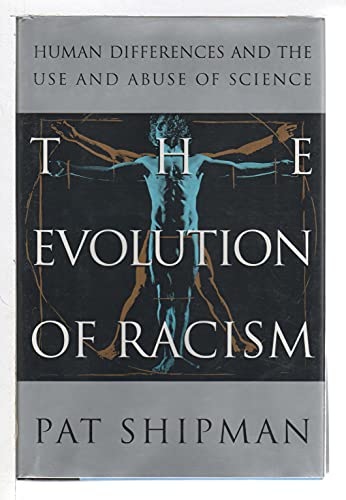
Combines a history of evolutionary theory with a study of its impact on ideas about race and racism to explain how the fear of making politically unacceptable discoveries has prevented scientists from honestly exploring human racial differences
"synopsis" may belong to another edition of this title.
Reviews
Shipman, coauthor of The Neanderthals , has written an accessible history of the attempts of scientists, from the mid-19th century to the present, to grapple with issues of race. From Charles Darwin's wide-ranging explorations of evolution emerged fellow Briton's Thomas Henry Huxley's applications to human history. By the late 19th century, Herbert Spencer seized on Darwinism to argue for laissez-faire government. Darwin's cousin, Francis Galton, proposed the idea of eugenics: advancing the species through careful breeding. From eugenics came intelligence testing, used in the early 20th century to the detriment of immigrants to America and eventually by Nazi science. Shipman tracks the continuing controversy in the 1950s and 1960s about whether to examine or deny racial difference and discusses at much length a proposed but canceled 1992 conference on genetics and crime. This thoughtful study warns that treating race as a taboo subject hinders legitimate scientific investigation of differences among humans.
Copyright 1994 Reed Business Information, Inc.
A thoughtful and provocative look at scientific racism from the rise of the theory of evolution to the present. Paleoanthropologist Shipman (coauthor, The Neanderthals: Changing the Image of Mankind, not reviewed) explores scientific (and, all too often, pseudoscientific) thinking about the meaning of race, showing that its history is ineluctably linked to the story of thoughts about the origins of humanity itself. The author begins her consideration with Charles Darwin. Although he contended that there were no value judgments attached to his theory of evolution, he also refused to believe that indigenous, ``less civilized'' peoples were human beings of the same order as Europeans. In England, Thomas Huxley proselytized on behalf of Darwinian theory as a way of affirming the primacy of science in its frequent battles with the church, which grew nastier as the theory of evolution challenged the biblical account of creation. In Germany, the debate took on a more political character, eventually culminating in the state's attempt, backed by a politicized science of eugenics, to distinguish a master race from subhumans. Shipman traces the story from the publication of Darwin's Origin of Species through the horrors of Nazism and down to the present. She convincingly demonstrates the links between the abuse of evolutionary theory and racism, showing that such thinking still sets the terms for discussion of matters of race and human characteristics today. The key question she raises is whether we have the capacity to acknowledge human differences without rushing to measure their value. It's a problem, she notes, of growing importance given the advances currently being made in genetics. This volume is ``must'' reading. Shipman gives readers a compelling discussion and candidly asks: ``Have we the courage and the intelligence to face the truth about ourselves?'' -- Copyright ©1994, Kirkus Associates, LP. All rights reserved.
Shipman, coauthor of The Neandertals (LJ 12/92), is quickly becoming one of the better popular science writers working today. Here she traces the intertwined history of evolution and racism from the publication of Charles Darwin's Origin of the Species to current controversies over genetic links to violent behavior. Despite the title, the story focuses more on the history of race as a scientific concept than on the misappropriation of such concepts by political leaders and social crusaders. As a result we learn much about the scientists involved in the debate but only a little about the use and abuse of science by nonscientists. Still, Shipman's book is clearly written and very accessible. A valuable addition to most libraries.
Eric Hinsdale, Trinity Univ. Lib., San Antonio
Copyright 1994 Reed Business Information, Inc.
As she did in a book coauthored with Erik Trinkaus, The Neandertals , Shipman analyzes how scientific ideas develop and how they influence and are influenced by their social and political context. Shipman's book is a history of both the theory of evolution and the manipulation of that theory in support ofand opposition toracism. Vivid portraits of individualsfrom Charles Darwin and T. H. Huxley to German opponents Ernst Haeckel and Rudolf Virchow and their contemporaries in the British and American eugenics movements to the horrors of Nazi race hygiene and the battles of postwar antagonists Ashley Montagu and Carleton Coon--are matched by lucid explanations of both science's changing understanding of evolutionary history and the interplay of political and scientific factors in defining acceptable subjects for scientific research. While some readers will find Shipman's criticism of what she labels the widespread refusal to acknowledge, much less examine, racial issues over the past 30 years rather naive, almost all will discover much of value in this graceful, insightful study. Mary Carroll
"About this title" may belong to another edition of this title.
Search results for Evolution of Racism: The Human Differences and the...

Seller Image
Evolution of Racism: The Human Differences and the Use and Abuse of Science
Seller: Bay State Book Company, North Smithfield, RI, U.S.A.
Seller rating 5 out of 5 stars

Condition: very_good. Seller Inventory # BSM.18VCF
Stock Image
Evolution of Racism : The Human Difference and the Use and Abuse of Science
Seller: Better World Books, Mishawaka, IN, U.S.A.
Seller rating 5 out of 5 stars
Condition: Very Good. Pages intact with possible writing/highlighting. Binding strong with minor wear. Dust jackets/supplements may not be included. Stock photo provided. Product includes identifying sticker. Better World Books: Buy Books. Do Good. Seller Inventory # 9172655-6
Stock Image
Evolution of Racism : The Human Difference and the Use and Abuse of Science
Seller: Better World Books, Mishawaka, IN, U.S.A.
Seller rating 5 out of 5 stars
Condition: Very Good. Former library copy. Pages intact with possible writing/highlighting. Binding strong with minor wear. Dust jackets/supplements may not be included. Includes library markings. Stock photo provided. Product includes identifying sticker. Better World Books: Buy Books. Do Good. Seller Inventory # GRP76662486
Stock Image
Evolution of Racism: The Human Differences and the Use and Abuse of Science
Seller: Wonder Book, Frederick, MD, U.S.A.
Seller rating 5 out of 5 stars
Condition: As New. Like New condition. Very Good dust jacket. A near perfect copy that may have very minor cosmetic defects. Seller Inventory # U03B-05849
Stock Image
Evolution of Racism: The Human Differences and the Use and Abuse of Science
Seller: Wonder Book, Frederick, MD, U.S.A.
Seller rating 5 out of 5 stars
Condition: Good. Good condition. Very Good dust jacket. A copy that has been read but remains intact. May contain markings such as bookplates, stamps, limited notes and highlighting, or a few light stains. Seller Inventory # M11O-1417
Stock Image
Evolution of Racism: The Human Differences and the Use and Abuse of Science
Seller: ThriftBooks-Atlanta, AUSTELL, GA, U.S.A.
Seller rating 5 out of 5 stars
Hardcover. Condition: Good. No Jacket. Pages can have notes/highlighting. Spine may show signs of wear. ~ ThriftBooks: Read More, Spend Less. Seller Inventory # G0671754602I3N00
Stock Image
Evolution of Racism: The Human Differences and the Use and Abuse of Science
Seller: ThriftBooks-Dallas, Dallas, TX, U.S.A.
Seller rating 5 out of 5 stars
Hardcover. Condition: Very Good. No Jacket. Former library book; May have limited writing in cover pages. Pages are unmarked. ~ ThriftBooks: Read More, Spend Less. Seller Inventory # G0671754602I4N10
Seller Image
Evolution of Racism: The Human Differences and the Use and Abuse of Science
Seller: Blue Vase Books, Interlochen, MI, U.S.A.
Seller rating 5 out of 5 stars
Condition: good. Former library book with the usual stamps, stickers and labels. The item shows wear from consistent use, but it remains in good condition and works perfectly. All pages and cover are intact including the dust cover, if applicable . Spine may show signs of wear. Pages may include limited notes and highlighting. May NOT include discs, access code or other supplemental materials. Seller Inventory # BVV.0671754602.G
Stock Image
Evolution of Racism: The Human Differences and the Use and Abuse of Science
Seller: The Maryland Book Bank, Baltimore, MD, U.S.A.
Seller rating 5 out of 5 stars
hardcover. Condition: Very Good. Used - Very Good. Seller Inventory # 8-P-4-0184
Stock Image
Evolution of Racism: The Human Differences and the Use and Abuse of Science
Seller: Visible Voice Books, Cleveland, OH, U.S.A.
Seller rating 5 out of 5 stars
hardcover. Condition: Very Good. Simon & Schuster July 1994 Hardcover with jacket, with two old stickers and slight smudge on back. No markings in text. Seller Inventory # 152754