
Items related to Songs, Roars, and Rituals: Communication in Birds,...
Synopsis
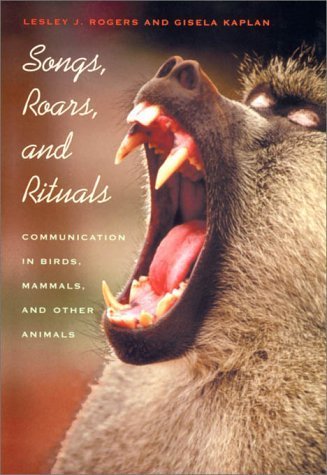
From the calling macaw and the roaring lion to the dancing lyrebird, animals all around us can be heard and seen communicating with each other and, occasionally, with us. Why they do so, what their utterances mean, and how much we know about them are the subject of Songs, Roars, and Rituals. This is a concise, yet comprehensive, introduction to the complexities of communication in animals.
Rogers and Kaplan take us on an exciting journey through communication in the animal world, offering insights on how animals communicate by sight, sound, smell, touch, and even electrical signaling. They explore a wide variety of communication patterns in many species of mammals and birds and discuss in detail how communication signals evolved, how they are learned, and what song and mimicry may mean.
An up-to-date account of the science of animal communication, this book also considers modern concepts (such as that of deceptive communication) and modern controversies, primarily those surrounding the evolution of human language and the use of symbolic language by apes. It concludes with a thought-provoking look at the future of communication between humans and animals.
"synopsis" may belong to another edition of this title.
About the Authors
Lesley J. Rogers is a full professor at the University of New England, Armidale, Australia.
Gisela Kaplan is a full professor at the University of New England, Armidale, Australia.
Reviews
From the cat's meow to the bowerbird's bright-blue nest, animals constantly and variously exchange information. Avians, primates, seals, whales, even insects and lizards send signals in order to find and keep their mates; to deceive predators, or to warn them away; to mark their territories; to train their young; and to pass on useful information. Neurobiologist Rogers (Minds of Their Own) and social scientist Kaplan (also the author of books on Australian feminism) have written an accessible, consistently absorbing and scientifically scrupulous survey of how animals send signals and of what evolutionary theory tells us about how they came to do so. The authors first explain how biologists distinguish between intentional signaling and other behaviors, such as "intention movements" (e.g., a bird flapping its wings before takeoff). Bird songs have inspired their own flock of specialized research; much of this volume covers warblers' warbles, lyrebirds' melodies and finches' trills. We learn why certain acoustic properties suit certain calls (staccato chirps, for example, make birds easier to locate), and we find out how various species teach their young their own calls, signs and songsAsome calls are largely "learned," others seem to be genetically programmed in much more detail. Mammal calls have proven harder to study, but Rogers and Kaplan explain what we do know. A concluding chapter describes how humans communicate with animals: pet owners and tribal hunter-gatherers both get sympathetic attention. An earlier version of this work was published in England in 1998 as Not Only Roars and Rituals; this revised American edition follows the May publication of the authors' other collaborative survey, The Orangutans (Forecasts, May 22). 8 halftones, 14 line illus. (Sept.)
Copyright 2000 Reed Business Information, Inc.
"Communication requires one individual to send a signal of some description and another individual to receive that signal and interpret its meaning." This simple definition appears early in the first chapter of this study of communication in animals and provides the foundation for the remainder of the text. Rogers and Kaplan (The Orangutans [BKL Je 1 & 15 00]) offer a wellwritten survey of what is known about communication in animals (mostly birds and mammals) in eight concise chapters. Simple behaviors, such as producing alarm calls to warn of predators, are explained in terms of what function the individual signals perform. This then leads the reader to understanding more complex communicative behaviors, such as "dishonest" signaling (bluffing). An interesting chapter explores the question of whether signaling is intentional or unintentional. Do animals signal unintentionally because of their emotional reaction to a situation, or are they sending specific information in specific circumstances? As a primer to an exciting field of animal behavior, this eminently readable account succeeds in thoroughly engaging the reader and is therefore recommended. Nancy Bent
Copyright © American Library Association. All rights reserved
The authors (behavioral sciences, Univ. of New England, Australia) focus on communication among animals, with chapters on its definition, evolution, use, how it is learned, whether it is intentional, signaling and sensory perception, and human-animal contacts. This rather advanced look at animal behavior is authoritative and well documented but suffers from a pedantic, academic style that makes for laborious reading. Bland phrases such as it is important, invites further comment, we have said that, and research on any aspect of are legion. Nevertheless, because it effectively synthesizes available information, as evidenced by the extensive bibliography, this book is an important contribution to the study of animal behavior and ethologyDa field of growing interest, notable for such Nobel laureates and iluminaries as Konrad Lorenz, Niko Tinbergen, and E.O. Wilson. Therefore, it is recommended for academic and larger public libraries, but with reservations as to its writing style.DHenry T. Armistead, Free Lib. of Philadelphia
Copyright 2000 Reed Business Information, Inc.
"About this title" may belong to another edition of this title.
Search results for Songs, Roars, and Rituals: Communication in Birds,...

Seller Image
Songs, Roars, and Rituals: Communication in Birds, Mammals, and Other Animals
Published by
Harvard University Press, 2000
ISBN 10: 0674000587
ISBN 13: 9780674000582
Used
Hardcover
Seller: -OnTimeBooks-, Phoenix, AZ, U.S.A.
Seller rating 5 out of 5 stars

Condition: very_good. Gently read. May have name of previous ownership, or ex-library edition. Binding tight; spine straight and smooth, with no creasing; covers clean and crisp. Minimal signs of handling or shelving. 100% GUARANTEE! Shipped with delivery confirmation, if you're not satisfied with purchase please return item! Ships USPS Media Mail. Seller Inventory # OTV.0674000587.VG
Stock Image
Songs, Roars, and Rituals : Communication in Birds, Mammals, and Other Animals
Published by
Harvard University Press, 2000
ISBN 10: 0674000587
ISBN 13: 9780674000582
Used
Hardcover
Seller: Better World Books, Mishawaka, IN, U.S.A.
Seller rating 5 out of 5 stars
Condition: Good. Former library copy. Pages intact with minimal writing/highlighting. The binding may be loose and creased. Dust jackets/supplements are not included. Includes library markings. Stock photo provided. Product includes identifying sticker. Better World Books: Buy Books. Do Good. Seller Inventory # 3381943-6
Stock Image
Songs, Roars, and Rituals: Communication in Birds, Mammals, and Other Animals
Published by
Harvard University Press, 2000
ISBN 10: 0674000587
ISBN 13: 9780674000582
Used
Hardcover
Seller: Wonder Book, Frederick, MD, U.S.A.
Seller rating 5 out of 5 stars
Condition: Good. Good condition. Good dust jacket. A copy that has been read but remains intact. May contain markings such as bookplates, stamps, limited notes and highlighting, or a few light stains. Seller Inventory # Q04N-00692
Stock Image
Songs, Roars, and Rituals: Communication in Birds, Mammals, and Other Animals
Published by
Harvard University Press, 2000
ISBN 10: 0674000587
ISBN 13: 9780674000582
Used
Hardcover
Seller: ThriftBooks-Dallas, Dallas, TX, U.S.A.
Seller rating 5 out of 5 stars
Hardcover. Condition: Very Good. No Jacket. Former library book; May have limited writing in cover pages. Pages are unmarked. ~ ThriftBooks: Read More, Spend Less. Seller Inventory # G0674000587I4N10
Stock Image
Songs, Roars, and Rituals: Communication in Birds, Mammals, and Other Animals Rogers, Lesley J. and Kaplan, Gisela
Published by
Harvard University Press, 2000
ISBN 10: 0674000587
ISBN 13: 9780674000582
Used
Hardcover
Seller: Ocean Books, Dacula, GA, U.S.A.
Seller rating 5 out of 5 stars
Hardcover. Condition: Good. Good ex-library book with protective plastic cover. Sticker on spine under plastic and on back of last page. Stamps on first page, second page, title page, top and bottom outer page edges. Seller Inventory # 76-8D3V-UUS0