
Items related to Mao’s Last Revolution
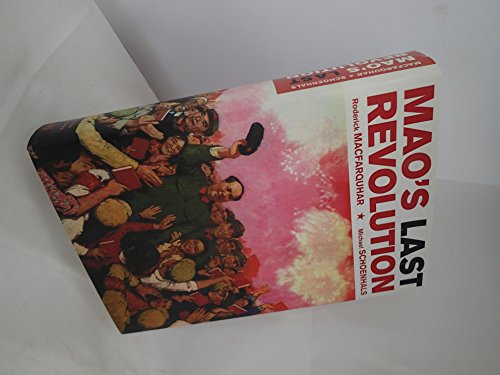
Synopsis
The Cultural Revolution was a watershed event in the history of the People’s Republic of China, the defining decade of half a century of communist rule. Before 1966, China was a typical communist state, with a command economy and a powerful party able to keep the population under control. But during the Cultural Revolution, in a move unprecedented in any communist country, Mao unleashed the Red Guards against the party. Tens of thousands of officials were humiliated, tortured, and even killed. Order had to be restored by the military, whose methods were often equally brutal.
In a masterly book, Roderick MacFarquhar and Michael Schoenhals explain why Mao launched the Cultural Revolution, and show his Machiavellian role in masterminding it (which Chinese publications conceal). In often horrifying detail, they document the Hobbesian state that ensued. The movement veered out of control and terror paralyzed the country. Power struggles raged among Lin Biao, Zhou Enlai, Deng Xiaoping, and Jiang Qing―Mao’s wife and leader of the Gang of Four―while Mao often played one against the other.
After Mao’s death, in reaction to the killing and the chaos, Deng Xiaoping led China into a reform era in which capitalism flourishes and the party has lost its former authority. In its invaluable critical analysis of Chairman Mao and its brilliant portrait of a culture in turmoil, Mao’s Last Revolution offers the most authoritative and compelling account to date of this seminal event in the history of China.
"synopsis" may belong to another edition of this title.
About the Authors
Roderick MacFarquhar was Leroy B. Williams Professor of History and Political Science, and Professor of Government, Harvard University.
Michael Schoenhals is Professor of Chinese, Emeritus, at Lund University, Sweden.
Reviews
It has been enthralling to read Roderick MacFarquhar and Michael Schoenhals's exhaustively researched new book on China's Cultural Revolution -- a sensation akin to returning to a Chinese painting in which a mist-shrouded landscape has miraculously cleared to reveal what was obscured beyond. While it was not difficult to feel the tension, even the fear, aloft in the land when I reported from Mao Zedong's China for the New Yorker during the mid-1970s, being there gave few intimations of the dark complexity of the political struggle playing out beneath the surface. By making sense out of this opaque decade, MacFarquhar (who teaches at Harvard University) and Schoenhals (who teaches at Lund University in Sweden) have provided the most definitive roadmap to date of China's odyssey through those tumultuous times.
But what happened is still not easy to explain completely. For complex reasons that involved Mao's political beliefs as well as his own psychological pathologies, the communist leader felt compelled to goad China into an extended paroxysm of revolutionary madness that ran from 1966 to 1976. Both to protect his own political supremacy and to wrench China out of its "feudal" past, he made politics and "class struggle" the currency of his revolutionary realm. In his own words, he created "great disorder under heaven." Proclaiming that "to rebel is justified," he called on students to "bombard the headquarters" of the Communist Party and thus set in motion one of the most unprecedented upheavals of the 20th century.
"You ask us how to do it," President Liu Shaoqi, who later died as a political enemy in one of Mao's prisons, told students as the leftist surge gathered momentum. "I tell you honestly, I don't know either. We're mainly going to be relying on you to make this revolution."
In the name of wiping out "capitalist roaders" (a euphemism for anyone seemingly opposed to Mao's revolutionary line) and "bourgeois revisionism," tens of millions of innocent victims were persecuted, professionally ruined, mentally deranged, physically maimed and even killed. "Beat to a pulp any and all persons who go against Mao Zedong Thought -- no matter who they are, what banner they fly, or how exalted their positions may be," proclaimed one Red Guard poster.
"Whereas party violence had normally been carefully controlled and calibrated, now the rules had been suspended," note the authors. "Freed from parental and societal constraints, youths, both girls and boys, had been unleashed to perpetrate assault, battery, and murder upon their fellow citizens to the extent their barely formed consciences permitted. The result was the juvenile state of nature, nationwide, foreshadowed in microcosm by Nobel Prize-winner William Golding in Lord of the Flies."
A few of China's more pragmatic leaders did shrink from Mao's cataclysmic vision of revolutionary extremism. But Mao's Last Revolution suggests how easy it can be for a mercurial "Big Leader," operating within a totalitarian system, to throw doubters so far off balance that none was able to organize resistance. And if there is one thing that Marxist-Leninist states do well, it is defoliating the political landscape of checks and balances, as well as watchdog institutions like the press. This is especially true when the media fall into the hands of one faction so that any sense of the actual variety of contending viewpoints is eclipsed, making it impossible for an outsider to discern how different factions were actually struggling against each other behind the scenes.
Mao was a master of keeping all comers in a state of paralyzing uncertainty. He garnered enormous power from his imperial opaqueness: While almost everyone wished "to work toward" Mao and his policies in order to please him, they could never be quite sure whether they were measuring up. Mao was the embodiment par excellence of the advice implicitly given by the Grand Inquisitor in Dostoyevsky's The Brothers Karamazov when he chastises Jesus for failing to compel belief by ruling by "miracle, mystery and authority."
By frequently absenting himself from the everyday sordidness of Beijing politics, Mao conjured up an almost otherworldly authority. And by making conflicting pronouncements that were impossible to factor together, he maintained both deniability and an ambiguity that kept his subordinates "transfixed like rabbits in front of a cobra," as the authors put it.
In the end, after years of chaos, even Mao seemed to realize that the party's ability to continue leading China hung in the balance. He then called back cashiered veteran army leaders such as Deng Xiaoping. Curiously, although most of them had been persecuted by Mao, when it came to evaluating his life after his death, they still gave Mao a pass, finding only 30 percent of his policies erroneous and 70 percent correct. But as Deng pragmatically observed, discrediting Mao "would mean discrediting our Party and state." And so, in the end, Mao's legacy as grand progenitor of the Chinese Communist Revolution was left largely intact, despite the horrors of this last revolutionary paroxysm.
MacFarquhar and Schoenhals have drawn from a truly impressive array of materials, including documents, wall posters, autobiographies, journalistic reports, interviews, speeches, academic studies and personal reminiscences. But here a cautionary word is in order. The field is awash with "wild" (rather than "official") histories and sources, which include autobiographies, memoirs, reminiscences and reflections filled with recovered memories and reconstructed dialogue of questionable provenance and accuracy. But the sources for this impressive book are more solid and varied than for any previous effort. One can only lament that Mao's Last Revolution will not be available in China, where the party's aversion to probing into such sensitive topics makes it unlikely that a similar historical research project will be forthcoming anytime soon.
China has come a long way since Mao. But neither he nor his revolution has been completely interred; his body still lies on public view in Tiananmen Square, his image remains on China's money, and his portrait still hangs on the Gate of Heavenly Peace. With China's political system still lacking the kinds of checks and balances that can bring a society back from the brink of extremism, optimism about its political future should be tempered by realism.
Indeed, this September, on the 30th anniversary of both Mao's death and the end of the Cultural Revolution, the party still chose to spend a week celebrating his legacy, culminating with an official concert in the Great Hall of the People entitled "The Sun is the reddest and Chairman Mao is the most beloved." No mention was made of the incalculable damage his Cultural Revolution inflicted on his country. In the future, one important index of China's passage toward political maturity will be the degree to which it feels able to repudiate both Mao and his Cultural Revolution legacy.
Reviewed by Orville Schell
Copyright 2006, The Washington Post. All Rights Reserved.
Given the hostile biographies and debunking histories that have recently appeared, it's safe to say that Mao's long honeymoon is over. In this exhaustive critique, MacFarquhar (director of the Fairbank Center for East Asian Research at Harvard) and Schoenhals (lecturer on modern Chinese society at Sweden's Lund University) cover the terrifying Great Proletarian Cultural Revolution between 1966 and 1976, when Mao unleashed the Red Guards on his people. As the unceasing, pointless intrigues between Mao and his chief henchmen unfolded, the violence and denunciations, the staged humiliations and mass executions raged remorselessly out of control, and the country lurched into turmoil. Even today, no one knows the final death count of the Mao cult. In rural China alone, according to a conservative estimate, 36 million people were persecuted, of whom between 750,000 and 1.5 million were murdered, with roughly the same number permanently injured. In the end, the authors, ironically, take comfort from one of the chairman's favorite sayings: "Out of bad things can come good things." For out of that dreadful decade, the authors conclude, "has emerged a saner, more prosperous, and perhaps one day a democratic China." 57 b&w photos.
Copyright © Reed Business Information, a division of Reed Elsevier Inc. All rights reserved.
MacFarquhar and Schoenhals successfully synthesize the many plotlines of the Cultural Revolution in a narrative that shuttles from the endless micro-maneuvers of the Party elite to the marauding teens of the Red Guard; and from the Revolution's macro-economic fallout to such bizarre manifestations as the cannibalizing of counter-revolutionaries in Guangxi. Carefully orchestrating the pandemonium and fuelling it with his "deliberate opaqueness" is the figure of Mao Zedong. Utterly unfazed by violence—"China is such a populous nation, it is not as if we cannot do without a few people," he remarked—he hoped the Revolution would perpetuate his legacy. But the arbitrary brutality of the regime insured the opposite. One weary subject recalled that when Mao died, in 1976, "the news filled me with such euphoria that for an instant I was numb."
Copyright © 2006 Click here to subscribe to The New Yorker
"About this title" may belong to another edition of this title.
Search results for Mao’s Last Revolution

Stock Image
Mao's Last Revolution
Published by
Harvard University Press, 2006
ISBN 10: 0674023323
ISBN 13: 9780674023321
Used
Hardcover
Seller: World of Books (was SecondSale), Montgomery, IL, U.S.A.
Seller rating 5 out of 5 stars

Hardback. Condition: Good. Before 1966, China was a typical communist state, with a powerful party able to keep the population under control. But, during the Cultural Revolution, Mao unleashed the Red Guards against the party. This book explains why Mao launched the Cultural Revolution, and shows his Machiavellian role in masterminding it. Seller Inventory # 00109942585
Stock Image
Mao's Last Revolution
Published by
Harvard University Press, 2006
ISBN 10: 0674023323
ISBN 13: 9780674023321
Used
Hardcover
Seller: World of Books (was SecondSale), Montgomery, IL, U.S.A.
Seller rating 5 out of 5 stars
Hardback. Condition: Very Good. Before 1966, China was a typical communist state, with a powerful party able to keep the population under control. But, during the Cultural Revolution, Mao unleashed the Red Guards against the party. This book explains why Mao launched the Cultural Revolution, and shows his Machiavellian role in masterminding it. Seller Inventory # 00110891864
Stock Image
Mao's Last Revolution
Published by
Belknap Press of Harvard Univers, 2006
ISBN 10: 0674023323
ISBN 13: 9780674023321
Used
Hardcover
Seller: HPB-Red, Dallas, TX, U.S.A.
Seller rating 5 out of 5 stars
Hardcover. Condition: Good. Connecting readers with great books since 1972! Used textbooks may not include companion materials such as access codes, etc. May have some wear or writing/highlighting. We ship orders daily and Customer Service is our top priority! Seller Inventory # S_472952826
Seller Image
Maoâs Last Revolution
Published by
Belknap Press: An Imprint of Harvard University Press, 2006
ISBN 10: 0674023323
ISBN 13: 9780674023321
Used
Hardcover
Seller: Goodwill Books, Hillsboro, OR, U.S.A.
Seller rating 5 out of 5 stars
Condition: acceptable. Fairly worn, but readable and intact. If applicable: Dust jacket, disc or access code may not be included. Seller Inventory # GICWV.0674023323.A
Stock Image
Maoâs Last Revolution
Published by
Belknap Press: An Imprint of Har, 2006
ISBN 10: 0674023323
ISBN 13: 9780674023321
Used
Hardcover
Seller: Visible Voice Books, Cleveland, OH, U.S.A.
Seller rating 5 out of 5 stars
hardcover. Condition: Very Good. Belknap Press August 2006 8vo. 693 pages. clean, tight copy. Seller Inventory # 199088
Stock Image
Maoâs Last Revolution
ISBN 10: 0674023323
ISBN 13: 9780674023321
Used
Hardcover
First Edition
Seller: BooksRun, Philadelphia, PA, U.S.A.
Seller rating 5 out of 5 stars
Hardcover. Condition: Fair. First Edition. With dust jacket. The item might be beaten up but readable. May contain markings or highlighting, as well as stains, bent corners, or any other major defect, but the text is not obscured in any way. Ex-Library. Seller Inventory # 0674023323-7-1-12_29
Stock Image
Mao's Last Revolution
Published by
Harvard University Press, 2006
ISBN 10: 0674023323
ISBN 13: 9780674023321
Used
Hardcover
Seller: World of Books Inc, Montgomery, IL, U.S.A.
Seller rating 4 out of 5 stars

Hardback. Condition: Very Good. Before 1966, China was a typical communist state, with a powerful party able to keep the population under control. But, during the Cultural Revolution, Mao unleashed the Red Guards against the party. This book explains why Mao launched the Cultural Revolution, and shows his Machiavellian role in masterminding it. Seller Inventory # CIN0674023323VG
Stock Image
Mao's Last Revolution
Published by
Harvard University Press, 2006
ISBN 10: 0674023323
ISBN 13: 9780674023321
Used
Hardcover
Seller: Better World Books: West, Reno, NV, U.S.A.
Seller rating 5 out of 5 stars
Condition: Very Good. Pages intact with possible writing/highlighting. Binding strong with minor wear. Dust jackets/supplements may not be included. Stock photo provided. Product includes identifying sticker. Better World Books: Buy Books. Do Good. Seller Inventory # 3968933-6
Stock Image
Mao's Last Revolution
Published by
Harvard University Press, 2006
ISBN 10: 0674023323
ISBN 13: 9780674023321
Used
Hardcover
Seller: Better World Books, Mishawaka, IN, U.S.A.
Seller rating 5 out of 5 stars
Condition: Very Good. Former library copy. Pages intact with possible writing/highlighting. Binding strong with minor wear. Dust jackets/supplements may not be included. Includes library markings. Stock photo provided. Product includes identifying sticker. Better World Books: Buy Books. Do Good. Seller Inventory # 4802540-6
Stock Image
Mao's Last Revolution
Published by
Harvard University Press, 2006
ISBN 10: 0674023323
ISBN 13: 9780674023321
Used
Hardcover
Seller: Sell Books, Elland, YORKS, United Kingdom
Seller rating 5 out of 5 stars
hardcover. Condition: Acceptable. Please see the condition note after this for details, if this is missing please consider Acceptable to mean poor quality that could include major staining, water damage, writing, missing dustjacket, etc etc. Our books are dispatched from a Yorkshire former cotton mill. We list via barcode/ISBN so please note that the images are stock images and may not be the exact copy you receive, furthermore the details about edition and year might not be accurate as many publishers reuse the same ISBN for multiple editions and as we simply scan a barcode or enter an ISBN we do not check the validity of the edition data when listing. If you're looking for an exact edition please don't order (at least not without checking with us first, although we don't always have time to check). We aim to dispatch prompty, the service used will depend on order value and book size. We can ship to most countries, see our shipping policies. Payment is via Abe only. Seller Inventory # SBAB-P-BPO00324-MIX-20250225-A
Buy Used
US$ 25.88
US$ 15.21 shipping
Ships from United Kingdom to U.S.A.
Ships from United Kingdom to U.S.A.
Quantity: 1 available