
Items related to "Until You Are Dead": Steven Truscott's...
Synopsis
“Talk to anyone you find, investigate wherever things lead you. I know I'm innocent and I’m not afraid of what you’ll turn up.” — Steven Truscott to Julian Sher
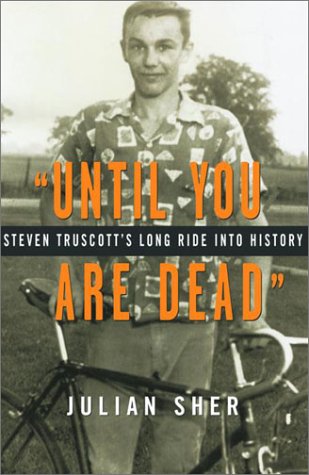
“Until You Are Dead” chronicles the loss of Canada’s innocence. Prior to June 11, 1959, Canadian parents could allow their children to play outdoors, unsupervised, in places children traditionally love: schoolyards, fields and nearby swimming holes. But on that hot summer day, when the body of a twelve-year-old girl turned up in a woody area near Clinton, Ontario, that innocence was shattered.
The girl’s name was Lynne Harper and she had been raped and murdered. The summer was barely over before a popular schoolboy named Steven Truscott, fourteen years old at the time, was tried, convicted and sentenced to hang. Truscott spent ten years in prison after the federal cabinet commuted his death sentence. He has always maintained his innocence.
His trial in 1959 was the most famous and controversial in Canadian history. As a producer at CBC TV’s the fifth estate, Julian Sher spent two years investigating the Steven Truscott story for an explosive documentary. When it aired in the spring of 2000, more than 1.4 million Canadians watched the program that sparked headlines across the country and questions in Parliament. Now, in this gripping and shocking account, Sher gives us the full story of that investigation, including new material not revealed on television. From the news that a young girl had gone missing in 1959 to the efforts four decades later by lawyers — those who assisted Guy Paul Morin and others — preparing an application to the federal justice minister for a verdict of wrongful conviction, this is a thorough and chilling examination of the case that rocked the country, and the man who continues to reside at its centre.
When Steven Truscott decided to come out of hiding and tell his story to the fifth estate, there were no deals, no commitments, no promises. If Sher and the fifth estate were to investigate one of Canada’s most controversial murder cases, they had to have unfettered access. Truscott readily agreed.
"Until You Are Dead” reveals witnesses not called upon to testify; other, more likely suspects, including a known pedophile, never questioned; and important leads that were kept from the defence, the judge and jurors. Boxes of police files and military records hidden or buried in government vaults reveal astonishing and disturbing information about an investigation and trial the authorities always claimed was above reproach. All told, the book uncovers a wealth of information that could have lead to a different verdict and a very different life for the young boy who was nearly executed over forty years ago.
"synopsis" may belong to another edition of this title.
About the Author
Julian Sher worked with the CBC’s flagship current affairs program the fifth estate for ten years, and was the producer of “His Word Against History,” the documentary about Steven Truscott that won the Canadian Association of Journalists’ Award for Best Investigative Story of the Year. That report was also part of a package of fifth estate exposés on the Canadian justice system that won the prestigious Michener Award for meritorious public service. He is now a freelance journalist, training reporters around the world to use the Internet as an investigative tool through his Web site, JournalismNet.com. His articles have appeared in The Globe and Mail, The Ottawa Citizen, La Presse and CNN.com. He is a past president of the Canadian Association of Journalists and the author of White Hoods: Canada’s Ku Klux Klan. He lives in Montreal.
From the Back Cover
“Read this book. You will be jarred by the reality of our justice system. This excellent, in-depth compilation of Steven Truscott’s very disturbing case keeps you absorbed and in disbelief: Where is the justice?” — Guy Paul Morin
"Sher writes with a finely measured sense of disbelief. How could this happen? he asks through every page. And we share his amazement, notwithstanding David Milgaard, Donald Marshall, Guy Paul Morin and Thomas Sophonow, all convicted until proven innocent ... Sher has written an important book. One that ought to serve as a warning to those who administer justice against arrogance. Nor should anyone be complacent on the issue, for every time a case is closed with the wrongly accused, a killer is left free to roam among us. " — The Montreal Gazette, October 20, 2001"The CBC television producer who earned Truscott's trust and helped make a national case of his continued claim of innocence, Montreal's Julian Sher, presents another compelling indictment of our justice system." — The Toronto Star, October 21, 2001
"There have been previous books on the trial of Steven Truscott, but 'Until You Are Dead' ... is the most comprehensive analysis to date." — The Globe and Mail
From the Inside Flap
?Talk to anyone you find, investigate wherever things lead you. I know I'm innocent and I?m not afraid of what you?ll turn up.? ? Steven Truscott to Julian Sher
?Until You Are Dead? chronicles the loss of Canada?s innocence. Prior to June 11, 1959, Canadian parents could allow their children to play outdoors, unsupervised, in places children traditionally love: schoolyards, fields and nearby swimming holes. But on that hot summer day, when the body of a twelve-year-old girl turned up in a woody area near Clinton, Ontario, that innocence was shattered.
The girl?s name was Lynne Harper and she had been raped and murdered. The summer was barely over before a popular schoolboy named Steven Truscott, fourteen years old at the time, was tried, convicted and sentenced to hang. Truscott spent ten years in prison after the federal cabinet commuted his death sentence. He has always maintained his innocence.
His trial in 1959 was the most famous and controversial in Canadian history. As a producer at CBC TV?s the fifth estate, Julian Sher spent two years investigating the Steven Truscott story for an explosive documentary. When it aired in the spring of 2000, more than 1.4 million Canadians watched the program that sparked headlines across the country and questions in Parliament. Now, in this gripping and shocking account, Sher gives us the full story of that investigation, including new material not revealed on television. From the news that a young girl had gone missing in 1959 to the efforts four decades later by lawyers ? those who assisted Guy Paul Morin and others ? preparing an application to the federal justice minister for a verdict of wrongful conviction, this is a thorough and chilling examination of the case that rocked the country, and the man who continues to reside at its centre.
When Steven Truscott decided to come out of hiding and tell his story to the fifth estate, there were no deals, no commitments, no promises. If Sher and the fifth estate were to investigate one of Canada?s most controversial murder cases, they had to have unfettered access. Truscott readily agreed.
"Until You Are Dead? reveals witnesses not called upon to testify; other, more likely suspects, including a known pedophile, never questioned; and important leads that were kept from the defence, the judge and jurors. Boxes of police files and military records hidden or buried in government vaults reveal astonishing and disturbing information about an investigation and trial the authorities always claimed was above reproach. All told, the book uncovers a wealth of information that could have lead to a different verdict and a very different life for the young boy who was nearly executed over forty years ago.
Excerpt. © Reprinted by permission. All rights reserved.
Chapter 8
Trapped
By Friday evening, a tumultuous week was coming to an end in Clinton. As much as they could, the children and adults in the PMQs around the air force station tried to follow life’s normal pursuits. Steve was looking forward to some fun and adventure over the weekend. Some fishing, some baseball, maybe another trip into the woods to work on the tree house. As the sun dipped in the horizon, Steve headed over to one of his favourite places around the base, Lawson’s farm — unaware that he was about to spend his last hour of liberty for the next ten years.
***
It looked like rain, Bob Lawson thought as he rushed to finish the evening chores — a godsend after the crop-scorching heat all week. Lawson was eager to get a little haying done. “If you start the lawn mower, I can cut the grass,” suggested his mother, Alice Lawson.
Bob was in the barn with the cows when he heard a loud, clanging racket. A fifteen-foot metal chain attached to the farm dog had somehow got tangled up in the mower and was slowly dragging the terrified mutt toward the sharp, spinning rotors. Lawson knew he was too far away to get to the mower in time. He caught sight of Steve rushing up the driveway to the farm. Fortunately, the mower stalled, and the chain stopped only a few feet before the dog would have had an unappetizing encounter with the rotors.
Laughing, the boy began to untangle the chain from the lawn mower. Still, the Lawsons felt that Steve was more reserved than usual. “Steve seems a little quiet this evening,” Alice Lawson told her son. Perhaps Lynne’s death had shaken the boy, Bob thought. The day before, Steve had dropped by the barn and appeared to be bewildered by events: “I heard they found Lynne in the bush,” Lawson remembers Steve telling him. “How did she get there?”
With the Lawsons’ dog safe from the marauding mower, Steve hopped on Lawson’s new Ferguson 35 tractor. “He loved being on that tractor,” Lawson recalls. “I would often let him ride on it. Steve was good with machines.” The lanky boy stood on the tractor’s floorboard, leaning against the fender, while the farmer rode across his land. When they got to the edge of the crops, Steve jumped off and perched himself on a large rock. For safety reasons, Lawson never let Steve stay on the tractor when he hooked it up to the harvester. As Lawson began haying, Steve rested on the rock, gazing out at the paths and trails where the children played hide-and-seek and picked berries. He saw the thick expanse of Lawson’s bush where only a few weeks earlier he and his friend Leslie had built a tree house.
“He was sitting on that stone, but next time, when I turned the tractor around and came back, he was gone,” Lawson recalls. “I guessed he had walked back to the barn.”
Bored, or perhaps anxious to get home for a bite to eat, Steve headed back down to the county road.
He never made it home.
***
At the Goderich OPP station, Inspector Harold Graham had made up his mind. Jocelyne’s story about a date and the phone call with the results from the laboratory analysis of Lynne’s stomach contents pointed the finger at the Truscott boy. “At ten minutes to seven, I had him picked up,” Graham said. He sent out Const. Donald Trumbley to bring in the boy — preferably without his parents’ knowledge. “I asked the constable to try and get him away from home.” The OPP cruiser pulled up to the gateway at the Lawson farm.
“Would you get into the car and come with me? We want you to read over your statement,” Trumbley explained, referring to Steve’s interview with Graham that morning.
“Yes,” said the teenager, without a moment’s hesitation. Looking back forty years later at that fateful moment, Steven explains that in 1959 young people had an abiding respect and trust in authority. “Back then when you’re fourteen years old, you looked up to the police. When they told you to get in the car, you got in the car,” he says. Steve never thought to question where Trumbley was taking him, much less to ask about his legal rights.
Trumbley pulled into the Goderich police post with his teenage passenger and took the boy into a small room at the back of the station. Steve had no reason to believe he was doing anything but signing a witness statement. The police did not tell him he was no longer simply a witness, that he had instead become their chief suspect. They did not tell him this trip to the station was, to all intents and purposes, an arrest. Certainly, they wanted his signature–but not just on a statement. What the OPP wanted from Steven was a confession and they were going to do everything they could to get one, even if that meant bending a few rules to the breaking point.
When Steven walked into that police station Friday, he was walking into what, in hindsight, can only be described as a trap, carefully planned and well executed by Harold Graham. Twenty minutes before dispatching Trumbley to pick up Steve, Graham had another officer, Sgt. Charles Anderson, obtain a search warrant for the Truscott home. Anderson then contacted Dr. David Hall Brooks, the chief medical officer on the base “and advised him of what we had planned to do.”
Graham had a very specific objective in mind — get Steven alone, without any interference from his parents. Years later, at a police convention, he boasted about his well-planned strategy: “I was well aware of the judge’s guidelines that it is preferable to have a parent or social worker present when you are questioning a juvenile,” he explained to his appreciative audience. “I was also well aware that it would be an exercise in futility, so I chose to disregard those guides.”
Graham’s was a bold admission of how far the police were willing to go to get their man, even if their man happened to be a fourteen-year-old boy. “Judges can always set their own guides for prisoners, they are not laws,” Graham said defiantly. And he was right. The Juvenile Delinquents Act in 1959 did not require the police to ensure a youth’s parent or guardian was present; today it is the law. Still, while Graham had not strictly violated any laws, he seemed to forget that the police had not told Steven he was a “prisoner” or even officially a suspect. At the boy’s murder trial three months later, the judge was unsparing in his criticism of the police’s tactics that night: “The ordinary safeguard should have been taken and he should have been warned. He was undoubtedly under arrest. It was clear he would never have been allowed to go.”
“Will you read this aloud,” the inspector told the boy as he handed him a typed statement based on Steve’s interview earlier that day. Steve read the text out loud and, according to Graham’s account, asked for only one minor change. He said his return to the school was not at 8:00 p.m., but closer to 7:50 or 7:55 p.m. “That was crossed out . . . and changed, and he said then it was correct, and I asked him to sign it and he did,” Graham said. Steven signed the statement at eight o’clock, ten minutes after their meeting began.
The inspector from the Criminal Investigations Bureau, a veteran of a decade’s worth of homicide cases, now had the boy exactly where he wanted him: alone in a room in a police station. Every police officer hopes they can crack a murder case with a confession, thereby saving the courts time and trouble. For the next hour and a half, Graham, assisted by Constable Trumbley, probed and prodded Steven.
Graham began by questioning his story of seeing a car at the highway. “I told him it was difficult to understand that because the distance was so great and I asked him if he was sure,” the inspector later recounted.
Yes, Steve said, he was sure.
Was he sure that he had seen Lynne with her thumb out at the highway?
Well, the boy said, he had not actually seen her thumb; he had seen her arm out.
Graham noticed a crescent-shaped scratch on Steven’s left arm. How did he injure himself, the police officer asked.
On a tractor in Lawson’s barn, came the reply.
Then Graham moved to the guts of the interrogation: “Have you ever taken a girl into Lawson’s bush?” he asked.
“No,” Steve said.
“Have you ever made a date to take a girl into Lawson’s bush?”
“No.”
“Have you ever spoken to Jocelyne Gaudet about going into Lawson’s bush?”
“No.”
“Were you at Jocelyne Gaudet’s house on Tuesday night?”
“No, I haven’t been to Jocelyne Gaudet’s home since last winter,” Steve answered, according to Graham’s account.
“Have you ever phoned Jocelyne Gaudet?”
“No, I have never telephoned Jocelyne Gaudet.” Steve said. “The only conversation I have had with her is in school.” It was a strange question. Had Jocelyne told the police about a phone call to arrange the alleged secret date? If so, the police apparently considered it an unreliable claim, for the police would never again mention a phone call to Jocelyne.
There is no official record of what went on for the duration of the ninety-minute interrogation. The two police officers were the only witnesses. Graham took only a single sheet of notes. Today, Steven Truscott remembers the first hours of his slow, steady slide into the abyss of incarceration: “They would take turns questioning me and calling me a liar,” he says of Graham and Trumbley. “One would come in and question you. He would leave the room. The other one would come in and he would say: ‘You lied....
"About this title" may belong to another edition of this title.
Search results for "Until You Are Dead": Steven Truscott's...

Stock Image
Until You Are Dead: Steven Truscott's Long Ride into History
Seller: World of Books (was SecondSale), Montgomery, IL, U.S.A.
Seller rating 5 out of 5 stars

Hardback. Condition: Good. Seller Inventory # 00104770978
Seller Image
"Until You Are Dead": Steven Truscott's Long Ride into History
Seller: Zoom Books East, Glendale Heights, IL, U.S.A.
Seller rating 5 out of 5 stars
Condition: acceptable. Book is in acceptable condition and shows signs of wear. Book may also include underlining highlighting. The book can also include "From the library of" labels. May not contain miscellaneous items toys, dvds, etc. . We offer 100% money back guarantee and 24 7 customer service. Seller Inventory # ZEV.0676973809.A
Seller Image
"Until You Are Dead": Steven Truscott's Long Ride into History
Seller: Zoom Books Company, Lynden, WA, U.S.A.
Seller rating 5 out of 5 stars
Condition: very_good. Book is in very good condition and may include minimal underlining highlighting. The book can also include "From the library of" labels. May not contain miscellaneous items toys, dvds, etc. . We offer 100% money back guarantee and 24 7 customer service. Seller Inventory # ZBV.0676973809.VG
Stock Image
Until You Are Dead: Steven Truscott's Long Ride into History
Seller: World of Books Inc, Montgomery, IL, U.S.A.
Seller rating 4 out of 5 stars

Hardback. Condition: Good. Seller Inventory # CIN0676973809G
Stock Image
Until You Are Dead: Steven Truscott's Long Ride into History
Seller: ThriftBooks-Dallas, Dallas, TX, U.S.A.
Seller rating 5 out of 5 stars
Hardcover. Condition: Good. No Jacket. Pages can have notes/highlighting. Spine may show signs of wear. ~ ThriftBooks: Read More, Spend Less. Seller Inventory # G0676973809I3N00
Stock Image
Until You Are Dead: Steven Truscott's Long Ride into History
Seller: ThriftBooks-Atlanta, AUSTELL, GA, U.S.A.
Seller rating 5 out of 5 stars
Hardcover. Condition: Very Good. No Jacket. May have limited writing in cover pages. Pages are unmarked. ~ ThriftBooks: Read More, Spend Less. Seller Inventory # G0676973809I4N00
Stock Image
Until You Are Dead: Steven Truscott's Long Ride into History
Seller: ThriftBooks-Atlanta, AUSTELL, GA, U.S.A.
Seller rating 5 out of 5 stars
Hardcover. Condition: Good. No Jacket. Pages can have notes/highlighting. Spine may show signs of wear. ~ ThriftBooks: Read More, Spend Less. Seller Inventory # G0676973809I3N00
Stock Image
Until You Are Dead: Steven Truscott's Long Ride into History
Seller: ThriftBooks-Atlanta, AUSTELL, GA, U.S.A.
Seller rating 5 out of 5 stars
Hardcover. Condition: Fair. No Jacket. Former library book; Readable copy. Pages may have considerable notes/highlighting. ~ ThriftBooks: Read More, Spend Less. Seller Inventory # G0676973809I5N10
Stock Image
"Until You Are Dead": Steven Truscott's Long Ride into History
Seller: SustainableBooks.com, Amherst, NY, U.S.A.
Seller rating 5 out of 5 stars
Condition: Good. Book is in Used-Good condition. Pages and cover are clean and intact. Used items may not include supplementary materials such as CDs or access codes. May show signs of minor shelf wear and contain limited notes and highlighting. Seller Inventory # 0676973809-2-4
Stock Image
"Until You Are Dead"; Steven Truscott's Long Ride into History
Seller: BISON BOOKS - ABAC/ILAB, Winnipeg, MB, Canada
Seller rating 5 out of 5 stars
Hardcover. Dust Jacket Condition: dj. pp. 580. 8vo. Black binding. Light shelfwear. Foxing to inside of dustjacket; very good+ in very good+ dustjacket. Seller Inventory # 086916
Buy Used
US$ 12.98
US$ 12.98 shipping
Ships from Canada to U.S.A.
Ships from Canada to U.S.A.
Quantity: 1 available