Synopsis
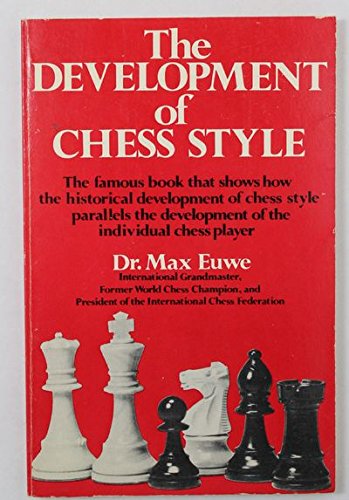
Max Euwe was the fifth official world champion, and met many of the other champions in chessboard battles. Here, he assesses the contributions of each to the way chess is played and approached.
John Nunn has brought the book fully up to date by discussing the contributions of Karpoc, Kasparov, and the new generation of professionals and the supercomputers.
A new edition of Euwe's classic and instructive trip though chess history
Updated and converted to algebraic by Juhn Nunn, who draws upon his firsthand experience of playing against Karpov and Kasparov
Provides and excellent way to develop an understanding of the concepts that underpin modern chess
Features some of the best chess games ever played
"synopsis" may belong to another edition of this title.
About the Author
Dr. Max Euwe was world chess champion from 1935 to 1937. He played all of the great players from Lasker to Fischer in tournaments and studied all of their games in great detail. He knew more about them and their games than anybody else. Max Euwe was born on May 20, 1901 in Amsterdam, Netherlands. Among the world Champions, Euwe was certainly the most active and prolific writer about the game. He was never a professional player. He had a real job. He was a math professor. After retirement he became a chess official. He was president of FIDE, the World Chess Federation, from 1970 to 1978. This was during the Cold War and Euwe had to make difficult decisions for the good of chess. It was absolutely, definitely because of Euwe that Bobby Fischer got to sit down at the board to play a match for the World Chess Championship. Fischer had been disqualified many times along the way, the first time being when he refused to play in the US Championship that was a necessary preliminary to the World Chess Championship competition. Max Euwe, himself a past world champion, acted as both referee and official at the famous Iceland matches in 1972. Max Euwe died on November 26, 1981 in his native Amsterdam at age 80.
Language Notes
Text: English, Dutch (translation)
"About this title" may belong to another edition of this title.
Other Popular Editions of the Same Title

Search results for The Development of Chess Style

Stock Image
The Development of Chess Style
Seller: Wonder Book, Frederick, MD, U.S.A.
Seller rating 5 out of 5 stars

Condition: Very Good. Very Good condition. A copy that may have a few cosmetic defects. May also contain light spine creasing or a few markings such as an owner's name, short gifter's inscription or light stamp. Seller Inventory # P07Q-00139
Stock Image
The Development of Chess Style
Seller: Stony Hill Books, Madison, WI, U.S.A.
Seller rating 5 out of 5 stars
Soft cover. Condition: Very Good. Trade softcover clean tight and unmarked with light overall handling wear. Seller Inventory # 022591
Seller Image
The Development of Chess Style The Famous Book That Shows How the Historical Development of Chess Style Parallels the Development of Te Individual Chess Player
Published by
David McKay, New York, NY, 1978
ISBN 10: 067914045X
ISBN 13: 9780679140450
Used
Paperback
First Edition
Seller: True Oak Books, Highland, NY, U.S.A.
Seller rating 5 out of 5 stars
Paperback. Condition: Very Good-. 152 pages; minor rubbing to the covers. Light fading to pages. Very Good condition otherwise. No other noteworthy defects. No markings. ; - We offer free returns for any reason and respond promptly to all inquiries. Your order will be packaged with care and ship on the same or next business day. Buy with confidence. First Paperback Edition; Fourth Printing. Seller Inventory # HVD-51533-A-0
Stock Image
The Development of Chess Style
Published by
U.S.A.: Three Rivers Press, 1978
ISBN 10: 067914045X
ISBN 13: 9780679140450
Used
Soft cover
First Edition
Seller: Bingo Books 2, Vancouver, WA, U.S.A.
Seller rating 5 out of 5 stars
Soft cover. Condition: Near Fine. 1st Edition. SOFT COVER IN NEAR FINE CONDITION. Seller Inventory # 303036
Stock Image
DEVELOPMENT OF CHESS STYLE: The Famous Book That Shows How the Historical Development of Chess Style Parallels the Development of the Individual Chess Player
Published by
David McKay Company, Inc., New York, 1978
ISBN 10: 067914045X
ISBN 13: 9780679140450
Used
Soft cover
Seller: Shoemaker Booksellers, Gettysburg, PA, U.S.A.
Seller rating 5 out of 5 stars
Soft cover. Condition: Very Good-. Dust Jacket Condition: No Dust Jacket. 152 pp. Original red wraps, lightly rubbed w/ mild edge wear. Contents very nice. Seller Inventory # 19127FUNC
Seller Image
The development of chess style [Veldheerschap op de vierenzestig. English]
Published by
New York : McKay, 1978, 1968, 1978
ISBN 10: 067914045X
ISBN 13: 9780679140450
Used
Soft cover
Seller: Joseph Valles - Books, Stockbridge, GA, U.S.A.
Seller rating 5 out of 5 stars
Soft cover. Condition: Poor. No Jacket. 152 pages : illustrations ; 20 cm ; ISBN: 067914045X; 9780679140450; National Library: B8090044 LCCN: 78-51942 ; LC: GV1318; GN395; Dewey: 794.1/2/09 ; OCLC: 3707620 ; photographic stiff paper wrappers ; "This is essentially a book on chess history, showing how different styles of chess play became popular and flourished and then faded in popularity, such as for example the Hyper-Modern Style of play that became "All the Rage" in the 1920s and 1930s. Former World Chess Champion Dr. Max Euwe traces the history of chess going through the games of the greatest players in history showing how the earliest recorded games show a wild attacking style. Later styles emphasized development, then pawn structure, then defensive play, then positional. Now primarily strategic planning is emphasized." ; waterstained at bottom fifth of book ; store stamp on front inside cover ; front endpaper corner-clipped ; a READING COPY only. Book. Seller Inventory # 007444