
Items related to The Nine Lives of Charlotte Taylor
Synopsis
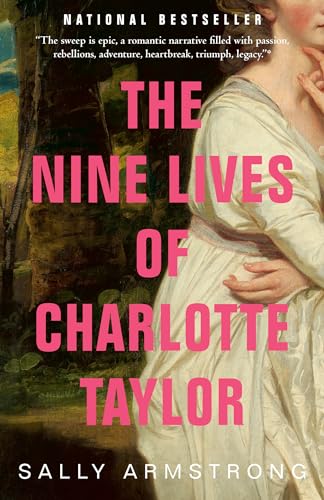
Charlotte Taylor lived in the front row of history. In 1775, at the young age of twenty, she fled her English country house and boarded a ship to Jamaica with her lover, the family’s black butler. Soon after reaching shore, Charlotte’s lover died of yellow fever, leaving her alone and pregnant in Jamaica. In the sixty-six years that followed, she would find refuge with the Mi’kmaq of what is present-day New Brunswick, have three husbands, nine more children and a lifelong relationship with an aboriginal man. Using a seamless blend of fact and fiction, Charlotte Taylor's great-great-great-granddaughter, Sally Armstrong, reclaims the life of a dauntless and unusual woman and delivers living history with all the drama and sweep of a novel.
Excerpt from from The Nine Lives of Charlotte Taylor:
“Every summer of my youth, we would travel from the family cottage at Youghall Beach to visit my mother’s extended clan in Tabusintac near the Miramichi River. And at every gathering, just as much as there would be chickens to chase and newly cut hay to leap in, so there would be an ample serving of stories about Charlotte Taylor. . .
She was a woman with a “past.” The potboilers about her ran like serials from summer to summer, at weddings and funerals and whenever the clan came together. She wasn’t exactly presented as a gentlewoman, although it was said that she came from an aristocratic family in England. Nor was there much that seemed genteel about the person they always referred to as “old Charlotte.” Words like “lover” and “land grabber” drifted down from the supper table to where we kids sat on the floor. There were whoops of laughter at her indiscretions, followed by sideways glances at us. But for all the stories passed around, it was clear the family still had a powerful respect for a woman long dead. We owed our very existence to her, and the anecdotes the older generation told suggested that their own fortitude and guile were family traits passed down from the ancestral matriarch. For as long as I can remember, I’ve tried to imagine the real life Charlotte Taylor lived and, more, how she ever survived.”
"synopsis" may belong to another edition of this title.
About the Author
SALLY ARMSTRONG has covered stories in zones of conflict all over the world as a journalist. From Bosnia and Somalia to Congo and Afghanistan, her eyewitness reports have earned her the Amnesty International Media Award four times over, as well as acclaim all over the world.
In addition to her journalism, Armstrong is the author of several books, including Veiled Threat: The Hidden Power of the Women of Afghanistan; The Nine Lives of Charlotte Taylor; Bitter Roots, Tender Shoots: The Uncertain Fate of Afghanistan’s Women; and her most recent title, Ascent of Women: A New Age is Dawning for Every Mother’s Daughter.
In 2017, Armstrong won, along with photographer/videographer Peter Bregg, her fourth Amnesty International Canada Media Award for their work in Iraq, as well as the Gold Award for Investigative Journalism at The Canadian Online Publishing Gala for their work about the Yazidis called Resisting Genocide.
In 2019, Armstrong delivered the renowned CBC Massey Lecture series, traveling across the country to discuss how improving the status of woman globally is crucial to our survival. The book version of her lectures, Power Shift: The Longest Revolution, is available now. In recognition of her work, Armstrong was promoted to Officer of the Order of Canada in 2019.
Armstrong is a former member of the International Women’s Commission at the UN, and is the recipient of ten honorary doctorate degrees. When not traveling to war zones, she lives part of each year in the quiet community of Bathurst, her childhood summer home, near the spot where Charlotte Taylor first set foot in New Brunswick.
Excerpt. © Reprinted by permission. All rights reserved.
Chapter 1
The Ocean
1775
It’s just an hour after dawn on the first Monday in May 1775 when the Anton lurches its bulk away from the docks at Bristol and sets sail for the West Indies. Charlotte Taylor is at the rail, rivetted to the huge square sails puffing out like bullies in the wind and bucking the ship into the open sea. A tall woman with flame-red hair tied in a knot at her neck, she keeps her eye to the bow as if setting her own course and her back to the land she has left behind. Standing beside her at the rail is Pad Willisams, her lover and co-conspirator in the hurried exit from Charlotte’s family, Pad’s job as butler in the Taylor household and a truth they each had only a part of.
A hastily packed trunk is stowed with the cargo. The calico sack she’d prepared for the voyage, and now realizes is pathetically inadequate since the trunk cannot be opened again until they reach shore six to eight weeks from now, is slung over her back.
A scrofulous man of indiscriminate age eyes her repeatedly from his place by the forward capstan. He’s one of the woebegone collection of humanity she’s travelling with–mostly men in their twenties and thirties and one young boy with freckles on his nose who seems to be in the employ of the haughty Captain Skinner. They all stare shamelessly at the white woman and the black man by her side. Pad has pulled together all the stiff dignity of the butler he had been just days earlier, but she can feel the anxiety that thrums through him. She is somewhat surprised to realize that she isn’t daunted by the stares, the days ahead or the consequences of leaving her family’s country home outside of London. Standing in the brisk wind on the deck of a sailing ship just a week after her twentieth birthday, Charlotte Taylor is unafraid–maybe even elated.
She’s still leaning on the portside, watching the water, letting the wind blow on her face when she allows herself to cast her thoughts to what she has run away from. The terrible row with her father when he learned she’d been “consorting,” as he called it, with Pad. The endless rounds of tea, the suffocating rules and her mother’s predictable attacks of the vapours whenever there was a hint of excitement in the household. She smiles in anticipation of the life ahead. A marriage to the dashing Pad, a home in the tropics. She’s grinning at the prospects when Pad interrupts her reverie to suggest they go below and secure their living quarters.
The quarters are cramped; the ceiling is so low they have to duck their heads. The bunks are arranged in two rows, one on each side of the dreary lower deck with damp curtains hanging between them to lend an illusion of privacy. There are hooks on which to hang their possessions and a lopsided stove in the centre. The only light and fresh air is from the hatch to the upper deck; the quarters smell of mildew and rotten wood. Indeed, the black streaks of rot crawling up the legs of the cots speak of the months at sea, the flourishing business of carrying human and other cargo across the ocean as many times as the weather will allow between May and October, never stopping long enough to refit or repair.
They pick a bunk at the end of the row and tie their sacks to the hooks before exploring the rest of the lower deck. There are stalls toward the stern filled with animals–two steers, four sheep, a ragged flock of chickens and three fat pigs. Charlotte looks at each and lingers on the soft, uncomprehending eyes of the steers that will become meals for the passengers and crew. Tucked under the bow in a wedge-shaped hold are the ship’s stores–burlap sacks of flour, sugar and grain, cases of biscuits, salt and limes. Charlotte and Pad walk back to midship, where a wide hatch is battened shut on the deck.
“What’s down there?” Charlotte asks a stocky sailor who is hurrying aft.
“Cargo, madam,” he says. “Plenty a’ cotton cloth and wool. That’s what makes ’em rich, madam, shippin’ the likes a’ that.”
My trunk is down there too, Charlotte thinks ruefully.
The young lad who’d caught her eye when they left the dock is friendly, puppyish and not too shy to tell her his name is Tommy Yates when she finds him exploring the lower deck.
“Me dad was the one who got me on board,” the boy confides gravely. “He brought me to the dock and hired me out to the captain. He told him I was sixteen, an’ I’m but thirteen.”
“Thirteen?” Charlotte looks at him closely. “Are you even that?”
“Oh yes, madam. Honest, I am.”
She had thought him no more than a scrawny eleven.
When he is not scrambling up the rigging at the captain’s orders or crawling through the hold below the sleeping quarters to fetch something the captain needs from the cargo, Tommy finds his way to Charlotte’s side. In the first week at sea, she heard about his fourteen brothers and sisters, the drink that made his father what he was and the mother who was so sickly she could hardly manage to stagger from her bed.
Charlotte shares her own story with him–putting a more varnished spin on her departure than is the case. She tells Tommy that she and Pad are married and that her father, General Taylor, doesn’t approve of the relationship so they decided to leave home for the West Indies and start a new life.
She entertains the winsome boy with details of the world she left behind, imitating her nanny’s priggish etiquette. “She insisted I sit like this all day long,” says Charlotte, perching herself on a bench and exaggerating the pose–her back ramrod straight, her legs bent at the knee and turned slightly sideways and her hands folded together in her lap. She makes him laugh when she describes her antics in the straitlaced household–refusing to marry the man her mother had chosen for her, looking contrite when her father admonished her, galloping around the estate on her horse and lingering at the stable with Pad. Tommy thinks it’s a blissful life she’s left, but even this boy can see the rebel in the woman he has befriended
"About this title" may belong to another edition of this title.
Search results for The Nine Lives of Charlotte Taylor

Stock Image
The Nine Lives of Charlotte Ta
Seller: World of Books (was SecondSale), Montgomery, IL, U.S.A.
Seller rating 5 out of 5 stars

Condition: Good. Item in good condition. Textbooks may not include supplemental items i.e. CDs, access codes etc. Seller Inventory # 00098522770
Stock Image
The Nine Lives of Charlotte Ta
Seller: World of Books (was SecondSale), Montgomery, IL, U.S.A.
Seller rating 5 out of 5 stars
Condition: Acceptable. Item in good condition. Textbooks may not include supplemental items i.e. CDs, access codes etc. Seller Inventory # 00067916723
Stock Image
The Nine Lives of Charlotte Ta
Seller: World of Books (was SecondSale), Montgomery, IL, U.S.A.
Seller rating 5 out of 5 stars
Condition: Very Good. Item in very good condition! Textbooks may not include supplemental items i.e. CDs, access codes etc. Seller Inventory # 00110789471
Seller Image
The Nine Lives of Charlotte Taylor
Seller: Zoom Books East, Glendale Heights, IL, U.S.A.
Seller rating 5 out of 5 stars
Condition: acceptable. Book is in acceptable condition and shows signs of wear. Book may also include underlining highlighting. The book can also include "From the library of" labels. May not contain miscellaneous items toys, dvds, etc. . We offer 100% money back guarantee and 24 7 customer service. Seller Inventory # ZEV.0679314059.A
Seller Image
The Nine Lives of Charlotte Taylor
Seller: Zoom Books East, Glendale Heights, IL, U.S.A.
Seller rating 5 out of 5 stars
Condition: good. Book is in good condition and may include underlining highlighting and minimal wear. The book can also include "From the library of" labels. May not contain miscellaneous items toys, dvds, etc. . We offer 100% money back guarantee and 24 7 customer service. Seller Inventory # ZEV.0679314059.G
Stock Image
The Nine Lives of Charlotte Taylor
Published by
Vintage Canada (edition Reprint), 2008
ISBN 10: 0679314059
ISBN 13: 9780679314059
Used
Paperback
Seller: BooksRun, Philadelphia, PA, U.S.A.
Seller rating 5 out of 5 stars
Paperback. Condition: Fair. Reprint. The item might be beaten up but readable. May contain markings or highlighting, as well as stains, bent corners, or any other major defect, but the text is not obscured in any way. Seller Inventory # 0679314059-7-1
Seller Image
The Nine Lives of Charlotte Taylor
Seller: ZBK Books, Carlstadt, NJ, U.S.A.
Seller rating 5 out of 5 stars
Condition: good. Fast & Free Shipping â" Good condition. It may show normal signs of use, such as light writing, highlighting, or library markings, but all pages are intact and the book is fully readable. A solid, complete copy that's ready to enjoy. Seller Inventory # ZWV.0679314059.G
Stock Image
The Nine Lives of Charlotte Taylor
Seller: World of Books Inc, Montgomery, IL, U.S.A.
Seller rating 4 out of 5 stars

Paperback. Condition: Fair. Charlotte Taylor lived in the front row of history. In 1775, at the young age of twenty, she fled her English country house and boarded a ship to Jamaica with her lover, the family's black butler. Soon after reaching shore, Charlotte's lover died of yellow fever, leaving her alone and pregnant in Jamaica. In the sixty-six years that followed, she would find refuge with the Mi'kmaq of what is present-day New Brunswick, have three husbands, nine more children and a lifelong relationship with an aboriginal man. Using a seamless blend of fact and fiction, Charlotte Taylor's great-great-great-granddaughter, Sally Armstrong, reclaims the life of a dauntless and unusual woman and delivers living history with all the drama and sweep of a novel. Excerpt from from The Nine Lives of Charlotte Taylor Every summer of my youth, we would travel from the family cottage at Youghall Beach to visit my mother's extended clan in Tabusintac near the Miramichi River. And at every gathering, just as much as there would be chickens to chase and newly cut hay to leap in, so there would be an ample serving of stories about Charlotte Taylor. . . She was a woman with a past. The potboilers about her ran like serials from summer to summer, at weddings and funerals and whenever the clan came together. She wasn't exactly presented as a gentlewoman, although it was said that she came from an aristocratic family in England. Nor was there much that seemed genteel about the person they always referred to as old Charlotte. Words like lover and land grabber drifted down from the supper table to where we kids sat on the floor. There were whoops of laughter at her indiscretions, followed by sideways glances at us. But for all the stories passed around, it was clear the family still had a powerful respect for a woman long dead. We owed our very existence to her, and the anecdotes the older generation told suggested that their own fortitude and guile were family traits passed down from the ancestral matriarch. For as long as I can remember, I've tried to imagine the real life Charlotte Taylor lived and, more, how she ever survived. Seller Inventory # CIN0679314059A
Stock Image
The Nine Lives of Charlotte Taylor
Seller: World of Books Inc, Montgomery, IL, U.S.A.
Seller rating 4 out of 5 stars
Paperback. Condition: Good. Charlotte Taylor lived in the front row of history. In 1775, at the young age of twenty, she fled her English country house and boarded a ship to Jamaica with her lover, the family's black butler. Soon after reaching shore, Charlotte's lover died of yellow fever, leaving her alone and pregnant in Jamaica. In the sixty-six years that followed, she would find refuge with the Mi'kmaq of what is present-day New Brunswick, have three husbands, nine more children and a lifelong relationship with an aboriginal man. Using a seamless blend of fact and fiction, Charlotte Taylor's great-great-great-granddaughter, Sally Armstrong, reclaims the life of a dauntless and unusual woman and delivers living history with all the drama and sweep of a novel. Excerpt from from The Nine Lives of Charlotte Taylor Every summer of my youth, we would travel from the family cottage at Youghall Beach to visit my mother's extended clan in Tabusintac near the Miramichi River. And at every gathering, just as much as there would be chickens to chase and newly cut hay to leap in, so there would be an ample serving of stories about Charlotte Taylor. . . She was a woman with a past. The potboilers about her ran like serials from summer to summer, at weddings and funerals and whenever the clan came together. She wasn't exactly presented as a gentlewoman, although it was said that she came from an aristocratic family in England. Nor was there much that seemed genteel about the person they always referred to as old Charlotte. Words like lover and land grabber drifted down from the supper table to where we kids sat on the floor. There were whoops of laughter at her indiscretions, followed by sideways glances at us. But for all the stories passed around, it was clear the family still had a powerful respect for a woman long dead. We owed our very existence to her, and the anecdotes the older generation told suggested that their own fortitude and guile were family traits passed down from the ancestral matriarch. For as long as I can remember, I've tried to imagine the real life Charlotte Taylor lived and, more, how she ever survived. Seller Inventory # CIN0679314059G
Stock Image
The Nine Lives of Charlotte Taylor
Seller: World of Books Inc, Montgomery, IL, U.S.A.
Seller rating 4 out of 5 stars
Paperback. Condition: Very Good. Charlotte Taylor lived in the front row of history. In 1775, at the young age of twenty, she fled her English country house and boarded a ship to Jamaica with her lover, the family's black butler. Soon after reaching shore, Charlotte's lover died of yellow fever, leaving her alone and pregnant in Jamaica. In the sixty-six years that followed, she would find refuge with the Mi'kmaq of what is present-day New Brunswick, have three husbands, nine more children and a lifelong relationship with an aboriginal man. Using a seamless blend of fact and fiction, Charlotte Taylor's great-great-great-granddaughter, Sally Armstrong, reclaims the life of a dauntless and unusual woman and delivers living history with all the drama and sweep of a novel. Excerpt from from The Nine Lives of Charlotte Taylor Every summer of my youth, we would travel from the family cottage at Youghall Beach to visit my mother's extended clan in Tabusintac near the Miramichi River. And at every gathering, just as much as there would be chickens to chase and newly cut hay to leap in, so there would be an ample serving of stories about Charlotte Taylor. . . She was a woman with a past. The potboilers about her ran like serials from summer to summer, at weddings and funerals and whenever the clan came together. She wasn't exactly presented as a gentlewoman, although it was said that she came from an aristocratic family in England. Nor was there much that seemed genteel about the person they always referred to as old Charlotte. Words like lover and land grabber drifted down from the supper table to where we kids sat on the floor. There were whoops of laughter at her indiscretions, followed by sideways glances at us. But for all the stories passed around, it was clear the family still had a powerful respect for a woman long dead. We owed our very existence to her, and the anecdotes the older generation told suggested that their own fortitude and guile were family traits passed down from the ancestral matriarch. For as long as I can remember, I've tried to imagine the real life Charlotte Taylor lived and, more, how she ever survived. Seller Inventory # CIN0679314059VG