
Items related to The First Man
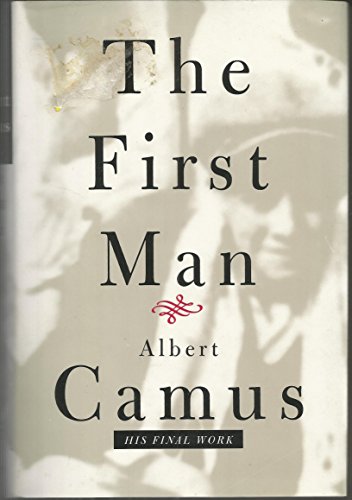
Synopsis
In The First Man Albert Camus tells the story of Jacques Cormery, a boy who lived a life much like his own. Camus summons up the sights, sounds, and textures of a childhood circumscribed by poverty and a father's death yet redeemed by the austere beauty of Algeria and the boy's attachment to his nearly deaf-mute mother. The result is a moving journey through the lost landscape of youth that also discloses the wellspring of Camus' aesthetic powers and moral vision.
"synopsis" may belong to another edition of this title.
About the Author
Born in Algeria in 1913, Albert Camus published The Stranger-- now one of the most widely read novels of this century-- in 1942. Celebrated in intellectual circles, Camus was awarded the Nobel Prize for Literature in 1957. On January 4, 1960, he was killed in a car accident.
From the Inside Flap
Man Albert Camus tells the story of Jacques Cormery, a boy who lived a life much like his own. Camus summons up the sights, sounds, and textures of a childhood circumscribed by poverty and a father's death yet redeemed by the austere beauty of Algeria and the boy's attachment to his nearly deaf-mute mother. The result is a moving journey through the lost landscape of youth that also discloses the wellspring of Camus' aesthetic powers and moral vision.
Reviews
YA?This autobiographical novel was found in the car wreckage that killed the author 34 years ago. Through it, today's teens are given a glimpse of Camus's Algerian childhood. In the story, the protagonist, Jacques Cormery, lives in a variety of concurrent worlds. His much-loved, deaf-mute mother and illiterate, tyrannical grandmother provide him with a secure, though poverty-stricken family life. The sea and countryside provide him with a rich, sensuous play life while the lycee challenges him intellectually. Jacques's thoughts and adventures are enriched by the vividly drawn settings?the oppressive gray heat of summer, the feel of the sea and sun, the vision of crowded bodies on the trolley. YAs will find the story accessible and may be surprised at the universality of emotions expressed. Readers seeking a quiet guide through the deepest reaches of another spirit will gain further understanding of the human condition.?Barbara Hawkins, Oakton High School, Fairfax, VA
Copyright 1996 Reed Business Information, Inc.
Among the wreckage of Camus's fatal car crash in 1960 was a 144-page handwritten manuscript, a first draft of a projected epic, the Nobel Prize winner's final novel. Suppressed by his family for decades in order to avoid criticism from the Left, the manuscript, transcribed by Camus' daughter, was finally published last year in France, where it became a bestseller. Now the narrative, carefully annotated, has reached our shores, allowing admirers of Camus and of fine literature in general to delve into its complex, strongly autobiographical pages. Jacques Cormery, 40, returns to his native Algeria to learn about his father, who died at the Battle of the Marne when Jacques was one. In Africa, Jacques relives his childhood growing up in a house dominated by a gentle and illiterate mother and an abusive and illiterate grandmother. His only father figures are a "half-mute" uncle and a grade-school teacher who manages to get the boy a scholarship to a private high school. Meanwhile, the simmering racial and political conflict between Arabs and Frenchmen provides a compelling subtext that threatens to come to the fore at any moment. The autobiographical nature of the material is betrayed by Camus's occasional use of real-life names for the characters; for instance, as when he calls Jacques's mother the "Widow Camus." The profuse footnotes can make the reading slow going, but the novel is a vital example of the writer's craft, its pages filled with alluring passages depicting an exotic world so removed it feels like part of another century. Camus, who customarily revised his fiction up to a half dozen times, no doubt would have changed much, and perhaps the final version would have stressed the bitter class animus already in evidence ("Remembrance of things past is just for the rich"). It's likely that no amount of reworking, however, would have disguised the novel's most compelling aspect: the warmth and humanity of its author's spirit. BOMC and QPB selections
Copyright 1995 Reed Business Information, Inc.
The circumstances surrounding the publication of this work, which first appeared in France in 1994, establish it as a genuine literary event: the manuscript was discovered in the wreckage of the car in which Camus was killed in 1960; it was not published at the time because the author's wife and close friends feared a negative reaction from the French Left. Although the text offers the only record of Camus' childhood, it is no simple autobiographical novel. In telling the story of his metaphorical search for his father, who died in World War I, Camus returns to the "land of oblivion where each one is the first man" and must find his own answers. The book also offers a defense of Camus' controversial position on the war that was then raging in Algeria; arguing for a federation of Arabs and Europeans in Algeria, Camus found himself at odds with other French intellectuals of the time, who were against the European presence. But Camus had grown up French in Algeria, a pied noir, poor, without roots, and knowing only the land his family and others like them had been forced to adopt. This novel is rough and incomplete; the editors have included explanatory comments and Camus' marginal notes, though these aren't necessary to experience the content. The distinctive rhythm of Camus' language is here, as is his deep understanding of life. Some ideas are not polished, but others are perfect gems: "Remembrance of things past is just for the rich. For the poor it only marks the faint traces along the path to death." Fortunately, the manuscript wasn't destroyed because it provides a beautiful testament to the human capacity to learn and to rejoice in life in spite of the circumstances of one's birth. Bonnie Smothers
When Camus died in an automobile accident in 1960, a manuscript was found near him. It turned out to be the first chapters of his autobiographical novel. At that time, when the French Nobel laureate had fallen from the good graces of many leftist intellectuals, his family decided against publishing the unfinished draft. When his daughter finally published it in 1994 with little editing, it was widely acclaimed by French critics and media. The book covers the first 14 years of the life of Jacques Cormery, a.k.a. Albert Camus. First there is a "search for the father," the undercurrent of a boy's quest to fill a tragic vacuum created by his father's death when he is only a year old. The poverty and difficult circumstances in which he grows up in French Algeria make him feel like an outsider, even when he becomes an adult. Yet the memories of the child are filled with energy and physical intensity. The spontaneity of the narrative by an otherwise reserved writer makes this book a unique document for anyone interested in Camus. Essential for academic libraries and recommended for large collections.
Ali Houissa, Cornell Univ., Ithaca, N.Y.
Copyright 1995 Reed Business Information, Inc.
Excerpt. © Reprinted by permission. All rights reserved.
Intercessor: Widow Camus
To you who will never be able to read this book
Above the wagon rolling along a stony road, big thick clouds were hurrying to the East through the dusk. Three days ago they had inflated over the Atlantic, had waited for a wind from the West, had set out, slowly at first then faster and faster, had flown over the phosphorescent autumn waters, straight to the continent, had unraveled on the Moroccan peaks, had gathered again in flocks on the high plateaus of Algeria, and now, at the approaches to the Tunisian frontier, were trying to reach the Tyrrhenian Sea to lose themselves in it. After a journey of thousands of kilometers over what seemed to be an immense island, shielded by the moving waters to the North and to the South by the congealed waves of the sands, passing scarcely any faster above this nameless country than had empires and peoples over the millennia, their momentum was wearing out and some already were melting into occasional large raindrops that were beginning to plop on the canvas hood above the four travelers.
The wagon was creaking over a route that was fairly well marked but had scarcely any surfacing. From time to time a spark would flash under a metal wheel rim or a horse's hoof, and a stone would strike the wood of the wagon or else would sink with a muted sound into the soft soil of the ditch. Meanwhile the two small horses moved steadily ahead, occasionally flinching a bit, their chests thrust forward to pull the heavy wagon, loaded with furniture, continuously putting the road behind them as they trotted along at different paces. One of them would now and then blow the air noisily from its nostrils, and would be thrown off its pace. Then the Arab who was driving would snap the worn reins flat on its back, and the beast would gamely pick up its rhythm.
The man who was on the front seat by the driver, a Frenchman about thirty, gazed with an impenetrable look at the two rumps moving rhythmically in front of him. He was of medium height, stocky, with a long face, a high square forehead, a strong jaw, and blue eyes. Though the season was well along, he wore a three-button duckcloth jacket, fastened at the neck in the style of that time, and a light pith helmet over his close-cut hair. When the rain began streaming across the canvas above them, he turned toward the inside of the vehicle: "Are you all right?" he shouted.
On a second seat, wedged between the first seat and a heap of old trunks and furniture, sat a woman who, though shabbily dressed, was wrapped in a coarse woolen shawl. She smiled feebly at him. "Yes, yes," she said, with a little gesture of apology. A small four-year-old boy slept leaning against her. She had a gentle look and regular features, a warm gaze in her brown eyes, a small straight nose, and the black wavy hair of a Spanish woman. But there was something striking about that face. Not only would fatigue or something similar momentarily mask its features; no, it was more like a faraway look, a look of sweet distraction, such as you always see on some simpletons, but which would burst out only fleetingly on the beauty of this face. The kindness of that gaze, which was so noticeable, would sometimes be joined by a gleam of unreasoning fear that would as instantly vanish. With the flat of her hand, already worn with work and somewhat gnarled at the joints, she tapped her husband's back: "It's all right, it's all right," she said. And immediately she stopped smiling to watch, from under the canvas top, the road where puddles were already beginning to shine.
The man turned to the Arab, placid in his turban with its yellow cords, his body made stouter by baggy pants with a roomy seat gathered above the calf. "Do we have much farther to go?"
The Arab smiled under his big white moustache. "Eight kilometers and you're there."
The man turned to look at his wife, not smiling yet attentive. She had kept her eyes on the road. "Give me the reins," the man said.
"As you wish,"said the Arab. He handed him the reins, and the man stepped across while the old Arab slipped under him to the place just vacated. With two slaps of the flat of the reins the man took over the horses, who picked up their trot and suddenly were pulling straighter. "You know horses," the Arab said.
The husband's reply was curt and unsmiling. "Yes," he said.
The light had dimmed and all at once night settled in. The Arab took the square lantern from its catch at his left and, turning toward the back, used several crude matches to light the candle inside it. Then he replaced the lantern. Now the rain was falling gently and steadily. It shone in the weak light of the lamp, and, all around, it peopled the utter darkness with its soft sound. Now and then the wagon skirted spiny bushes; small trees were faintly lit for a few seconds. But the rest of the time it rolled through an empty space made still more vast by the dark of night. The smell of burned grass, or, suddenly, the strong odor of manure, was all that suggested they were passing by land under cultivation. The wife spoke behind the driver, who held his horses in a bit and leaned back. "There are no people here," the wife said again.
"Are you afraid?"
"What?"
The husband repeated the question, but this time he was shouting.
"No, no, not with you." But she seemed worried.
"You're in pain," the man said.
"A little."
He urged his horses on, and once more all that filled the night were the heavy sounds of the wheels crushing ridges in the road and the eight shod hooves striking its surface.
It was a night in the fall of 1913. Two hours earlier the voyagers had left the railroad station in B?ne where they had arrived from Algiers after a journey of a night and a day on hard third-class benches. In the station they had found the wagon and the Arab waiting to take them to the farm located near a small village, about twenty kilometers into the interior of the country, where the husband was to take over the management. It had taken time to load the trunks and their few belongings, and then the bad road had delayed them still further. The Arab, as if aware of his companion's disquiet, said to him: "Have no fear. Here there are no bandits."
"They're everywhere," the man said. "But I have the necessary." And he slapped his tight pocket.
"You're right," said the Arab. "There's always madmen."
At that moment, the woman called her husband. "Henri," she said. "It hurts."
The man swore and pushed his horses a bit more. "We're getting there," he said. After a moment, he looked at his wife again. "Does it still hurt?"
She smiled at him with a strangely absent air, yet she did not seem to be suffering."Yes, a lot."
He continued to gaze gravely at her.
Again she apologized. "It's nothing. Maybe it's the train."
"Look," the Arab said, "the village." Indeed they could see, to the left of the road and a little farther on, the lights of Solf?rino blurred by the rain. "But you take the road to the right,"said the Arab.
The man hesitated, then turned to his wife. "Should we go to the house or the village?" he asked.
"Oh, to the house, that's better."
A bit farther, the vehicle turned to the right toward the unfamiliar house that awaited them. "Another kilometer," said the Arab.
"We're getting there," the man said, in the direction of his wife. She was bent over double, her face in her arms. "Lucie," the man said. She did not move. The man touched her with his hand. She was weeping silently. He shouted, stressing each syllable and acting out his words: "You are going to lie down there! I will go get the doctor!"
"Yes. Go get the doctor. I think this is it."
The Arab was watching them with surprise. "She's going to have a baby," the husband said. "Is there a doctor in the village?"
"Yes. I'll get him if you wish."
"No, you stay at the house. You keep watch. I'll go faster. Is there a small cart or a horse?"
"There's a cart."Then the Arab said to the wife, "You will have a boy. Let him be a fine one." The wife smiled at him without seeming to understand.
"She doesn't hear," the man said. "At the house, you'll have to shout out loud and make signs." Suddenly the wagon was rolling almost without sound over the chalky subsurface of tuff. The road was narrower now. It passed alongside some tiled sheds behind which could be seen the first rows of the vineyard. They were met by a strong smell of fermenting grapes. They passed some large buildings with high-pitched roofs, and the wheels flattened the slag of a yard where there were no trees. The Arab took the reins without speaking and pulled them in. The horses stopped, and one of them snorted. With his hand the Arab indicated a small whitewashed house. A creeping vine ran around a low door with a frame stained blue by copper sulfate. The man jumped to the ground and ran through the rain to the house. He opened the door. It led to a dark room which smelled of an empty hearth. The Arab, who was following him, walked straight through the dark to the fireplace, and, scraping an ember, lit a kerosene lamp that hung in the middle of the room over a round table. The man barely took time to notice that he was in a whitewashed kitchen with a sink of red ceramic tile, an old sideboard, and a sodden calendar on the wall. Stairs finished with the same red tiles led to the second floor. "Light the fire," he said, and he returned to the wagon. (He took the little boy?) The woman was waiting in silence. He took her in his arms to set her on the ground and, holding her close ...
"About this title" may belong to another edition of this title.
Search results for The First Man

Stock Image
The First Man
Seller: New Legacy Books, Annandale, NJ, U.S.A.
Seller rating 5 out of 5 stars

hardcover. Condition: Good. The pages show normal wear. Fast shipping and order satisfaction guaranteed. A portion of your purchase benefits Non-Profit Organizations, First Aid and Fire Stations! Seller Inventory # mon0000186797
Seller Image
The First Man
Seller: Greenworld Books, Arlington, TX, U.S.A.
Seller rating 5 out of 5 stars
Condition: good. Fast Free Shipping â" Good condition. It may show normal signs of use, such as light writing, highlighting, or library markings, but all pages are intact and the book is fully readable. A solid, complete copy that's ready to enjoy. Seller Inventory # GWV.0679439374.G
Seller Image
The First Man
Seller: ZBK Books, Carlstadt, NJ, U.S.A.
Seller rating 5 out of 5 stars
Condition: good. Fast & Free Shipping â" Good condition. It may show normal signs of use, such as light writing, highlighting, or library markings, but all pages are intact and the book is fully readable. A solid, complete copy that's ready to enjoy. Seller Inventory # ZWV.0679439374.G
Seller Image
The First Man
Seller: Greenworld Books, Arlington, TX, U.S.A.
Seller rating 5 out of 5 stars
Condition: like_new. Fast Free Shipping â" Excellent condition book with clean cover and pages. Barely handled, with minimal wear. An outstanding copy, close to enjoy! Seller Inventory # GWV.0679439374.LN
Stock Image
The First Man
Seller: ThriftBooks-Atlanta, AUSTELL, GA, U.S.A.
Seller rating 5 out of 5 stars
Hardcover. Condition: Very Good. No Jacket. Former library book; May have limited writing in cover pages. Pages are unmarked. ~ ThriftBooks: Read More, Spend Less. Seller Inventory # G0679439374I4N10
Stock Image
The First Man
Seller: ThriftBooks-Dallas, Dallas, TX, U.S.A.
Seller rating 5 out of 5 stars
Hardcover. Condition: Good. No Jacket. Pages can have notes/highlighting. Spine may show signs of wear. ~ ThriftBooks: Read More, Spend Less. Seller Inventory # G0679439374I3N00
Stock Image
The First Man
Seller: ThriftBooks-Reno, Reno, NV, U.S.A.
Seller rating 5 out of 5 stars
Hardcover. Condition: Good. No Jacket. Former library book; Pages can have notes/highlighting. Spine may show signs of wear. ~ ThriftBooks: Read More, Spend Less. Seller Inventory # G0679439374I3N10
Stock Image
The First Man
Seller: ThriftBooks-Atlanta, AUSTELL, GA, U.S.A.
Seller rating 5 out of 5 stars
Hardcover. Condition: Fair. No Jacket. Missing dust jacket; Readable copy. Pages may have considerable notes/highlighting. ~ ThriftBooks: Read More, Spend Less. Seller Inventory # G0679439374I5N01
Stock Image
The First Man
Seller: ThriftBooks-Phoenix, Phoenix, AZ, U.S.A.
Seller rating 5 out of 5 stars
Hardcover. Condition: Fair. No Jacket. Readable copy. Pages may have considerable notes/highlighting. ~ ThriftBooks: Read More, Spend Less. Seller Inventory # G0679439374I5N00
Stock Image
The First Man
Seller: ThriftBooks-Reno, Reno, NV, U.S.A.
Seller rating 5 out of 5 stars
Hardcover. Condition: Fair. No Jacket. Former library book; Readable copy. Pages may have considerable notes/highlighting. ~ ThriftBooks: Read More, Spend Less. Seller Inventory # G0679439374I5N10