"Baseball is not a Summer snap, but a business....
A player is not a sporting man. He is hired to do certain work and do it as well as he possibly can."
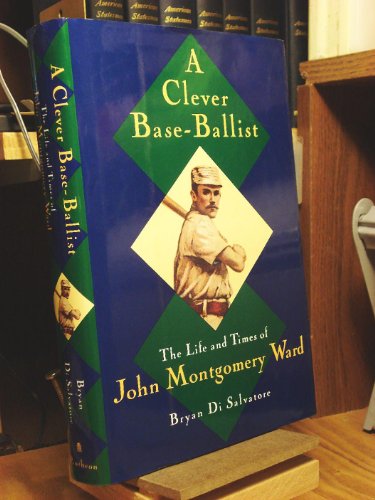
John Montgomery Ward, nineteenth-century America's most-talked-about (both reviled and applauded) baseball player, spoke these words shortly after the failure of the great player rebellion of 1890, a revolution Ward almost singlehandedly fomented. That year, four out of every five National Leaguers, taking great economic risk, deserted professional baseball's establishment to create an "outlaw" rival organization: The Players' League. Team owners, the players felt, treated them like chattel: they "dished saltpeter in their sidemeat and gave them shameful financial
beatings if they misbehaved," writes Bryan
Di Salvatore in this fascinating, rigorous, and brisk biography.
A Clever Base-Ballist is also a keenly observant narrative of late nineteenth-century America. In it can be found the likes of Mark Twain, Hawaii's King Kalakuau, and Moses Fleetwood Walker, the major league's first black player. It travels from the groaning boards of Delmonico's restaurant to the boisterous pages of the 1880s entertainment press to the Egyptian desert, where the target of one thrown baseball was the Sphinx's right eye.
Handsome, erudite, and brilliantly talented, Ward made front-page headlines across the country when he married New York actress Helen Dauvray. And when they weren't branding him a terrorist, owners trumpeted the college-educated Ward as the sport's premier role model. An unblinking antidote to "good-old-days" syndrome, A Clever Base-Ballist is an accessible, compelling, and unconventional biography of an unconventional and, until now, obscure American.
"synopsis" may belong to another edition of this title.
Bryan Di Salvatore's work has appeared in The New Yorker, The New York Times Magazine, and Outside, among other publications. He lives in Missoula, Montana.
"This
is a grand book
--vehement, scholarly,
funny, exuberant, and artfully
evocative of the man and his time. Bryan
Di Salvatore is one of the finest writers
of nonfiction in America."
--Ian Frazier
ll is not a Summer snap, but a business....<br>A player is not a sporting man. He is hired to do certain work and do it as well as he possibly can."<br><br>John Montgomery Ward, nineteenth-century America's most-talked-about (both reviled and applauded) baseball player, spoke these words shortly after the failure of the great player rebellion of 1890, a revolution Ward almost singlehandedly fomented. That year, four out of every five National Leaguers, taking great economic risk, deserted professional baseball's establishment to create an "outlaw" rival organization: The Players' League. Team owners, the players felt, treated them like chattel: they "dished saltpeter in their sidemeat and gave them shameful financial <br>beatings if they misbehaved," writes Bryan <br>Di Salvatore in this fascinating, rigorous, and brisk biography.<br>A Clever Base-Ballist is also a keenly observant narrative of late nineteenth-century America.
Providing yet more support to the theory that one should take a close look at baseball in order to understand America, Di Salvatore paints a lively portrait of 19th-century America by focusing on the life of Ward (1860-1925). Ward began his career as a professional baseball player in the late 1870s, just as the sport transformed from a popular amateur club game into a competitive business. In that transformation are rooted many of the issues that confront baseball today, and Di Salvatore follows baseball's evolution masterfully, with Ward the touchstone for the era. Ward himself evolved from small-town hopeful to gentleman star, from seasoned captain to mastermind of the first players' union. Along the way, he pitched the first perfect game ever recorded (though no one called it that yet); married a famous actress, Helen Dauvray (the marriage ended in a publicized divorce); and saved the art of the slide (the retired star argued against allowing players to run through every base, not just first). Di Salvatore avoids romantic nostalgia, relying instead on a narrative structure that breathes life into abstract topics such as owner-player relations, the changing rules of the game and the origin of the dreaded reserve clause, which drove Ward and the Brotherhood of Professional Base Ball Players to start their own league in 1890 (it lasted a year). Offering entertaining anecdotes and intelligent analysis, Di Salvatore, who has written for the New Yorker, Outside and other publications, tells a good story rife with captivating social history that reveals how different the gameAand yet how similar the worldAwas long ago. (Aug.)
Copyright 1999 Reed Business Information, Inc.
The life of one of the pivotal pioneers of Major League baseball provides an examination into the complicated evolution of the sport as industry. Di Salvatore, who has written for numerous magazines, focuses on John Montgomery Ward, a rookie in 1878 who would play for 17years (as pitcher, position player, and also player-manager for Brooklyn and New York), and later become, for a year, president of a franchise. However, more than Hall of Fame statistics, Ward's significance can be read in the understated last line on his plaque in Cooperstown: ``Played important part in establishing modern baseball.'' Ward played when baseball was changing constantly, both on the field (the number of balls required for a walk fluctuated until 1889, and in 1887 a strikeout required four strikes) and off. At a time when owners had absolute control (they could withhold pay for any reason, fire players at will, and force them to pay the medical costs for injuries suffered), the intelligent Ward was a key battler for players' rights, opposing, among other things, the reserve clause and salary cap. While playing, Ward also worked both behind the scenes and openly for his beliefs, as lawyer, writer (of articles and a popular book), and celebrity (he was married for a time to an actress). He became a leader of the Brotherhood, a players organization, and helped form a briefly successful new leaguethe Players' League. The book, a detailed look into financial and legal nuts-and-bolts rather than a feel-the-magic narrative, gives a picture of Ward as more businessman/lawyer than as noble hero, but it leaves no doubt of his role in baseball's adolescent years. Chockful of turn-of-the-century baseball information, and gives insight to the sport's development into its modern-day business configuration. (16 pages b&w photos, not seen) -- Copyright ©1999, Kirkus Associates, LP. All rights reserved.
Nineteenth-century baseball player John Montgomery Ward's ticket to the Hall of Fame was his versatility, not his brilliance in one given area. He posted a 164-102 pitching record and threw a perfect game but went only 56-46 after his first three seasons; he had a .275 lifetime batting average and was an adept infielder but never led the league in a single offensive or defensive category except stolen bases. Ward masterminded the players' revolt against the owners that led to the formation of the Players' League in 1890, though it lasted only one season; he was 412-320 as a manager but never had a first-place team. Fans doting on accounts of derring-do on the field will be disappointed by this book, as it focuses on action off the field, but it is a useful primer on baseball labor relations for those who think that strikes and tooth-and-claw contract battles are strictly phenomena of our times. Recommended for larger sports collections.AJim Burns, Ottumwa, P.L., IA
Copyright 1999 Reed Business Information, Inc.
John Montgomery ward was handsome, slender, slim-hipped--five feet eight inches tall, in cleats. As an eighteen-year-old rookie pitcher for the 1878 Providence Grays of the National League of Professional Base Ball Clubs, he weighed 140 pounds. Over the course of his
seventeen-year major league career, he filled out some, gaining fifteen or twenty pounds.
Baseball players during the nineteenth century--the sport's gawky, vituperative adolescence--came, as they do now, in all sizes. Ward was smaller than the likes of Boileryard Clarke, Jumbo McGinnis, Big Dan Brouthers, Silver Flint, Big Dave Orr, Cupid Childs, Chief Zimmer, Fatty Briody, Adonis Terry, Podge Weihe, Chicken Wolf, Pud Galvin, Candy LaChance, Hick Carpenter, and Eagle Eye Beckley. In turn, Ward dwarfed a few players himself: Dummy Hoy, for one, Doggie Miller for another, as well as Shorty Radford, Wee Willie Keeler, Trick McSorley, and Buttercup Dickerson.
But when all is said and done, Ward--give or take an inch here and a few pounds there--was about the same size as many of his fellow base-ballists, including Ubbo Ubbo Hornung, Lip Pike, Ice Box Chamberlain, Lady Baldwin, Germany Long, Oyster Burns, The Only Nolan, Monkey Hotaling, Bid McPhee, Bug Holliday, Crab Burkett, Dupee Shaw, Tido Daly, Nig Cuppy, Hunkey Hines, Dude Esterbrook, Dirty Jack Doyle, Blondie Purcell, Count Campau, Yank Robinson, Patsy Tebeau, Cannonball Morris, and Bald Billy Barnie.
His shoulders sloped dramatically. He was fair-skinned and high-cheeked, his face at once stalwart and delicate. He had a broad nose--in some photos it looks as if it had been broken, though there is no record of such an injury. His ears, large as playing cards, jutted boldly. His eyes were blue--pale, by some accounts. By the time of his death, in 1925, when he was sixty-five years old--gentleman farmer, successful lawyer, and first-rank golfer--he had a weathered, scoured look. All those afternoons in the summer sun.
His hair was light--the color of sand--and sometimes his eyebrows disappear in photographs. As a boy his hair was long. As a grown-up, he wore it neither long nor short. Sometimes he parted it on the left, sometimes on the right. In one photo, taken when he was fifty years old, he parts it more or less in the middle. He never lost his hair: it was thick and straight in his youth; later, when he was famous and rich, it looked as if it wanted to swoop and bank modestly, but had been brilliantined into submission.
There's an early photograph of Ward, taken in his home town of Bellefonte, Pennsylvania. He is perhaps nine years old, eleven at most, with a lingering of baby fat. He wears a heavy dress jacket with comically wide lapels. Those ears have outpaced the rest of him, as a puppy's paws do the puppy. His eyebrows are thick, bold as diacritics. He is not smiling--there exists no known likeness of him smiling--but Ward's visage here is a different thing from unsmiling. His small thin mouth, curving downward, suggests some pure and deep-seated misery.
How much should we read into this? If in fact he was eleven, and the year 1871, and the photo taken after May 1--the day his father died--his lost-boy look passes without comment. But let's assume he was ten. If it was spring or summer or fall, he would rather have been outside playing baseball--a sandlot boy with cheeks of tan--than sitting in J. W. Moore's studio. If it was winter, he would rather it were spring, summer, or fall, so he could be out playing ball. And how he loved to do so! He tells us so himself, in his 1888 book, "Base-Ball: How to Become a Player":
"Base-ball cannot be learned as a trade. It begins with the sport of the schoolboy, and though it may end in the professional, I am sure there is not a single one of these who learned the game with the expectation of making it a business. There have been years in the life of each during which he must have ate and drank and dreamed base-ball. It is not a calculation but an inspiration."
In another Bellefonte studio portrait, Ward is sitting next to his friend, neighbor, college chum, and teammate, Ellis L. Orvis. Orvis would become a locally prominent judge and town bastion. Even at the time of the photograph--it is 1875 or thereabouts and Ward is fifteen years old, Orvis about eighteen--Orvis looks poised, judicial. He is dressed in a handsome, well-fitting dark suit. One hand rests on his leg, the other against his vest. He looks as if he has sat for many portraits and knows he will sit for many more.
Not John Ward. He looks like every teenager who has been roped into yet another episode of damn foolishness by a doting parent. Sit up straight, Monte! See how Ellis does it?
Ward's light-colored jacket has those familiar immense lapels. The jacket fits him like a question: Whose was it originally? It drapes around his shoulders as if he were an amputee; it rides over his wrists as if he were trying to keep his hands warm. Like Orvis's, Ward's legs are crossed, but his hands, instead of resting on his thighs, grip them like talons. Ward's head is enormous, so disproportionate to the rest of his reedy self that we can't but wonder if the boy suffered from a terrible malady. He did not.
A team photo, the first of many, shows the Pennsylvania State College nine--"Champions of Center County"--in 1875. There's Frank Keller, who, like Ellis Orvis next to him, became a judge. There are the Calder boys, Charles and A. Russell, sons of the college president--Charles died in 1880, A. Russell became a metallurgist. There's Frank Knoche, whose father owned a music store in Harrisburg, which Frank inherited. Joseph Stull--he's the one whose long skeletal face reminds us of a tubercular poet--became an attorney in Salt Lake City.
Five of the State College boys are holding bats, cradled like rifles. The team has scraped together money for uniforms: caps, shirts, what we would all recognize as baseball pants, the sort that end just below the knee, and striped hose. They also wear ties--knotted like cowboy bandannas. Ward wears his differently--it trails down his chest like a modern-day necktie.
That's Ward, on the far left. One large ear is visible--if Ward had been born one hundred years later his schoolyard name would have been "Dumbo." He's holding a bat near the knob and leaning back slightly, against Frank Keller's bat, and he has his arm over Frank Knoche's shoulder. Again, how disturbingly sad Ward looks. Of course no one looked exactly lighthearted in photographs back then. Having one's picture taken was a rare, prolonged, and solemn business in 1875, and people approached a portrait session as we might the altar rail or a radiology lab.
But this stillness, this melancholy of young John Ward is of a different order entirely. He looks beaten, limp, distracted, bowed. His mouth is in collapse. Maybe the boys had just lost a game, or John had gone hitless at the plate and played like a muffin in the field. No, he looks more crestfallen than that. The photograph was taken less than a year after his mother's death from pneumonia. In all likelihood, the camera happened to catch him midstride down a dark alley of memory. Whatever the cause, if we were to pick from this long-ago pack of local heroes the one most likely to kill himself, we would guess Ward, and guess wrong.
Look at how tiny he is--bantamlike. How like a cathedral choirboy. Ward is the one whose voice hasn't broken; the one who has yet to shave. In baseball, size is, often as not, incidental to talent and effectiveness--and Ward was brilliantly talented and effective. What Ward did, in the parlance of sport, was put up numbers--numbers we will get to shortly. But there was much more to Ward the ballplayer than statistics.
Baseball of yore was a quicker, more dashing, arguably more deft game than baseball now. The ball was more crudely manufactured, became softer sooner, and remained in play longer--home runs were rare. The infields were lumpy, the outfields spacious and topographical. Runners tended to advance no more than one base or two at a time. Speed was important. Bunts were important. Base-stealing was important. Fielding prowess was more important than life itself. Players, for years, played gloveless. By the late 1880s many had donned what we would describe as fingerless golf gloves. (Fielding errors were common as spit and despite the lack of home runs, scores were quite often very high.)
Ward was the sort of player that other players appreciate as a teammate and curse as an opponent. Whether he was pitching or playing the infield or outfield, he was a hustler, a scrapper, a playmaker, a gamer, a thinker, an analyzer. He beat you invisibly as often as he beat you visibly. In "Base-Ball: How to Become a Player" he expounds on the importance of the sport's vital edges: pickoffs, relay throws, brushback pitches, drawing the infield in or moving it out, hit-and-run plays, signals--all commonplace today, but in 1888 only aborning. There were, statistically, better fielders than Ward, but the man who ranges wide--as Ward did--and gets his hands on more balls than average--as Ward did--often ends up committing more errors than a stay-at-home Joe. Ward, in the field, was the guy who always seemed to be in the right place at the right time. He was the one who held a possible double down to a single by deflecting the ball as it left the infield; the one who placed himself far enough out on the outfield grass or close enough to home plate to relay the throw to home quick as a ricochet. He was the one who directed his teammates to move right, left, in, out--playing the percentages, thinking, thinking, thinking.
Offensively, he drove teams to drink. Clean hits were fine, but in those error-thick days, making contact was often as effective. Say it's the bottom of the ninth and Ward's team, down by a run, has its last at-bats. The opposing pitcher is tired. He gets one out. Ward steps into the box. The pitcher tenses; knows Ward's reputation for damage; knows he has to retire him. Ward watches the pi...
"About this title" may belong to another edition of this title.
Seller: Gulf Coast Books, Cypress, TX, U.S.A.
hardcover. Condition: Good. Seller Inventory # 0679442340-3-35249616
Seller: Your Online Bookstore, Houston, TX, U.S.A.
hardcover. Condition: Good. Seller Inventory # 0679442340-3-34744615
Seller: World of Books (was SecondSale), Montgomery, IL, U.S.A.
Condition: Acceptable. Item in acceptable condition! Textbooks may not include supplemental items i.e. CDs, access codes etc. Seller Inventory # 00094940774
Seller: World of Books (was SecondSale), Montgomery, IL, U.S.A.
Condition: Very Good. Item in very good condition! Textbooks may not include supplemental items i.e. CDs, access codes etc. Seller Inventory # 00095692502
Seller: ThriftBooks-Dallas, Dallas, TX, U.S.A.
Hardcover. Condition: As New. No Jacket. Pages are clean and are not marred by notes or folds of any kind. ~ ThriftBooks: Read More, Spend Less. Seller Inventory # G0679442340I2N00
Seller: ThriftBooks-Dallas, Dallas, TX, U.S.A.
Hardcover. Condition: Very Good. No Jacket. May have limited writing in cover pages. Pages are unmarked. ~ ThriftBooks: Read More, Spend Less. Seller Inventory # G0679442340I4N00
Seller: Wonder Book, Frederick, MD, U.S.A.
Condition: Very Good. Very Good condition. Very Good dust jacket. In protective mylar cover. A copy that may have a few cosmetic defects. May also contain light spine creasing or a few markings such as an owner's name, short gifter's inscription or light stamp. Seller Inventory # E19F-00134
Seller: Better World Books: West, Reno, NV, U.S.A.
Condition: Very Good. 1st. Former library book; may include library markings. Used book that is in excellent condition. May show signs of wear or have minor defects. Seller Inventory # 12452591-6
Seller: Better World Books, Mishawaka, IN, U.S.A.
Condition: Very Good. 1st. Former library book; may include library markings. Used book that is in excellent condition. May show signs of wear or have minor defects. Seller Inventory # 12452591-6
Seller: Better World Books: West, Reno, NV, U.S.A.
Condition: Very Good. 1st. Used book that is in excellent condition. May show signs of wear or have minor defects. Seller Inventory # 10053410-6