
Items related to Trail Fever: Spin Doctors, Rented Strangers, Thumb...
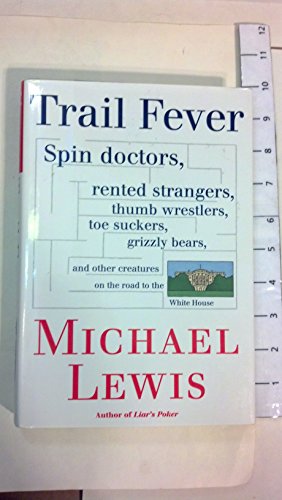
Trail Fever: Spin Doctors, Rented Strangers, Thumb Wrestlers, Toe Suckers, grizzly Bears, and Other Creatures on the Road to the White House - Hardcover
Synopsis
A wickedly funny and astute chronicle of the 1996 presidential campaign--and how we go about choosing our leaders at the turn of the century. In it Michael Lewis brings to the political scene the same brilliance that distinguished his celebrated best-seller about the financial world, Liar's Poker.
Beginning with the primaries, Lewis traveled across America--a concerned citizen who happened to ride in candidates' airplanes (as well as rented cars in blinding New Hampshire blizzards) and write about their adventures. Among the contenders he observed: Pat Buchanan, a walking tour of American anger; Lamar Alexander, who appealed to people who pretend to be nice to get ahead; Steve Forbes, frozen in a smile and refusing to answer questions about his father's motorcycles; Alan Keyes, one of the great political speakers of our age, whom no one has ever heard of; Morry Taylor--"the Grizz"--the hugely successful businessman who became the refreshing embodiment of ordinary Americans' appetites and ambitions; Bob Dole, a man who set out to prove he would never be president; and Bill Clinton, the big snow goose who flew too high to be shot out of the sky.
We watch the clichés of this peculiar subculture collide with characters from the real world: a pig farmer in Iowa; an evangelical preacher in Colorado Springs; a homeless person in Manhattan; a prospective illegal immigrant in Mexico. The politicians speak and speak, often reversing positions, denying direct quotations, mastering the sound bite, dodging hard questions, wreaking havoc on the English language. Spin doctors spin. Rented strangers (campaign workers) proliferate. One particular toe sucker goes awry. Ads are honed to misrepresent and distort. Money makes the world go round.
And the citizens are left dumbfounded or cheering empty platitudes. When trail fever breaks on Election Day, half of America's eligible voters stay home.
This book offers a striking look at us and our politics and the mammoth unlikelihood of connection between the inauthentic modern candidate and the voter's passions, needs, and desires. In telling the story, Michael Lewis once again proves himself a masterful observer of the American scene.
"synopsis" may belong to another edition of this title.
About the Author
Michael Lewis pursued a career on Wall Street for several years until he left to write a book about it--Liar's Poker. He is also the author of The Money Culture. A regular columnist for The New York Times Magazine, he has been a senior editor at The New Republic, as well as the American editor of The Spectator. He grew up in New Orleans, and now lives in Cold Spring, New York.
From the Inside Flap
unny and astute chronicle of the 1996 presidential campaign--and how we go about choosing our leaders at the turn of the century. In it Michael Lewis brings to the political scene the same brilliance that distinguished his celebrated best-seller about the financial world, Liar's Poker.<br><br>Beginning with the primaries, Lewis traveled across America--a concerned citizen who happened to ride in candidates' airplanes (as well as rented cars in blinding New Hampshire blizzards) and write about their adventures. Among the contenders he observed: Pat Buchanan, a walking tour of American anger; Lamar Alexander, who appealed to people who pretend to be nice to get ahead; Steve Forbes, frozen in a smile and refusing to answer questions about his father's motorcycles; Alan Keyes, one of the great political speakers of our age, whom no one has ever heard of; Morry Taylor--"the Grizz"--the hugely successful businessman who became the refreshing embodiment of ordinary Americans' appetites and am
Reviews
Bestselling author Lewis (Liar's Poker, 1989, etc.) applies his sense of humor to a subject that really needs it: the 1996 presidential campaign. To escape the boring but politically prudent staged events offered by the Clinton and Dole campaigns, Lewis focuses on the secondary players. This draws him to candidates like Morry Taylor, who responds to the challenge of hosting a reception at the Republican National Convention with a motorcycle rally featuring 7,000 Republicans on Harleys, and Alan Keyes, whose verbal virtuosity makes Lewis a (temporary) believer every time he speaks, despite suspicions that Keyes might have a screw loose somewhere. Among noncandidates there are the spin doctors and ``rented strangers''--professional campaign operatives--as well as Senator John McCain, whose ``alarming preference for the truth'' so disorients Lewis that it becomes difficult for him to function as a journalist. Please note: The purpose here is not to explain why Dole lost and Clinton won. In an era where major American presidential candidates are congenitally allergic to reality, taking them and their campaigns at face value reveals little. By setting aside the official stories concocted by rented strangers and disseminated by the mainstream press, yet avoiding the automatic cynicism of the professional critic, Lewis conveys a sense of what is really going on. His lack of enthusiasm for a campaign (Dole's) that ``plans its trips to the bathroom four days before it goes'' is easy to understand, regardless of one's politics, and his recognition that Americans' indifference to electoral politics is a sensible response to ``this crap'' is oddly optimistic: The people are sane even if our leaders are not. Written with Hunter Thompson's eye for the revealing detail but without his self-indulgence, and with Mark Russell's facility with one-liners but without his superficiality, this is a book to be enjoyed. (8 photos) (First printing of 100,000) -- Copyright ©1997, Kirkus Associates, LP. All rights reserved.
Tired of the conventional campaign postmortem cranked out by the likes of Elizabeth Drew or Bob Woodward? Lewis criticizes their sort of books for taking a top-down view of campaigns and politics, so he adopts a from-the-fringe perspective on the 1996 presidential extravaganza. Because the only question in doubt was who would lose to Clinton, Lewis started out following the Republicans, most closely the candidates without even the proverbial snowball's chance: Morry "the Grizz" Taylor and Alan Keyes. Something about their amateurishness (Taylor) or intense moralizing (Keyes) attracted Lewis, not to mention their disdain for hired political pros--the "rented strangers" of the subtitle. Lewis dislikes the artifice of PR-and poll-propelled politicians, and his antic journal is largely a poking at the thick protection that overlays most serious candidates, as well as a pricking of the pomposity of the bigfoot journalists who tail them. Vignettes, all telling and pointed, are the name of Lewis' game, and they unroll from Iowa to New Hampshire to San Diego to Chicago in a rich, sardonic sequence that easily makes this the most fun campaign book since Richard Ben Cramer's What It Takes (1992). The innumerable acid asides give Lewis' story a delightful digging tone that captures the zaniness, phoniness, and earnestness of a process that, in the end, was a battle for 17 percent: that, believe it or not, was the percentage of all eligible voters who voted for the 1996 winner. Gilbert Taylor
Journalist Lewis's (Liar's Poker, LJ 9/1/89) chronicle of the 1996 presidential campaign examines the battle for the Republican Party nomination and the following general election. It differs from most campaign books in that its perspective is "from the bottom of the political food chain." Lewis argues that the leading candidates were so preoccupied with risk avoidance that they failed to address important concerns of the electorate. This meant that to the extent such matters were addressed at all, it was by the lesser candidates. Therefore, Lewis devotes more attention to such minor Republican candidates as Alan Keyes and Morry Taylor and to Green Party candidate Ralph Nader than to Clinton and Dole. His book is not comprehensive, but it provides a frequently humorous and occasionally insightful look into contemporary electoral politics for lay readers.?Thomas H. Ferrell, Univ. of Southwestern Louisiana, Lafayette
Copyright 1997 Reed Business Information, Inc.
"About this title" may belong to another edition of this title.
Search results for Trail Fever: Spin Doctors, Rented Strangers, Thumb...

Stock Image
Trail Fever, Spin Doctors, Rented Strangers, Thumb Westlers
Seller: World of Books (was SecondSale), Montgomery, IL, U.S.A.
Seller rating 5 out of 5 stars

Hardback. Condition: Very Good. A wickedly funny and astute chronicle of the 1996 presidential campaign--and how we go about choosing our leaders at the turn of the century. In it Michael Lewis brings to the political scene the same brilliance that distinguished his celebrated best-seller about the financial world, Liar's Poker. Beginning with the primaries, Lewis traveled across America--a concerned citizen who happened to ride in candidates' airplanes (as well as rented cars in blinding New Hampshire blizzards) and write about their adventures. Among the contenders he observed: Pat Buchanan, a walking tour of American anger; Lamar Alexander, who appealed to people who pretend to be nice to get ahead; Steve Forbes, frozen in a smile and refusing to answer questions about his father's motorcycles; Alan Keyes, one of the great political speakers of our age, whom no one has ever heard of; Morry Taylor--the Grizz--the hugely successful businessman who became the refreshing embodiment of ordinary Americans' appetites and ambitions; Bob Dole, a man who set out to prove he would never be president; and Bill Clinton, the big snow goose who flew too high to be shot out of the sky. We watch the cliches of this peculiar subculture collide with characters from the real world: a pig farmer in Iowa; an evangelical preacher in Colorado Springs; a homeless person in Manhattan; a prospective illegal immigrant in Mexico. The politicians speak and speak, often reversing positions, denying direct quotations, mastering the sound bite, dodging hard questions, wreaking havoc on the English language. Spin doctors spin. Rented strangers (campaign workers) proliferate. One particular toe sucker goes awry. Ads are honed tomisrepresent and distort. Money makes the world go round. And the citizens are left dumbfounded or cheering empty platitudes. When trail fever breaks on Election Day, half of America's eligible voters stay home. This book offers a striking look at us and our politics and the mammoth unlikelihood of connection between the inauthentic modern candidate and the voter's passions, needs, and desires. In telling the story, Michael Lewis once again proves himself a masterful observer of the American scene. Seller Inventory # 00101939466
Stock Image
Trail Fever, Spin Doctors, Rented Strangers, Thumb Westlers
Seller: World of Books (was SecondSale), Montgomery, IL, U.S.A.
Seller rating 5 out of 5 stars
Hardback. Condition: Good. A wickedly funny and astute chronicle of the 1996 presidential campaign--and how we go about choosing our leaders at the turn of the century. In it Michael Lewis brings to the political scene the same brilliance that distinguished his celebrated best-seller about the financial world, Liar's Poker. Beginning with the primaries, Lewis traveled across America--a concerned citizen who happened to ride in candidates' airplanes (as well as rented cars in blinding New Hampshire blizzards) and write about their adventures. Among the contenders he observed: Pat Buchanan, a walking tour of American anger; Lamar Alexander, who appealed to people who pretend to be nice to get ahead; Steve Forbes, frozen in a smile and refusing to answer questions about his father's motorcycles; Alan Keyes, one of the great political speakers of our age, whom no one has ever heard of; Morry Taylor--the Grizz--the hugely successful businessman who became the refreshing embodiment of ordinary Americans' appetites and ambitions; Bob Dole, a man who set out to prove he would never be president; and Bill Clinton, the big snow goose who flew too high to be shot out of the sky. We watch the cliches of this peculiar subculture collide with characters from the real world: a pig farmer in Iowa; an evangelical preacher in Colorado Springs; a homeless person in Manhattan; a prospective illegal immigrant in Mexico. The politicians speak and speak, often reversing positions, denying direct quotations, mastering the sound bite, dodging hard questions, wreaking havoc on the English language. Spin doctors spin. Rented strangers (campaign workers) proliferate. One particular toe sucker goes awry. Ads are honed tomisrepresent and distort. Money makes the world go round. And the citizens are left dumbfounded or cheering empty platitudes. When trail fever breaks on Election Day, half of America's eligible voters stay home. This book offers a striking look at us and our politics and the mammoth unlikelihood of connection between the inauthentic modern candidate and the voter's passions, needs, and desires. In telling the story, Michael Lewis once again proves himself a masterful observer of the American scene. Seller Inventory # 00097241950
Seller Image
Trail Fever: Spin Doctors, Rented Strangers, Thumb Wrestlers, Toe Suckers, grizzly Bears, and Other Creatures on the Road to the White House
Seller: Zoom Books East, Glendale Heights, IL, U.S.A.
Seller rating 5 out of 5 stars
Condition: good. Book is in good condition and may include underlining highlighting and minimal wear. The book can also include "From the library of" labels. May not contain miscellaneous items toys, dvds, etc. . We offer 100% money back guarantee and 24 7 customer service. Seller Inventory # ZEV.0679446605.G
Stock Image
Trail Fever: Spin Doctors, Rented Strangers, Thumb Wrestlers, Toe Suckers, grizzly Bears, and Other Creatures on the Road to the White House
Seller: BooksRun, Philadelphia, PA, U.S.A.
Seller rating 5 out of 5 stars
Hardcover. Condition: Very Good. 1. With dust jacket. It's a well-cared-for item that has seen limited use. The item may show minor signs of wear. All the text is legible, with all pages included. It may have slight markings and/or highlighting. Seller Inventory # 0679446605-11-6-29
Stock Image
Trail Fever, Spin Doctors, Rented Strangers, Thumb Westlers
Seller: World of Books Inc, Montgomery, IL, U.S.A.
Seller rating 4 out of 5 stars

Hardback. Condition: Very Good. A wickedly funny and astute chronicle of the 1996 presidential campaign--and how we go about choosing our leaders at the turn of the century. In it Michael Lewis brings to the political scene the same brilliance that distinguished his celebrated best-seller about the financial world, Liar's Poker. Beginning with the primaries, Lewis traveled across America--a concerned citizen who happened to ride in candidates' airplanes (as well as rented cars in blinding New Hampshire blizzards) and write about their adventures. Among the contenders he observed: Pat Buchanan, a walking tour of American anger; Lamar Alexander, who appealed to people who pretend to be nice to get ahead; Steve Forbes, frozen in a smile and refusing to answer questions about his father's motorcycles; Alan Keyes, one of the great political speakers of our age, whom no one has ever heard of; Morry Taylor--the Grizz--the hugely successful businessman who became the refreshing embodiment of ordinary Americans' appetites and ambitions; Bob Dole, a man who set out to prove he would never be president; and Bill Clinton, the big snow goose who flew too high to be shot out of the sky. We watch the cliches of this peculiar subculture collide with characters from the real world: a pig farmer in Iowa; an evangelical preacher in Colorado Springs; a homeless person in Manhattan; a prospective illegal immigrant in Mexico. The politicians speak and speak, often reversing positions, denying direct quotations, mastering the sound bite, dodging hard questions, wreaking havoc on the English language. Spin doctors spin. Rented strangers (campaign workers) proliferate. One particular toe sucker goes awry. Ads are honed tomisrepresent and distort. Money makes the world go round. And the citizens are left dumbfounded or cheering empty platitudes. When trail fever breaks on Election Day, half of America's eligible voters stay home. This book offers a striking look at us and our politics and the mammoth unlikelihood of connection between the inauthentic modern candidate and the voter's passions, needs, and desires. In telling the story, Michael Lewis once again proves himself a masterful observer of the American scene. Seller Inventory # CIN0679446605VG
Stock Image
Trail Fever, Spin Doctors, Rented Strangers, Thumb Westlers
Seller: World of Books Inc, Montgomery, IL, U.S.A.
Seller rating 4 out of 5 stars
Hardback. Condition: Good. A wickedly funny and astute chronicle of the 1996 presidential campaign--and how we go about choosing our leaders at the turn of the century. In it Michael Lewis brings to the political scene the same brilliance that distinguished his celebrated best-seller about the financial world, Liar's Poker. Beginning with the primaries, Lewis traveled across America--a concerned citizen who happened to ride in candidates' airplanes (as well as rented cars in blinding New Hampshire blizzards) and write about their adventures. Among the contenders he observed: Pat Buchanan, a walking tour of American anger; Lamar Alexander, who appealed to people who pretend to be nice to get ahead; Steve Forbes, frozen in a smile and refusing to answer questions about his father's motorcycles; Alan Keyes, one of the great political speakers of our age, whom no one has ever heard of; Morry Taylor--the Grizz--the hugely successful businessman who became the refreshing embodiment of ordinary Americans' appetites and ambitions; Bob Dole, a man who set out to prove he would never be president; and Bill Clinton, the big snow goose who flew too high to be shot out of the sky. We watch the cliches of this peculiar subculture collide with characters from the real world: a pig farmer in Iowa; an evangelical preacher in Colorado Springs; a homeless person in Manhattan; a prospective illegal immigrant in Mexico. The politicians speak and speak, often reversing positions, denying direct quotations, mastering the sound bite, dodging hard questions, wreaking havoc on the English language. Spin doctors spin. Rented strangers (campaign workers) proliferate. One particular toe sucker goes awry. Ads are honed tomisrepresent and distort. Money makes the world go round. And the citizens are left dumbfounded or cheering empty platitudes. When trail fever breaks on Election Day, half of America's eligible voters stay home. This book offers a striking look at us and our politics and the mammoth unlikelihood of connection between the inauthentic modern candidate and the voter's passions, needs, and desires. In telling the story, Michael Lewis once again proves himself a masterful observer of the American scene. Seller Inventory # CIN0679446605G
Stock Image
Trail Fever: Spin Doctors, Rented Strangers, Thumb Wrestlers, Toe Suckers, grizzly Bears, and Other Creatures on the Road to the White House
Seller: HPB-Emerald, Dallas, TX, U.S.A.
Seller rating 5 out of 5 stars
hardcover. Condition: Very Good. Connecting readers with great books since 1972! Used books may not include companion materials, and may have some shelf wear or limited writing. We ship orders daily and Customer Service is our top priority! Seller Inventory # S_475431097
Stock Image
Trail Fever : Spin Doctors, Rented Strangers, Thumb Wrestlers, Toe Suckers, Grizzly Bears, and Other Creatures on the Road to the White House
Published by
Knopf Doubleday Publishing Group, 1997
ISBN 10: 0679446605
ISBN 13: 9780679446606
Used
Hardcover
First Edition
Seller: Better World Books, Mishawaka, IN, U.S.A.
Seller rating 5 out of 5 stars
Condition: Good. 1st. Former library copy. Pages intact with minimal writing/highlighting. The binding may be loose and creased. Dust jackets/supplements are not included. Includes library markings. Stock photo provided. Product includes identifying sticker. Better World Books: Buy Books. Do Good. Seller Inventory # 5415002-6
Stock Image
Trail Fever : Spin Doctors, Rented Strangers, Thumb Wrestlers, Toe Suckers, Grizzly Bears, and Other Creatures on the Road to the White House
Published by
Knopf Doubleday Publishing Group, 1997
ISBN 10: 0679446605
ISBN 13: 9780679446606
Used
Hardcover
First Edition
Seller: Better World Books: West, Reno, NV, U.S.A.
Seller rating 5 out of 5 stars
Condition: Good. 1st. Pages intact with minimal writing/highlighting. The binding may be loose and creased. Dust jackets/supplements are not included. Stock photo provided. Product includes identifying sticker. Better World Books: Buy Books. Do Good. Seller Inventory # 732627-6
Stock Image
Trail Fever : Spin Doctors, Rented Strangers, Thumb Wrestlers, Toe Suckers, Grizzly Bears, and Other Creatures on the Road to the White House
Published by
Knopf Doubleday Publishing Group, 1997
ISBN 10: 0679446605
ISBN 13: 9780679446606
Used
Hardcover
First Edition
Seller: Better World Books, Mishawaka, IN, U.S.A.
Seller rating 5 out of 5 stars
Condition: Good. 1st. Pages intact with minimal writing/highlighting. The binding may be loose and creased. Dust jackets/supplements are not included. Stock photo provided. Product includes identifying sticker. Better World Books: Buy Books. Do Good. Seller Inventory # 732627-6