
Items related to Finding a Form: Essays
Synopsis
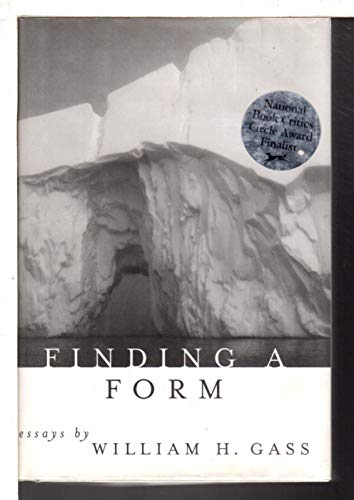
From the author of The Tunnel comes a new collection of essays, his first in eight years, on art, writing, nature and culture. This book is by one of the most important and briliant thinkers at work today.
"synopsis" may belong to another edition of this title.
About the Author
William Gass has been a Professor of Philosophy at Purdue University in Indiana and at Washington University in St. Louis, where he is Director of the International Writers Center.
From the Inside Flap
From the author of The Tunnel comes a new collection of essays, his first in eight years, on art, writing, nature and culture. This book is by one of the most important and briliant thinkers at work today.
Reviews
In his first gathering of essays in several years, novelist and critic Gass's commitment to ideas, concentrated energy and originality shine through on every page. The title essay, an exploration of how writers navigate complex, refractory reality, discloses how his childhood with an abusive father and alcoholic mother influenced his escape into writing and shaped his fictional characters, symbols and preoccupations. "Nature, Culture, and Cosmos" pessimistically gauges the "immense indifference" of the universe to our moral values and our deaths. Other pieces deal with Ezra Pound as a failed modernist; the lives of Nietzsche and Wittgenstein in relation to their thought; various species of the avant-garde from Pierre de Ronsard to Degas, Beckett and the Bauhaus; the exacting demands of autobiography; the Pulitzer Prize Committee's "banal and hokey" choices in fiction; and the abyss between the moral viewpoints expressed in works of art and the lives of their creators. Gass's deeply felt essays, reprinted from the New York Times Book Review, Antaeus, etc., are quotable, flecked with fertile insights and a pleasure to read. On stoicism: "If we have to accept what we get, why not imagine that it's just what we want?" On Impressionism: "It allows subversion to go on with the approval of the subverted."
Copyright 1996 Reed Business Information, Inc.
These 19 essays showcase precision intellectual workmanship, displaying intricate, multifaceted models of how writing and thinking relate to life. Gass won the 1985 National Book Award for a previous essay collection, Habitations of the Word; most recently he authored an ingenious, gigantic novel, The Tunnel (1995). The essays reprinted here belong to a variety of genres, but all centrally consider how writing enters into the world--how writers find forms adequate for their thoughts. In an opening section Gass takes on several institutions that in his opinion mark today's writing with mediocrity; he dissects the disgraceful track record of the Pulitzer Prize for literature and the inadequacies of the minimalist prose style that emenates from academic fiction-writing programs. His main focus, however, is on conjunctions of writing with philosophy and experience. Gass offers appreciations of favorite modern authors whose works and lives are rich in philosophical meditiation, such as Robert Walser and Danilo Kis; biographical review essays treating the relationship of life to work for Nietzsche, Wittgenstein, and Ezra Pound; and digests of intellectual history burdened with such portentous titles as ``Nature, Culture, and Cosmos.'' These latter can suffer from showboating and cutefying. Such faults crop up occasionally even in the best essays here. Gass's postmodern idiom at times leads him to facile would-be cleverness--informing us with regard to Nietzsche, for instance, that ``of course, the superman doesn't sport blue underwear.'' At his best, however, when Gass puts his philosophical bent at the service of his literary gifts, singular insights emerge. This volume's finest essays shed new light on the workings of prose style--on ``the music of prose''--in cases ranging from a lively piece of Middle English sermonizing to the impressionism of Ford Madox Ford. Gass shines when he addresses the subject most befitting a self-described ``Methodologist,'' one ``for whom the medium is the muse''--his own prose medium itself. -- Copyright ©1996, Kirkus Associates, LP. All rights reserved.
Gass (The Tunnel, LJ 1/95), the head of the International Writers Center at Washington University, is "as obdurate as nails" when it comes to the best possible use of the written word. Each essay in this wide-ranging book (be it titled "Ezra Pound," "Nietzche: The Polemical Philosopher," "Robert Walser," "Nature, Culture, and Cosmos," "Pulitzer, The People Prize," or "The Music of Prose") offers evidence for such a conclusion. Gass is concerned with how best to use a phrase or word and believes we should be tough-minded when it comes to reading. He reveals a sardonic sense of humor as well, for example, in discussing the winners of the Pulitzer prize, and he dislikes the fact that anyone would enjoy his/her own writing. His compound sentences?"little shimmied stretches of human awareness"?are utterly unique and perfectly difficult. This collection succeeds in his aim to arrest and inform persuasively. For literature collections.?Robert Kelly, Fort Wayne Community Schs., Ind.
Copyright 1996 Reed Business Information, Inc.
"About this title" may belong to another edition of this title.
Search results for Finding a Form: Essays

Stock Image
Finding a Form: Essays
Seller: World of Books (was SecondSale), Montgomery, IL, U.S.A.
Seller rating 5 out of 5 stars

Hardback. Condition: Good. Gass's commitment to ideas, concentrated energy and originality shine through on every page. . . . Ezra Pound as a failed modernist; the lives of Nietzsche and Wittgenstein . . . the avant garde . . . the demands of autobiography; the Pulitzer Prize Committee's . . . choices in fiction . . . flecked with fertile insights and a pleasure to read.--PUBLISHERS WEKLY, starred review. A 1996 National Book Critics Circle Award winner. Seller Inventory # 00108013696
Seller Image
Finding a Form: Essays
Seller: -OnTimeBooks-, Phoenix, AZ, U.S.A.
Seller rating 5 out of 5 stars
Condition: very_good. Gently read. May have name of previous ownership, or ex-library edition. Binding tight; spine straight and smooth, with no creasing; covers clean and crisp. Minimal signs of handling or shelving. 100% GUARANTEE! Shipped with delivery confirmation, if you're not satisfied with purchase please return item! Ships USPS Media Mail. Seller Inventory # OTV.0679446621.VG
Stock Image
Finding a Form : Essays
Published by
Knopf Doubleday Publishing Group, 1996
ISBN 10: 0679446621
ISBN 13: 9780679446620
Used
Hardcover
Seller: Better World Books, Mishawaka, IN, U.S.A.
Seller rating 5 out of 5 stars
Condition: Good. Former library copy. Pages intact with minimal writing/highlighting. The binding may be loose and creased. Dust jackets/supplements are not included. Includes library markings. Stock photo provided. Product includes identifying sticker. Better World Books: Buy Books. Do Good. Seller Inventory # 4927920-20
Stock Image
Finding a Form : Essays
Published by
Knopf Doubleday Publishing Group, 1996
ISBN 10: 0679446621
ISBN 13: 9780679446620
Used
Hardcover
Seller: Better World Books, Mishawaka, IN, U.S.A.
Seller rating 5 out of 5 stars
Condition: Good. Pages intact with minimal writing/highlighting. The binding may be loose and creased. Dust jackets/supplements are not included. Stock photo provided. Product includes identifying sticker. Better World Books: Buy Books. Do Good. Seller Inventory # 732628-6
Stock Image
Finding a Form: Essays
Seller: World of Books Inc, Montgomery, IL, U.S.A.
Seller rating 4 out of 5 stars

Hardback. Condition: Good. Gass's commitment to ideas, concentrated energy and originality shine through on every page. . . . Ezra Pound as a failed modernist; the lives of Nietzsche and Wittgenstein . . . the avant garde . . . the demands of autobiography; the Pulitzer Prize Committee's . . . choices in fiction . . . flecked with fertile insights and a pleasure to read.--PUBLISHERS WEKLY, starred review. A 1996 National Book Critics Circle Award winner. Seller Inventory # CIN0679446621G
Seller Image
Finding a Form: Essays
Seller: Bethesda Used Books, Bethesda, MD, U.S.A.
Seller rating 5 out of 5 stars
Hardcover. Condition: Good. Dust Jacket Condition: Good. 1st Edition. Moderate wear to the jacket, a old price sticker on the back. Clean boards, firm binding. Remainder mark on the top edge. Unmarked pages and endpapers. Not ex-librar. Ships in a box. Seller Inventory # ABE-1731806827167
Stock Image
Finding a Form: Essays
Seller: Midtown Scholar Bookstore, Harrisburg, PA, U.S.A.
Seller rating 5 out of 5 stars
hardcover. Condition: Good. Torn/worn dj. Good hardcover with some shelfwear; may have previous owner's name inside. Standard-sized. Seller Inventory # mon0000347051
Seller Image
Finding a Form: Essays
Seller: tLighthouse Books, Onekama, MI, U.S.A.
Seller rating 5 out of 5 stars
Condition: acceptable. Acceptable condition. Reading copy. May have signs of wear and previous use scuffs, library copy, highlighting, writing, and underlining . May have foxing, slight water damage or tears. 100% GUARANTEE! Shipped with delivery confirmation. If you're not satisfied with purchase just return it! Seller Inventory # HSV.0679446621.A
Stock Image
Finding a Form: Essays
Seller: Chaparral Books, Portland, OR, U.S.A.
Seller rating 5 out of 5 stars
Hardcover. Condition: Very Good. Dust Jacket Condition: Very Good. First Edition. The binding is tight, corners sharp. Mild toning to panel edges. Text is unmarked. The dust jacket shows light handling and toning, a small closed tear along rear fold, in a mylar cover. National Book Critics Circle Award Finalist sticker on front panel. Seller Inventory # SELgasFIN
Seller Image
Finding a form
Published by
Alfred A. Knopf, 1996
ISBN 10: 0679446621
ISBN 13: 9780679446620
Used
Hardcover
First Edition
Seller: Southampton Books, Sag Harbor, NY, U.S.A.
Seller rating 5 out of 5 stars
Hardcover. Condition: Like New. First Edition. First Edition, First Printing. Not price-clipped. Published by Alfred A. Knopf, 1996. Octavo. Hardcover. Book is like new with spotting on top page end. Dust jacket is like new.100% positive feedback. 30 day money back guarantee. NEXT DAY SHIPPING! Excellent customer service. Please email with any questions. All books packed carefully and ship with free delivery confirmation/tracking. All books come with free bookmarks. Ships from Sag Harbor, New York. Seller Inventory # 437947