Items related to Theodore Roosevelt: A Strenuous Life
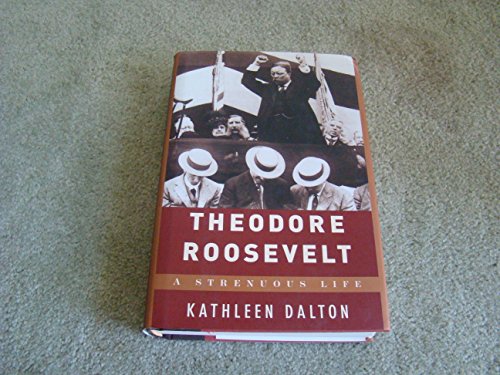

Theodore Roosevelt made himself the hero of his own strenuous life. He transformed himself from a sickly and fearful patrician boy into a fiercely adventurous--and always active--hunter, sportsman, writer, politician, and finally president. But one self-making was never enough for TR. He slowly fashioned himself into a man of the people, a defender of the poor and downtrodden, and a prophet of political ideas advanced for his day. This is the story of his personal and political development, of one man's struggle to conquer his own fears and to build a greater nation out of a divided collection of states. He urged America to engage life to the utmost, as he did.
Kathleen Dalton's Theodore Roosevelt: A Strenuous Life incorporates the latest scholarship into a vigorous narrative. It stands as the only full-length biography to use manuscripts recently discovered in Roosevelt attics. Dalton sheds new light on young Theodore's life during the Civil War and his fascination with the new natural history, his shame over his father's failure to enlist in the Union army, his struggle to achieve manhood, and his desperate pursuit of and sometimes less than idyllic marriage to Alice Hathaway Lee, the daughter of a banking magnate, when she was seventeen. Her death four years later left Roosevelt a grieving widower and father at twenty-six, and he went west to make himself a cowboy and western writer, before he could recommit himself to a new life and a new love in the East.
No other biographer has described how formative Roosevelt's marriage to Edith Carow proved to be in shaping his political career. In an account that may be compared with Joseph Lash's Eleanor and Franklin, Dalton demonstrates how Edith and Theodore's marriage, with its ups and downs, remade our history. In partnership with Massachusetts political mastermind Henry Cabot Lodge, Edith served as her husband's advisor, image builder, conscience, and at times censor. Dalton unravels the complex relationship between Roosevelt's initial political conservatism and the growing mood of progressivism that swept the nation in the early 1900s. He found unlikely allies among the army of women reformers who campaigned for pure milk and clean streets in the cities, and by 1912 he had become an active suffragist.
Out of this biography emerges a new picture of the Progressive Era, of state-building and reform won in partnership between TR and activists such as Jane Addams and Frances Kellor. In his political maturity Roosevelt aspired to be the builder of the modern American welfare state in order to give industrial workers a better life and at the same time to stand up more forcefully against the arrogance and greed of large corporations. Dalton shows how TR called for a revival of American arts and letters, and how his career as a scientist affected his reform program and his views on race, and how toward the end of his life he finally commited himself to the cause of racial equality. Both an updated political interpretation and an intimate personal story of a loving but difficult man, his wife, his family, and his loyal friends, Theodore Roosevelt: A Strenuous Life will change persuasively the way we see this great and complex man and his times.
Kathleen Dalton's Theodore Roosevelt: A Strenuous Life incorporates the latest scholarship into a vigorous narrative. It stands as the only full-length biography to use manuscripts recently discovered in Roosevelt attics. Dalton sheds new light on young Theodore's life during the Civil War and his fascination with the new natural history, his shame over his father's failure to enlist in the Union army, his struggle to achieve manhood, and his desperate pursuit of and sometimes less than idyllic marriage to Alice Hathaway Lee, the daughter of a banking magnate, when she was seventeen. Her death four years later left Roosevelt a grieving widower and father at twenty-six, and he went west to make himself a cowboy and western writer, before he could recommit himself to a new life and a new love in the East.
No other biographer has described how formative Roosevelt's marriage to Edith Carow proved to be in shaping his political career. In an account that may be compared with Joseph Lash's Eleanor and Franklin, Dalton demonstrates how Edith and Theodore's marriage, with its ups and downs, remade our history. In partnership with Massachusetts political mastermind Henry Cabot Lodge, Edith served as her husband's advisor, image builder, conscience, and at times censor. Dalton unravels the complex relationship between Roosevelt's initial political conservatism and the growing mood of progressivism that swept the nation in the early 1900s. He found unlikely allies among the army of women reformers who campaigned for pure milk and clean streets in the cities, and by 1912 he had become an active suffragist.
Out of this biography emerges a new picture of the Progressive Era, of state-building and reform won in partnership between TR and activists such as Jane Addams and Frances Kellor. In his political maturity Roosevelt aspired to be the builder of the modern American welfare state in order to give industrial workers a better life and at the same time to stand up more forcefully against the arrogance and greed of large corporations. Dalton shows how TR called for a revival of American arts and letters, and how his career as a scientist affected his reform program and his views on race, and how toward the end of his life he finally commited himself to the cause of racial equality. Both an updated political interpretation and an intimate personal story of a loving but difficult man, his wife, his family, and his loyal friends, Theodore Roosevelt: A Strenuous Life will change persuasively the way we see this great and complex man and his times.
"synopsis" may belong to another edition of this title.
Review:
"Kathleen Dalton's Theodore Roosevelt: A Strenuous Life is a brave, bold, revisionist study of the most multidimensional of our American Presidents. Debunking academic notions that TR was a jingoistic nativist, Dalton establishes the Sage of Oyster Bay as an open-minded public servant crusading for social justice. She leaves the reader convinced that there was a bedrock sanity to TR's irascible manic behaviour. A truly remarkable biography."
--Douglas Brinkley
“Kathleen Dalton's engaging full-length biography of Theodore Roosevelt is distinguished throughout by her fresh findings about TR's family life and her keen interest in his progressively social and economic views in his last decade. She presents a convincing assessment of the positive influence of women's concerns on TR's beliefs and policies, and she writes compellingly of his essentially moral commitment to federal regulation of corporations. Imaginatively researched and unflaggingly interesting, THEODORE ROOSEVELT is intimate, insightful, and informing. Readers familiar with TR and readers just coming to him will enjoy and be enlightened by it.”
--William H. Harbaugh, author of POWER AND RESPONSIBILITY (bio of TR, 1961)
“Like its subject, this book is charming and intellectually sound. And at last, someone pays serious attention to TR's scientific interests and achievements.”
—Stephen Jay Gould
“At a time when we yearn for great moral leadership and conviction, Kathleen Dalton brings back to us a man who marvelously embraced these qualities, in a continually dramatic account told with skill and grace.”
---James MacGregor Burns
Biographers have often treated Theodore Roosevelt as "a larger-than-life monument carved in stone, unchanging, far from being flesh and blood, and quite imperturbable." So writes Kathleen Dalton, who gives us a fully fleshed, quite down-to-earth TR in this vigorous, sometimes critical biography of the 26th president.
From the Back Cover:
Roosevelt carefully crafted an image of himself as a self-made man. Fair enough, Dalton suggests, though he had a big head start in coming from one of New York's wealthiest and best-connected families. More than shaping his body to overcome weakness, his spirit to overcome fear, he had to overcome the prejudices of his time and class in order to be truly fit for leadership, and even as president he wrestled with a few contradictions (opposing, for instance, a woman's right to divorce, but endorsing public flogging of spousal abusers). He was not always successful, Dalton writes, but he emerged in the end as a great champion of civil rights and of the middle and working classes, very much ahead of his time.
There's a lot of interest in Theodore Roosevelt these days--and for good reason, given the recent international turmoil and financial tumble, which, some would argue, beg for TR's patented big-stick and trust-busting treatment. Dalton's Theodore Roosevelt offers a satisfying portrait of a constantly fascinating subject. --Gregory McNamee
"Kathleen Dalton's Theodore Roosevelt: A Strenuous Life is a brave, bold, revisionist study of the most multidimensional of our American Presidents. Debunking academic notions that TR was a jingoistic nativist, Dalton establishes the Sage of Oyster Bay as an open-minded public servant crusading for social justice. She leaves the reader convinced that there was a bedrock sanity to TR's irascible manic behaviour. A truly remarkable biography."
--Douglas Brinkley
“Kathleen Dalton's engaging full-length biography of Theodore Roosevelt is distinguished throughout by her fresh findings about TR's family life and her keen interest in his progressively social and economic views in his last decade. She presents a convincing assessment of the positive influence of women's concerns on TR's beliefs and policies, and she writes compellingly of his essentially moral commitment to federal regulation of corporations. Imaginatively researched and unflaggingly interesting, THEODORE ROOSEVELT is intimate, insightful, and informing. Readers familiar with TR and readers just coming to him will enjoy and be enlightened by it.”
--William H. Harbaugh, author of POWER AND RESPONSIBILITY (bio of TR, 1961)
“Like its subject, this book is charming and intellectually sound. And at last, someone pays serious attention to TR's scientific interests and achievements.”
—Stephen Jay Gould
“At a time when we yearn for great moral leadership and conviction, Kathleen Dalton brings back to us a man who marvelously embraced these qualities, in a continually dramatic account told with skill and grace.”
---James MacGregor Burns
"About this title" may belong to another edition of this title.
- PublisherKnopf
- Publication date2002
- ISBN 10 067944663X
- ISBN 13 9780679446637
- BindingHardcover
- Edition number1
- Number of pages752
- Rating
Buy New
Learn more about this copy
US$ 60.12
Shipping:
US$ 4.00
Within U.S.A.
Top Search Results from the AbeBooks Marketplace
Stock Image
Theodore Roosevelt: A Strenuous Life
Seller:
Rating

Book Description Hardcover. Condition: new. New. Fast Shipping and good customer service. Seller Inventory # Holz_New_067944663X
Buy New
US$ 60.12
Convert currency
Stock Image
Theodore Roosevelt: A Strenuous Life
Seller:
Rating
Book Description Condition: new. Seller Inventory # newMercantile_067944663X
Buy New
US$ 61.25
Convert currency
Stock Image
Theodore Roosevelt: A Strenuous Life
Seller:
Rating
Book Description Hardcover. Condition: new. New Copy. Customer Service Guaranteed. Seller Inventory # think067944663X
Buy New
US$ 60.93
Convert currency
Stock Image
Theodore Roosevelt: A Strenuous Life
Seller:
Rating
Book Description Hardcover. Condition: new. Buy for Great customer experience. Seller Inventory # GoldenDragon067944663X
Buy New
US$ 62.10
Convert currency
Stock Image
Theodore Roosevelt: A Strenuous Life
Seller:
Rating
Book Description Hardcover. Condition: new. New. Seller Inventory # Wizard067944663X
Buy New
US$ 61.87
Convert currency
Stock Image
Theodore Roosevelt: A Strenuous Life
Seller:
Rating
Book Description Condition: new. Seller Inventory # FrontCover067944663X
Buy New
US$ 61.10
Convert currency
Stock Image
THEODORE ROOSEVELT: A STRENUOUS
Seller:
Rating

Book Description Condition: New. New. In shrink wrap. Looks like an interesting title! 2.6. Seller Inventory # Q-067944663X
Buy New
US$ 59.58
Convert currency
Stock Image
Theodore Roosevelt: A Strenuous Life
Seller:
Rating
Book Description Hardcover. Condition: New. Seller Inventory # Abebooks570316
Buy New
US$ 74.00
Convert currency