
Items related to Tender at the Bone: Growing Up at the Table
Synopsis
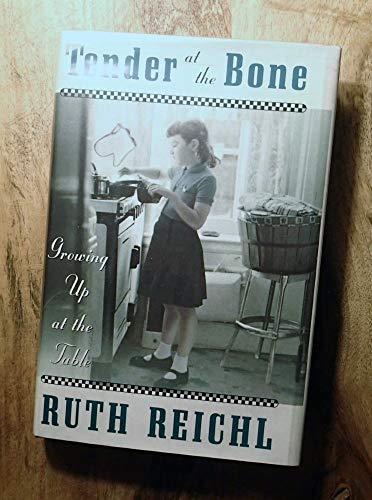
For better or worse, almost all of us grow up at the table. It is in this setting that Ruth Reichl's brilliantly written memoir takes its form. For, at a very early age, Reichl discovered that "food could be a way of making sense of the world . . . if you watched people as they ate, you could find out who they were."
Tender at the Bone is the story of a life determined, enhanced, and defined in equal measure by unforgettable people, the love of tales well told, and a passion for food. In other words, the stuff of the best literature. The journey begins with Reichl's mother, the notorious food-poisoner known for-evermore as the Queen of Mold, and moves on to the fabled Mrs. Peavey, onetime Baltimore socialite millionaress, who, for a brief but poignant moment, was retained as the Reichls' maid. Then we are introduced to Monsieur du Croix, the gourmand, who so understood and yet was awed by this prodigious child at his dinner table that when he introduced Ruth to the soufflé, he could only exclaim, "What a pleasure to watch a child eat her first soufflé!" Then, fast-forward to the politically correct table set in Berkeley in the 1970s, and the food revolution that Ruth watched and participated in as organic became the norm. But this sampling doesn't do this character-rich book justice. After all, this is just a taste.
Tender at the Bone is a remembrance of Ruth Reichl's childhood into young adulthood, redolent with the atmosphere, good humor, and angst of a sensualist coming-of-age.
"synopsis" may belong to another edition of this title.
About the Author
Ruth Reichl is the restaurant critic of The New York Times. She lives in New York City with her husband, her son, and two cats.
From the Back Cover
"In this intimate and charming memoir, Ruth Reichl shares a wonderful truth: a sentimental and sensory education that begins at home--around the family table, in the kitchen, in the garden--can give life meaning." --Alice Waters
"People who have a calling, it has always seemed to me, are the luckiest ones. Tender at the Bone reminds us that the vital and interesting things we are drawn to as we grow up are really preparation for our callings. I was moved by Ruth Reichl's story of finding the thing that saved her and brought her happiness and love. Her writing is the clearest, simplest, and best I have read in a very long time. This book made me happy and will continue to as I use the recipes and read it all again."
--Mike Nichols
"Like most of her admirers, you've probably spent years wishing you could have dinner with Ruth Reichl--because you expected you'd eat well. It turns out that good food is only one of the pleasures of her company. Tender at the Bone is one great tale after another, some funny, some profoundly touching. To read this book is to spend time with a truly enthralling storyteller."
--Dan Rather
From the Inside Flap
r worse, almost all of us grow up at the table. It is in this setting that Ruth Reichl's brilliantly written memoir takes its form. For, at a very early age, Reichl discovered that "food could be a way of making sense of the world . . . if you watched people as they ate, you could find out who they were."
Tender at the Bone is the story of a life determined, enhanced, and defined in equal measure by unforgettable people, the love of tales well told, and a passion for food. In other words, the stuff of the best literature. The journey begins with Reichl's mother, the notorious food-poisoner known for-evermore as the Queen of Mold, and moves on to the fabled Mrs. Peavey, onetime Baltimore socialite millionaress, who, for a brief but poignant moment, was retained as the Reichls' maid. Then we are introduced to Monsieur du Croix, the gourmand, who so understood and yet was awed by this prodigious child at his dinner table that when he introduced Ruth to the soufflé, he could o
Reviews
...[a] graceful book.
The restaurant critic of the New York Times whips up a savory memoir of her apprentice years. Growing up in New York City and Connecticut during the 1950s, Reichl learned early ``that food could be dangerous.'' Her manic-depressive mother favored weird mlanges crafted from culinary bargains of dubious freshness; throwing an engagement party for Reichl's half-brother, Mom served spoiled leftovers from Horn and Hardart that sent 26 people to the hospital. Reichl enjoyed safer food elsewhere: at her Aunt Birdie's, the apple dumplings of an African-American cook; at the home of a wealthy classmate from her Montreal boarding school, classic French cuisine. The descriptions of each sublime taste are mouthwateringly precise, and the recipes scattered throughout nicely reflect the author's personal odyssey. After a disorderly adolescence, she attended the University of Michigan at Ann Arbor. The education of her taste buds continued during trips to North Africa and Europe, a waitressing stint at a doomed French restaurant in Michigan, and impoverished early married life on New York's Lower East Side. In Berkeley, Calif., she worked at a collectively owned restaurant whose entire staff cooked, cleaned, and served such vintage '70s dishes as quiche and Indonesian fishball soup. Reichl describes these experiences with infectious humor, then achieves a deeper level of emotion and maturity when her story reaches the year 1977. That summer, she returned to New York and for the first time successfully rescued one of her mother's manic party efforts. In the fall, she became restaurant critic for a San Francisco magazine and found the voices of various people who had taught her about food echoing in her ears as she discovered the work her editor told her ``you were born to do.'' The book closes with a moving scene in which Reichl eats a sumptuous lunch with two women as forceful and resilient as she has finally become. A perfectly balanced stew of memories: not too sweet, not too tart. (First printing of 40,000; author tour) -- Copyright ©1998, Kirkus Associates, LP. All rights reserved.
YA-This gastronomic delight is best taken slowly so that readers can savor each word. Motivated by fear of her mother's bizarre cooking escapades ("She liked to brag about 'Everything Stew,' a dish invented while she was concocting a casserole out of a two-week-old turkey carcass"), Reichl learned to cook early and her entertaining descriptions of kitchen disasters are sure to cause howls of laughter time and again. There were also some requisite difficulties, too, and readers will wince while reading of the author's weight battles and self-image problems while growing up; her college roommate's estrangement; and her mother's mental imbalances. Every job she took, from social work to commune cook, gave her one more piece of experience that eventually led to her current career, that of restaurant reviewer and writer extraordinaire. As an added bonus, this thoroughly enjoyable memoir also includes a handful of recipes that will make readers' mouths water.
Susan R. Farber, Ardsley Public Library, NY
Copyright 1998 Reed Business Information, Inc.
Reichl discovered early on that since she wasn't "pretty or funny or sexy," she could attract friends with food instead. But that initiative isn't likely to secure her an audience for her chaotic, self-satisfied memoirs, although her restaurant reviews in the New York Times are popular. Reichl's knack for describing food gives one a new appreciation for the pleasures of the table, as when she writes here: "There were eggplants the color of amethysts and plates of sliced salami and bresaola that looked like stacks of rose petals left to dry." But when she is recalling her life, she seems unable to judge what's interesting. Raised in Manhattan and Connecticut by a docile father who was a book designer and a mother who suffered from manic depression, Reichl enjoyed such middle-class perks as a Christmas in Paris when she was 13 and high school in Canada to learn French. But her mother was a blight, whom Reichl disdains to the discomfort of the reader who wonders if she exaggerates. The author studied at the University of Michigan, earned a graduate degree in art history, married a sculptor named Doug, lived in a loft in Manhattan's Bowery and then with friends bought a 17-room "cottage" in Berkeley, Calif., which turned into a commune so self-consciously offbeat that their Thanksgiving feast one year was prepared from throwaways found in a supermarket dumpster. Seasoning her memoir with recipes, Reichl takes us only through the 1970s, which seems like an arbitrary cutoff, and one hopes the years that followed were more engaging than the era recreated here.
Copyright 1998 Reed Business Information, Inc.
From the New York Times food critic: growing up in love with food.
Copyright 1997 Reed Business Information, Inc.
New York Times restaurant critic Reichl understands the importance and significance of storytelling. Her memoir covers her early life, combining dozens of anecdotes with an occasional recipe. Reichl's storytelling mastery makes characters stand out vividly. Most memorable is her affectionate, exasperated portrait of her mother. Afflicted with manic depression, her mother prepared huge, elaborate dinners with aging foods from questionable sources, and her guests and family suffered from more than one bout of acute food poisoning. Reichl and her brother became masters of the art of pushing food about a plate in order to appear to be eating without actually ingesting anything. This talent no doubt proved useful in Reichl's later career. Reichl attended the University of Michigan, and her introduction to restaurants started in Ann Arbor with a stint of waitressing. The unpretentiousness of Reichl's prose has marked her Times success and makes her memoir equally satisfying. Mark Knoblauch
Excerpt. © Reprinted by permission. All rights reserved.
Most mornings I got out of bed and went to the refrigerator to see how my mother was feeling. You could tell instantly just by opening the door. One day in 1960 I found a whole suckling pig staring at me. I jumped back and slammed the door, hard. Then I opened it again. I'd never seen a whole animal in our refrigerator before; even the chickens came in parts. He was surrounded by tiny crab apples ("lady apples" my mother corrected me later), and a whole wreath of weird vegetables.
This was not a bad sign: the more odd and interesting things there were in the refrigerator, the happier my mother was likely to be. Still, I was puzzled; the refrigerator in our small kitchen had been almost empty when I went to bed.
"Where did you get all this stuff?" I asked. "The stores aren't open yet."
"Oh," said Mom blithely, patting at her crisp gray hair, "I woke up early and decided to go for a walk. You'd be surprised at what goes on in Manhattan at four A.M. I've been down to the Fulton Fish Market. And I found the most interesting produce store on Bleecker Street."
"It was open?" I asked.
"Well," she admitted, "not really." She walked across the worn linoleum and set a basket of bread on the Formica table. "But I saw someone moving around so I knocked. I've been trying to get ideas for the party."
"Party?" I asked warily. "What party?"
"Your brother has decided to get married," she said casually, as if I should have somehow intuited this in my sleep. "And of course we're going to have a party to celebrate the engagement and meet Shelly's family!"
My brother, I knew, would not welcome this news. He was thirteen years older than I and considered it a minor miracle to have reached the age of twenty-five. "I don't know how I survived her cooking," he said as he was telling me about the years when he and Mom were living alone, after she had divorced his father and was waiting to meet mine. "She's a menace to society."
Bob went to live with his father in Pittsburgh right after I was born, but he always came home for holidays. When he was there he always helped me protect the guests, using tact to keep them from eating the more dangerous items.
I took a more direct approach. "Don't eat that," I ordered my best friend Jeanie as her spoon dipped into one of Mom's more creative lunch dishes. My mother believed in celebrating every holiday: in honor of St. Patrick she was serving bananas with green sour cream.
"I don't mind the color," said Jeanie, a trusting soul whose own mother wouldn't dream of offering you an all-orange Halloween extravaganza complete with milk dyed the color of orange juice. Ida served the sort of perfect lunches that I longed for: neat squares of cream cheese and jelly on white bread, bologna sandwiches, Chef Boyardee straight from the can.
"It's not just food coloring," I said. "The sour cream was green to begin with; the carton's been in the refrigerator for months."
Jeanie quickly put her spoon down and when Mom went into the other room to answer the phone we ducked into the bathroom and flushed our lunches down the toilet.
"That was great, Mim," said Jeanie when Mom returned.
"May we be excused?" is all I said. I wanted to get away from the table before anything else appeared.
"Don't you want dessert?" Mom asked.
"Sure," said Jeanie.
"No!" I said. But Mom had already gone to get the cookies. She returned with some strange black lumps on a plate. Jeanie looked at them dubiously, then politely picked one up.
"Oh, go ahead, eat it," I said, reaching for one myself. "They're just Girl Scout mint cookies. She left them on the radiator so all the chocolate melted off, but they won't kill you."
As we munched our cookies, Mom asked idly, "What do you girls think I should serve for Bob's engagement party?"
"You're not going to have the party here, are you?" I asked, holding my breath as I looked around at our living room, trying to see it with a stranger's eye.
Mom had moments of decorating inspiration that usually died before the project was finished. The last one, a romance with Danish modern, had brought a teak dining table, a wicker chair that looked like an egg and hung from a chain, and a Rya rug into our lives. The huge turquoise abstract painting along one wall dated from that period too. But Mom had, as usual, gotten bored, so they were all mixed together with my grandmother's drum table, an ornate breakfront, and some Japanese prints from an earlier, more conservative period.
Then there was the bathroom, my mother's greatest decorating feat. One day she had decided, on the spur of the moment, to install gold towels, a gold shower curtain, and a gold rug. They were no problem. But painting all the porcelain gold was a disaster; it almost immediately began peeling off the sink and it was years before any of us could take a bath without emerging slightly gilded.
My father found all of this slightly amusing. An intellectual who had escaped his wealthy German-Jewish family by coming to America in the twenties, he had absolutely no interest in things. He was a book designer who lived in a black-and-white world of paper and type; books were his only passion. He was kindly and detached and if he had known that people described him as elegant, he would have been shocked; clothes bored him enormously, when he noticed them at all.
"No," said Mom. I exhaled. "In the country. We have more room in Wilton. And we need to welcome Shelly into the family properly."
I pictured our small, shabby summer house in the woods. Wilton is only an hour from New York, but in 1960 it was still very rural. My parents had bought the land cheaply and designed the house themselves. Since they couldn't afford an architect, they had miscalculated a bit, and the downstairs bedrooms were very strangely shaped. Dad hardly knew how to hold a hammer, but to save money he had built the house himself with the aid of a carpenter. He was very proud of his handiwork, despite the drooping roof and awkward layout. He was even prouder of our long, rutted, meandering driveway. "I didn't want to cut down a single tree!" he said proudly when people asked why it was so crooked.
I loved the house, but I was slightly embarrassed by its unpainted wooden walls and unconventional character. "Why can't we have the party in a hotel?" I asked. In my mind's eye I saw Shelly's impeccable mother, who seemed to go to the beauty parlor every day and wore nothing but custom-made clothes. Next to her, Mom, a handsome woman who refused to dye her hair, rarely wore makeup, and had very colorful taste in clothes, looked almost bohemian. Shelly's mother wore an enormous diamond ring on her beautifully manicured finger; my mother didn't even wear a wedding band and her fingernails were short and haphazardly polished.
"Nonsense," said Mom. "It will be much nicer to have it at home. So much more intimate. I'd like them to see how we live, find out who we are."
"Great," I said under my breath to Jeanie. "That'll be the end of Bob's engagement. And a couple of the relatives might die, but who worries about little things like that?"
"Just make sure she doesn't serve steak tartare," said Jeanie, giggling.
Steak tartare was the bane of my existence: Dad always made it for parties. It was a performance. First he'd break an egg yolk into the mound of raw chopped steak, and then he'd begin folding minced onions and capers and Worcestershire sauce into the meat. He looked tall and suave as he mixed thoughtfully and then asked, his German accent very pronounced, for an assistant taster. Together they added a little more of this or that and then Dad carefully mounded the meat into a round, draped some anchovies across the top, and asked me to serve it.
My job was to spread the stuff onto slices of party pumpernickel and pass the tray. Unless I had bought the meat myself I tried not to let the people I liked best taste Dad's chef d'oeuvre. I knew that my mother bought prepackaged hamburger meat at the supermarket and that if there happened to be some half-price, day-old stuff she simply couldn't resist it. With our well-trained stomachs my father and I could take whatever Mom was dishing out, but for most people it was pure poison.
Just thinking about it made me nervous. "I've got to stop this party," I said.
"How?" asked Jeanie.
I didn't know. I had four months to figure it out.
My best hope was that my mother's mood would change before the party took place. That was not unrealistic; my mother's moods were erratic. But March turned into April and April into May and Mom was still buzzing around. The phone rang constantly and she was feeling great. She cut her gray hair very short and actually started wearing nail polish. She lost weight and bought a whole new wardrobe. Then she and Dad took a quick cruise to the Caribbean.
"We booked passage on a United Fruit freighter," she said to her friends, "so much more interesting than a conventional cruise." When asked about the revolutions that were then rocking the islands she had a standard response: "The bomb in the hotel lobby in Haiti made the trip much more interesting."
When they returned she threw herself into planning the party. I got up every morning and looked hopefully into the refrigerator. Things kept getting worse. Half a baby goat appeared. Next there was cactus fruit. But the morning I found the box of chocolate-covered grasshoppers I decided it was time to talk to Dad.
"The plans are getting more elaborate," I said ominously.
&q...
"About this title" may belong to another edition of this title.
Other Popular Editions of the Same Title

Search results for Tender at the Bone: Growing Up at the Table

Stock Image
Tender at the Bone: Growing Up at the Table
Seller: World of Books (was SecondSale), Montgomery, IL, U.S.A.
Seller rating 5 out of 5 stars

Condition: Acceptable. Item in good condition. Textbooks may not include supplemental items i.e. CDs, access codes etc. Seller Inventory # 00069091631
Stock Image
Tender at the Bone: Growing Up at the Table
Seller: World of Books (was SecondSale), Montgomery, IL, U.S.A.
Seller rating 5 out of 5 stars
Condition: Acceptable. Item in acceptable condition! Textbooks may not include supplemental items i.e. CDs, access codes etc. Seller Inventory # 00106337284
Stock Image
Tender at the Bone: Growing Up at the Table
Seller: World of Books (was SecondSale), Montgomery, IL, U.S.A.
Seller rating 5 out of 5 stars
Condition: Good. Item in good condition. Textbooks may not include supplemental items i.e. CDs, access codes etc. Seller Inventory # 00095389618
Stock Image
Tender at the Bone: Growing Up at the Table
Seller: Gulf Coast Books, Cypress, TX, U.S.A.
Seller rating 5 out of 5 stars
hardcover. Condition: Good. Seller Inventory # 0679449876-3-28016393
Stock Image
Tender at the Bone: Growing Up at the Table
Seller: Gulf Coast Books, Cypress, TX, U.S.A.
Seller rating 5 out of 5 stars
hardcover. Condition: Fair. Seller Inventory # 0679449876-4-34851489
Seller Image
Tender at the Bone: Growing Up at the Table
Seller: ZBK Books, Carlstadt, NJ, U.S.A.
Seller rating 5 out of 5 stars
Condition: good. Fast & Free Shipping â" Good condition. It may show normal signs of use, such as light writing, highlighting, or library markings, but all pages are intact and the book is fully readable. A solid, complete copy that's ready to enjoy. Seller Inventory # ZWV.0679449876.G
Seller Image
Tender at the Bone: Growing Up at the Table
Seller: Zoom Books East, Glendale Heights, IL, U.S.A.
Seller rating 5 out of 5 stars
Condition: good. Book is in good condition and may include underlining highlighting and minimal wear. The book can also include "From the library of" labels. May not contain miscellaneous items toys, dvds, etc. . We offer 100% money back guarantee and 24 7 customer service. Seller Inventory # ZEV.0679449876.G
Stock Image
Tender at the Bone: Growing Up at the Table
Seller: Evergreen Goodwill, Seattle, WA, U.S.A.
Seller rating 5 out of 5 stars
hardcover. Condition: Good. Seller Inventory # mon0000589522
Seller Image
Tender at the Bone: Growing Up at the Table
Seller: Greenworld Books, Arlington, TX, U.S.A.
Seller rating 5 out of 5 stars
Condition: very_good. Fast Free Shipping â" Very Good condition book with a firm cover and clean pages. Shows normal use and some light wear or limited notes markings. A solid, nice copy to enjoy. Seller Inventory # GWV.0679449876.VG
Stock Image
Tender at the Bone: Growing Up at the Table
Seller: ThriftBooks-Atlanta, AUSTELL, GA, U.S.A.
Seller rating 5 out of 5 stars
Hardcover. Condition: Good. No Jacket. Former library book; Pages can have notes/highlighting. Spine may show signs of wear. ~ ThriftBooks: Read More, Spend Less. Seller Inventory # G0679449876I3N10