
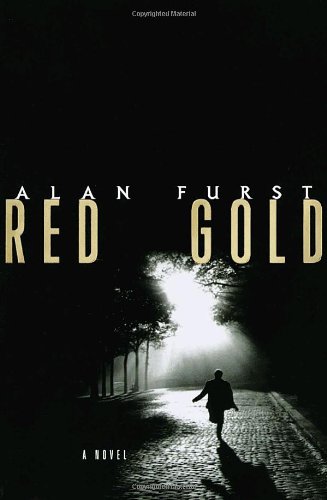
Items related to Red Gold: A Novel
Synopsis
"In the world of the espionage thriller, Alan Furst is in a class of his own."--William Boyd
Paris. Autumn, 1941. In a shabby hotel off the place Clichy, the course of the French resistance is about to change. German tanks are rolling toward Moscow. Stalin has issued a decree: all partisan operatives are to strike behind enemy lines--from Kiev to Brittany.
Set in the back streets of Paris and deep in occupied France, Red Gold moves with quiet and pervasive menace as predators from the dark edge of the war--arms dealers, lawyers, spies, and assassins--emerge from the shadows of the Parisian underworld.
In their midst is Jean Casson, once a producer of gangster films, now living on a few francs a day and hunted by the Gestapo. As the German occupation tightens, Casson is drawn into an ill-fated mission: running guns to combat units of the French Communist party. Their NKVD contact, a former Comintern operative named Weiss--his seventeenth name--begins to orchestrate a series of attacks against the Germans. Reprisals are brutal. Fear spreads through the city. At last the real resistance has begun.
Red Gold masterfully recreates the duplicitous world of the French resistance in the worst days of World War II.
"synopsis" may belong to another edition of this title.
About the Author
Often compared to Graham Greene and Eric Ambler, Alan Furst is a master of the spy thriller and one of the great war novelists of our time. He is the author of Night Soldiers, Dark Star, The Polish Officer, and The World at Night. He lives in Sag Harbor, New York.
From the Back Cover
PRAISE FOR ALAN FURST'S PREVIOUS BOOKS
"Furst's ability to re-create the terror of espionage is matchless."
--Robert Harris
"First-rate reading--vivid, compelling, and rich with authentic detail about clandestine battles and battlegrounds. No one evokes World War II behind the lines better than Alan Furst does."
--Geoffrey C. Ward
"With the skill of Eric Ambler and John le Carré, Alan Furst practically invents a new genre: historical espionage . . . Extremely well written."
--Nelson DeMille
"Beautifully written, powerfully imagined, and riveting as pure story, yet so true to the historical facts and to the human realities of the tortured Europe of 1940-41 that it deserves to be regarded as an act of witness as well as an enthralling work of fiction. A triumph, with something to remember on every page."
--Charles McCarry
"Imagine discovering an unscreened espionage thriller from the late 1930s, a classic black-and-white movie that captures the murky allegiances and moral ambiguities of Europe on the brink of war . . . Nothing can be like watching Casablanca for the first time, but Furst comes closer than anyone has in years."
--Time
From the Inside Flap
world of the espionage thriller, Alan Furst is in a class of his own."--William Boyd
Paris. Autumn, 1941. In a shabby hotel off the place Clichy, the course of the French resistance is about to change. German tanks are rolling toward Moscow. Stalin has issued a decree: all partisan operatives are to strike behind enemy lines--from Kiev to Brittany.
Set in the back streets of Paris and deep in occupied France, Red Gold moves with quiet and pervasive menace as predators from the dark edge of the war--arms dealers, lawyers, spies, and assassins--emerge from the shadows of the Parisian underworld.
In their midst is Jean Casson, once a producer of gangster films, now living on a few francs a day and hunted by the Gestapo. As the German occupation tightens, Casson is drawn into an ill-fated mission: running guns to combat units of the French Communist party. Their NKVD contact, a fo
Reviews
From the atmosphere established in his fifth novel's first sentence ("Casson woke in a room in a cheap hotel and smoked his last cigarette") to the knock on the door at the denouement, Furst again proves himself the master of his chosen terrain?behind the lines of Nazi occupation in France during WWII. His previous novel, The World at Night, opened in May 1940, with French film producer Jean Casson setting out to take newsreels of the defense of France's Maginot line and becoming swamped in the German invasion. It is now September 1941, and Casson, broke and hiding under a false name, is about to commit fully to the Resistance. As a man of indeterminate political affiliation, he's chosen to negotiate between the Resistance and the French Communists, who, with the German army on the verge of taking Moscow, have orders from Stalin to sabotage the Nazis in any way possible. The "red gold" SS looters try to steal in Russia is a metaphoric payment in blood, while in Paris informers are everywhere and collaboration is still rampant. Furst's textured plot?exhibiting shifting loyalties and betrayals; lone, often hopeless acts of heroism; and lovers bravely parting?makes for spellbinding drama. (In one scene, a clandestine radio operator broadcasts a few moments too long, and hears soldiers' boots racing up the stairs to get him.) Furst, who deserves the comparisons he's earned to Graham Greene and Eric Ambler, seems to be settling into a franchise here, rather than reaching for the fire he caught in his third novel, The Polish Officer. Casson's story unfolds convincingly, however, and as it continues here to April of 1942, promises a few more episodes to come from this author's tried and true brand of masterfully detailed espionage.
Copyright 1999 Reed Business Information, Inc.
More masterful, richly atmospheric WWII spy fiction sends Furst's despairing, dissolute, but delightfully resourceful film producer Jean Casson on yet another existential errand among the fiends and fanatics of the French Resistance. Having spied, loved, and lost in The World at Night (1996), Casson is spending the cold autumn of 1941 hiding out from the Gestapo in a sleazy Paris pensione, spending his dwindling pile of Vichy francs on sex and cigarettes. Fearing that his spiteful landlady may turn him in, he pawns his overcoat, falls in with a gang of makes a fortune selling a sack of stolen sugar, and loses everything at a decadent nightclub when he's robbed and beaten by gendarmes who, instead of tossing him to the Nazis, convey him to his former intelligence commander, DeGrave, now a Vichy bureaucrat. DeGrave wants Casson to dig up a few of his left-leaning filmmaking cronies to provide liaison between a group of Vichy officers, eager to subvert the Nazi occupation, and a fanatical group of Communist terrorist fighters, whose reckless bloodlust is doing more harm than good. Casson, sunk in Gallic funk, accepts becausewell, hed rather sleep in a better hotel. The Communists, supervised by a fearsomely intelligent fatalist named Weiss, come across as a mixed bag of trembling adolescents, cocky Jews, and violent thugs. Alas, Weiss wont take Casson seriously until Casson delivers to him a thousand machine guns, with ammunition. DeGrave agrees to finance the guns, and slyly gives Casson a reason to live by introducing him to Helene Shrieber, another wounded soul who beds him, then warily permits herself to fall in love. Despite the occasional history lecture, Furst's intricate exploration of a stylishly lethal war-torn Paris never fails to fascinate. Witty, inventive, distinctively French film-noir espionage, told with the terse brutality and jaundiced romanticism of Chandler and Hammett at their peak. -- Copyright ©1999, Kirkus Associates, LP. All rights reserved.
Veteran novelist Furst's second effort featuring former film producer Jean Casson is just as good as his first (The World at Night, LJ 5/15/96) and exerts the marvelous emotional pull of a world-weary postwar French film. The time is 1941; the place, occupied Paris. Reluctantly, Casson becomes involved in the French Resistance as an intermediary between feuding factions of partisans. An associate exclaims, "Well, Casson, you're in luck.... You may not have found patriotism, but it appears...to have found you." Communists and loyalists jockey for advantage against each other; no one trusts anyone. Casson is a wonderful character under pressure, outwardly cynical but intensely romantic at heart. An officer asks, "What's Casson like?" The response: "Intelligent, a good heart, some professional success, some failure." Comparison with Eric Ambler and Graham Greene is inevitable. A classy thriller, strong on mood and action; highly recommended.
-?David Keymer, California State Univ., Stanislaus
Copyright 1999 Reed Business Information, Inc.
Excerpt. © Reprinted by permission. All rights reserved.
Paris. 18 September, 1941.
Casson woke in a room in a cheap hotel and smoked his last cigarette. The window by the bed was open and the shade, yellow and faded, bumped gently against the sill in the morning breeze. When it moved he could see fierce blue sky, a bar of sunlight on the lead sheeting of the roof across the courtyard. Something in the air, he thought, a ghost of something, and the sky was lit a certain way. So then, autumn.
A knock at the door; a woman came in and sat on the edge of the bed. She had a room down the hall and came to see him sometimes. He offered her the cigarette, she inhaled and gave it back. "Thank you," she said. She stood up, pulled her slip over her head and hung it on a nail in the wall, then climbed in next to him. "Tell me," she said, "what is it you see out there?"
"Sky. Nothing much."
She pulled the blanket up so it covered their shoulders. "You live in a dream," she said.
"You think it's wrong?"
He felt her shrug. "I don't know--why bother?"
She settled next to him, so the tips of her breasts brushed the skin of his back, ran a finger down the line of hair from his chest to his stomach, and slid her hand between his legs. He stubbed the cigarette out carefully in a saucer he kept on the windowsill, then closed his eyes. For a time he stayed like that, adrift.
"Well," he said, "maybe you're right."
He turned to face her, she rested a knee on his hip, opening her legs. After a moment she said, "Your hands are always warm."
"Warm hands, cold heart."
She laughed, then kissed him. "Not you," she said. He could smell wine on her breath.
His mind wandered. It was very quiet, all he could hear was her breathing, long and slow, and the yellow shade, bumping against the sill in the morning air.
Place Clichy. He sat at an outside table at a café and sipped the roast barley infusion the waiter brought him. Coffee, he thought, remembering it. Very expensive now, he didn't have the money. He stared out at the square, Clichy a little lost in the daylight, the cheap hotels and dance halls gray and crooked in the morning sun, but Casson didn't mind. He liked it--in the same way he liked deserted movie sets and winter beaches.
On the chair next to him somebody had left a damp copy of yesterday's Le Soir. He spread it out on the table.
. . . the low hills of Lokhvitsa, brooding at nightfall, the steep banks of the river Dnieper, the grumble of distant cannonade. Suddenly, white Very lights fired from flare pistols, sputtering as they float to earth. A signal! Guderian's Third Panzer has linked up with Kleist's Sixteenth Panzer! The Kiev pocket has snapped shut like a trap: 300,000 Russian casualties, 600,000 taken prisoner, five Soviet armies obliterated. Now, Kiev must fall within hours. Victorious Wehrmacht columns burst into song as they prepare to march into the defeated city.
Casson shook his head--who writes this shit? His eyes wandered to the top of the column. Oh, from their foreign correspondent, Georges Broux. Well, that explained it. Once upon a time, when he'd been Jean Casson, producer of gangster films, with an office near the Champs-Elysées, Georges Broux had sent him a screenplay. Morning Must Come, something like that. Maybe it was Dawn that had to come, or A New Day, but that was the general idea. La Belle France brought to her knees by decadence and socialism. "Dear Georges, thanks for letting us have a look; unfortunately . . ." And did, Casson wondered, the Wehrmacht actually burst into song? Maybe it did.
He searched in his pocket until he found the cigarette stub and lit it, sipped his barley coffee, turned to the movie page. Playing at the Impériale, over on the Champs-Elysées, was Premier Rendezvous--first date--with Danielle Darrieux and Louis Jourdan. If you'd seen that, the Gaumont had "a frothy romantic comedy." Or, if you were really hard to please, you could go out to Neuilly for "a little jewel, bubbling over with mirth! A sly French wink!" Casson read through the listings for the smaller theatres, sometimes they ran revivals and his old films showed up. No Way Out or The Devil's Bridge. Maybe, even, Night Run.
He heard the engine--tuned to a perfect hum--and forced himself to look up casually. A black traction-avant Citroën, a Gestapo car, had pulled to the curb in front of the café. Casson's heart hammered against his ribs. He bent over the newspaper, concealing his face, and turned the page. A goalie leaped toward the edge of his net as the ball sailed past his hands, a jumble of print, this team 2, that team 1. He had an identity card, Marin, Jean Louis, and a ration book. Nothing more. It wasn't a quality fake, he'd bought it from a taxi driver, one phone call and that was the end of him. Casson was wanted by the Gestapo; taken in for questioning at the rue des Saussaies office three months earlier, he had crawled out an unbarred window and escaped over the roof. Dumb luck, Casson thought, the kind that doesn't come a second time.
The driver got out of the Citroën and held the back door open. A tall man in a dark suit, a raincoat worn over his shoulders, came out of the little hotel next to the café. He was young and fair, very white, very drawn. There wasn't much, really there wasn't anything, that you couldn't buy on the place Clichy. Perhaps the German officer had bought something he hadn't liked--or maybe it was just the next morning he didn't like it. He paused at the door, put one hand on the roof, leaned forward. Was he going to be sick? No, he climbed into the car, the driver slammed the door.
Look down. That was barely in time. Casson stared at people--who were they? It was just something he could not stop himself from doing. And the man who'd held the door for his superior had caught him at it. Nantes 0, Lille 0. Caen 3, Rouen 2. Please. The Citroën idled, then the front door closed, the driver put the car in gear and drove off, turning onto the boulevard Batignolles.
His room at the Hotel Victoria. Six floors up, under the roof. Ten by ten, narrow iron bed, a chair, a washstand. Ancient wallpaper, the color of oatmeal, and bare wooden boards. Faint smell of sulfur, burned to get rid of the bugs, faint smell of black tobacco. And all the rest of it. Casson took an overcoat down from a hook in the wall. Not so bad. He rubbed his thumb idly across a small stain above the pocket. He'd bought it back in August, when he still had a little money, from a peddler's cart in the place République. For winter, he'd thought, but he wasn't the one who was going to wear it this winter.
He hunted through the pockets, made sure the Goddess of Luck hadn't left a fifty-franc note in there for him. No, nothing. He rolled the coat up tight, held it to the right side of his body. It was his one possession and La Patronne knew it. He owed three weeks' rent, if the owner caught him taking it out of the hotel, she'd stop him, would make a great scene, would probably call the police. Like a mythic beast she stood behind the hotel desk, keeping guard on the door. Draped always in black, wearing broken carpet slippers for her sore feet. Flabby face, eyes like wet stones. She could smell money in the next block. She truly could, Casson thought.
He closed his door silently, went downstairs one cautious step at a time. On the landing of the second floor he became aware of conversation in the lobby, something not right in the tone of it. Halfway down the final flight he stopped. He could see black shoes, blue trousers, the bottom of a cape. Merde. Police. Not an exotic moment in the life of the Hotel Victoria, but Casson could have done without it. He stood still, held his breath, listened intently. About forty years old. Was last seen. If by chance he should.
He went cold. Tried to swallow. The police voice stopped. A long moment. Casson could hear people talking in the street outside the door. Then, finally, the patronne. Mmm, no, she didn't think so. It wasn't anybody she'd seen. Of course she would notify the préfecture if. Jesus, they were looking at a photograph. He counted to three, then clomped down the stairs in a hurry, making all the noise he could. The policeman turned to glance at him as he went by, the patronne looked up from the photograph. "Bonjour, madame," he muttered--busy, tense, angry at the world. She started to say something to him, he could feel her mind working, but he was through the door in three strides and that was that.
He went around the corner, slowed down, got his composure back. Then headed south, toward the 3rd Arrondissement. A bright day, the little ghost of a chill still hung in the morning air. Early autumn this year, he thought. Which meant: early winter. Well, good. Maybe he'd get a few francs more for the overcoat.
He took backstreets, crossing into the 10th Arrondissement. Turgot, Condorcet, d'Abbeville. Then the rue des Petits-Hotels--yes, there were some. On rue Paradis, too many Germans, milling around the Baccarat salesroom. Then, a choice: to cross the boulevard you could take either the rue de la Fidelité or the passage du Désir--street of fidelity or alley of desire. Which? He took the alley, but noted that it ran downhill. Next, he hurried across the broad boulevard Magenta. Too wide, too open. That fucking Haussmann, he thought, rebuilding Paris a hundred years earlier, designing open boulevards to facilitate field-of-fire, cannon shot, against the revolutionary mobs of days to come. A visionary, in his way. He had destroyed the medieval rat's nest of Paris streets, anybody, even a lumbering German, could find his way around. Real Parisians, even those, like Casson, who'd spent their lives in the Passy district of the snob 16th, knew the value of a good maze, rank with crumbling drains and metal pissotières on the corners.
Head down on the narrow streets. Baggy flannel pants, suit...
"About this title" may belong to another edition of this title.
Search results for Red Gold: A Novel

Seller Image
Red Gold: A Novel
Seller: Greenworld Books, Arlington, TX, U.S.A.
Seller rating 5 out of 5 stars

Condition: good. Fast Free Shipping â" Good condition. It may show normal signs of use, such as light writing, highlighting, or library markings, but all pages are intact and the book is fully readable. A solid, complete copy that's ready to enjoy. Seller Inventory # GWV.0679451862.G
Seller Image
Red Gold: A Novel
Seller: Greenworld Books, Arlington, TX, U.S.A.
Seller rating 5 out of 5 stars
Condition: very_good. Fast Free Shipping â" Very Good condition book with a firm cover and clean pages. Shows normal use and some light wear or limited notes markings. A solid, nice copy to enjoy. Seller Inventory # GWV.0679451862.VG
Stock Image
Red Gold
Seller: World of Books (was SecondSale), Montgomery, IL, U.S.A.
Seller rating 5 out of 5 stars
Hardback. Condition: Good. Seller Inventory # 00103813153
Stock Image
Red Gold: A Novel
Seller: Wonder Book, Frederick, MD, U.S.A.
Seller rating 5 out of 5 stars
Condition: Good. Good condition. Good dust jacket. A copy that has been read but remains intact. May contain markings such as bookplates, stamps, limited notes and highlighting, or a few light stains. Seller Inventory # Q01G-01503
Stock Image
Red Gold
Published by
Random House, Incorporated, 1998
ISBN 10: 0679451862
ISBN 13: 9780679451860
Used
Hardcover
Seller: Better World Books, Mishawaka, IN, U.S.A.
Seller rating 5 out of 5 stars
Condition: Good. Former library copy. Pages intact with minimal writing/highlighting. The binding may be loose and creased. Dust jackets/supplements are not included. Includes library markings. Stock photo provided. Product includes identifying sticker. Better World Books: Buy Books. Do Good. Seller Inventory # GRP21153335
Stock Image
Red Gold
Published by
Random House, Incorporated, 1998
ISBN 10: 0679451862
ISBN 13: 9780679451860
Used
Hardcover
Seller: Better World Books, Mishawaka, IN, U.S.A.
Seller rating 5 out of 5 stars
Condition: Very Good. Former library copy. Pages intact with possible writing/highlighting. Binding strong with minor wear. Dust jackets/supplements may not be included. Includes library markings. Stock photo provided. Product includes identifying sticker. Better World Books: Buy Books. Do Good. Seller Inventory # 4084166-6
Seller Image
Red Gold: A Novel
Seller: ZBK Books, Carlstadt, NJ, U.S.A.
Seller rating 5 out of 5 stars
Condition: very_good. Fast & Free Shipping â" Very Good condition book with a firm cover and clean pages. Shows normal use and some light wear or limited notes markings. A solid, nice copy to enjoy. Seller Inventory # ZWV.0679451862.VG
Stock Image
Red Gold: A Novel
Seller: ThriftBooks-Dallas, Dallas, TX, U.S.A.
Seller rating 5 out of 5 stars
Hardcover. Condition: Good. No Jacket. Former library book; Pages can have notes/highlighting. Spine may show signs of wear. ~ ThriftBooks: Read More, Spend Less. Seller Inventory # G0679451862I3N10
Stock Image
Red Gold: A Novel
Seller: ThriftBooks-Atlanta, AUSTELL, GA, U.S.A.
Seller rating 5 out of 5 stars
Hardcover. Condition: Very Good. No Jacket. May have limited writing in cover pages. Pages are unmarked. ~ ThriftBooks: Read More, Spend Less. Seller Inventory # G0679451862I4N00
Stock Image
Red Gold: A Novel
Seller: ThriftBooks-Dallas, Dallas, TX, U.S.A.
Seller rating 5 out of 5 stars
Hardcover. Condition: Fair. No Jacket. Former library book; Readable copy. Pages may have considerable notes/highlighting. ~ ThriftBooks: Read More, Spend Less. Seller Inventory # G0679451862I5N10