
Items related to The File: A Personal History
Synopsis
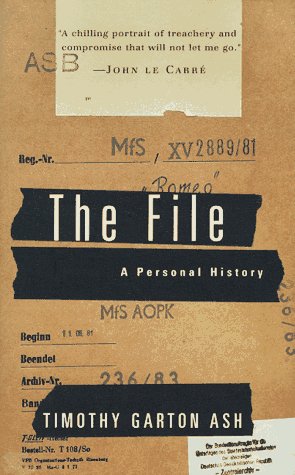
"An invaluable document for our time, bravely and beautifully written. A chilling portrait of treachery and compromise that will not let me go."
--John le Carré
In 1978, fresh out of Oxford, Timothy Garton Ash set out for Berlin to see what he could learn from the divided city about freedom and despotism. As he moved from west to east--from Berlin glamour to Berlin danger--the East German secret police, the so-called Stasi, was compiling a secret file on his activities, monitoring his Berlin days and nights and tracking his growing involvement with the Solidarity movement in Poland.
Fifteen years later, with the Wall torn down and Berlin now unified, Garton Ash visited Stasi headquarters to find his file. The thick dossier he was given forms the basis for this real-life thriller in which he traces and confronts the German friends and acquaintances who informed on him, and the officers who hired them. Behind Stasi reports of suspicious meetings we discover the love affairs, friendships, and formative intellectual encounters that actually occurred. And behind a baffling web of lies, half-truths, and forgotten stories we find a forty-year-old man spying on his younger self.
"Amid the ghost of secret Germany," he writes, "I was searching for the answer to a personal question: What is it that makes one person a resistance fighter and another the faithful servant of a dictatorship--this man a Stauffenberg, that a Speer?" And he forces us to ask: Which would I be?
The File reads like a brilliant work of fiction by Graham Greene or George Orwell--but every word is true.
"The File is by far the wisest and most penetrating study of a communist informer society ever written by an outsider. "
--Neal Ascherson, The Independent
"synopsis" may belong to another edition of this title.
About the Author
Timothy Garton Ash is a Fellow of St. Antony's College, Oxford. Celebrated for his essays in The New York Review of Books, he is the author of The Polish Revolution, which won the Somerset Maugham Award; The Uses of Adversity, which won the Prix Européen de l'Essai; In Europe's Name; and The Magic Lantern, his eyewitness account of the Central European revolutions of 1989, which has been translated into fourteen languages. He lives in Oxford with his wife and two sons.
From the Inside Flap
aluable document for our time, bravely and beautifully written. A chilling portrait of treachery and compromise that will not let me go." <br>--John le Carré<br><br>In 1978, fresh out of Oxford, Timothy Garton Ash set out for Berlin to see what he could learn from the divided city about freedom and despotism. As he moved from west to east--from Berlin glamour to Berlin danger--the East German secret police, the so-called Stasi, was compiling a secret file on his activities, monitoring his Berlin days and nights and tracking his growing involvement with the Solidarity movement in Poland.<br><br>Fifteen years later, with the Wall torn down and Berlin now unified, Garton Ash visited Stasi headquarters to find his file. The thick dossier he was given forms the basis for this real-life thriller in which he traces and confronts the German friends and acquaintances who informed on him, and the officers who hired them. Behind Stasi reports of suspicious meetings we discover
Reviews
A British historian has the eerie experience of reading the secret file kept on him by the Stasi, the East German secret police, and meeting with those who informed on him and the police who were responsible. After the unification of Germany, the government made the unprecedented decision to open the secret police records to every person who is in them. It was an appallingly comprehensive archive. Ash (History/Oxford; The Polish Revolution, 1984) states that one out of every fifty adult East Germans had a direct connection with the secret police. The Stasi tracked him from the time that he first crossed the border as a young student. His file was 325 pages and included copies of his notes, photographed during a secret search of his luggage, and even copies of references written by his Oxford tutors. Those who informed on him included ``Michaela,'' who was also informing on her own stepdaughter; ``Schuldt,'' a middle-aged lecturer who made homosexual advances to his students; ``Doktor,'' an Englishman who was told falsely that he was suspected of being a Western spy; and a once-brave woman, a Communist who had set out ``to fight for a better world'' and ended as an informer. His confrontations with these figures are difficult (some are abashed, some defiant), fascinating, but rarely satisfying for Ash. He fares little better with the police he tracks down, including a ``perfect textbook example of the petty bureaucratic executor of evil'' and an unrepentant colonel, reeking of ``alcohol, cigarette smoke, boredom and emptiness.'' Few it seems, can face what they have done. In the files, writes Ash, is ``a vast anthology of human weakness,'' reflecting less deliberate dishonesty ``than our almost infinite capacity for self-deception.'' Sensitive, subtle, and illuminating, as a fine historian explores those infinitely complicated choices made by human beings confronted by the issue of collaboration or resistance. (First serial to the New Yorker; author tour) -- Copyright ©1997, Kirkus Associates, LP. All rights reserved.
Garton Ash's (In Europe's Name, LJ 1/94) investigative memoir focuses on the waning days of the Cold War, when espionage and suspicion were the order of the day in Eastern Europe. The author went to Berlin to study in 1978 and soon came under the scrutiny of the Stasi, the notorious East German secret police. In 1993, Garton Ash had the opportunity to examine the secret file kept on him. Comparing the file reports with his private diary of the time, he finds distortions, fabrications, and surprising omissions in the file. There are compelling accounts of visits to his informers and the officers who monitored his case, yet the most revealing aspects of this book center on Garton Ash's search for his "lost self." While marveling at reunited Germany's unprecedented opening of the secret police files, he also analyzes the Germans' attempts to come to terms with their past. Hence, this work makes an important contribution to the literature of the new Europe and is recommended for most academic and public libraries.
-?Thomas A. Karel, Franklin & Marshall Coll. Lib., Lancaster, Pa.
Copyright 1997 Reed Business Information, Inc.
In a totalitarian state, who informs and why? How truthful are the files, anyway? These questions animate Ash's extraordinary investigation of his investigators, the East German secret police. Ash, an Oxford professor of history, lived in East Berlin in his student days around 1980--an obvious cover for spying in the Stasi weltanschauung. His diary, contemporaneous with the Stasi's surveillance of him, while a useful documentary check on informants' reports, rather embarrasses Ash for the "insouciance with which [he] barged into other people's lives," and so he examines his personality in youth and how fickle his memory of that time is. That he writes fluidly and precisely only enhances the factual material, which culminates in visits to the people who informed on him and to the officers who hooked and controlled the informers. Astute and absorbing, Ash's analysis of his dossier reads like a good cold war spy novel, none the less so that only the fate of himself, rather than the world, is in the balance. Gilbert Taylor
"About this title" may belong to another edition of this title.
Search results for The File: A Personal History

Seller Image
The File: A Personal History
Seller: Bay State Book Company, North Smithfield, RI, U.S.A.
Seller rating 5 out of 5 stars

Condition: very_good. Seller Inventory # BSM.1FCHX
Stock Image
File: The: A Personal History
Seller: World of Books (was SecondSale), Montgomery, IL, U.S.A.
Seller rating 5 out of 5 stars
Hardback. Condition: Good. Eloquent, aware and scrupulous . . . a rich and instructive examination of the Cold War past. --The New York Times In 1978 a romantic young Englishman took up residence in Berlin to see what that divided city could teach him about tyranny and freedom. Fifteen years later Timothy Garton Ash--who was by then famous for his reportage of the downfall of communism in Central Europe--returned. This time he had come to look at a file that bore the code-name Romeo. The file had been compiled by the Stasi, the East German secret police, with the assistance of dozens of informers. And it contained a meticulous record of Garton Ash's earlier life in Berlin. In this memoir, Garton Ash describes what it was like to rediscover his younger self through the eyes of the Stasi, and then to go on to confront those who actually informed against him to the secret police. Moving from document to remembrance, from the offices of British intelligence to the living rooms of retired Stasi officers, The File is a personal narrative as gripping, as disquieting, and as morally provocative as any fiction by George Orwell or Graham Greene. And it is all true. In this painstaking, powerful unmasking of evil, the wretched face of tyranny is revealed. --Philadelphia Inquirer. Seller Inventory # 00105946736
Stock Image
The File: A Personal History
Seller: ThriftBooks-Atlanta, AUSTELL, GA, U.S.A.
Seller rating 5 out of 5 stars
Hardcover. Condition: Fair. No Jacket. Readable copy. Pages may have considerable notes/highlighting. ~ ThriftBooks: Read More, Spend Less. Seller Inventory # G0679455744I5N00
Stock Image
The File: A Personal History
Seller: ThriftBooks-Atlanta, AUSTELL, GA, U.S.A.
Seller rating 5 out of 5 stars
Hardcover. Condition: Good. No Jacket. Former library book; Pages can have notes/highlighting. Spine may show signs of wear. ~ ThriftBooks: Read More, Spend Less. Seller Inventory # G0679455744I3N10
Stock Image
The File: A Personal History
Seller: ThriftBooks-Dallas, Dallas, TX, U.S.A.
Seller rating 5 out of 5 stars
Hardcover. Condition: Good. No Jacket. Former library book; Pages can have notes/highlighting. Spine may show signs of wear. ~ ThriftBooks: Read More, Spend Less. Seller Inventory # G0679455744I3N10
Seller Image
The File: A Personal History
Seller: ZBK Books, Carlstadt, NJ, U.S.A.
Seller rating 5 out of 5 stars
Condition: very_good. Fast & Free Shipping â" Very Good condition book with a firm cover and clean pages. Shows normal use and some light wear or limited notes markings. A solid, nice copy to enjoy. Seller Inventory # ZWV.0679455744.VG
Stock Image
The File: A Personal History
Seller: ThriftBooks-Dallas, Dallas, TX, U.S.A.
Seller rating 5 out of 5 stars
Hardcover. Condition: Very Good. No Jacket. May have limited writing in cover pages. Pages are unmarked. ~ ThriftBooks: Read More, Spend Less. Seller Inventory # G0679455744I4N00
Stock Image
The File: A Personal History
Seller: ThriftBooks-Reno, Reno, NV, U.S.A.
Seller rating 5 out of 5 stars
Hardcover. Condition: Very Good. No Jacket. May have limited writing in cover pages. Pages are unmarked. ~ ThriftBooks: Read More, Spend Less. Seller Inventory # G0679455744I4N00
Stock Image
The File: A Personal History
Seller: ThriftBooks-Phoenix, Phoenix, AZ, U.S.A.
Seller rating 5 out of 5 stars
Hardcover. Condition: Very Good. No Jacket. May have limited writing in cover pages. Pages are unmarked. ~ ThriftBooks: Read More, Spend Less. Seller Inventory # G0679455744I4N00
Stock Image
The File: A Personal History
Seller: ThriftBooks-Atlanta, AUSTELL, GA, U.S.A.
Seller rating 5 out of 5 stars
Hardcover. Condition: Very Good. No Jacket. May have limited writing in cover pages. Pages are unmarked. ~ ThriftBooks: Read More, Spend Less. Seller Inventory # G0679455744I4N00