
Items related to Normal: Transsexual CEOs, Crossdressing Cops, and Hermaphrod...
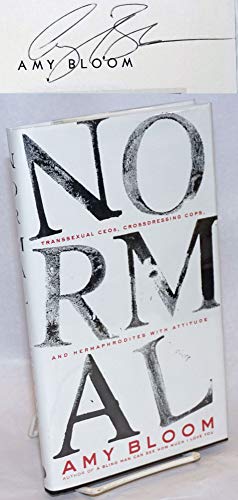
Synopsis
Amy Bloom has won a devoted readership and wide critical acclaim for fiction of rare humor, insight, grace, and eloquence, and the same qualities distinguish Normal, her first full-length work of nonfiction. In Normal, the National Book Critics Circle Award and National Book Award finalist explores sex and gender through portraits of people who are widely considered not normal.
“A great many people, sick of news from the margins, worn out by the sand shifting beneath their assumptions, like to imagine Nature as a sweet, simple voice: tulips in spring, Vermont’s leaves falling in autumn,” Bloom writes. “Nature is more like Aretha Franklin: vast, magnificent, capricious, occasionally hilarious, and infinitely varied.”
Bloom takes us on a provocative, intimate journey into the lives of “people who reveal, or announce, that their gender is variegated rather than monochromatic”—female-to-male transsexuals, heterosexual crossdressers, and the intersexed. We meet Lyle Monelle and his mother, Jessie, who recognized early on that her little girl was in fact a boy and used her life savings to help Lyle make the transgender transition. On a Carnival cruise with a group of crossdressers and their spouses, we meet Peggy Rudd and her husband, “Melanie,” who devote themselves to the cause of “ordinary heterosexual men with an additional feminine dimension.” And we meet Hale Hawbecker, “a regular, middle-of-the-road, white-bread guy” with a wife, kids, and a medical condition, the standard treatment for which would have changed his life and his gender.
Bloom shows the essential humanity in this infinite variety, allowing us to appreciate these people as they really are—both like and unlike everyone else—and inviting us “to see into these particular worlds and back out to the larger one we all share.” Casting light into the dusty corners of our assumptions about sex, gender, and identity, about what it means to be male or female, Bloom reveals new facets to ideas about happiness, personality, and character, even as she brilliantly illumines the very concept of “normal.”
"synopsis" may belong to another edition of this title.
About the Author
Amy Bloom is the author of A Blind Man Can See How Much I Love You, Come to Me, and a novel, Love Invents Us. Her work has appeared in The New Yorker, The Atlantic Monthly, and Harper’s Bazaar, among other publications, and in many anthologies, including The Best American Short Stories; Prize Stories: The O. Henry Awards; and The Scribner Anthology of Contemporary Short Fiction. A practicing psychotherapist, she lives in Connecticut and teaches at Yale University.
From the Back Cover
Advance Praise for Normal
“Amy Bloom’s wonderful eye and ear are evident as she encounters people for whom gender is a complex issue. Bloom cares for her subjects but retains her objectivity; her great skill is in extracting and weaving from the specific stories her own original thesis about sexuality and gender. This is an important work.”
—Abraham Verghese, author of My Own Country and The Tennis Partner
“Wonderfully written, thoughtfully and compassionately told, this book stretches the concept of ‘normal’ to show how elastic, how all-embracing, nature’s view of gender really is. It’s a mind-opening, spirit-enlarging book.”
—Deborah Tannen, author of You Just Don’t Understand and I Only Say This Because I Love You
Praise for Amy Bloom
“Amy Bloom is possessed of great subtlety and rock-solid integrity. Her stories crackle with subvert revelation. She is a compassionate writer who, more important, loves the world too much to sentimentalize it.”
—Michael Cunningham, about A Blind Man Can See How Much I Love You
“Amy Bloom gets more meaning into individual sentences than most authors manage in whole books.”
—The New Yorker, about A Blind Man Can See How Much I Love You
“The highest compliment I can pay a writer is to say that her work is Chekhovian—which is to say that its fine, fierce intelligence is matched by its compassion....This is a rare book.”
—Rosellen Brown, about Love Invents Us
“Amy Bloom has many voices and lives many lives....Come to Me is charged from the first line....Then, step by step, it gathers weight, texture and power, and suddenly it ends with what is really another beginning....We know we are in the hands of a real writer.”
—Margo Jefferson, The New York Times, about Come to Me
From the Inside Flap
Amy Bloom has won a devoted readership and wide critical acclaim for fiction of rare humor, insight, grace, and eloquence, and the same qualities distinguish Normal, her first full-length work of nonfiction. In Normal, the National Book Critics Circle Award and National Book Award finalist explores sex and gender through portraits of people who are widely considered not normal.
A great many people, sick of news from the margins, worn out by the sand shifting beneath their assumptions, like to imagine Nature as a sweet, simple voice: tulips in spring, Vermont s leaves falling in autumn, Bloom writes. Nature is more like Aretha Franklin: vast, magnificent, capricious, occasionally hilarious, and infinitely varied.
Bloom takes us on a provocative, intimate journey into the lives of people who reveal, or announce, that their gender is variegated rather than monochromatic female-to-male transsexuals, heterosexual crossdressers, and the intersexed. We meet Lyle Monelle and his mother, Jessie, who recognized early on that her little girl was in fact a boy and used her life savings to help Lyle make the transgender transition. On a Carnival cruise with a group of crossdressers and their spouses, we meet Peggy Rudd and her husband, Melanie, who devote themselves to the cause of ordinary heterosexual men with an additional feminine dimension. And we meet Hale Hawbecker, a regular, middle-of-the-road, white-bread guy with a wife, kids, and a medical condition, the standard treatment for which would have changed his life and his gender.
Bloom shows the essential humanity in this infinite variety, allowing us to appreciate these people as they really are both like and unlike everyone else and inviting us to see into these particular worlds and back out to the larger one we all share. Casting light into the dusty corners of our assumptions about sex, gender, and identity, about what it means to be male or female, Bloom reveals new facets to ideas about happiness, personality, and character, even as she brilliantly illumines the very concept of normal.
Reviews
Taking in an amazing range and diversity of the human experience of gender and sexuality, novelist Bloom (Love Invents Us) devotes an essay each to three phenomena: female to male transsexualism, heterosexual cross-dressing and the intersexed, or those with ambiguous genitalia or confusing chromosomal balance. But she is most interested in examining "why the rest of us struggle" with gender and sexual experiences we do not share. Bloom interviews people from each of the above groups (as well as doctors, social scientists and gender activists) and brings together, in graceful, readable prose, a plethora of facts, ideas, arguments and personal responses to help us reconsider received ideas about gender. While some of her information is surprising (babies born with "confusing" gentials are more common than babies born with cystic fibrosis), she never uses the lives of her subjects to titillate. Bloom is happy to confess her own, and others', confusions and lack of information, pointing out that there is no reliable information on the number of heterosexual cross-dressers, for instance. And she allows her subjects like the female-to-male-transsexual who has not undergone phalloplasty and claims, "I can live this way, as a man with a vagina" their complicated lives. Fascinating without being prurient, detailed without being overly scientific, the book opens new ways of viewing not only gender but our own inability to accept difference.
Copyright 2002 Cahners Business Information, Inc.
Bloom's understanding of gender changed radically after her remarkable odyssey into the hidden worlds of female-to-male transsexuals, heterosexual cross-dressers, and hermaphrodites, and so will her readers'. She is uniquely qualified to tell the perplexing and poignant stories of gender-benders by virtue of her work as a clinical social worker and empathic fiction writer (the exceptional A Blind Man Can See How Much I Love You [2000] reflects the invaluable revelations sparked by this inquiry), not to mention her curiosity and piquant sense of humor. Lucid, frank, and compassionate, Bloom succinctly recounts her illuminating conversations with straight men who feel compelled to dress as women and their amazingly supportive wives; individuals who were born with a woman's body and a man's soul who underwent excruciating and expensive surgery (which Bloom explains in detail) in order to live as their true selves; people born with "ambiguous genitals"; surgeons who perform the complicated, sometimes controversial operations that "correct" these confusing states; and the activists and entrepreneurs who support them. Beautifully done, Bloom's fascinating and enlightening disquisition greatly extends our perception of humanness. Donna Seaman
Copyright © American Library Association. All rights reserved
Exploring territory that lies beyond the dichotomies of female and male, gay and straight, Bloom, a National Book Critics Circle finalist for her story collection, A Blind Man Can See How Much I Love You, introduces members of three very different groups who challenge common definitions of gender and sexuality. For her first nonfiction book, she interviewed women who have surgery in order to conform physically with the male gender they have always seen themselves as having; heterosexual men who satisfy a sexual fetish (they prefer to call it a hobby) by dressing in women's clothing; and the intersexed, whose prime political objective is to do away with the unquestioned cosmetic surgery on children born with ambiguous genitalia. A practicing psychotherapist, fiction writer, feminist, and lesbian, Bloom dares the reader to be willingly confounded by her always engaging, frequently humorous interviewees while also airing her own reactions, particularly her outrage at the brutal surgeries whose benefits have yet to be proven performed on unwitting infants. As an accessible, nonsensationalistic introduction to a fascinating and controversial subject, this volume is recommended for all collections. Ina Rimpau, Newark P.L., NJ
Copyright 2002 Cahners Business Information, Inc.
Excerpt. © Reprinted by permission. All rights reserved.
THE BODY LIES
FEMALE-TO-MALE TRANSSEXUALS
What would you go through not to have to live the life of Kafka’s Gregor Samsa? Not to realize, early in childhood, that other people perceive a slight, unmistakable bugginess about you, which you find horrifying but they claim to find unremarkable? That glimpses of yourself in the mirror are upsetting and puzzling and to be avoided, since they show a self that is not you? That although you can ignore your shell much of the time and your playmates often seem to see you and not your cockroach exterior, teachers and relatives pluck playfully at your antennae with increasing frequency and suggest, not unkindly, that you might be more comfortable with the other insects? And when you say, or cry, that you are not a cockroach, your parents are sad, or concerned, or annoyed, but unwavering in their conviction—how could it be otherwise?—that you are a cockroach, and are becoming more cockroachlike every day. Would you hesitate to pay thirty thousand dollars and experience some sharp but passing physical misery in order to be returned to your own dear, soft, skin-covered self?
Approximately two people in every hundred thousand are diagnosed—first by themselves, then by endocrinologists, family doctors, psychiatrists, or psychologists—as high-intensity transsexuals, meaning that they will be motivated, whether or not they succeed, to have surgery that will bring their bodies into accord with the gender to which they have known themselves, since toddlerhood, to belong. Until a decade or so ago the clinical literature and the unreliable statistics suggested that for every four men seeking to become anatomically female, there was one woman seeking the opposite change. Now clinical evaluation centers report that the ratio is almost one to one.
In twenty years of practice as a clinical social worker, I met men who liked to wear women’s clothing, women who preferred sex in public conveyances to sex at home, men who were more attracted to shoes than to the people in them; I didn’t meet any transsexuals. I encountered transsexuals only the way most people do: in Renee Richards’s story, in Jan Morris’s Conundrum, in Kate Bornstein’s books, and on afternoon talk shows, where transsexuals are usually represented by startlingly pretty young women, sometimes holding hands with their engagingly shy, love-struck fiancés, sometimes accompanied by defensive, supportive wives turned best friends. I wondered, in the middle of the afternoon, where the female-to-male transsexuals were. Even if there were four times as many male-to-female transsexuals, there still had to be a few thousand of the other kind somewhere. But not in mainstream bookstores, not in magazines, not in front of talk-show audiences of middle-aged women standing up to applaud the guests’ ability to “look just like the real thing.”
I thought there must be a reason female-to-male transsexuals were invisible. I wondered if their physical transformations were so pitiful that no one could bear to interview them, if women who wished to be men were less interesting, less interview-worthy than men who wished to be women, or if these people were so floridly disturbed that even the talk-show hosts were ashamed to be seen with them.
Much of the early psychiatric literature about transsexu- als, from the pre–Christine Jorgensen 1940s until the late 1970s, leaned heavily toward psychoanalytic explanations and toward clinical descriptions that, however sympathetic to the unhappy patient, emphasized the bizarreness not of the biological condition but of the conviction that there was a biological condition. The next psychiatric wave emphasized “personality disorders” as the root of transsexuality, specifically the popularized borderline personality syndrome, with its inadequately formed sense of self and frightened yearning for symbiosis. In The Transsexual Empire (1979), Janice Raymond dismissed the biological reality of transsexuality and attacked transsexuals as agents and pawns of the patriarchy. Her overwrought theories about the meaning of transsexu- ality and the training and practice of surgeons who perform transsexual procedures read like the feminist equivalent of some of the Mafia–CIA–White Russian conspiracy theories of Kennedy’s assassination, but her essential point, that transsexuals are psychologically unstable victims of a society that overemphasizes the roles of sexual insignia and gender difference, made sense to me. If the people involved were less nuts and society were less rigid, it seemed, neither transsexuals nor the surgery they seek would exist.
Most of us can understand a wish, even a persistent wish, to belong to the other gender. History and fiction are full of examples, many charming, some heroic, of women who dressed as men throughout their lives. It’s the medical procedures that make transsexuals seem crazy: six months to two years of biweekly intramuscular injections of two hundred milligrams of Depo-Testosterone, which cause an outbreak of adolescent acne, the cessation of menstruation, and the development of male secondary sex characteristics; then a double mastectomy, in which most but not all of the breast tissue is removed, the nipple saved, and the chest recontoured for a more masculine, pectorally pronounced look; and then, a year to ten years later (depending on the patient’s wishes and financial resources), a hysterectomy and one of two possible genital surgeries: a phalloplasty (a surgery to create a full-size phallus and testicles) or a metoidioplasty (a surgery that frees the testosterone-enlarged clitoris to act as a small penis). In short: multiple, expensive, and traumatic surgeries to remove healthy tissue. Who would do this?
Lyle Monelle, a burly man of twenty-eight, lives with his mother, Jessie, in a trailer park in suburban Montana, a state in which I’d never imagined suburbs. The trailer park is neatly laid out beneath a shocking cobalt sky, and all the culs-de-sac have their own blue-and-white street signs, none of which are bent or rusted or facing the wrong way. The careful hand of people who are used to making do, doing without, and trying again is everywhere. Jessie and Lyle are watching for me from the trailer’s little porch, and they come toward the car like a couple of welcoming relatives.
The inside of the trailer looks familiar; it is the Montana twin of my late mother-in-law’s home in northern Minnesota. Sturdy, slightly bowed Herculon love seat and matching recliner in shades of orange; copper mallards hanging on the opposite wall, arching over the TV. The three of us finish two pitchers of iced tea during the afternoon’s conversation, and Lyle and Jessie allow themselves to be sad and occasionally puzzled by their own story, but not for long. All their painful stories are followed by moments of remembered grief but end in the genuine and ironic laughter of foxhole buddies; they know what they know, and they are not afraid anymore.
Lyle is older than I had thought he would be—he’s an adult. He was a patient of three of the people I’ve already interviewed—Dr. Donald Laub, a preeminent plastic surgeon known especially for female-to-male sex change surgery; Judy Van Maasdam, the counselor at Laub’s surgical center in Palo Alto; and Dr. Ira Pauly, a noted psychiatrist and when they told me about Lyle, they all focused on how young he was at the time of transition, much younger than most people who apply for surgery. Even though I knew better, I had half expected to meet a teenager. He was fourteen when he began hormone treatments, with medical approval, fifteen when he had his mastectomies, but twenty-three before he and his parents had enough money for the phalloplasty, the “bottom” surgery. (That’s what the guys say about their surgeries—“my top,” “my bottom.”) I was horrified when I first heard the stories about this kid, and I imagined meeting his parents and clinically evaluating them as misguided, covertly sadistic, or perversely ignorant, acting out their own unhappiness on their helpless child.
We should all have such parents.
When Lyle entered puberty, his mother and his late father took him from doctor to doctor, looking for explanations for Lyle’s unhappiness and fierce resistance to being treated like a young woman. An endocrinologist who had worked with Don Laub recognized Lyle as possibly transsexual, and Ira Pauly and Judy Van Maasdam confirmed the diagnosis. Then, after extensive hormone treatments, Laub performed the first surgery and the family moved to another state, to allow Lyle to enter high school as a boy. Later, they nursed him after his hysterectomy and his phalloplasty, and used all their savings, and then some, to pay his medical bills.
Jessie says, “I want everyone to know who reads this that this wasn’t easy—it was a really terrible shock. I didn’t understand. I said to the first endocrinologist, ‘Where did we go wrong?’ and he said nowhere, it was biological. I called every single—I’m not kidding you—every single insurance company in the USA, and they said, ‘No, it’s cosmetic.’ ”
Lyle interrupts—the only time I’ll see him openly angry. “Yeah, right. Like I wanted a nose job. Cosmetic. Well, it was only my life.”
Jessie makes soothing hand gestures, reminding him that it’s all right now. “And of course, the money,” she says. “Our other kids resented it. I understand. But what could I do? What could we do? If your child has a birth defect, you get help. We understood—we understood even when he was little that something wasn’t right. And we knew, when the doctors told us what could be done—we just knew what we had to do. When the doctors said he was transsexual, I felt that I knew that.”
After heari...
"About this title" may belong to another edition of this title.
Search results for Normal: Transsexual CEOs, Crossdressing Cops, and Hermaphrod...

Stock Image
Normal: Transsexual CEOs, Crossdressing Cops, and Hermaphrodites with Attitude
Seller: World of Books (was SecondSale), Montgomery, IL, U.S.A.
Seller rating 5 out of 5 stars

Condition: Very Good. Item in very good condition! Textbooks may not include supplemental items i.e. CDs, access codes etc. Seller Inventory # 00099921215
Stock Image
Normal: Transsexual CEOs, Crossdressing Cops, and Hermaphrodites with Attitude
Seller: World of Books (was SecondSale), Montgomery, IL, U.S.A.
Seller rating 5 out of 5 stars
Condition: Good. Good condition ex-library book with usual library markings and stickers. Seller Inventory # 00110084785
Stock Image
Normal: Transsexual CEOs, Crossdressing Cops, and Hermaphrodites with Attitude
Published by
Random House (edition 1), 2002
ISBN 10: 067945652X
ISBN 13: 9780679456520
Used
Hardcover
Seller: BooksRun, Philadelphia, PA, U.S.A.
Seller rating 5 out of 5 stars
Hardcover. Condition: Very Good. 1. With dust jacket. It's a well-cared-for item that has seen limited use. The item may show minor signs of wear. All the text is legible, with all pages included. It may have slight markings and/or highlighting. Seller Inventory # 067945652X-8-1-29
Stock Image
Normal: Transsexual CEOs, Crossdressing Cops, and Hermaphrodites with Attitude
Seller: HPB-Ruby, Dallas, TX, U.S.A.
Seller rating 5 out of 5 stars
hardcover. Condition: Very Good. Connecting readers with great books since 1972! Used books may not include companion materials, and may have some shelf wear or limited writing. We ship orders daily and Customer Service is our top priority! Seller Inventory # S_476759093
Stock Image
Normal: Transsexual CEOs, Crossdressing Cops, and Hermaphrodites with Attitude
Seller: HPB Inc., Dallas, TX, U.S.A.
Seller rating 5 out of 5 stars
hardcover. Condition: Very Good. Connecting readers with great books since 1972! Used books may not include companion materials, and may have some shelf wear or limited writing. We ship orders daily and Customer Service is our top priority! Seller Inventory # S_368072802
Stock Image
Normal
Seller: World of Books Inc, Montgomery, IL, U.S.A.
Seller rating 4 out of 5 stars

Hardback. Condition: Very Good. Amy Bloom has won a devoted readership and wide critical acclaim for fiction of rare humor, insight, grace, and eloquence, and the same qualities distinguish Normal, her first full-length work of nonfiction. In Normal, the National Book Critics Circle Award and National Book Award finalist explores sex and gender through portraits of people who are widely considered not normal. “A great many people, sick of news from the margins, worn out by the sand shifting beneath their assumptions, like to imagine Nature as a sweet, simple voice: tulips in spring, Vermont’s leaves falling in autumn,” Bloom writes. “Nature is more like Aretha Franklin: vast, magnificent, capricious, occasionally hilarious, and infinitely varied.” Bloom takes us on a provocative, intimate journey into the lives of “people who reveal, or announce, that their gender is variegated rather than monochromatic”—female-to-male transsexuals, heterosexual crossdressers, and the intersexed. We meet Lyle Monelle and his mother, Jessie, who recognized early on that her little girl was in fact a boy and used her life savings to help Lyle make the transgender transition. On a Carnival cruise with a group of crossdressers and their spouses, we meet Peggy Rudd and her husband, “Melanie,” who devote themselves to the cause of “ordinary heterosexual men with an additional feminine dimension.” And we meet Hale Hawbecker, “a regular, middle-of-the-road, white-bread guy” with a wife, kids, and a medical condition, the standard treatment for which would have changed his life and his gender. Bloom shows the essential humanity in this infinite variety, allowing us to appreciate these people as they really are—both like and unlike everyone else—and inviting us “to see into these particular worlds and back out to the larger one we all share.” Casting light into the dusty corners of our assumptions about sex, gender, and identity, about what it means to be male or female, Bloom reveals new facets to ideas about happiness, personality, and character, even as she brilliantly illumines the very concept of “normal.” Seller Inventory # CIN067945652XVG
Stock Image
Normal: Transsexual CEOs, Crossdressing Cops, and Hermaphrodites with Attitude
Seller: ThriftBooks-Atlanta, AUSTELL, GA, U.S.A.
Seller rating 5 out of 5 stars
Hardcover. Condition: Very Good. No Jacket. Former library book; May have limited writing in cover pages. Pages are unmarked. ~ ThriftBooks: Read More, Spend Less. Seller Inventory # G067945652XI4N10
Stock Image
Normal: Transsexual CEOs, Crossdressing Cops, and Hermaphrodites with Attitude
Seller: ThriftBooks-Dallas, Dallas, TX, U.S.A.
Seller rating 5 out of 5 stars
Hardcover. Condition: Very Good. No Jacket. May have limited writing in cover pages. Pages are unmarked. ~ ThriftBooks: Read More, Spend Less. Seller Inventory # G067945652XI4N00
Stock Image
Normal: Transsexual CEOs, Crossdressing Cops, and Hermaphrodites with Attitude
Seller: ThriftBooks-Dallas, Dallas, TX, U.S.A.
Seller rating 5 out of 5 stars
Hardcover. Condition: Good. No Jacket. Pages can have notes/highlighting. Spine may show signs of wear. ~ ThriftBooks: Read More, Spend Less. Seller Inventory # G067945652XI3N00
Stock Image
Normal: Transsexual CEOs, Crossdressing Cops, and Hermaphrodites with Attitude
Seller: St Vincent de Paul of Lane County, Eugene, OR, U.S.A.
Seller rating 5 out of 5 stars
Condition: Good. FORMER LIBRARY COPY,MAY HAVE INDENTIFYING STAMPS AND/OR STICKERS BUT REMAINS IN FINE READABLE CONDITION. Former Library book. hardcover 100% of proceeds go to charity! Good condition with all pages in tact. Item shows signs of use and may have cosmetic defects. Seller Inventory # 2BB-03-3926