
Items related to American Academy of Pediatrics Guide to Your Child's...
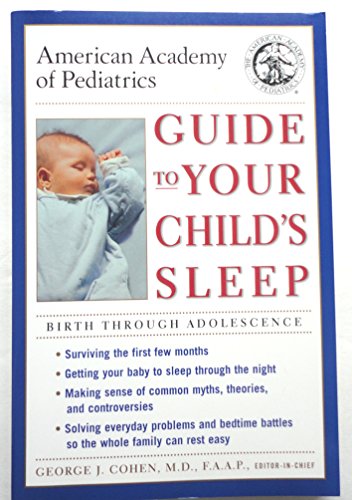
Synopsis
The foremost medical authority on children's health, the American Academy of Pediatrics, has collected in these pages the best advice on getting newborns, toddlers, and school-age children to sleep. Packed with practical tips, this guide offers invaluable information, answers questions from parents, and provides reassuring ad-vice for preventing SIDS, getting your baby to sleep through the night, and solving sleep-wake problems. Above all, the Academy weighs in on the controversies over the most popular child-sleep advice--by evaluating the pros and cons of these conflicting theories--enabling parents to make the best decisions for their families.
Here, in a compact and accessible package, is information to ensure that even the most bleary-eyed parents and their children get a good night's sleep.
"synopsis" may belong to another edition of this title.
About the Author
George J. Cohen, M.D., F.A.A.P., is attending pediatrician at Children's National Medical Center and a professor of pediatrics in Washington, D.C.
The American Academy of Pediatrics is an organization of more than 55,000 primary-care pediatricians, pediatric medical subspecialists, and pediatric surgical specialists dedicated to the health, safety, and well-being of infants, children, adolescents, and young adults. Previous AAP books include the Guide to Your Child's Nutrition and Guide to Your Child's Symptoms.
From the Inside Flap
The foremost medical authority on children's health, the American Academy of Pediatrics, has collected in these pages the best advice on getting newborns, toddlers, and school-age children to sleep. Packed with practical tips, this guide offers invaluable information, answers questions from parents, and provides reassuring ad-vice for preventing SIDS, getting your baby to sleep through the night, and solving sleep-wake problems. Above all, the Academy weighs in on the controversies over the most popular child-sleep advice--by evaluating the pros and cons of these conflicting theories--enabling parents to make the best decisions for their families.
Here, in a compact and accessible package, is information to ensure that even the most bleary-eyed parents and their children get a good night's sleep.
Reviews
Everything you want to know about night terrors, midnight ramblers, larks and owls, and snoring in children can be found between the pages of this handy guide from the American Academy of Pediatrics. Representing a consensus of its 55,000 members, it offers reassurance to parents of newborns and young children with explanations of normal sleep patterns and common problems such as night waking and monsters under the bed. The guide emphasizes the importance of bedtime rituals and good sleep hygiene, physical problems that may affect sleep quality, and differences in temperament and developmental stages. Controversies such as the family bed vs. cribs for newborns and whetherAor for how longAto allow a baby to cry at bedtime are also addressed. Though this is written largely for parents of infants and young children, it does touch upon the sleep problems of school-age children and adolescents: if you have to pry your teen out of bed with a crowbar in the morning, this book will tell you why and what can be done about it. A list of sleep centers is appended. Recommended for public libraries and parenting/consumer health collections.AAnne C. Tomlin, Auburn Memorial Hosp. Lib., NY
Copyright 1999 Reed Business Information, Inc.
Excerpt. © Reprinted by permission. All rights reserved.
Avoiding Bedtime Battles So the Whole Family Sleeps Well
Sooner or later, almost every parent must deal with a child's sleeptime problems. In early infancy, the first task is to help your baby learn to sleep longer at night and stay awake for increasingly longer periods during the daytime. A few months on, separation anxiety makes its first appearance. During this phase, which may come and go for at least a year and possibly much longer, parents have to persuade their child over and over again that they're around to protect him, that it's safe to go to sleep, that "Good night" doesn't mean "Good-bye forever!"
Other issues crop up throughout childhood. Each one is different, just as each child is unique. And yet the problems fall into predictable patterns, such as bedtime resistance, nighttime fears that keep a child sleepless, the midnight rambler who roams the house, the child who insists she can only sleep in her parents' bed. As each new problem arises, parents not only implore, "How can we get our child to sleep?" but also wonder, "When will we ever get a night's sleep?"
While sleep disturbances are common in childhood, they shouldn't be ignored. One study of 3-year-olds receiving treatment for sleep problems found that 84 percent of the children had had their problems since infancy. Another study showed that college students with sleep troubles had had familiar difficulties since early childhood.
Unlike some minor behavioral issues, sleep problems usually don't just go away if you ignore them. Troubles with sleep can dog youngsters throughout the school years, causing difficulties with learning and behavior. The good news is that no matter what your family's specific problem may be, it's never too late to take steps to correct it.
Some sleep problems reflect normal stages in children's emotional and behavioral development. Provided a satisfactory routine was established early on, calm, loving reassurance may be enough to help get your child back into a habit of settling down to sleep.
Other problems stem from habits that may have been unintentionally fostered by parents or caregivers. In such cases, well-meaning efforts to help the child sleep have backfired, resulting in a child who resists going to bed, can't get to sleep on his own, has to be rocked to sleep, needs a bottle at night, wakes often during the night, or wakes up too early in the morning and looks for company.
In this book, a Guide to Your Child's Sleep, the members of the American Academy of Pediatrics share suggestions that have helped many of the families in their care. Pediatricians recognize that there is not always an easy answer to a sleep problem, and what works for one family may not necessarily be the answer for others.
Parents should feel free to adapt the Academy's recommendations according to the different temperaments and personalities of their children and themselves, as well as the many other factors that influence family dynamics. In this, as in other aspects of bringing up your child, trust your instincts and listen to your child. You know your own child better than anyone. Finding a solution that suits your family's style will make everybody happy and ensure restful nights.
In preparing a Guide to Your Child's Sleep, Academy members received invaluable help from parents, caregivers, and children who responded to our sleep survey website. The same themes recurred again and again:
"How do I get my baby to sleep in her own bed?"
"When will my toddler stop waking up several times a night?"
"Why does my child wake up too early every morning?"
"What's the best way to deal with persistent bed-wetting?"
"Where do nighttime fears come from?"
"My child's schedule is all mixed up; how do I get him to sleep at night and stay awake for school?"
Other frequently asked questions probed the pros and cons of the family bed for young families, sleep changes in the teenage years, and how much sleep is needed for rest and repair at the various stages of childhood.
We have included many of these questions, together with our contributors' recommendations, as framed boxes alongside the text. Not every question could be reprinted, due to the large numbers received, but we selected at least one from each category to ensure that problems were addressed from as broad a viewpoint as possible.
In this book we recommend strategies for establishing lifelong habits of restful sleep. These suggestions reflect our experience not only as pediatricians, but also as parents who have survived many sleepless nights and groggy days. Our suggestions take account of parents' need for sleep, which is too often overlooked. Sleep-deprived parents and crotchety babies don't make a happy combination.
This book deals extensively with the early childhood years, because that's when problems are most common and when parents feel most in need of sleep. However, sleep troubles in the school years and in adolescence are also covered. Here and there, we have repeated information as it applies to the different ages and stages of childhood. This repetition together with a detailed index and extensive cross-referencing will, we hope, make it easier for parents to refer to the book as new issues arise.
The information in this guide has been reviewed by many experts and represents the consensus of the 55,000 pediatricians who are members of the American Academy of Pediatrics. Members include pediatricians, pediatric medical subspecialists, and pediatric surgical specialists.
Not only are they physicians concerned with the health and well-being of children and young people, but the overwhelming majority are also parents who have to deal with the same childhood issues-in colicky infants, wakeful toddlers, resistant school-age youngsters, and sleepy adolescents-that every parent and caregiver must handle. The advice in this guide comes, therefore, from their experiences both as trained medical specialists and as sometimes exhausted, occasionally perplexed, and always loving and fulfilled parents.
Sleep, my child, and peace attend thee
All through the night.
George J. Cohen, M.D., EA.A.P
Editor-in-Chief
"About this title" may belong to another edition of this title.
Search results for American Academy of Pediatrics Guide to Your Child's...

Stock Image
Guide to Your Child's Sleep (Cb0011)
Published by
Bantam Doubleday Dell Publishing Group Inc, 2000
ISBN 10: 0679769811
ISBN 13: 9780679769811
Used
Paperback
Seller: World of Books (was SecondSale), Montgomery, IL, U.S.A.
Seller rating 5 out of 5 stars

Paperback. Condition: Good. Seller Inventory # 00103424787
Stock Image
Guide to Your Child's Sleep (Cb0011)
Published by
Bantam Doubleday Dell Publishing Group Inc, 2000
ISBN 10: 0679769811
ISBN 13: 9780679769811
Used
Paperback
Seller: World of Books (was SecondSale), Montgomery, IL, U.S.A.
Seller rating 5 out of 5 stars
Paperback. Condition: Very Good. Seller Inventory # 00097733614
Stock Image
American Academy of Pediatrics Guide to Your Child's Sleep: Birth Through Adolescence
Published by
Villard (edition First Edition), 1999
ISBN 10: 0679769811
ISBN 13: 9780679769811
Used
Paperback
First Edition
Seller: BooksRun, Philadelphia, PA, U.S.A.
Seller rating 5 out of 5 stars
Paperback. Condition: Fair. First Edition. The item might be beaten up but readable. May contain markings or highlighting, as well as stains, bent corners, or any other major defect, but the text is not obscured in any way. Seller Inventory # 0679769811-7-18
Stock Image
American Academy of Pediatrics Guide to Your Child's Sleep: Birth Through Adolescence
Seller: BookHolders, Towson, MD, U.S.A.
Seller rating 5 out of 5 stars
Condition: Good. [ No Hassle 30 Day Returns ][ Ships Daily ] [ Underlining/Highlighting: NONE ] [ Writing: NONE ] [ Edition: Reprint ] Publisher: Villard Pub Date: 11/10/1999 Binding: paperback Pages: 224 Reprint edition. Seller Inventory # 6827157
Stock Image
American Academy of Pediatrics Guide to Your Child's Sleep: Birth Through Adolescence
Seller: ThriftBooks-Atlanta, AUSTELL, GA, U.S.A.
Seller rating 5 out of 5 stars
Paperback. Condition: Very Good. No Jacket. May have limited writing in cover pages. Pages are unmarked. ~ ThriftBooks: Read More, Spend Less. Seller Inventory # G0679769811I4N00
Stock Image
American Academy of Pediatrics Guide to Your Child's Sleep: Birth Through Adolescence
Seller: ThriftBooks-Dallas, Dallas, TX, U.S.A.
Seller rating 5 out of 5 stars
Paperback. Condition: Very Good. No Jacket. May have limited writing in cover pages. Pages are unmarked. ~ ThriftBooks: Read More, Spend Less. Seller Inventory # G0679769811I4N00
Stock Image
American Academy of Pediatrics Guide to Your Child's Sleep : Birth Through Adolescence
Published by
Random House, Incorporated, 2000
ISBN 10: 0679769811
ISBN 13: 9780679769811
Used
Softcover
Seller: Better World Books, Mishawaka, IN, U.S.A.
Seller rating 5 out of 5 stars
Condition: Good. Former library copy. Pages intact with minimal writing/highlighting. The binding may be loose and creased. Dust jackets/supplements are not included. Includes library markings. Stock photo provided. Product includes identifying sticker. Better World Books: Buy Books. Do Good. Seller Inventory # 38643448-6
Stock Image
American Academy of Pediatrics Guide to Your Child's Sleep: Birth Through Adolescence
Seller: HPB-Diamond, Dallas, TX, U.S.A.
Seller rating 5 out of 5 stars
paperback. Condition: Very Good. Connecting readers with great books since 1972! Used books may not include companion materials, and may have some shelf wear or limited writing. We ship orders daily and Customer Service is our top priority! Seller Inventory # S_463382139
Stock Image
American Academy of Pediatrics Guide to Your Child's Sleep: Birth Through Adolescence
Seller: Half Price Books Inc., Dallas, TX, U.S.A.
Seller rating 5 out of 5 stars
paperback. Condition: Very Good. Connecting readers with great books since 1972! Used books may not include companion materials, and may have some shelf wear or limited writing. We ship orders daily and Customer Service is our top priority! Seller Inventory # S_461996226
Stock Image
Guide to Your Child's Sleep (Cb0011)
Published by
Bantam Doubleday Dell Publishing Group Inc, 2000
ISBN 10: 0679769811
ISBN 13: 9780679769811
Used
Paperback
Seller: World of Books Inc, Montgomery, IL, U.S.A.
Seller rating 4 out of 5 stars

Paperback. Condition: Good. Seller Inventory # CIN0679769811G