
Items related to Storming the Statehouse: Running for Governor with...
Synopsis
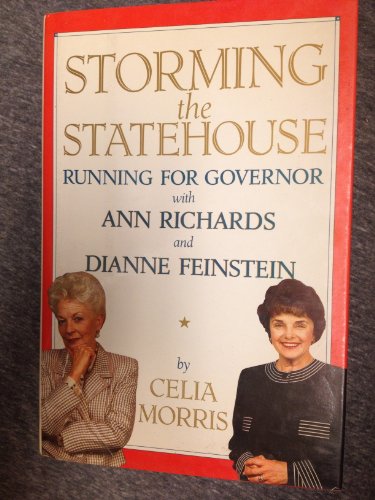
An examination of the future of political campaigning in America tells how two very different women ran two historic gubernatorial races and why one failed and the other succeeded.
"synopsis" may belong to another edition of this title.
Reviews
Advocacy journalism written with a feminist slant, this is a powerful, knowing, instructive, ingratiating recreation, as Morris ( Fanny Wright ), taking to the 1990 gubernatorial campaign trails in Texas and California, introduces us to two inspiring women and bruising politics. Ann Richards proved to be a winner not only with the Texas electorate but with the author as well. The former state treasurer captured the Democratic gubernatorial nomination from Jim Mattox, state attorney general, then narrowly defeated Republican contender Clayton Williams in a vituperative race made even sleazier by the good ol' boy millionaire rancher's assertions that his opponent--a member of AA and divorced mother of four--was a drug addict and lesbian. By comparison, San Francisco mayor Dianne Feinstein's unsuccessful (by 300,000 votes) gubernatorial race against Republican Pete Wilson, U.S. senator, after she bested state attorney general John Van de Kamp in the Democratic primary, was politics as usual. Morris is hard put to make the admirable Feinstein as appealing as Richards, resulting in the book's less vivid second half. Still, so fully are readers caught up in the excitement, uncertainties and manipulations of the political process that they will be held fast.
Copyright 1992 Reed Business Information, Inc.
Weighted report on the 1990 Democratic campaigns of Ann Richards, who won the statehouse in Texas, and Dianne Feinstein, who lost it in California; by the author of Fanny Wright: Rebel in America (not reviewed). Morris burdens her reading of the two races by trying to forge feminist lessons from the stories of two very different 58-year-old women in contests that broke records for cost (around $50 million) rather than high-mindedness. To the author, Ann Richards's ``triumph''--winning in the state ``that set the American standard for macho''--``was not only a tribute to her courage, shrewdness, tenacity, and luck, but a cultural phenomenon tantamount to revolution.'' The Waco-born perfectionist with the ``hard hair,'' briefly in the spotlight making fun of George Bush at the 1988 Democratic convention, seems to have won by counterattacking her cowboy-style opponent, businessman Clayton Williams, whose campaign collapsed. (As Morris puts it, he ``shot off the lower half of his body.'') In the author's view, Dianne Feinstein, who'd become San Francisco mayor when George Moscone was assassinated, won the nomination because she had ``a rich husband'' and ``the television camera loved her.'' Throughout, Morris relies on what campaign advisers thought and what newspapers reported; she fails to dig any deeper. The controversial financial dealings of Feinstein's husband she discusses at the hypothetical level of ``widgets.'' Feinstein lost a close race, in Morris's view, because she couldn't distinguish herself from Republican Pete Wilson, and made mistakes. An agenda-driven play-by-play that's told too far from the heat of the field. -- Copyright ©1992, Kirkus Associates, LP. All rights reserved.
In 1990, two of the most important and exciting gubenatorial races were dominated by two very different women. Ann Richards was a down-home Texas native whose sharp wit won her national prominence at the 1988 Democratic convention when she described George Bush as being born with a silver foot in his mouth. Coming from a wealthy San Francisco family, Dianne Feinstein became the city's first woman mayor after the assassination of George Moscone. Yet both women shared a great deal in common because they were "women breaking barriers in a world designed and ruled by men." Morris ( Fanny Wright: Rebel in America , Harvard Univ. Pr., 1984) brings a feminist perspective to this fascinating study of why Richards triumphed over Clayton Williams in the maelstrom of "macho" Texas politics while Feinstein, virtually indistinguishable from her Republican opponent, lost in California. Although Morris tries to give fair coverage to both candidates, the section on Richards, like Ann herself, is far more vivid and colorful than her chapters on Feinstein. Still, this inside look at women in politics is highly recommended for all collections. Previewed in "On the Campaign Book Trail," LJ 3/15/92.--Ed.
- Wilda Williams, "Library Journal"
Copyright 1992 Reed Business Information, Inc.
"About this title" may belong to another edition of this title.
Search results for Storming the Statehouse: Running for Governor with...

Stock Image
Storming the Statehouse: Running for Governor with Ann Richards and Dianne Feinstein
Seller: World of Books (was SecondSale), Montgomery, IL, U.S.A.
Seller rating 5 out of 5 stars

Condition: Good. Item in good condition. Textbooks may not include supplemental items i.e. CDs, access codes etc. Seller Inventory # 00107925117
Stock Image
Storming the Statehouse: Running for Governor with Ann Richards and Dianne Feinstein
Seller: World of Books (was SecondSale), Montgomery, IL, U.S.A.
Seller rating 5 out of 5 stars
Condition: Very Good. Item in very good condition! Textbooks may not include supplemental items i.e. CDs, access codes etc. Seller Inventory # 00108160911
Stock Image
Storming the Statehouse: Running for Governor with Ann Richards and Dianne Feinstein
Published by
Scribner (edition First Edition), 1992
ISBN 10: 0684193280
ISBN 13: 9780684193281
Used
Hardcover
First Edition
Seller: BooksRun, Philadelphia, PA, U.S.A.
Seller rating 5 out of 5 stars
Hardcover. Condition: Very Good. First Edition. With dust jacket. It's a well-cared-for item that has seen limited use. The item may show minor signs of wear. All the text is legible, with all pages included. It may have slight markings and/or highlighting. Seller Inventory # 0684193280-11-1-29
Stock Image
Storming the Statehouse: Running for Governor with Ann Richards and Dianne Feinstein
Published by
Prentice Hall (a Pearson Education company), 1992
ISBN 10: 0684193280
ISBN 13: 9780684193281
Used
Hardcover
Seller: World of Books Inc, Montgomery, IL, U.S.A.
Seller rating 4 out of 5 stars

Hardback. Condition: Good. Seller Inventory # CIN0684193280G
Stock Image
Storming the Statehouse: Running for Governor with Ann Richards and Dianne Feinstein
Seller: Wonder Book, Frederick, MD, U.S.A.
Seller rating 5 out of 5 stars
Condition: Good. Good condition. Very Good dust jacket. A copy that has been read but remains intact. May contain markings such as bookplates, stamps, limited notes and highlighting, or a few light stains. Seller Inventory # H05K-01585
Stock Image
Storming the Statehouse: Running for Governor with Ann Richards and Dianne Feinstein
Published by
Prentice Hall (a Pearson Education company), 1992
ISBN 10: 0684193280
ISBN 13: 9780684193281
Used
Hardcover
Seller: World of Books Inc, Montgomery, IL, U.S.A.
Seller rating 4 out of 5 stars
Hardback. Condition: Very Good. Seller Inventory # CIN0684193280VG
Stock Image
Storming the Statehouse: Running for Governor with Ann Richards and Dianne Feinstein
Seller: St Vincent de Paul of Lane County, Eugene, OR, U.S.A.
Seller rating 5 out of 5 stars
Condition: Very Good. hardcover 100% of proceeds go to charity! May have signs of use, wear and minor cosmetic defects. Seller Inventory # K-03-4981
Stock Image
Storming the Statehouse : Running for Governor with Ann Richards and Dianne Feinstein
Seller: Better World Books, Mishawaka, IN, U.S.A.
Seller rating 5 out of 5 stars
Condition: Very Good. Pages intact with possible writing/highlighting. Binding strong with minor wear. Dust jackets/supplements may not be included. Stock photo provided. Product includes identifying sticker. Better World Books: Buy Books. Do Good. Seller Inventory # 17995562-6
Stock Image
Storming the Statehouse : Running for Governor with Ann Richards and Dianne Feinstein
Seller: Better World Books, Mishawaka, IN, U.S.A.
Seller rating 5 out of 5 stars
Condition: Good. Former library copy. Pages intact with minimal writing/highlighting. The binding may be loose and creased. Dust jackets/supplements are not included. Includes library markings. Stock photo provided. Product includes identifying sticker. Better World Books: Buy Books. Do Good. Seller Inventory # 15645759-20
Stock Image
Storming the Statehouse: Running for Governor with Ann Richards and Dianne Feinstein
Seller: HPB-Movies, Dallas, TX, U.S.A.
Seller rating 5 out of 5 stars
hardcover. Condition: Very Good. Connecting readers with great books since 1972! Used books may not include companion materials, and may have some shelf wear or limited writing. We ship orders daily and Customer Service is our top priority! Seller Inventory # S_470841723