
Items related to Henry R. Luce: A Political Portrait of the Man Who...
Synopsis
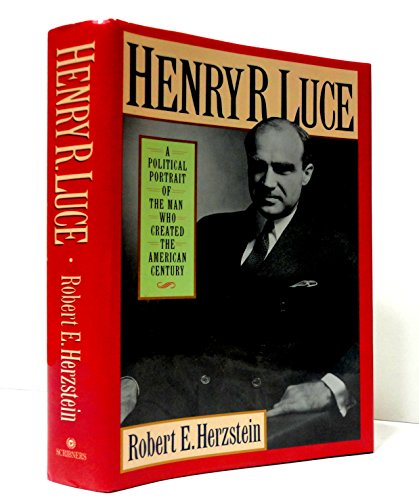
The "American Century" was an idea that the founder of Time, Life, and Fortune preached to two generations of Americans, using the persuasive powers of his propaganda empire. Herzstein (history, U. of South Carolina) examines Luce's political ideas and their influence as the century which he named comes to an end and the 100th anniversary of Luce's birth approaches. Annotation copyright Book News, Inc. Portland, Or.
"synopsis" may belong to another edition of this title.
About the Author
Robert E. Herzstein is Carolina Research Professor of History at the University of South Carolina.
Reviews
As the subtitle suggests, this is less a full life of Time founder Luce (1898-1967) than a partial, balanced account of his work and influence. Herzstein ( Waldheim: The Missing Years ) traces Luce's Middle American hometown instincts to his boyhood as a "mishkid" (of missionary parents) in China, and deftly tells how Luce and Yale classmate Briton Hadden in 1922 conceived Time , a newsmagazine for a new age. Luce's business acumen led him to found Fortune and Life , and he turned Time, Inc. into his "missionary compound," launching attacks on Franklin D. Roosevelt, denouncing Japan while promoting China and in 1941 proclaiming "The American Century," an era of American-led internationalism. Herzstein closely describes Time, Inc.'s views of Russia and China, including Luce's clashes with famed correspondents Theodore White and John Hersey, as well as Luce's jousts and alliances with the politicians of the day. Unfortunately, Herzstein ends his narrative in 1945, losing a chance for a rounder portrait of his subject. Nevertheless, his epilogue, citing Luce's achievements, like boosting global interventionism and domestic fairness, and his weaknesses, like paving the way for McCarthyism, provides a judicious summation of Luce's legacy. Photos not seen by PW.
Copyright 1994 Reed Business Information, Inc.
Herzstein (History/Univ. of South Carolina) offers a liberal's critical appraisal of the life, times, and fortunes of Henry Robinson Luce at the height of his considerable powers during the convulsive period that preceded and encompassed WW II. On the evidence of this impeccably researched text, however, ``promoted'' might have been a better choice of words than ``created'' for the subtitle. Which is not to say that the influential founder of Time, Life, and Fortune magazines would have quarreled with the author's overstated designation. Drawing on access to Luce's personal papers and those of his formidable wife, Clare Boothe, and from interviews with surviving colleagues, Herzstein presents a thematically organized account of an evangelist on a crusade. Born in China to Presbyterian missionaries in 1898, the Yale-educated publisher was a true believer in the US as an enlightened, interventionist force for good throughout a world beset by evil and despotism. Accordingly, Luce proselytized relentlessly on behalf of capitalism, Christianity, and the Republican Party. Although the grandeur of Luce's vision was sweeping, the realities of his workaday relations with notables and subordinates are equally fascinating. The author recounts how headstrong correspondents (Whittaker Chambers, John Hersey, Archibald MacLeish, et al.) caused their employer considerable grief in covering his beloved China, communism, the USSR, and other touchy subjects. And for all the help he had provided in combating isolationism on the home front, Luce never gained much favor with New Dealers. In the global marketplace for ideas, though, he made his mark, if only for a while. Although Luce lived until 1967, Herzstein halts the narrative at the start of the Cold War and closes with a hindsightful appreciation of where his protagonist's idealistic patriotism went wrong. Without ever diminishing Luce's achievements and contributions, in fact, the author manages to present him as a man who lacked the wisdom and wit to realize that his grand visions were, in fact, just that: visions. In brief, then, an interpretive, warts-and-all portrait of a consequential conservative. (8 pages of photos--not seen.) -- Copyright ©1994, Kirkus Associates, LP. All rights reserved.
Founder of the Time-Life magazine empire, FDR hater, and champion of American world leadership, Luce presents an anachronistic face to the modern biographer. Raised in China by Protestant missionaries and endowed with prep-school and Yale educations, Luce projected his firmly felt piety, probusiness sentiments, and internationalism onto Time; if media moguls nowadays tread lightly on editorial departments, Luce felt no such compunction. Luce advocated various political causes and conceived himself a kingmaker in Republican Party politics. Created on a shoestring, his chatty, waggish roundup of the week's news made him millions, with which he launched Life in 1936. His press power, enhanced by his glamorous wife, Clare Boothe, soon reached 25 percent of Americans and was trifled with at peril. Herzstein extracts from the archives evidence of how Luce worked and offers anecdotes of Luce's meetings, crusades (famously, and with the least effect, on behalf of his beloved China), and autocratic editorial style. A meticulously detail-minded historian who shuts down his story with the onset of the Cold War (Luce died in 1967), Herzstein has successfully cornered the professional side of this influential publisher and coiner of the phrase "The American Century"; readers addicted to the personal lives of the famous will have to wait for another sort of biography. Gilbert Taylor
Herzstein (history, Univ. of South Carolina) has written a fair-minded biography of Luce, the man who founded Time, Life , and Fortune. "I am biased in favor of God, the Republican Party, and free enterprise," Luce once said. As his magazines grew and began to have great influence over U.S. public opinion, Luce did not hesitate to see that they reflected his viewpoint. Herzstein ( Roosevelt & Hitler , LJ 11/1/89), has written a scholarly work that chronicles Luce's feuds with President Roosevelt and his persistent support of Chiang Kai-shek in China. Recommended for most libraries.
- Rebecca Wondriska, Trinity Coll. Lib., Hartford, Ct.
Copyright 1994 Reed Business Information, Inc.
"About this title" may belong to another edition of this title.
Search results for Henry R. Luce: A Political Portrait of the Man Who...

Stock Image
Henry R. Luce: A Political Portrait of the Man Who Created the American Century
Seller: Orion Tech, Kingwood, TX, U.S.A.
Seller rating 5 out of 5 stars

hardcover. Condition: As New. Seller Inventory # 0684193604-1-36142670
Stock Image
Henry R.Luce: A Political Portrait of the Man Who Created the American Century
Published by
Prentice Hall (a Pearson Education company), 1994
ISBN 10: 0684193604
ISBN 13: 9780684193601
Used
Hardcover
Seller: World of Books (was SecondSale), Montgomery, IL, U.S.A.
Seller rating 5 out of 5 stars
Hardback. Condition: Good. Seller Inventory # 00100198874
Stock Image
Henry R.Luce: A Political Portrait of the Man Who Created the American Century
Published by
Prentice Hall (a Pearson Education company), 1994
ISBN 10: 0684193604
ISBN 13: 9780684193601
Used
Hardcover
Seller: World of Books (was SecondSale), Montgomery, IL, U.S.A.
Seller rating 5 out of 5 stars
Hardback. Condition: Very Good. Seller Inventory # 00108218813
Stock Image
Henry R. Luce: A Political Portrait of the Man Who Created the American Century
Seller: Open Books, Chicago, IL, U.S.A.
Seller rating 5 out of 5 stars
hardcover. Condition: Very Good. Open Books is a nonprofit social venture that provides literacy experiences for thousands of readers each year through inspiring programs and creative capitalization of books. Seller Inventory # mon0000849912
Stock Image
Henry R. Luce: A Political Portrait of the Man Who Created the American Century
Seller: HPB-Ruby, Dallas, TX, U.S.A.
Seller rating 5 out of 5 stars
hardcover. Condition: Very Good. Connecting readers with great books since 1972! Used books may not include companion materials, and may have some shelf wear or limited writing. We ship orders daily and Customer Service is our top priority! Seller Inventory # S_430883619
Stock Image
Henry R. Luce: A Political Portrait of the Man Who Created the American Century
Seller: ThriftBooks-Atlanta, AUSTELL, GA, U.S.A.
Seller rating 5 out of 5 stars
Hardcover. Condition: Good. No Jacket. Pages can have notes/highlighting. Spine may show signs of wear. ~ ThriftBooks: Read More, Spend Less. Seller Inventory # G0684193604I3N00
Stock Image
Henry R. Luce: A Political Portrait of the Man Who Created the American Century
Seller: ThriftBooks-Dallas, Dallas, TX, U.S.A.
Seller rating 5 out of 5 stars
Hardcover. Condition: Very Good. No Jacket. May have limited writing in cover pages. Pages are unmarked. ~ ThriftBooks: Read More, Spend Less. Seller Inventory # G0684193604I4N00
Stock Image
Henry R. Luce: A Political Portrait of the Man Who Created the American Century
Seller: Wonder Book, Frederick, MD, U.S.A.
Seller rating 5 out of 5 stars
Condition: Good. Good condition. Very Good dust jacket. A copy that has been read but remains intact. May contain markings such as bookplates, stamps, limited notes and highlighting, or a few light stains. Seller Inventory # P15E-00042
Stock Image
Henry R.Luce: A Political Portrait of the Man Who Created the American Century
Published by
Prentice Hall (a Pearson Education company), 1994
ISBN 10: 0684193604
ISBN 13: 9780684193601
Used
Hardcover
Seller: World of Books Inc, Montgomery, IL, U.S.A.
Seller rating 4 out of 5 stars

Hardback. Condition: Good. Seller Inventory # CIN0684193604G
Stock Image
Henry R.Luce: A Political Portrait of the Man Who Created the American Century
Published by
Prentice Hall (a Pearson Education company), 1994
ISBN 10: 0684193604
ISBN 13: 9780684193601
Used
Hardcover
Seller: World of Books Inc, Montgomery, IL, U.S.A.
Seller rating 4 out of 5 stars
Hardback. Condition: Very Good. Seller Inventory # CIN0684193604VG