
Items related to Collision: How the Rank and File Took Back the Teamsters
Synopsis
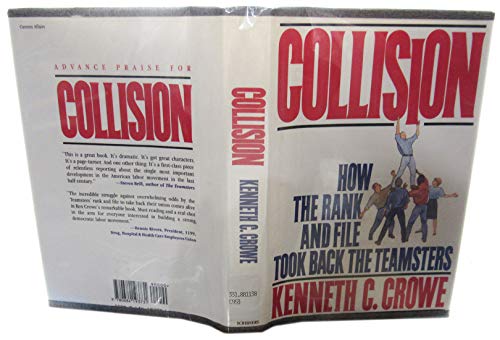
A look at the various efforts that have been made to eradicate organized crime discusses the thirty-year drive by the Justice Department, union organizers, the FBI, and dissident Teamsters to eradicate it.
"synopsis" may belong to another edition of this title.
Reviews
This is the stirring story of how a reform slate was elected to leadership of the International Brotherhood of Teamsters in 1991. Going back to the regime of Jimmy Hoffa, who assumed the presidency in 1957, the Mafia had been a powerful force in the IBT, especially in the New York City area, notes Crowe, a labor reporter for Newsday whose encyclopedic knowledge of the union informs this important book. He shows how the top union officials paid themselves huge salaries, practiced nepotism and consistently arranged sweetheart deals for themselves with employers by refusing to ratify strike votes taken by local members. Dissidents were either fired from their trucking jobs or beaten up. But reform was made possible by a RICO civil suit filed against the IBT, which paved the way for Ron Carey's landslide election to the union presidency. Photos not seen by PW .
Copyright 1993 Reed Business Information, Inc.
The gritty, well-told tale of an overdue change in leadership at the International Brotherhood of Teamsters. Newsday labor correspondent Crowe (America for Sale, 1978) recounts how Ron Carey, erstwhile head of a UPS local in N.Y.C., last December became the first general president of the IBT to be democratically elected in many a decade. But before explaining how his working-class hero gained an office once held by the infamous likes of Dave Beck, Jimmy Hoffa, and Jackie Presser, Crowe delivers a detailed rundown on the factors that made reform necessary as well as possible. Noting, for instance, that the US Department of Justice had been pushing the mob-influenced union to clean up its act for 30 or more years, the author details the agency's preparation of racketeering charges during the late 1980's. On the eve of a jury trial, though, the case was settled by a 1989 consent decree that provided for the appointment of three court-appointed monitors, who eventually modified the rules that had permitted corrupt regimes to perpetuate themselves. Crowe then offers a frequently engrossing account of how an independent upstart bested two representatives of the old guard. The lengthy, closely watched campaign, he shows, was marked by dirty politics (albeit precious little intimidation or violence), inadequate financing--and apathy. Although only 28% of those eligible to vote did so, Carey nonetheless achieved, with a 48.5% plurality, the equivalent of a landslide mandate. Since taking control, moreover, he's been making good on promises to cut executive salaries, sell off the IBT's jetliners, increase the organizing budget, and otherwise get his union back into labor's mainstream. As Crowe suggests, this may be the first book about the Teamsters to feature a happy ending. More to the point, though, it's a consistently absorbing and instructive piece of work with potentially wide appeal. (Eight-page photo insert--not seen.) -- Copyright ©1993, Kirkus Associates, LP. All rights reserved.
The December 1991 election of Ron Carey, a rank-and-file leader, as the reform president of the Teamsters' Union, was a reversal of fortune for the nation's largest private-sector labor organization: it effectively ended a half-century of domination by organized crime and systematic looting by corrupt union officials. This was also the culmination of a 30-year drive by the Federal government to rid this now court-monitored labor organization of law breaking and venal practices. Crowe, a veteran newspaper labor reporter, shows an intimate knowledge of the major players and of the inner workings of the Teamsters' Union, but his flat, cliche-strewn writing style, which includes much unnecessary detail and repetitions, blunts the force of his narrative. Suitable for libraries with labor collections.
- Harry Frumerman, formerly with Hunter Coll., CUNY
Copyright 1993 Reed Business Information, Inc.
"About this title" may belong to another edition of this title.
Search results for Collision: How the Rank and File Took Back the Teamsters

Stock Image
Collision: How the Rank and File Took Back the Teamsters
Published by
Scribner (edition First Edition), 1993
ISBN 10: 0684193736
ISBN 13: 9780684193731
Used
Hardcover
First Edition
Seller: BooksRun, Philadelphia, PA, U.S.A.
Seller rating 5 out of 5 stars

Hardcover. Condition: Very Good. First Edition. With dust jacket. It's a well-cared-for item that has seen limited use. The item may show minor signs of wear. All the text is legible, with all pages included. It may have slight markings and/or highlighting. Seller Inventory # 0684193736-11-1-29
Stock Image
Collision : How the Rank and File Took Back the Teamsters
Seller: Better World Books, Mishawaka, IN, U.S.A.
Seller rating 5 out of 5 stars
Condition: Very Good. 0th Edition. Pages intact with possible writing/highlighting. Binding strong with minor wear. Dust jackets/supplements may not be included. Stock photo provided. Product includes identifying sticker. Better World Books: Buy Books. Do Good. Seller Inventory # 14863203-6
Stock Image
Collision : How the Rank and File Took Back the Teamsters
Seller: Better World Books, Mishawaka, IN, U.S.A.
Seller rating 5 out of 5 stars
Condition: Good. 0th Edition. Former library copy. Pages intact with minimal writing/highlighting. The binding may be loose and creased. Dust jackets/supplements are not included. Includes library markings. Stock photo provided. Product includes identifying sticker. Better World Books: Buy Books. Do Good. Seller Inventory # GRP68689595
Stock Image
Collision: How the Rank and File Took Back the Teamsters
Seller: ThriftBooks-Dallas, Dallas, TX, U.S.A.
Seller rating 5 out of 5 stars
Hardcover. Condition: Good. No Jacket. Missing dust jacket; Pages can have notes/highlighting. Spine may show signs of wear. ~ ThriftBooks: Read More, Spend Less. Seller Inventory # G0684193736I3N01
Stock Image
Collision: How the Rank and File Took Back the Teamsters
Seller: St Vincent de Paul of Lane County, Eugene, OR, U.S.A.
Seller rating 5 out of 5 stars
Condition: Good. hardcover 100% of proceeds go to charity! Good condition with all pages in tact. Item shows signs of use and may have cosmetic defects. Seller Inventory # Q-06-5141
Seller Image
Collision: How the Rank and File Took Back the Teamsters
Seller: Goodwill of Greater Milwaukee and Chicago, Racine, WI, U.S.A.
Seller rating 5 out of 5 stars
Condition: acceptable. Book is considered to be in acceptable condition. The actual cover image may not match the stock photo. Book may have one or more of the following defects: noticeable wear on the cover dust jacket or spine; curved, dog eared or creased page s ; writing or highlighting inside or on the edges; sticker s or other adhesive on cover; CD DVD may not be included; and book may be a former library copy. Seller Inventory # SEWV.0684193736.A
Stock Image
Collision: How the Rank and File Took Back the Teamsters
Published by
Charles Scribner's Sons, New York, 1993
ISBN 10: 0684193736
ISBN 13: 9780684193731
Used
Hardcover
First Edition
Seller: Harbor Books LLC, Old Saybrook, CT, U.S.A.
Seller rating 5 out of 5 stars
Hardcover. Condition: Very Good. Dust Jacket Condition: Very Good. First Edition. Blue boards over cream cloth spine, 303pp with illustrations, small 1/4 inch stain to bottom corner of some central pages, nowhere near text, otherwise contents clean, tight and unmarked in very lightly rubbed dust jacker. Seller Inventory # 011862
Seller Image
Collision: How the Rank and File Took Back the Teamsters
Seller: Southampton Books, Sag Harbor, NY, U.S.A.
Seller rating 5 out of 5 stars
Hardcover. Condition: Very Good. First Edition. First Edition, First Printing. Published by Scribner, 1993. Octavo. Hardcover. Book is very good. Dust jacket is very good. Seller Inventory # 545504
Stock Image
Collision: How the Rank and File Took Back the Teamsters
Seller: SHIMEDIA, Brooklyn, NY, U.S.A.
Seller rating 4 out of 5 stars

Condition: New. Satisfaction Guaranteed or your money back. Seller Inventory # 0684193736
Stock Image
Collision: How the Rank and File Took Back the Teamsters
Seller: BennettBooksLtd, Los Angeles, CA, U.S.A.
Seller rating 5 out of 5 stars
Hardcover. Condition: New. In shrink wrap. Looks like an interesting title! Seller Inventory # Q-0684193736