
Items related to Making Monsters
Synopsis
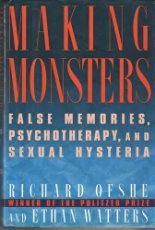
Looks at the history of recovered memory therapy, argues that this approach creates false memories, and assesses the damage done by those memories
"synopsis" may belong to another edition of this title.
Reviews
This is the most thoroughgoing and powerful critique to date of the use of recovered memories in psychotherapy. Many retrieved memories of childhood sexual abuse, the authors argue, are fabrications generated in a coercive, highly charged atmosphere using questionable therapeutic techniques such as hypnosis, dream analysis, artwork and the constant revisiting and rewriting of vague early memories. Ofshe, a social psychology professor at UC Berkeley and a Pulitzer-winning reporter, and freelance writer Watters extend their analysis to include alleged sufferers of multiple-personality disorder and people who claim to have been abused or tortured by satanic cults that engage in sacrificial murder and rape. The authors name names, attacking therapists, experts and writers, and they cover such well-publicized cases involving recovered memories as the 1990 San Francisco murder trial that convicted George Franklin on the basis of his daughter Eileen Lipsker's accusation that he had killed her childhood friend Susan Nasson 20 years earlier. This report is certain to escalate a heated public debate.
Copyright 1994 Reed Business Information, Inc.
A forceful, persuasive indictment of the fad of repressed memory therapy and its attendant theories of multiple personality disorder and satanic cult abuse. Ofshe (Social Psychology/Univ. of Calif., Berkeley), a Pulitzer Prize winner for public service reporting, and Mother Jones contributor Watters document the harm done by psychotherapists who practice memory therapy. Using the writings of its practitioners, the authors examine cases to show how powerful therapeutic techniques, such as hypnosis and guided imagery, implant in patients the erroneous belief that they are uncovering repressed memories of childhood sexual abuse. As memory therapy has grown, so has the diagnosis of multiple personality disorder, which the authors charge is a product of such therapy. Multiple personalities are believed to be formed in response to childhood abuse, and memory therapists claim that each alter personality can produce a set of memories of that abuse. Perhaps the most bizarre aspect of repressed memory therapy is the assertion by some of its leading proponents that among the abusers they have uncovered a secret international satanic cult linked to (among others) the Mafia, the Ku Klux Klan, and the CIA. Here the authors manfully resist the impulse to poke fun, but their disbelief is clear. Unsubstantiated theories are nothing new in the mental health field, but they assert that the current popularity of memory therapy is an especially serious problem. Aside from the primary victims--the patients subjected to such therapy--the authors point to the harm done to their families, who often must defend themselves in court against false accusations of abuse. Their hope is that mental health empiricists, who argue that practice should be based on scientific observation, will carry the day. Looks at some of the same cases as Elizabeth Loftus's The Myth of Repressed Memory (p. 908) but covers more ground and digs deeper. Sure to provoke angry outcries. (Author tour) -- Copyright ©1994, Kirkus Associates, LP. All rights reserved.
If you haven't heard of false memory syndrome and the controversy it engenders, you haven't seen a talk show recently. In the last decade, there has been a veritable explosion of cases in which (mostly) women in therapy remember being sexually abused by their parents. In many instances, the memories escalate, and the patients eventually exhibit symptoms of multiple personality disorder or recall being victims of satanic cults. Ofshe, a social psychologist, and Watters, a Mother Jones writer, examine this psychological phenomenon and offer two explanations for its current prevalence: either recovered-memory therapists have achieved a breakthrough in the understanding of the human mind, in which case much that is fundamental about our understanding of psychology will need to be reinterpreted, or the practice of uncovering repressed memories has been built into a pseudoscience by therapists who have created "an Alice-in-Wonderland world in which opinion, metaphor, and ideological preference substitute for objective evidence." Firmly supporting the latter view, the authors offer a thoughtfully written, restrained (even a bit dry), and generally persuasive examination of what false memory syndrome reveals about society as well as ourselves. Ilene Cooper
"About this title" may belong to another edition of this title.
Search results for Making Monsters

Stock Image
Making Monsters
Seller: Orion Tech, Kingwood, TX, U.S.A.
Seller rating 5 out of 5 stars

hardcover. Condition: Fair. Seller Inventory # 0684196980-4-36275119
Stock Image
Making Monsters: False Memory, Satanic Cult Abuse, and Sexual Hysteria
Published by
Prentice Hall (a Pearson Education company), 1994
ISBN 10: 0684196980
ISBN 13: 9780684196985
Used
Hardcover
Seller: World of Books (was SecondSale), Montgomery, IL, U.S.A.
Seller rating 5 out of 5 stars
Hardback. Condition: Very Good. Seller Inventory # CIN0684196980VG
Stock Image
Making Monsters
Seller: BooksRun, Philadelphia, PA, U.S.A.
Seller rating 5 out of 5 stars
Hardcover. Condition: Fair. With dust jacket. The item might be beaten up but readable. May contain markings or highlighting, as well as stains, bent corners, or any other major defect, but the text is not obscured in any way. Seller Inventory # 0684196980-7-22-29
Stock Image
Making Monsters
Seller: ThriftBooks-Reno, Reno, NV, U.S.A.
Seller rating 5 out of 5 stars
Hardcover. Condition: Fair. No Jacket. Readable copy. Pages may have considerable notes/highlighting. ~ ThriftBooks: Read More, Spend Less. Seller Inventory # G0684196980I5N00
Stock Image
Making Monsters
Seller: Wonder Book, Frederick, MD, U.S.A.
Seller rating 5 out of 5 stars
Condition: Good. Good condition. No Dust Jacket A copy that has been read but remains intact. May contain markings such as bookplates, stamps, limited notes and highlighting, or a few light stains. Seller Inventory # L17L-00919
Stock Image
Making Monsters: False Memory, Satanic Cult Abuse, and Sexual Hysteria
Published by
Prentice Hall (a Pearson Education company), 1994
ISBN 10: 0684196980
ISBN 13: 9780684196985
Used
Hardcover
Seller: World of Books Inc, Montgomery, IL, U.S.A.
Seller rating 4 out of 5 stars

Hardback. Condition: Very Good. Seller Inventory # CIN0684196980VG
Stock Image
Making Monsters
Seller: HPB-Red, Dallas, TX, U.S.A.
Seller rating 5 out of 5 stars
hardcover. Condition: Good. Connecting readers with great books since 1972! Used textbooks may not include companion materials such as access codes, etc. May have some wear or writing/highlighting. We ship orders daily and Customer Service is our top priority! Seller Inventory # S_440841869
Stock Image
Making Monsters : False Memories, Psychotherapy, and Sexual Hysteria
Seller: Better World Books, Mishawaka, IN, U.S.A.
Seller rating 5 out of 5 stars
Condition: Good. Pages intact with minimal writing/highlighting. The binding may be loose and creased. Dust jackets/supplements are not included. Stock photo provided. Product includes identifying sticker. Better World Books: Buy Books. Do Good. Seller Inventory # 5935116-20
Stock Image
Making Monsters : False Memories, Psychotherapy, and Sexual Hysteria
Seller: Better World Books: West, Reno, NV, U.S.A.
Seller rating 5 out of 5 stars
Condition: Very Good. Former library copy. Pages intact with possible writing/highlighting. Binding strong with minor wear. Dust jackets/supplements may not be included. Includes library markings. Stock photo provided. Product includes identifying sticker. Better World Books: Buy Books. Do Good. Seller Inventory # 10561416-75
Stock Image
Making Monsters : False Memories, Psychotherapy, and Sexual Hysteria
Seller: Better World Books, Mishawaka, IN, U.S.A.
Seller rating 5 out of 5 stars
Condition: Very Good. Pages intact with possible writing/highlighting. Binding strong with minor wear. Dust jackets/supplements may not be included. Stock photo provided. Product includes identifying sticker. Better World Books: Buy Books. Do Good. Seller Inventory # 5859036-6