Items related to POWER AND THE DARKNESS: The Life of Josh Gibson in...
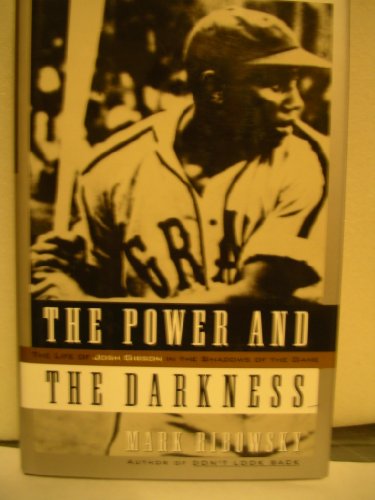

Examines the record-breaking career and tormented personal life of Negro League legend Josh Gibson, from his dramatic baseball feats to his self-destructive drug and alcohol abuse to his death at age thirty-seven
"synopsis" may belong to another edition of this title.
From Kirkus Reviews:
An accomplished chronicler of baseball's Negro Leagues (Don't Look Back: Satchel Paige in the Shadows of Baseball, 1994, etc.) attempts to reclaim from myth the true character of a man best known as the ``Black Babe Ruth.'' Between 1928 and 1946, a time that featured such greats as Leroy ``Satchel'' Paige, Judy Johnson, and ``Cool Papa'' Bell, Josh Gibson was possibly black baseball's greatest attraction. Gibson's career spanned what, for all black players, were times of famine, feast, and, later, uncertainty arising from the major leagues' eradication of the color barrier. Through careful and facile use of a wealth of first- and second-hand accounts (including interviews with the slugger's son Josh Jr.), the author exposes to a wide audience for the first time how Gibson hid his indiscretions behind the massive shadow of his own fame and imposing physique. Persistent image-mongering by the black and white media of the `30s and his bosses, team-owners Cumberland ``Cum'' Posey of the Homestead Grays and W. Augustus ``Gus'' Greenlee of the Crawfords, kept Gibson's drinking, drug use, and womanizing out of the spotlight until they finally overwhelmed him, contributing to this death in 1947 from a stroke; he was 35. Ribowsky places the roots of Gibson's self-destructiveness in his inability to face emotional crises--including his wife Helen's sudden death in childbirth in 1930 and the manipulation by black and white organizers and promoters throughout his career--as defiantly as he faced the best pitchers of the day. The temptations of life on the road were also a factor (when not playing in the Negro Leagues, Gibson barnstormed off-season and played winter ball in Latin America). Ribowsky lays bare Gibson's ``tortured soul.'' This exemplary and long-overdue work demonstrates that Gibson took himself out of the game, or as the author writes in his closing, ``like Achilles, he had no defense against his own mortal flaw: himself.'' -- Copyright ©1996, Kirkus Associates, LP. All rights reserved.
From Booklist:
Josh Gibson is remembered as the Babe Ruth of the Negro Leagues, his fame eclipsed only by the inimitable Satchel Paige. Like Ruth, Gibson was a man of enormous appetites: women, food, alcohol, and--in Gibson's case--drugs were all absorbed indiscriminately. Ribowsky, also the author of a superb Paige biography (Don't Look Back, 1994), has researched his subject well by means of newspaper accounts and personal interviews. The defining event in Gibson's life appears to have been the death in childbirth of his beloved wife, Helen. Using his gypsylike meanderings through the world of black baseball to distance himself from his twin children, Gibson sank further into depression even as his on-field legend grew. As in his account of Paige's life, Ribowsky seamlessly weaves together a history of black baseball with the life of a superstar. There are plenty of game accounts, mind-boggling statistics, and glowing recollections of Gibson's prowess, along with the dark accounts of his off-field misadventures. Although it might have been politically expedient to ascribe Gibson's agony to the frustration of being excluded from white baseball, Ribowsky never takes that easy route. The man who emerges here is complex and multidimensional; like that of other troubled geniuses, his talent may have been fueled by his emotional demons. A compelling examination of a fascinating, tragic life. Wes Lukowsky
"About this title" may belong to another edition of this title.
- PublisherSimon & Schuster
- Publication date1996
- ISBN 10 0684804026
- ISBN 13 9780684804026
- BindingHardcover
- Edition number1
- Number of pages320
- Rating
Buy New
Learn more about this copy
US$ 29.08
Shipping:
US$ 4.00
Within U.S.A.
Top Search Results from the AbeBooks Marketplace
Stock Image
POWER AND THE DARKNESS: The Life of Josh Gibson in the Shadows of the Game
Published by
Simon & Schuster
(1996)
ISBN 10: 0684804026
ISBN 13: 9780684804026
New
Hardcover
Quantity: 1
Seller:
Rating

Book Description Hardcover. Condition: new. New. Fast Shipping and good customer service. Seller Inventory # Holz_New_0684804026
Buy New
US$ 29.08
Convert currency
Stock Image
POWER AND THE DARKNESS: The Life of Josh Gibson in the Shadows of the Game
Published by
Simon & Schuster
(1996)
ISBN 10: 0684804026
ISBN 13: 9780684804026
New
Hardcover
Quantity: 1
Seller:
Rating
Book Description Hardcover. Condition: new. Brand New Copy. Seller Inventory # BBB_new0684804026
Buy New
US$ 30.53
Convert currency
Stock Image
POWER AND THE DARKNESS: The Life of Josh Gibson in the Shadows of the Game
Published by
Simon & Schuster
(1996)
ISBN 10: 0684804026
ISBN 13: 9780684804026
New
Hardcover
Quantity: 1
Seller:
Rating

Book Description Hardcover. Condition: new. Prompt service guaranteed. Seller Inventory # Clean0684804026
Buy New
US$ 29.46
Convert currency
Stock Image
POWER AND THE DARKNESS: The Life of Josh Gibson in the Shadows of the Game
Published by
Simon & Schuster
(1996)
ISBN 10: 0684804026
ISBN 13: 9780684804026
New
Hardcover
Quantity: 1
Seller:
Rating
Book Description Condition: new. Seller Inventory # FrontCover0684804026
Buy New
US$ 30.34
Convert currency
Stock Image
POWER AND THE DARKNESS: The Life of Josh Gibson in the Shadows of the Game
Published by
Simon & Schuster
(1996)
ISBN 10: 0684804026
ISBN 13: 9780684804026
New
Hardcover
Quantity: 1
Seller:
Rating
Book Description Hardcover. Condition: new. New. Seller Inventory # Wizard0684804026
Buy New
US$ 31.14
Convert currency
Stock Image
POWER AND THE DARKNESS: The Life of Josh Gibson in the Shadows of the Game
Published by
Simon & Schuster
(1996)
ISBN 10: 0684804026
ISBN 13: 9780684804026
New
Hardcover
Quantity: 1
Seller:
Rating
Book Description Hardcover. Condition: new. Buy for Great customer experience. Seller Inventory # GoldenDragon0684804026
Buy New
US$ 31.87
Convert currency
Stock Image
POWER AND THE DARKNESS: The Life of Josh Gibson in the Shadows of the Game
Published by
Simon & Schuster
(1996)
ISBN 10: 0684804026
ISBN 13: 9780684804026
New
Hardcover
Quantity: 1
Seller:
Rating
Book Description Hardcover. Condition: new. New Copy. Customer Service Guaranteed. Seller Inventory # think0684804026
Buy New
US$ 34.73
Convert currency
Stock Image
POWER AND THE DARKNESS: The Life of Josh Gibson in the Shadows of the Game
Published by
Simon & Schuster
(1996)
ISBN 10: 0684804026
ISBN 13: 9780684804026
New
Hardcover
Quantity: 1
Seller:
Rating
Book Description Hardcover. Condition: New. Brand New!. Seller Inventory # VIB0684804026
Buy New
US$ 58.85
Convert currency
Stock Image
POWER AND THE DARKNESS: The Life of Josh Gibson in the Shadows of the Game
Published by
Simon & Schuster
(1996)
ISBN 10: 0684804026
ISBN 13: 9780684804026
New
Hardcover
Quantity: 1
Seller:
Rating
Book Description Hardcover. Condition: New. Seller Inventory # Abebooks170361
Buy New
US$ 59.00
Convert currency
Stock Image
POWER AND THE DARKNESS: THE LIFE
Published by
Simon & Schuster
(1996)
ISBN 10: 0684804026
ISBN 13: 9780684804026
New
Hardcover
Quantity: 1
Seller:
Rating
Book Description Condition: New. New. In shrink wrap. Looks like an interesting title! 0.75. Seller Inventory # Q-0684804026
Buy New
US$ 98.02
Convert currency