
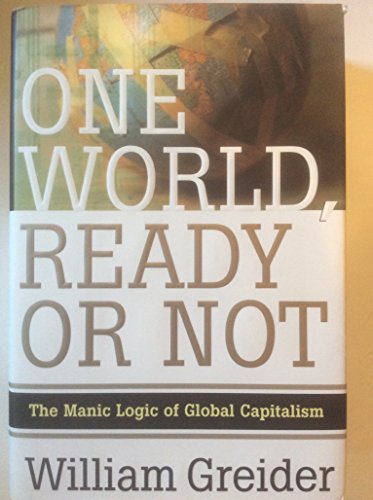
Items related to One World Ready or Not: The Manic Logic of Global Capitalism
Synopsis
The global economy is the leitmotif of the end of the twentieth century. Driven by the logic of modern capitalism, the global economy, a product of the Third Industrial Revolution, is a wondrous free-running system that is reordering the world as it transforms the lives and economic prospects of workers, corporations and nations. Having traveled the globe and talked to factory workers, corporate CEOs, economists and government officials, Greider contends that the global economy is sowing "creative destruction" everywhere: while making possible great accumulations of wealth, it is also reviving forms of human exploitation that characterized industry one hundred years ago and raising profound questions about the relevance of the nation-state in the face of impersonal market forces.
Greider explains the dynamics of the global economy in terms of human struggle of diverse peoples and nations, rich and poor alike, facing a multiplicity of opportunities and dangers. As manufacturers in search of greater returns on investment move their assembly lines to low-wage countries, the globalization of industrial production is resulting in excess supplies of goods and labor, which, in turn, exert downward pressures on prices and wages. The deregulation of cross-border capital flows has opened new opportunities for currency traders while allowing unfettered speculation on a scale that can overwhelm the resources of even major governments. Meanwhile, the high interest rates that global investors charge to finance the growing debt of rich nations threaten the modern welfare state, with the attendant risks of class conflict and social chaos.
"synopsis" may belong to another edition of this title.
About the Author
William Greider is the National Editor of Rolling Stone magazine.
Reviews
Greider (Secrets of the Temple) here surveys the dynamics and contradictions of the corporate-driven global economy, which, he says, is heading toward "an economic or political cataclysm." His selective tour?he avoids Africa and much of South America, and focuses on U.S. corporations?nonetheless vividly introduces this changing economic world and suggests populist reforms well worth discussion. In developing Malaysia, Greider sees multinational corporations seeking not just cheaper workers but another power base. He observes that technological improvement has actually led to overcapacity in the global auto industry. He notes that the industrialization of China?substituting low-paid workers for higher-paid Westerners?will erode the world's purchasing power. He perceives the U.S. as ominously failing to decrease its trade deficit or to defend domestic producers and jobs. Then Greider looks at the metastasizing world of finance capital and proposes a transaction tax to slow down the "furious pace" of computer-driven traders impelled to seek higher returns. He suggests debt forgiveness for poor nations. To foster a more responsible capitalism, he proposes taxes on capital, not payrolls, reciprocity with mercantilist countries such as Japan and labor rights for workers in poor countries. Greider devotes a final section to emerging examples (e.g., employee ownership) of his proposed "global humanism." But he skirts the question of how religious and ethnic nationalism might affect global economic convergence.
Copyright 1996 Reed Business Information, Inc.
Greider (Who Will Tell the People, 1992, etc) has looked into the future and determined it won't work to his progressive/populist satisfaction. Indeed, the author foresees rack and ruin if steps aren't taken to deliver the postCold War world from the ravages of what he views as a new, out-of-control industrial revolution. Attempting to go behind the numbers usually used to describe the global economy, Greider draws largely on anecdotal material gathered during extended sojourns in a dozen Asian, European, and North American countries. He provides a dour guide to the ways in which the unrestrained advance of conscienceless capitalism (without an effective challenger since socialism's dramatic demise) could, in combination with the globalization of commerce, lead to overcapacity, glutted markets, superfluous labor, unbridled speculation, recurrent debt crises, social disorder, and worse. Informed by an abiding suspicion as to the ability of free markets to match supply and demand with any consistency, the author first focuses on mutinationals, essentially stateless enterprises that, he warns, are gaining awesome economic power without thoughtful, let alone effectual, oversight. The author next casts a cold eye on institutional investors whose collective trading judgments have on occasion brought the Global Village's largest companies to book and frequently left sovereign governments something less than masters of their own financial houses. For his windup, Greider offers a potpourri of power-to-the-people proposals on how socioeconomic catastrophe might be avoided in the period ahead. He commends such liberal articles of faith as managing trade as a zero-sum game (i.e., with a loser for every winner); redressing the imbalance of returns that separates wage earners from the rentier class; imposing transaction taxes on cross-border flows of capital; obliging firms not only to protect the environment but also to embrace the arguable concept of sustainable development; and creating new forms of labor unions. Politically correct alarmism masquerading as prophetic analysis. -- Copyright ©1996, Kirkus Associates, LP. All rights reserved.
In this broad look at global economics, Greider (Who Will Tell the People?: The Betrayal of American Democracy, S. & S., 1992) discusses the evolution of the world's economy and the global spread of capitalism, in free and "managed" forms. He first examines the trend toward multinational corporations and the concurrent competition for work that is forcing wages downward, then explains how the world's capital markets encourage that trend and create separate economic problems. Although these sections are engaging, melding national economic statistics with interviews and observations from around the world, Greider's major contribution comes in the concluding section, in which he ties together the trends and suggests remedies for current and future global economic problems, such as oversupply of goods, unemployment, and pollution. He admits that implementation of his suggestions would require political changes and probably would necessitate international cooperation, but he states that such changes might become necessary. A solid study, for all readers.?A.J. Sobczak, formerly with California State Univ., Northridge
Copyright 1997 Reed Business Information, Inc.
Greider is best known as a columnist and writer for Rolling Stone, that magazine's counterpoint to another of its writers, libertarian gadfly P. J. O'Rourke. In the past, Greider exposed the growing doubts about the viability of Reaganomics held by the then-budget director (in The Education of David Stockman and Other Americans, 1982). He provided insight into how the Federal Reserve System is run and what it does in the highly readable Secrets of the Temple (1987); and most recently, in Who WIll Tell the People (1992), he inveighed against the American political system. This time Greider takes on the global industrial revolution, arguing that it may be a "wondrous new machine" but that it is one with no one at the controls. From the Pacific Rim to eastern Europe, he documents the abuses of a rampant capitalism with compassion, wit, and perception. Greider's journalistic eye for detail and human interest helps make this book as absorbing as his previous ones. David Rouse
"About this title" may belong to another edition of this title.
Search results for One World Ready or Not: The Manic Logic of Global Capitalism

Stock Image
One World Ready or Not: The Manic Logic of Global Capitalism
Seller: Gulf Coast Books, Cypress, TX, U.S.A.
Seller rating 5 out of 5 stars

hardcover. Condition: Fair. Seller Inventory # 0684811413-4-32225365
Stock Image
One World Ready or Not: The Manic Logic of Global Capitalism
Seller: Orion Tech, Kingwood, TX, U.S.A.
Seller rating 5 out of 5 stars
hardcover. Condition: Fair. Seller Inventory # 0684811413-4-32225365
Stock Image
One World Ready or Not: The Manic Logic of Global Capitalism
Seller: World of Books (was SecondSale), Montgomery, IL, U.S.A.
Seller rating 5 out of 5 stars
Condition: Good. Item in good condition. Textbooks may not include supplemental items i.e. CDs, access codes etc. Seller Inventory # 00096079968
Stock Image
One World Ready or Not: The Manic Logic of Global Capitalism
Seller: World of Books (was SecondSale), Montgomery, IL, U.S.A.
Seller rating 5 out of 5 stars
Condition: Very Good. Item in very good condition! Textbooks may not include supplemental items i.e. CDs, access codes etc. Seller Inventory # 00085636152
Stock Image
One World Ready or Not: The Manic Logic of Global Capitalism
Seller: World of Books (was SecondSale), Montgomery, IL, U.S.A.
Seller rating 5 out of 5 stars
Condition: Good. Good condition ex-library book with usual library markings and stickers. Seller Inventory # 00095893531
Seller Image
One World Ready or Not: The Manic Logic of Global Capitalism
Seller: Greenworld Books, Arlington, TX, U.S.A.
Seller rating 5 out of 5 stars
Condition: very_good. Fast Free Shipping â" Very Good condition book with a firm cover and clean pages. Shows normal use and some light wear or limited notes markings. A solid, nice copy to enjoy. Seller Inventory # GWV.0684811413.VG
Stock Image
One World Ready or Not: The Manic Logic of Global Capitalism
Seller: Wonder Book, Frederick, MD, U.S.A.
Seller rating 5 out of 5 stars
Condition: Very Good. Very Good condition. Good dust jacket. A copy that may have a few cosmetic defects. May also contain light spine creasing or a few markings such as an owner's name, short gifter's inscription or light stamp. Seller Inventory # A10M-01305
Stock Image
One World, Ready or Not : The Manic Logic of Global Capitalism
Published by
Simon & Schuster, Incorporated, 1997
ISBN 10: 0684811413
ISBN 13: 9780684811413
Used
Hardcover
Seller: Better World Books, Mishawaka, IN, U.S.A.
Seller rating 5 out of 5 stars
Condition: Good. Pages intact with minimal writing/highlighting. The binding may be loose and creased. Dust jackets/supplements are not included. Stock photo provided. Product includes identifying sticker. Better World Books: Buy Books. Do Good. Seller Inventory # 3391761-6
Stock Image
One World, Ready or Not : The Manic Logic of Global Capitalism
Published by
Simon & Schuster, Incorporated, 1997
ISBN 10: 0684811413
ISBN 13: 9780684811413
Used
Hardcover
Seller: Better World Books, Mishawaka, IN, U.S.A.
Seller rating 5 out of 5 stars
Condition: Very Good. Former library copy. Pages intact with possible writing/highlighting. Binding strong with minor wear. Dust jackets/supplements may not be included. Includes library markings. Stock photo provided. Product includes identifying sticker. Better World Books: Buy Books. Do Good. Seller Inventory # 8737178-75
Stock Image
One World Ready or Not: The Manic Logic of Global Capitalism
Seller: HPB-Ruby, Dallas, TX, U.S.A.
Seller rating 5 out of 5 stars
hardcover. Condition: Very Good. Connecting readers with great books since 1972! Used books may not include companion materials, and may have some shelf wear or limited writing. We ship orders daily and Customer Service is our top priority! Seller Inventory # S_467264644