
Items related to Code-Name Bright Light : The Untold Story of U.S. POW...
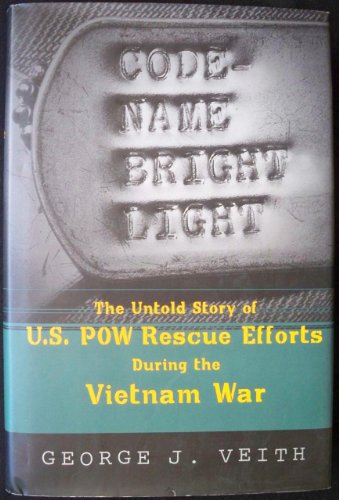
Code-Name Bright Light : The Untold Story of U.S. POW Rescue Efforts During the Vietnam War - Hardcover
Synopsis
Code-Name Bright Light tells one of the great unknown stories of the Vietnam War: the American military's extensive secret operations to locate and rescue POW/MIAs during the conflict. It is a tale of tragedy and heroism revealed in full for the first time in this volume. The history of the U.S. POW/MIA intelligence and wartime rescue operations has long remained concealed under the shroud of national security, unknown both to the public and to the families of the missing. George J. Veith has assembled an extensive range of previously unseen material, including recently declassified NSA intercepts, State Department cables, and wartime interrogation reports which reveal how the U.S. military conducted a centralized effort to identify, locate, and rescue its POW/MIAs. Code-Name Bright Light also traces the development of the various national wartime POW intelligence operations and provides an in-depth look at the activities of the Joint Personnel Recovery Center, a secretive and highly classified POW/MIA unit in South Vietnam responsible for rescuing captives. Further, it uncovers one of the most tightly held POW/MIA secrets, the primary reason why the government did not think any Americans were left behind: a clandestine communication program between the POWs and the U.S. military. This still-sensitive program provided the identities and locations of American prisoners, defeating North Vietnamese efforts to keep their names and locations a secret. The raids and efforts that make up the narrative of Code-Name Bright Light succeeded in freeing hundreds of captive South Vietnamese soldiers but resulted in the rescue of few Americans. The vast network of efforts, however, is a testament to the U.S. military's unknown commitment to freeing its captive soldiers. Veith concludes that the United States secretly went as far as any army could go in freeing its captives in this type of wartime situation. Our understanding of the war remains incomplete without this powerful history.
"synopsis" may belong to another edition of this title.
About the Author
A former army captain, George J. Veith commanded a tank battalion in West Germany and served for almost seven years in different command positions in U.S. combat units in Germany and the United States. An acknowledged expert on the POW issue, he was asked to address the 1995 League of Families convention on the subject of POW/MIAs, presented a paper in 1996 at a symposium of the Center for the Study of the Vietnam Conflict at Texas Tech University, and is frequently asked to speak before POW/MIA activist groups. Veith has been instrumental in putting the POW/MIA issue on the Internet as well. He lives with his wife and children in Aston, Pennsylvania. Code-Name Bright Light is his first book.
Reviews
An all-encompassing examination of the history of American POWs in Vietnam. Veith, a former army officer, sheds much-needed light on the history of American POWs in Southeast Asia. Using recently declassified wartime POW material, and extensive interviews with former POWs and those who worked to rescue them, Veith includes many, many details on how dozens of Americans were captured, how they fared in captivity, and how they tried to escape, were released, or died in captivity. The heart of the book is a close examination of the military's efforts to find the POWs in Laos, Cambodia, and Vietnam and free them during the war. Veith provides an illuminating (if at times overwritten and acronym-clogged) road map of an effort that began with various military Search-and-Rescue (SAR) teams and the covert Studies and Observation Group (SOG), which worked behind enemy lines. In 1966 the SOG and SAR POW duties were folded into a new unit, the Joint Personnel Recovery Center (JPRC), sometimes referred to by the unclassified code name Bright Light. As Veith shows, the often courageous and heroic work by these men came to naught. The Americans freed some 500 South Vietnamese POWs and recovered 110 American bodies, but not one captured American was rescued from an enemy camp. The many reasons for that failure included intraservice rivalries, intelligence breakdowns, and high-level political intransigence, especially in supposedly neutral Laos, where the Americans were waging a so-called ``secret war.'' Veith briefly addresses the heated issue of whether all American POWs were returned in 1973 and provides some food for thought about men left behind, primarily in Laos. But Veith's main task, and one at which he succeeds very well, is to offer a much-needed historial look at the vast array of efforts undertaken to recover American POWs during the war. -- Copyright ©1997, Kirkus Associates, LP. All rights reserved.
Using U.S. and Vietnamese government records plus interviews with military and intelligence personnel, Veith traces U.S. attempts to find and rescue its POWs during the Vietnam War. And it's a rather dispiriting story, because though "the military did their best to recover American POWs" during the war, "they completely failed." Veith claims that the core problems (crippling interservice rivalries, bureaucratic jealousies, and too much consideration for local politics) were in place from early rescue attempts through the formation of the supposedly centralized Joint Personnel Recovery Center (JPRC). All came together to make JPRC's first major recovery operation a bloodbath. The soldiers sent on these dangerous missions displayed herculean efforts; however, Veith's history also suggests that--for all talk to the contrary--the U.S. government's resolve to get back its POWs was lukewarm. He also posits much information that suggests the military knew considerably more about still-imprisoned Americans than it revealed after Vietnam. Apt to be very controversial. Brian McCombie
Popular and academic works on U.S. prisoners of war continue to play a central role in Vietnam War literature and historiography. But even as the number of such titles proliferate, the quality of the research and the political bias of the writers have long been issues. Although a definitive scholarly volume awaits the opening of Vietnam's archives, Veith's research in the U.S. records places his study on American rescue attempts in the forefront of the discussion. The author, a specialist on POWs/MIAs, presents a tightly written, challenging essay on the ill-starred rescue efforts of the Joint Personnel Recovery Center and associated units in Vietnam and Laos. The catalog of bureaucratic inertia, interservice rivalries, and incredible bad luck combined to frustrate the numerous missions of American and Vietnamese special forces. An arresting and dramatic story supported by exceptional research, this is an essential purchase for Vietnam War collections in academic and public libraries.?John R. Vallely, Siena Coll. Lib, Loudonville, N.Y.
Copyright 1998 Reed Business Information, Inc.
Excerpt. © Reprinted by permission. All rights reserved.
Chapter 1
Introduction
The revolution pertains to the people. The people undertake the revolution only when they are assimilated with revolutionary thought. The propaganda and indoctrination task plays a very important role in this. It constitutes the most essential link and always leads the way in the revolutionary movement. The propaganda task also involves the political indoctrination and leadership of the people's ideology to crush the enemy propaganda which poisons the people's minds....Ultimately, by understanding the ideology and characteristics of the enemy, we can crush his spirit and defeat him. Thus, use the enemy to defeat the enemy.
Captured enemy document, circa 1965
More than two decades after the end of the Vietnam war, the POW/MIA issue continues to divide Americans in a manner reminiscent of the war itself. While the Vietnam war is more of a peripheral issue compared to such enduring American controversies as racism and abortion, the societal fallout from the war remains firmly embedded in our culture. Passions about Vietnam are still periodically rekindled, both deliberately and by happenstance, and never more intensely than over the unresolved issue of still-missing American servicemen. Like many of the legacies from that bitter conflict, it is an emotional and complex subject, awkwardly reminding us of debts still owed -- at times seemingly inconvenient for those more interested in pressing their political and economic agenda to open diplomatic relations with Vietnam or planning ambitious business ventures in the region.
Skeptics and those with less charitable agendas point out that, despite the prayers and persistence of so many, in the years since the last American helicopter lifted off from the rooftop of the American embassy in Saigon, no ghost has materialized from a forgotten jungle outpost to rejoin his comrades and family, save one lone Marine in 1979, Robert Garwood. Why then, many cynics ask, is it so difficult for the remaining advocates of the missing to agree, at long last, to view Vietnam as a country and not a war?
The answer resides partially in the American military's commitment to never abandon a fallen comrade. That commitment continues today in the sense of responsibility for a full accounting for the missing felt by a regrettably small number of U.S. government officials. It is fueled by thousands of American citizens and veterans that, despite repeated claims to the contrary by the communists, the Vietnamese or Laotians do possess detailed knowledge on the fate of many American POW/MIAs. Ultimately, though, what sustains this issue is the love and devotion of families searching for answers, bolstered by the belief that the truths can still be discovered, and that eventually the full story of Vietnam's and Laos' duplicity regarding the fate of many Americans will be exposed.
Many Americans wonder why or how the issue has continued to this day. Although two full Congressional committees have investigated the issue, both struggled under accusations of malfeasance. Despite these investigations, from a historical perspective, the one area still most glaringly unexplored is the content and direction of American wartime POW intelligence and, concurrently, the U.S. military's covert wartime rescue efforts. These efforts have remained a mystery, hidden since the end of the war by the cloak of national security and buried under the duty to avoid disclosing important intelligence methods and sources.
This book, however, reveals that secret history -- the story of the immense, often highly classified efforts to identify, locate, and rescue American POWs. This study probes the history of the U.S. government's intelligence programs, botched rescue efforts, failed ransoms, and futile attempts at diplomatic swaps. While this study endeavors to show that the Vietnam-era military did not break faith with their missing or captured comrades, it also does not gloss over their mistakes or conceal their failings. The total effort was simply too riddled with bureaucratic and service jealousies, too compartmentalized, and too exposed to local and national political considerations, both in the United States and in Southeast Asia.
In essence, the military did their best to recover American POWs -- and yet they completely failed. The fact that the military failed shows how overwhelming the odds were, no matter how great the sacrifices to recover them or how much resourcefulness, dedication, and tenacity were displayed. Some of the barriers were self-imposed, for the military's POW endeavors often operated without a much-needed integration of resources, intelligence, and experience. However, despite every obstacle imaginable plus the frequently grudging cooperation of our Asian allies, the military tried desperately. But even failure can teach a great lesson, and because we failed does not mean we should not keep trying. The previously secret knowledge amassed from these activities has never before been thoroughly examined. If the hard-won lessons of the past can be applied to a future war, perhaps this country can avoid enduring another painful and lingering thirty-year controversy.
MACV-SOG, the Joint Personnel Recovery Center, and Search and Rescue
Understanding the many facets of the POW/MIA issue often seems to require a crash course in military jargon, plus a handbook to help the uninitiated comprehend the blizzard of acronyms, various layers of bureaucracies, and multitudes of organizations and units. The following sections are designed to provide the reader a basic grounding in the issue and the war.
MACV-SOG was established on January 24, 1964, when President Lyndon B. Johnson authorized covert operations against the North. The Military Assistance Command, Vietnam's (MACV) Studies and Observation Group (SOG) was designed to disrupt the enemy's sanctuaries clandestinely by conducting commando-style raids across the Laos-South Vietnam border to destroy or gather intelligence on supplies moving from North Vietnam through Laos along the Ho Chi Minh Trail.
To accomplish that difficult mission, SOG was granted authority to operate across the national borders of the other Southeast Asian countries, something normal U.S. ground units were forbidden to do. Because of the political sensitivities involved in attacking North Vietnamese Army (NVA) sanctuaries located across the borders in Laos and later in Cambodia, SOG was among the most secret, tightly held operations in the war.
Ostensibly, the Joint Personnel Recovery Center (JPRC) was a small staff office within the headquarters of the Military Assistance Command, Vietnam that handled POW intelligence. Only its relationship to SOG was classified. Within SOG, the JPRC was called the Recovery Studies Division, or OP-80.
While much of this book focuses on the efforts of the JPRC, other important search-and-rescue activity occurred in the years before the JPRC was set up. There were also critical activities that impacted the POW effort at the national level outside the purview of the unit, and covert actions in Vietnam that swirled beyond its reach during the unit's existence. The State Department, the CIA, and the Defense Intelligence Agency (DIA) had a great deal of involvement in those actions, and while the JPRC was often center stage, ultimately it was only one player among many. However, because of its highly classified relationship to SOG, little has been officially released on the JPRC's activities or is known about the exploits of this critical section responsible for rescuing captive Americans. Its vast efforts over its six years of existence have, until now, been no more than a footnote in the larger volumes on Vietnam or a paragraph or two in the postwar books on POWs and MIAs.
Essentially, the JPRC was the military's response to an al
"About this title" may belong to another edition of this title.
Search results for Code-Name Bright Light : The Untold Story of U.S. POW...

Seller Image
Code-Name Bright Light : The Untold Story of U.S. POW Rescue Efforts During the Vietnam War
Seller: Greenworld Books, Arlington, TX, U.S.A.
Seller rating 5 out of 5 stars

Condition: very_good. Fast Free Shipping â" Very Good condition book with a firm cover and clean pages. Shows normal use and some light wear or limited notes markings. A solid, nice copy to enjoy. Seller Inventory # GWV.0684835142.VG
Stock Image
Code-Name Bright Light : The Untold Story of U.S. POW Rescue Efforts During the Vietnam War
Seller: Half Price Books Inc., Dallas, TX, U.S.A.
Seller rating 5 out of 5 stars
hardcover. Condition: Very Good. Connecting readers with great books since 1972! Used books may not include companion materials, and may have some shelf wear or limited writing. We ship orders daily and Customer Service is our top priority! Seller Inventory # S_473208481
Stock Image
Code-Name Bright Light : The Untold Story of U.S. POW Rescue Efforts During the Vietnam War
Seller: HPB-Diamond, Dallas, TX, U.S.A.
Seller rating 5 out of 5 stars
hardcover. Condition: Very Good. Connecting readers with great books since 1972! Used books may not include companion materials, and may have some shelf wear or limited writing. We ship orders daily and Customer Service is our top priority! Seller Inventory # S_476901313
Stock Image
Code-Name Bright Light : The Untold Story of U.S. POW Rescue Efforts During the Vietnam War
Seller: HPB Inc., Dallas, TX, U.S.A.
Seller rating 5 out of 5 stars
hardcover. Condition: Very Good. Connecting readers with great books since 1972! Used books may not include companion materials, and may have some shelf wear or limited writing. We ship orders daily and Customer Service is our top priority! Seller Inventory # S_458243792
Stock Image
Code-Name Bright Light : The Untold Story of U.S. POW Rescue Efforts During the Vietnam War
Seller: ThriftBooks-Atlanta, AUSTELL, GA, U.S.A.
Seller rating 5 out of 5 stars
Hardcover. Condition: Good. No Jacket. Former library book; Pages can have notes/highlighting. Spine may show signs of wear. ~ ThriftBooks: Read More, Spend Less. Seller Inventory # G0684835142I3N10
Stock Image
Code-Name Bright Light : The Untold Story of U.S. POW Rescue Efforts During the Vietnam War
Seller: ThriftBooks-Dallas, Dallas, TX, U.S.A.
Seller rating 5 out of 5 stars
Hardcover. Condition: Good. No Jacket. Missing dust jacket; Pages can have notes/highlighting. Spine may show signs of wear. ~ ThriftBooks: Read More, Spend Less. Seller Inventory # G0684835142I3N01
Stock Image
Code-Name Bright Light : The Untold Story of U.S. POW Rescue Efforts During the Vietnam War
Seller: ThriftBooks-Dallas, Dallas, TX, U.S.A.
Seller rating 5 out of 5 stars
Hardcover. Condition: Very Good. No Jacket. Former library book; May have limited writing in cover pages. Pages are unmarked. ~ ThriftBooks: Read More, Spend Less. Seller Inventory # G0684835142I4N10
Stock Image
Code-Name Bright Light : The Untold Story of U.S. POW Rescue Efforts During the Vietnam War
Seller: ThriftBooks-Atlanta, AUSTELL, GA, U.S.A.
Seller rating 5 out of 5 stars
Hardcover. Condition: Good. No Jacket. Pages can have notes/highlighting. Spine may show signs of wear. ~ ThriftBooks: Read More, Spend Less. Seller Inventory # G0684835142I3N00
Stock Image
Code-Name Bright Light : The Untold Story of U.S. POW Rescue Efforts During the Vietnam War
Seller: HPB-Movies, Dallas, TX, U.S.A.
Seller rating 5 out of 5 stars
hardcover. Condition: Very Good. Connecting readers with great books since 1972! Used books may not include companion materials, and may have some shelf wear or limited writing. We ship orders daily and Customer Service is our top priority! Seller Inventory # S_478939904
Stock Image
Code-Name Bright Light : The Untold Story of U.S. POW Rescue Efforts During the Vietnam War
Seller: Umpqua Books, Roseburg, OR, U.S.A.
Seller rating 5 out of 5 stars
Hardcover. Condition: Very Good. Dust Jacket Condition: Very Good. Minimal Wear // Pages show sun tan // Spine Like New. Seller Inventory # OR-2023-O-11-AM