Items related to The Right Moment: Ronald Reagan's First Victory...
The Right Moment: Ronald Reagan's First Victory and the Decisive Turning Point in American Politics - Hardcover
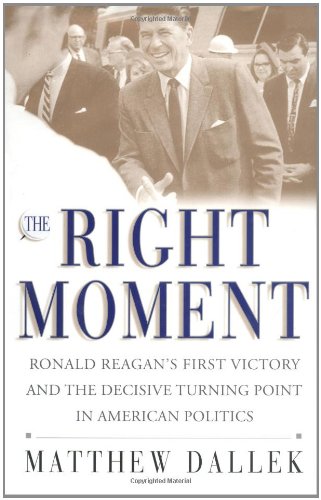

Returning to the roots of Ronald Reagan's political career, the author retraces the former president's first big victory in California, where he came from nowhere in 1966 to win the governorship.
"synopsis" may belong to another edition of this title.
Review:
Matthew Dallek, a former speechwriter for Richard A. Gephardt, earned his Ph.D. in American History from Columbia University in 1999. His articles and reviews have appeared in The Washington Post, The Atlantic Monthly , The New Republic, and other national publications. He lives in Washington, D.C.
When Ronald Reagan won the Republican nomination for governor of California in 1966, The New York Times called the GOP's decision "against all counsels of common sense and political prudence." That comment probably deserves to go down in history as one of the most spectacularly wrong political assessments ever to appear in a newspaper. As historian Matthew Dallek writes in The Right Moment, his account of Reagan's campaign against Democratic governor Pat Brown, "Ronald Reagan redefined politics like no one since Franklin Roosevelt." The future president's "stunning, out-of-nowhere victory," in which he beat Brown by nearly a million votes, altered the course of American politics for at least a generation: it signaled liberalism's descent into the fatal politics of 1970s McGovernism, announced the rebirth of the conservative movement out of the ashes of Barry Goldwater's crushing defeat two years earlier, and foreshadowed Reagan's greater accomplishments on the national stage.
About the Author:
Before becoming governor, Reagan faced the formidable challenge of persuading mainstream voters that an affable actor could indeed perform effectively as a chief executive. But an even trickier task, in Dallek's telling, was how Reagan rescued the conservative movement from its own extremist elements. There was, for instance, the John Birch Society, a right-wing organization whose thousands of members would form a part of any successful conservative coalition, but whose leaders believed in the plainly absurd idea that President Eisenhower was a Communist agent. Reagan at once had to harness this group's energies and keep his distance from its nuttier beliefs. This he accomplished with a deftly written one-page statement repudiating some of what the group's leaders had alleged and courting their followers at the same time. By zeroing in on this half-forgotten episode of Reagan's career, Dallek shows how the consequences of one election can reverberate throughout the years. This book is almost as much about Pat Brown as it is about Ronald Reagan--fans of Ronald Radosh's Divided They Fell, for instance, will surely enjoy that aspect of it--but most readers will be drawn to The Right Moment for its detailed chronicle of how Reagan got his start in politics. --John J. Miller
Matthew Dallek, a former speechwriter for Richard A. Gephardt, earned his Ph.D. in American History from Columbia University in 1999. His articles and reviews have appeared in The Washington Post, The Atlantic Monthly , The New Republic, and other national publications. He lives in Washington, D.C.
"About this title" may belong to another edition of this title.
- PublisherFree Press
- Publication date2000
- ISBN 10 068484320X
- ISBN 13 9780684843209
- BindingHardcover
- Edition number1
- Number of pages304
- Rating
Buy New
Learn more about this copy
US$ 20.00
Shipping:
US$ 3.00
Within U.S.A.
Top Search Results from the AbeBooks Marketplace
Stock Image
The Right Moment: Ronald Reagan's First Victory and the Decisive Turning Point in American Politics
Seller:
Rating

Book Description Hardcover. Condition: new. Brand New Copy. Seller Inventory # BBB_new068484320X
Buy New
US$ 20.00
Convert currency
Stock Image
The Right Moment: Ronald Reagan's First Victory and the Decisive Turning Point in American Politics
Seller:
Rating
Book Description Hardcover. Condition: new. Buy for Great customer experience. Seller Inventory # GoldenDragon068484320X
Buy New
US$ 24.57
Convert currency
Stock Image
The Right Moment: Ronald Reagan's First Victory and the Decisive Turning Point in American Politics
Seller:
Rating
Book Description Hardcover. Condition: new. New. Seller Inventory # Wizard068484320X
Buy New
US$ 27.13
Convert currency
Stock Image
The Right Moment: Ronald Reagan's First Victory and the Decisive Turning Point in American Politics
Seller:
Rating
Book Description Hardcover. Condition: new. New Copy. Customer Service Guaranteed. Seller Inventory # think068484320X
Buy New
US$ 28.47
Convert currency
Stock Image
The Right Moment: Ronald Reagan's First Victory and the Decisive Turning Point in American Politics
Seller:
Rating
Book Description Condition: new. Seller Inventory # FrontCover068484320X
Buy New
US$ 29.88
Convert currency
Stock Image
The Right Moment: Ronald Reagan's First Victory and the Decisive Turning Point in American Politics
Seller:
Rating
Book Description Hardcover. Condition: new. New. Fast Shipping and good customer service. Seller Inventory # Holz_New_068484320X
Buy New
US$ 32.00
Convert currency
Stock Image
The Right Moment: Ronald Reagan's First Victory and the Decisive Turning Point in American Politics
Seller:
Rating
Book Description Hardcover. Condition: New. Seller Inventory # Abebooks588651
Buy New
US$ 59.00
Convert currency
Stock Image
THE RIGHT MOMENT: RONALD REAGAN'
Seller:
Rating
Book Description Condition: New. New. In shrink wrap. Looks like an interesting title! 1.2. Seller Inventory # Q-068484320X
Buy New
US$ 74.98
Convert currency