
Synopsis
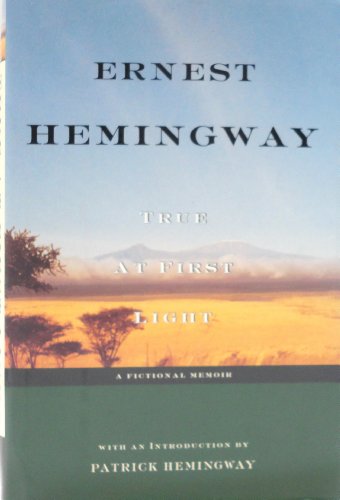
In commemoration of the Hemingway Centennial, the last unpublished work by the great American author contains a fictional account of his last African safari, a novel that mixes adventure, romance, and satire. 200,000 first printing. First serial, The New Yorker. BOMC Main. QPB Alt.
"synopsis" may belong to another edition of this title.
About the Author
Ernest Hemingway ranks as the most famous of twentieth-century American writers; like Mark Twain, Hemingway is one of those rare authors most people know about, whether they have read him or not. The difference is that Twain, with his white suit, ubiquitous cigar, and easy wit, survives in the public imagination as a basically, lovable figure, while the deeply imprinted image of Hemingway as rugged and macho has been much less universally admired, for all his fame. Hemingway has been regarded less as a writer dedicated to his craft than as a man of action who happened to be afflicted with genius. When he won the Nobel Prize in 1954, Time magazine reported the news under Heroes rather than Books and went on to describe the author as "a globe-trotting expert on bullfights, booze, women, wars, big game hunting, deep sea fishing, and courage." Hemingway did in fact address all those subjects in his books, and he acquired his expertise through well-reported acts of participation as well as of observation; by going to all the wars of his time, hunting and fishing for great beasts, marrying four times, occasionally getting into fistfights, drinking too much, and becoming, in the end, a worldwide celebrity recognizable for his signature beard and challenging physical pursuits.
Reviews
More a curiosity than a major contribution to his oeuvre, this fictional memoir of a 1953 safari in Kenya, edited by Hemingway's son Patrick from a first-draft manuscript and published to celebrate the 100th anniversary of Papa's birth, is a sometimes entertaining, sometimes trying read. Hemingway narrates the rambling story in his own voice, and others, including his wife, Mary, are identified by name. More humorous than most of Hemingway's novels, the narrative also contains enough hunting scenes for Hemingway and others to show the requisite grace under pressure. The old Hemingway magic flashes sporadically, like lightning, but not often enough. There are a series of sentences intoning "I wished..." reminiscent of his earlier linguistic triumphs, and some dialogue, crisp and to the point, like the stichomythia of Greek tragedy. Lines like "So I carried her in and she weighed just what a woman that you love should weigh when you lifted her in your arms...." still resonate. The Kenyan setting is atmospheric, but the promising elements of the plotAa possible Mau Mau attack on the camp, Miss Mary's determination to kill a lionAtoo often stagnate for lack of action and dramatic tension. Some uneasiness occurs between Hemingway and Mary over Hemingway's attraction to an African woman, Debba, but even this is pretty tame. A supporting cast of African characters are not distinct individuals, and the prolific use of Swahili words is often confusing in spite of a glossary. Yet, as prose by Hemingway, no matter how distanced and imperfect, the book is still worth reading. Perhaps it will inspire new readers to delve into Hemingway's true legacy, the novels and stories like "Cat in the Rain," and "The Short Happy Life of Francis Macomber." BOMC main selection; first serial to the New Yorker; rights sold in Denmark, England, France, Germany, Iceland, Italy, Norway, Poland, Spain, Sweden and the Czech Republic.
Copyright 1999 Reed Business Information, Inc.
Ernest Hemingway never kept a journal, says his son Patrick, editor of this book from a manuscript twice its size describing life in a Kenyan safari camp in the winter of 195354. It can of course be called fiction, however much it seems like a journal. An autobiography, say. Little happens. The threat of an uprising of local Africans soon dissipates. Christmas is coming (the Birthday of the Baby Jesus) and wife Mary chooses a tree that would make an elephant drunk for two days if he ever ate it. Daily hunting has taken place for six months in hopes of fulfilling Marys strong wish to kill a lion, a desire both she and Hemingway say they understand, though the reader may not. Patrick hints that it has to do with Marys feelings about Debba, a beautiful and charming African girl whom Hemingway would like (quite seriously) to take as a second wife if law only permitted. The lion is killed, but Mary is unsatisfied, believing that Hemingway shot first (he didnt). In time, after Mary takes a trip to Nairobi, all is well again and the two embarrass the reader anew with their love-endearments (well both sleep like good kittens). The true book, though, is less in its events than in the unmonitored voice of its author. Hemingway, talking, offers a compendium of his familiar old symbols, themes, moods, feelings, details. But the voice is also like hearing the author from somewhere beyond the grave, speaking from within his own absence. You dont ever have despair do you Ernie? asks a friend. The answer, sad in a way it could never have been when written: Ive seen it close enough to touch it but I always turned it down. Uneven, imperfect, irritating, amusing, moving, and of treasurable importance to an understanding of this massive however flawed genius of our literature. (First serial to The New Yorker; Book-of-the-Month main selection/QPB alternate selection) -- Copyright ©1999, Kirkus Associates, LP. All rights reserved.
Hemingway never completed the untitled manuscript he began after a 1953 safari in Kenya. His son, Patrick, undertook the demanding work of editing his father's tale, and this intriguing "fictional memoir" is the result. Its title is taken from a line of Hemingway's that begins, "In Africa a thing is true at first light and a lie by noon," and this sense of shifting perspective and ephemerality permeates his provocative narrative. A man called Pop and a woman named Mary are camped in the Kajiado District of Kenya's game country at the dawn of Jomo Kenyatta's push for independence. They know that their privileged days as white hunters are numbered, so they give themselves over to the pleasures of life in the bush with conscious and slightly melancholy abandon. Mary is determined to kill a magnificent, black-maned lion. Pop is embroiled in a tricky romance with a woman in a nearby village, whom Mary refers to stoically as his fiancee. As they wait for the lion to reveal himself, and for love and politics to take their course, Pop, Mary, and various visitors drink gin, indulge in sharply witty repartee, and take stock of their lives. Obviously Hemingway would have greatly revised his first draft, but the power of his unique and resonant vision is palpable on every page as he contrasts white cultures with those of Africa, and the crimes of humanity with the purity of nature. In one scene, Pop scolds himself for thinking only of the hunt or for indulging in long reminiscences of his sojourns in Paris. He should, he knows, be admiring the beauty all around him. "This looking and not seeing things was a great sin," he muses, thus stating the credo at the very heart of Hemingway's art. Patrick Hemingway has done a fine and noble thing here, and this resurrected work will be treasured long after the celebration of the centennial of Hemingway's birth on July 21, 1999. Donna Seaman
It's not often that this column gets to cite something by a truly classic author, but here it is: Hemingway's last work, written after he returned from his 1953 safari and edited by his son, Patrick, in time for this July's centennial celebration. Hemingway even stars in this "fictional memoir," running the safari camp in the absence of friend and lead hunter Pop even as hostile tribes gather to attack. But he still has time to sneak in an affair with an African girl. Along with this work, Scribner will publish three new hardcover editions of Hemingway classics: The Snows of Kilimanjaro and Other Stories (ISBN 0-684-86221-2. $25), Death in the Afternoon (ISBN 0-684-85922-X. $35), and To Have and Have Not (ISBN 0-684-85923-8. $25).
Copyright 1999 Reed Business Information, Inc.
"About this title" may belong to another edition of this title.
Other Popular Editions of the Same Title

Search results for True at First Light: A Fictional Memoir

Stock Image
True at First Light
Seller: World of Books (was SecondSale), Montgomery, IL, U.S.A.
Seller rating 5 out of 5 stars

Condition: Good. Item in good condition. Textbooks may not include supplemental items i.e. CDs, access codes etc. Seller Inventory # 00093904297
Stock Image
True at First Light
Seller: World of Books (was SecondSale), Montgomery, IL, U.S.A.
Seller rating 5 out of 5 stars
Condition: Acceptable. Item in acceptable condition! Textbooks may not include supplemental items i.e. CDs, access codes etc. Seller Inventory # 00101371020
Seller Image
True at First Light: A Fictional Memoir
Seller: Dream Books Co., Denver, CO, U.S.A.
Seller rating 5 out of 5 stars
Condition: acceptable. This copy has clearly been enjoyedâ"expect noticeable shelf wear and some minor creases to the cover. Binding is strong, and all pages are legible. May contain previous library markings or stamps. Seller Inventory # DBV.0684849216.A
Seller Image
True at First Light: A Fictional Memoir
Seller: Dream Books Co., Denver, CO, U.S.A.
Seller rating 5 out of 5 stars
Condition: good. Gently used with minimal wear on the corners and cover. A few pages may contain light highlighting or writing, but the text remains fully legible. Dust jacket may be missing, and supplemental materials like CDs or codes may not be included. May be ex-library with library markings. Ships promptly! Seller Inventory # DBV.0684849216.G
Seller Image
True at First Light: A Fictional Memoir
Seller: Zoom Books East, Glendale Heights, IL, U.S.A.
Seller rating 5 out of 5 stars
Condition: like_new. Book is in like new condition with minimal signs of wear. Pages are clean and free from notes or highlighting. Dust cover is intact. May not contain miscellaneous items toys, dvds, etc. . We offer 100% money back guarantee and 24 7 customer service. Seller Inventory # ZEV.0684849216.LN
Seller Image
True at First Light: A Fictional Memoir
Seller: Zoom Books East, Glendale Heights, IL, U.S.A.
Seller rating 5 out of 5 stars
Condition: very_good. Book is in very good condition and may include minimal underlining highlighting. The book can also include "From the library of" labels. May not contain miscellaneous items toys, dvds, etc. . We offer 100% money back guarantee and 24 7 customer service. Seller Inventory # ZEV.0684849216.VG
Seller Image
True at First Light: A Fictional Memoir
Seller: Zoom Books East, Glendale Heights, IL, U.S.A.
Seller rating 5 out of 5 stars
Condition: good. Book is in good condition and may include underlining highlighting and minimal wear. The book can also include "From the library of" labels. May not contain miscellaneous items toys, dvds, etc. . We offer 100% money back guarantee and 24 7 customer service. Seller Inventory # ZEV.0684849216.G
Stock Image
True at First Light: A Fictional Memoir
Seller: BooksRun, Philadelphia, PA, U.S.A.
Seller rating 5 out of 5 stars
Hardcover. Condition: Very Good. With dust jacket. It's a well-cared-for item that has seen limited use. The item may show minor signs of wear. All the text is legible, with all pages included. It may have slight markings and/or highlighting. Seller Inventory # 0684849216-11-1-29
Seller Image
True at First Light: A Fictional Memoir
Seller: Greenworld Books, Arlington, TX, U.S.A.
Seller rating 5 out of 5 stars
Condition: very_good. Fast Free Shipping â" Very Good condition book with a firm cover and clean pages. Shows normal use and some light wear or limited notes markings. A solid, nice copy to enjoy. Seller Inventory # GWV.0684849216.VG
Seller Image
True at First Light: A Fictional Memoir
Seller: Greenworld Books, Arlington, TX, U.S.A.
Seller rating 5 out of 5 stars
Condition: good. Fast Free Shipping â" Good condition. It may show normal signs of use, such as light writing, highlighting, or library markings, but all pages are intact and the book is fully readable. A solid, complete copy that's ready to enjoy. Seller Inventory # GWV.0684849216.G