
Items related to Jewish Holiday Style
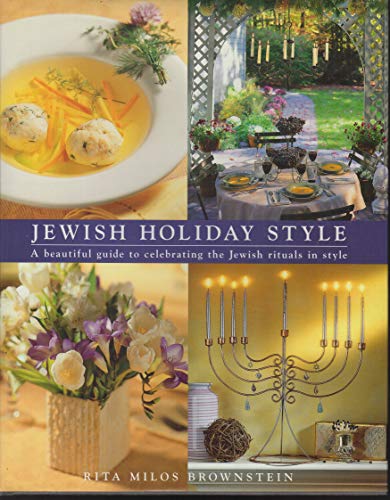
Synopsis
A meaningful collection of revitalizing contemporary ideas for celebrating the Jewish holidays offers recipes, crafts, decoration suggestions and more, including creative Purim carnival costumes, beeswax Menorah candles, and a Rosh Hashanah honey-tasting party. 17,500 first printing.
"synopsis" may belong to another edition of this title.
About the Author
Rita Milos Brownstein is a graphic designer and art director who has worked for House Beautiful, Good Housekeeping, and many other publications. Brownstein lives in Connecticut with her husband and two children.
Reviews
Jewish cookbooks have become a rapidly burgeoning category. Appearing at the beginning of the annual cycle that starts with Rosh Hashanah and Yom Kippur, three of these four new titles focus on Jewish holidays and holy days, while Friedland's concentrates just on the Sabbath. Greene's book, a revision of her 1985 title, is by far the most ambitious of the group, with more than 250 recipes (80 or so entirely new, the others thoroughly revised) for all the major holidays and some minor ones, and including Israel's Independence Day as well as religious celebrations. A cooking teacher and the longtime food editor of the Baltimore Jewish Times, Greene also offers extensive background on each holiday, and her diverse recipes are from all around the globe. Highly recommended. Recently, a growing number of Jews have found themselves returning to their religious roots and observances they have let lapse, making Friedland's book on celebrating the Sabbath particularly timely. A cookbook editor and author of The Passover Cookbook, Friedland presents 175 recipes for the three meals of Shabbat (Friday dinner, Saturday lunch, and the "third meal," marking the end of the Sabbath later on Saturday). Like Greene's, her recipes are international in scope, reflecting both the Ashkenazic and Sephardic heritages, and her text is readable and informative. Recommended for most collections. Brownstein, the former art director of Good Housekeeping and House Beautiful, offers a lavishly illustrated crafts book with recipes and ideas for the holidays. For each holiday, there is a menu, several crafts projects, and decorating suggestions. Brownstein's approach will not be to everyone's taste (the three sukkahs for Sukkot, for example, include a "fantasy" Penthouse Sukkah, "high-tech and sleek," but the minimatzo vases for the Passover seder are pretty cute). For larger collections. Rubin seems like a nice woman, but would her cookbooks have been published if she weren't actor/singer Mandy Patinkin's mother? Her second book, which opens with "testimonials" from grandchildren and other family members, includes recipes for Thanksgiving, a bridal luncheon, and a barbecue as well as for four major Jewish holidays. The recipes are simple, and many of them rely on convenience foods; some have little to do with traditional Jewish holiday cooking (the buffet menu includes Mexicali Layered Dip and two shellfish dishes). Only for collections where Rubin's Grandma Doralee Patinkin's Jewish Family Cookbook is popular.
Copyright 1999 Reed Business Information, Inc.
Excerpt. © Reprinted by permission. All rights reserved.
Chapter 1
Rosh Hashanah
The blast of the shofar is the signal -- the alarm -- that the Days of Awe, the ten-day period from Rosh Hashanah to Yom Kippur, has begun. This is a time of serious introspection and soul-searching, because everything done during this time period can affect the outcome of the year to come. It is a time to heal hurts, offer apologies, mend misunderstandings, and right wrongs. It is also a time to increase acts of kindness and charity. If our efforts are undertaken with a sincere heart, then God will look on us favorably and inscribe us in the Book of Life for another year. This process, called teshuvah, which means "return," allows us to return to our best true selves and to embark on the New Year with a clean slate. * The Days of Awe begin with Rosh Hashanah, meaning literally the "head of the year," on the first of Tishrei. It is the crown jewel of the Jewish calendar, marking the beginning of the Jewish New Year and the birthday of the world. * Rosh Hashanah is a delicious time of families and friends coming together. Family meals. Crunchy apple slices dipped in honey, as wishes for a sweet New Year. Fat, fragrant round challahs, sometimes studded with sweet raisins, just begging to be pulled apart and passed around. Kosher markets struggle to fill the many orders for fresh briskets of beef, and granddaughters thumb through old recipes for tzimmes, the Ashkenazi sweet potato, prune, and carrot side dish. Pomegranates, the traditional first fruit, are served so that we may do as many good deeds as there are seeds within the fruit. * The Jewish world is bright and joyous; even the fruits and vegetables served are vividly hued -- oranges, carrots, the many varieties of apples. Whatever traditions you opt to embrace or decide to create, make sure your Rosh Hashanah is bright, light, and sweet.
New Year Cards
This is one of the holidays during which Jewish people send greeting cards to friends and family. Card companies have gotten much more creative in recent years with their Rosh Hashanah cards, selling them singly or by the pack, but why not try your hand at making your family's own? They're much more personal, and recipients will treasure them more, knowing the effort and creativity that went into each card.
New Year's cards may be sent before Rosh Hashanah up until the beginning of Sukkot, so you have a couple of weeks to get them into the mail. Ours are made from both blank cards from the stationery store and colored paper that can be cut to the desired size. Quality art supply stores also sell handmade papers, some with flower petals or fiber pieces pressed right in. They're a beautiful canvas for handmade cards.
Open House Buffet
Our Rosh Hashanah open house buffet is short on prep time, long on pleasure. The spirit of the Jewish New Year permeates your home. The talk is relaxed and unhurried. The food is abundant yet simple. And a menu like this allows you to enjoy this special time with the people you love, not careening back and forth from the kitchen to the dining room. Here, we've created ideas for an easily elegant buffet table, headlining food that needn't be eaten at a sit-down meal, foods prepared days ahead, using a vibrant tumble of vegetables from the summer's rich harvest.
We've loaded our table with garden treasures: a heady eggplant dip, a mélange of crudités, and traditional challah-turned-bruschetta. The cognac-laced chopped liver is a dense, surprisingly delicious treat, and tiny apple honey tartlets blend the season's celebrity fruit with the symbolic sweetness of honey. Consider jugs of cold local cider, and keep a crock of long cinnamon sticks nearby.
Some extra perks for you: Except for the tartlets, the foods on our buffet needn't be heated, totally eliminating panic time. This is intentional -- Rosh Hashanah services at different synagogues end at different times, which means that your guests don't arrive en masse. Each element of this light luncheon fails into the finger food category -- enough to satisfy, never to overfill, since many of your guests will be going on to traditional multicourse family dinners later in the day.
The setting is up to you, but we've chosen earthy autumn colors. As a centerpiece, you might want to use pomegranates -- a seasonal "first fruit" -- in an attractive glass bowl. These dry beautifully and look great in the house all year long. If your buffet is set up in a room with a fireplace, try this for the mantle -- scoop out a large oblong gourd or overgrown zucchini, tuck in some florists' foam, and insert bittersweet.
If you live near a body of fresh running water that contains fish, take a walk after the meal to experience tashlich. This is the ceremony of reciting prayers and throwing bread crumbs into the water as a symbolic casting away of our transgressions so we might make a fresh start for the New Year. This ceremony teaches us that, just as a fish's eyes are always open, so is God always watching over us and waiting for us to resolve that we will not repeat our sins. Then, like the water, our sins will also move on. Tashlich is a beautiful tradition, and one that children especially love. Adults find something very cleansing about the ceremony, which binds us to nature and reminds us that we are all part of the Creator's world.
MENU
Herbed Challah Bruschetta
Cognac Chopped Liver
Mediterranean Eggplant Spread
Harvest Tomato Compote
Roasted Beet Relish
Apple and Honey Tartlets
Nana's Basic Mandel Bread
Crudités with Dip
HERBED CHALLAH BRUSCHETTA
SERVES 8-10
1 large challah
1 cup extra-virgin olive oil
2 tablespoons Italian seasoning
2 teaspoons kosher salt
1 teaspoon cracked black pepper
1. Preheat oven to 400°F.
2. Cut challah into 1/2-inch slices and cut each slice diagonally into 4 pieces.
3. Mix oil, seasoning, salt, and pepper in a small bowl. Place challah on a baking sheet and brush the pieces with the oil mixture. Bake for 5-8 minutes or until golden. Turn pieces over and brush remaining side. Bake for an additional 3-4 minutes or until golden. Remove from oven and cool. Repeat with remaining pieces.
SUGGESTIONS
* Any type of challah will work. We prefer a pullman style because you get even pieces.
* This can be made ahead of time and kept in an airtight container or Ziploc bag.
* Any type of dried seasoning will work, such as sage, thyme, rosemary, or chives.
COGNAC CHOPPED LIVER
MAKES 2 CUPS
1 pound chicken livers Kosher salt
3 tablespoons olive oil
3/4 cup minced shallots
1 teaspoon minced garlic
1/4 cup plus 1 tablespoon cognac
2 hard-boiled eggs
2 tablespoons chopped parsley
2 tablespoons chopped chives
Salt and pepper to taste
1. Preheat broiler to high.
2. Chicken livers need to be kashered -- salt livers on all sides. Place on a broiler pan, on a screen-type rack so that blood can drip off.
3. Broil chicken livers for 4-5 minutes or until blood has exuded. Wash salt away.
4. Heat 2 tablespoons of oil in a large sauté pan. Sauté shallots for 6-8 minutes or until golden. Add garlic and cook for 30 seconds. Add chicken livers and 1/4 cup cognac. Let simmer for 12-15 minutes over medium-high heat, until liquid has evaporated and livers are cooked through.
5. Transfer mixture to a food processor fitted with a steel blade. Process liver mixture, eggs, and remaining oil until smooth. Remove mixture to a bowl and fold in parsley and chives. Splash with 1 tablespoon cognac. Season with salt and pepper to taste. Refrigerate for 1 hour.
6. Serve with herbed challah bruschetta.
MEDITERRANEAN EGGPLANT SPREAD
SERVES 6-8
1 large eggplant
4 cloves roasted garlic
1 tablespoon lemon juice
2 tablespoons olive oil<
"About this title" may belong to another edition of this title.
Search results for Jewish Holiday Style

Stock Image
Jewish Holiday Style
Seller: World of Books (was SecondSale), Montgomery, IL, U.S.A.
Seller rating 5 out of 5 stars

Condition: Good. Item in good condition. Textbooks may not include supplemental items i.e. CDs, access codes etc. Seller Inventory # 00097397300
Stock Image
Jewish Holiday Style
Seller: World of Books (was SecondSale), Montgomery, IL, U.S.A.
Seller rating 5 out of 5 stars
Condition: Very Good. Item in very good condition! Textbooks may not include supplemental items i.e. CDs, access codes etc. Seller Inventory # 00105060669
Seller Image
Jewish Holiday Style
Seller: Greenworld Books, Arlington, TX, U.S.A.
Seller rating 5 out of 5 stars
Condition: good. Fast Free Shipping â" Good condition. It may show normal signs of use, such as light writing, highlighting, or library markings, but all pages are intact and the book is fully readable. A solid, complete copy that's ready to enjoy. Seller Inventory # GWV.0684849593.G
Stock Image
Jewish Holiday Style
Published by
Simon & Schuster (edition ), 1999
ISBN 10: 0684849593
ISBN 13: 9780684849591
Used
Hardcover
Seller: BooksRun, Philadelphia, PA, U.S.A.
Seller rating 5 out of 5 stars
Hardcover. Condition: Very Good. With dust jacket. It's a well-cared-for item that has seen limited use. The item may show minor signs of wear. All the text is legible, with all pages included. It may have slight markings and/or highlighting. Seller Inventory # 0684849593-11-1-29
Stock Image
Jewish Holiday Style
Seller: ThriftBooks-Reno, Reno, NV, U.S.A.
Seller rating 5 out of 5 stars
Hardcover. Condition: Very Good. No Jacket. May have limited writing in cover pages. Pages are unmarked. ~ ThriftBooks: Read More, Spend Less. Seller Inventory # G0684849593I4N00
Stock Image
Jewish Holiday Style
Seller: ThriftBooks-Atlanta, AUSTELL, GA, U.S.A.
Seller rating 5 out of 5 stars
Hardcover. Condition: Very Good. No Jacket. Former library book; May have limited writing in cover pages. Pages are unmarked. ~ ThriftBooks: Read More, Spend Less. Seller Inventory # G0684849593I4N10
Stock Image
Jewish Holiday Style
Seller: ThriftBooks-Dallas, Dallas, TX, U.S.A.
Seller rating 5 out of 5 stars
Hardcover. Condition: Very Good. No Jacket. May have limited writing in cover pages. Pages are unmarked. ~ ThriftBooks: Read More, Spend Less. Seller Inventory # G0684849593I4N00
Stock Image
Jewish Holiday Style
Seller: HPB-Emerald, Dallas, TX, U.S.A.
Seller rating 5 out of 5 stars
Hardcover. Condition: Very Good. Connecting readers with great books since 1972! Used books may not include companion materials, and may have some shelf wear or limited writing. We ship orders daily and Customer Service is our top priority! Seller Inventory # S_422531269
Stock Image
Jewish Holiday Style
Seller: HPB-Diamond, Dallas, TX, U.S.A.
Seller rating 5 out of 5 stars
hardcover. Condition: Very Good. Connecting readers with great books since 1972! Used books may not include companion materials, and may have some shelf wear or limited writing. We ship orders daily and Customer Service is our top priority! Seller Inventory # S_438540228
Stock Image
Jewish Holiday Style
Seller: Wonder Book, Frederick, MD, U.S.A.
Seller rating 5 out of 5 stars
Condition: Very Good. Very Good condition. Good dust jacket. A copy that may have a few cosmetic defects. May also contain light spine creasing or a few markings such as an owner's name, short gifter's inscription or light stamp. Seller Inventory # B06A-01973