
Items related to What Counts: How Every Brain is Hardwired for Math
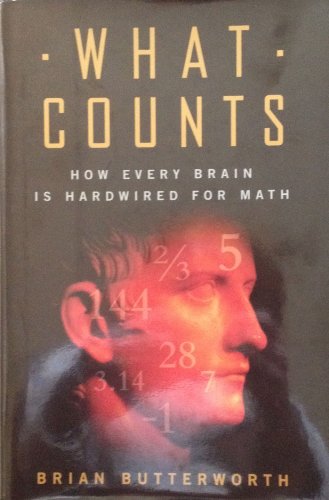
Synopsis
Though he admits to not being particularly good at math, Butterworth (cognitive neuropsychology, U. College, London), the founder of the Mathematical Cognition journal, contends that we all possess an inherent "numerosity" sense developed to different degrees of course. The author bases his case on empirical research and historical speculation. Annotation c. Book News, Inc., Portland, OR (booknews.com)
"synopsis" may belong to another edition of this title.
About the Author
Brian Butterworth is Professor of Cognitive Neuropsychology in the Institute of Cognitive Neuroscience at University College in London. In 1993 he launched the scientific journal Mathematical Cognition, which publishes studies on the psychology and neuropsychology of numbers. He lives in London.
Reviews
Are our brains "hardwired" to count and conceptualize numbers, or are counting, and other mathematical activities something that we learn, like playing the piano? Butterworth, editor of the journal Mathematical Cognition, is convinced that evidence points to the existence of circuits in the brain devoted to identifying what he calls "numerosities," or, more simply, the number of objects in a collection of things. To this network of specialized circuits, or "Number Module," Butterworth explains, each person adds the mathematical knowledge of his or her culture. Thus, people who "aren't good in math" have trouble not because they're dumb or not applying themselves, but because their Number Module is different from the prevailing one. Not surprisingly, Butterworth has strong views on how to teach mathematics, and these form a prominent part of his book. He also shows how a person's brain can change to devote more resources to respond to mathematical stimuli. For example, a study of Braille proofreaders based on brain-scan maps has demonstrated that the part of the brain devoted to this activity grows in size after six hours work. But give the proofreaders a few days off, and their brains shrink back to normal. Butterworth's prose is marred by repetition, and his digressions to explain various well-known math puzzles and peculiarities, such as Pascal's triangle, often aren't germane to his argument (do we really need a proof of G?del's theorem here?). But these are minor caveats about a provocative book that makes an important addition to the recent flurry of titles regarding how our minds work. Teachers as well as readers curious about the brain and psychology will be challenged by the ideas expounded here. (Aug.)
Copyright 1999 Reed Business Information, Inc.
Butterworth is a neuropsychologist (professor of cognitive neuropsychology at University College London) rather than a mathematician, but he has thought and read extensively about how people deal with math and has concluded that a basic mathematical ability is inborn. He notes that "everyone can count or tally up small collections of objects, and can carry out simple arithmetical operations, whether they are Cambridge graduates or tribesmen in the remote fastnesses of the New Guinea highlands." Why, then, do so many people have a hard time with more advanced forms of mathematics? Because "maths more than any other subject is sensitive to earlier failures to understand." And how well children understand "depends on how well they learn at each stage, and this in turn depends on how well the curriculum is designed and the teaching is carried out." Butterworth writes engagingly about the hardwiring of the brain for mathematical fundamentals and about the amazing quantity of numbers that each of us confronts every day.
A neuropsychologist (University College, London) argues that the ability to do math is inborn, not learned. Butterworth proposes a ``number module'' in the brain, containing the ability to count and to understand numbers. The evidence for this is drawn from history, animal studies, infant learning, and an impressive range of other disciplines. While few of us are professional mathematicians, numbers are an inescapable feature of everyone's life: grocery prices, phone numbers, children's ages, sports scores, speed limits, interest rates, and many other examples. The ability to use these numbers on some basic level appears to be as widespread as the ability to use language; yet the two appear not to be directly related. Number systems were developed independently in several parts of the world, and there are marked differences between them; the Babylonians used a base of 60, the Mayans one of 20, as counterexamples to the 10-based math Western cultures use. This argues against some single prehistoric genius having come up with an idea that then diffused to other cultures. In fact, the ability to distinguish between quantities and to perform primitive calculation seems inherent in infants and even in those animals and birds that have been tested. Studies of stroke patients who have lost their math ability indicates that key mathematical functions reside in the left parietal lobe of the brain. A fascinating chapter on the history of various methods of counting on fingers (or other body parts) shows a similar relationship between another specific brain region and math ability. Other chapters explore the question of why some of us are particularly good or bad at math and the ways that children learn math at home, on the streets, and in school. Butterworth writes clearly and entertainingly, with plenty of examples drawn from everyday life and flashes of humor that belie the notion that math is a dry subject. A pioneering study of a fascinating area of the human mind. -- Copyright ©1999, Kirkus Associates, LP. All rights reserved.
Excerpt. © Reprinted by permission. All rights reserved.
Chapter One: Thinking by Numbers
This grand book, the universe...cannot be understood unless one first learns to comprehend the language and read the letters in which it is composed. It is written in the language of mathematics.
Galileo
The World by Numbers
Of all the many abilities that have raised us from cave-dwellers using stone tools to creators of great cities and modern science, one of the most important is the ability to use numbers. It is also among the least understood. Traditional studies of the role of numbers have been concerned largely with their contribution to the development of science. However, numbers have affected almost all the aspects of our life which are most characteristically human. We have used numbers from the beginning of the historical record, and perhaps from way back in the prehistory of our species. This book is an attempt to explain why we all think about the world in terms of numbers.
Nowadays, we use numbers routinely. We use them to count things, to tell the time, as statistical data, to gamble, to buy and to sell. Even barter needs numbers: I'll give you six knives if you give me two pigs. We use them to rank competitors, in addresses (house numbers and postal codes), to grade examination candidates. Blood pressures, temperatures, and IQs are given numerical values. Cars and their engines, TV stations and telephone lines, all have their number labels. Goods in shops have bar codes. People have social security numbers, bank account numbers, and passport numbers. Your height, weight, and age are all denoted by some numerical multiple of a standard unit.
The importance of numbers lies not just in their obvious utility, but also in the way they have shaped how we think about the world. It is the language in which we formulate scientific theories. Numbers, as Einstein said, are the 'symbolic counterpart of the universe'; they are crucial to the measurements we take as the fundamental evidence for our theories. 'When you cannot measure...your knowledge is of a meagre and unsatisfactory kind,' to quote the great nineteenth-century scientist Lord Kelvin, who, not coincidentally, invented the scale for measuring absolute temperature.
To get some idea of just how fundamental numbers are, try to imagine our world without them. There would be no money, no counting, no income tax. Without numbers, trade would be restricted to face-to-face barter. I could see the knives you wished to trade, and you could see my pigs, but trade at a distance would be extraordinarily difficult: how could I convey the number of pigs I would be willing to trade for your knives, and the number of knives I would be willing to accept for my pigs?
Without numbers, there would be none of our familiar sports, such as football, baseball, and tennis, since they use numbers to define how many players may be in a team, and to keep the score. Many sports obsessively keep numerical records; thus athletics is a good example. Qualification for the Olympic Games depends on exceeding a numerical standard. This tradition goes back to the original Olympian Games, whose very period -- the Olympiad -- is a definite number of years, four. Numerical records were kept of some events. Phayllus of Croton was credited with a leap of 55 feet (16.8 metres), which you might think raises the question of just how good the Greeks were at measurement. Some modern competitions, such as the heptathlon, are defined by the number of events in which the athletes take part, seven in this case.
Without numbers, we could not frame basic theories of physical nature, such as Kepler's laws of planetary motion, Newton's laws of motion, or Einstein's E = mc2. Chemists would be at a distinct disadvantage without the numerically ordered periodic table of the elements. The study of human nature has also depended on numbers to quantify mental attributes such as intelligence, reading age, or degree of introversion.
The basic laws of perception are another good example of the use of numbers in the study of human nature. To see a bright light get brighter you need a bigger absolute increase in energy than to see a dim light get brighter; to hear a loud noise get louder you need a bigger absolute increase in energy than for a quiet noise. The scientist, with or without numbers, would ask whether there is some general law that will predict how big an increase is needed to make a noticeable difference to brightness or to loudness. It turns out that there is, and it was discovered in 1834 by Ernst Weber. The law states that a barely noticeable change in brightness depends on a proportional increase in energy, not an absolute increase. What is the value of the increase that yields a difference which is just detectable? Experimentation tells us that an increase of roughly 1% in energy gives us a noticeable difference in brightness and about 10% is needed for a noticeable difference in loudness. Weber's law could not be formulated, perhaps not even thought about, without numbers.
Clearly, numbers are extraordinarily useful, but there is still the question of how we came to describe and represent our world in terms of numbers. Is there something about the world that would oblige us to invent numbers if we didn't have them already? Many useful but difficult inventions, such as the alphabet, double entry bookkeeping, or the printed circuit,6 were invented just once and were diffused around the world. One possibility, then, is that there was one ancient Einstein who invented numbers. Once he had made the breakthrough, it became clear how valuable the idea was and so it was eagerly adopted by neighbours, and then neighbours of neighbours, and so on. This scenario implies that cultures distant from the inventor would get numbers later than those nearby, or perhaps not at all. This is what has happened with the alphabet, for example. Indeed, some Amazonian tribes still haven't learned to read or write.
On the other hand, many inventions seem to have been less difficult, like plant domestication, pottery, and fire, and arose independently in many areas. Is the idea of numbers a relatively easy invention that many societies could have developed by themselves? But even easy inventions depend on local circumstances. The invention of settled agriculture with crops and domesticated animals has depended on having plants and animals that are suitable and easy to domesticate. Although trading creates a need for numbering (as I discuss in Chapter 2), it is not clear what would make the invention of numbers harder or easier.
A third possibility is that the idea of numbers was not invented at all. Rather, they are something about us, an intrinsic part of human nature, like the ability to see colours, or schadenfreude.
Today using numbers for trading, ordering, and labelling seems very easy, convenient, and natural. In a way this is very surprising, since numbers are, in the words of Adam Smith, 'among the most abstract ideas which the human mind is capable of forming'. Numbers are not properties of objects. You cannot touch, see, or feel them. They are not like the properties of an orange. If an object is an orange it will have a characteristic colour, texture, size, shape, smell, and taste. You can check each of these properties to see whether a candidate object is an orange or, for example, a ball or a lemon. But a collection of five things doesn't possess characteristic colour, shape, or taste. What all such collections have in common is their fiveness, and this is abstract. To understand numbers -- to understand, for example, the difference between five and four -- is to understand something very abstract indeed.
To use numbers, therefore, we should require extensive training, as for other abstract concepts. Think how long it takes to learn and apply the principles of ch
"About this title" may belong to another edition of this title.
Search results for What Counts: How Every Brain is Hardwired for Math

Stock Image
What Counts
Seller: World of Books (was SecondSale), Montgomery, IL, U.S.A.
Seller rating 5 out of 5 stars

Hardback. Condition: Very Good. Seller Inventory # 00100479537
Stock Image
What Counts: How Every Brain is Hardwired for Math
Seller: BooksRun, Philadelphia, PA, U.S.A.
Seller rating 5 out of 5 stars
Hardcover. Condition: Very Good. With dust jacket. It's a well-cared-for item that has seen limited use. The item may show minor signs of wear. All the text is legible, with all pages included. It may have slight markings and/or highlighting. Seller Inventory # 0684854171-11-1-29
Stock Image
What Counts: How Every Brain is Hardwired for Math
Seller: Wonder Book, Frederick, MD, U.S.A.
Seller rating 5 out of 5 stars
Condition: Good. Good condition. Good dust jacket. A copy that has been read but remains intact. May contain markings such as bookplates, stamps, limited notes and highlighting, or a few light stains. Seller Inventory # G02E-02231
Stock Image
What Counts: How Every Brain is Hardwired for Math
Seller: Wonder Book, Frederick, MD, U.S.A.
Seller rating 5 out of 5 stars
Condition: Very Good. Very Good condition. Good dust jacket. A copy that may have a few cosmetic defects. May also contain light spine creasing or a few markings such as an owner's name, short gifter's inscription or light stamp. Seller Inventory # V04B-03892
Stock Image
What Counts: How Every Brain is Hardwired for Math
Seller: ThriftBooks-Dallas, Dallas, TX, U.S.A.
Seller rating 5 out of 5 stars
Hardcover. Condition: Good. No Jacket. Former library book; Pages can have notes/highlighting. Spine may show signs of wear. ~ ThriftBooks: Read More, Spend Less. Seller Inventory # G0684854171I3N10
Stock Image
What Counts: How Every Brain is Hardwired for Math
Seller: ThriftBooks-Atlanta, AUSTELL, GA, U.S.A.
Seller rating 5 out of 5 stars
Hardcover. Condition: As New. No Jacket. Pages are clean and are not marred by notes or folds of any kind. ~ ThriftBooks: Read More, Spend Less. Seller Inventory # G0684854171I2N00
Stock Image
What Counts
Seller: World of Books Inc, Montgomery, IL, U.S.A.
Seller rating 4 out of 5 stars

Hardback. Condition: Very Good. Seller Inventory # CIN0684854171VG
Stock Image
What Counts: How Every Brain is Hardwired for Math
Seller: HPB-Diamond, Dallas, TX, U.S.A.
Seller rating 5 out of 5 stars
Hardcover. Condition: Very Good. Connecting readers with great books since 1972! Used books may not include companion materials, and may have some shelf wear or limited writing. We ship orders daily and Customer Service is our top priority! Seller Inventory # S_452612954
Stock Image
What Counts: How Every Brain is Hardwired for Math
Seller: The Maryland Book Bank, Baltimore, MD, U.S.A.
Seller rating 5 out of 5 stars
hardcover. Condition: Very Good. Used - Very Good. Seller Inventory # 4-O-1-0599
Stock Image
What Counts : How Every Brain Is Hardwired for Math
Seller: Better World Books, Mishawaka, IN, U.S.A.
Seller rating 5 out of 5 stars
Condition: Good. illustrated edition. Pages intact with minimal writing/highlighting. The binding may be loose and creased. Dust jackets/supplements are not included. Stock photo provided. Product includes identifying sticker. Better World Books: Buy Books. Do Good. Seller Inventory # 2901073-6