
Items related to The Ballad of Little River: A Tale of Race and Restless...
Synopsis
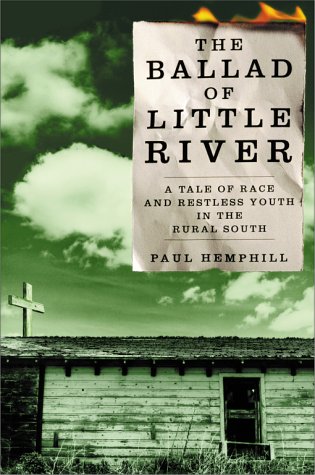
A veteran Southern journalist journeys into the heart of rural Alabama to reveal why the small town of Little River erupted into a series of violent racial incidents in 1997, including the murder of a young black man, an attack on the white owner of a local general store, and the burning of two black churches by five white teenagers.
"synopsis" may belong to another edition of this title.
About the Author
Paul Hemphill is a prolific journalist, sportswriter, and novelist. The author of ten books, he has focused much of his writing career on the blue-collar South and its working-class denizens. He lives in Atlanta, Georgia.
Reviews
Southern journalist Hemphill, noted for his telling portraits of the ordinary citizens of Dixie, probes the racial tinderbox in one of Alabama's poorest rural areas. Skillfully researched and written with a novelist's sure touch, his exploration of the economically depressed community of Little River moves beyond its infamy as the site of a huge colonial era massacre to reveal how politicians and industry have neglected it in recent years, transforming it into "a dangerous, violent place, where if the backbreaking labor or an errant piece of machinery doesn't maim or kill you, a neighbor might." In the summer of 1997, the bizarre shotgun murder of a young black man trying to force his way into a white family's trailer, followed by a hammer assault on a white store owner by a black convict, heightened racial tensions. Soon afterward, a group of restless, drug-fueled white youths went on a rampage, destroying black churches 48 hours after a rag-tag Klan rally, which Hemphill describes with sadness and dark humor. The book's real strength is the author's ability to bring the area's residents to life through their words and through colorful accounts of the community. Although the white youths were sent to prison, the residual scars of their actions have been slow to heal, despite widespread efforts to rebuild the churches and restore a sense of calm. Hemphill attributes these raw wounds to a poisonous nostalgia for a vanished Old South that continues to victimize both races, a theme he repeats like a mournful drumbeat throughout this engrossing, unforgettable chronicle. (May)
Copyright 2000 Reed Business Information, Inc.
A glimpse inside a Southern pocket of rural America that time seems to have passed by. While the rest of the country was consumed three years ago by accounts of the trial of the individuals responsible for the Oklahoma City bombing that killed 168 people, author Hemphill (Leaving Birmingham, 1993) began an investigation of what he himself acknowledges may come to be nothing more than a footnote in American history: the burning of a black church in the small Alabama town of Little River by five white youths. At the time, a number of black churches in the South were mysteriously being torched and it is possible that Hemphill may have had his sights set on a much larger story involving the Ku Klux Klan or a broad study of racial tensions in the South in the postCivil Rights Act era when he first got started. But neither outline can be discerned in this tale. For one thing, relations between blacks and whites in Little River, far from being hostile, are politely cordial if not openly friendly. For another, the convicted youngsters who set the church ablaze were hardly evil but were apparently so stoned on beer and pot that they seem not to have realized that the makeshift structure they were torching was a place of worship. Even the Klansmen, as boorish and malign as they are, have no provable connection to the crime. Hemphill even attempts to rope Harper Lee's Pulitzer Prizewinning novel To Kill a Mockingbird (set in a town not far from Little River) into the case. But that proves too much of a stretch by far. Whatever went down in Little River has the markings of an anomaly rather than an abomination. But despite his unsuccessful hunt for bigger game, Hemphill provides some marvelous character sketches of Southern poverty and culture blended neatly together in black and white. -- Copyright ©2000, Kirkus Associates, LP. All rights reserved.
In 1997, after five young white adults torched two black churches in Baldwin County, AL, journalist Hemphill (Leaving Birmingham; The Heart of the Game) traveled to Little River and uncovered a story involving race, class, and gender. Hemphill finds that race was the spark that ignited a volatile mix of social ills: a dysfunctional way of life endured with few amenities, much violence, deep poverty for blacks and whites, and widespread drug use. He observes a history of racial oppression and inequality that made many black parents encourage their children to build successful lives beyond Baldwin County. But white families suffer from broken dreams as well. They experience repeated patterns of divorce, while unsupervised youth struggle to make their way without a moral compass. Hemphill writes sensitively of an area of the rural South that time has left behind. Recommended for public and academic libraries.
-Charles L. Lumpkins, formerly with Bloomsburg Univ., PA
Copyright 2000 Reed Business Information, Inc.
Excerpt. © Reprinted by permission. All rights reserved.
Chapter One: Lost Colony
From shore to shore, the shortest length between national boundaries in the continental United States is the north-south route, a fairly straight shot of about nine hundred miles on Interstate 65, connecting the icy Great Lakes and the tropical Gulf of Mexico. There are more scenic drives in the country. By the time travelers have reached Montgomery, Alabama's capital city, they have seen about all of the rolling farmland a body can bear on one trip: Indiana's endless cornfields, Kentucky's white-fenced bluegrass country, Middle Tennessee's knobby little hills. The monotony breaks, though, and fairly abruptly, once the road has passed tired old Birmingham's battened steel mills to finally reach Montgomery, the "Cradle of the Confederacy." There are woodlands and pastures and farms there as well, but the change is more in attitude, for Montgomery is the jumping-off point for the vast forested no-man's-land of south Alabama. This is the Black Belt, so named for its rich black loam and the people who once slaved in the cotton fields, a broad band stretching from the coastal plains of the Carolinas to the piney woods of the Big Thicket in east Texas, and the motorists who might forsake the interstate for the sleepy back roads soon find themselves in the very bowels of the Deep South. HEART OF DIXIE, proclaim the state's vehicle license tags, and indeed it is.
This is the land of Bear Bryant and George Wallace, of tar paper shacks in the shadows of white-columned neo-plantations, of roadside fightin'-and-dancin' clubs and whoop-and-holler Pentecostal churches and trim little high school football stadiums, of magnolia and dogwood and mimosa and honeysuckle, of pine forests and farm ponds and pastures, of 4-H and VFW and Rotary clubs, of junkyards and sawmills and decaying barns swallowed up by kudzu. On the square at Enterprise: a statue playfully "honoring" the boll weevil, whose devastations early in the twentieth century forced the South to abandon cotton in favor of other crops. At Georgiana, south of Montgomery on the lonesome road to Mobile: one of the many childhood homes of Hank Williams, a wild urchin who sprang from the sawmills and logging camps to become the quintessential country singer and songwriter. "I'm So Lonesome I Could Cry," was his most plaintive tune, released soon after his death in the fifties, from whiskey and pills, at the age of twenty-nine, and the song's morbid sentiments perfectly suit the isolated nature of this part of the American outback, where all news is local. There might be an old geezer left in Pine Apple who remembers the terse mention in the Personals column of the weekly newspaper announcing a favorite son's triumphant return, bearing medals, from the 1932 Olympic Games in Los Angeles: "Percy Beard has returned home from California, where he participated in a footrace."
Most tourists not bound for the port city of Mobile, or on beyond to New Orleans, exit south on Alabama Highway 59 and make a beeline for the oceanside resort of Gulf Shores, the westernmost point of what Alabamians insist on calling the Redneck Riviera: a marvelous strand of sugar-white beaches, among the most beautiful in the world, sort of a good old boy's sandbox of cut-rate motels and bars and seafood diners, with miniature-golf courses and makeshift amusement parks for the kids. The Redneck Riviera lies eastward for more than a hundred miles along the coast of the Florida Panhandle -- "L.A.," they call it, for Lower Alabama -- and although the 1990s saw the coming of expensive condos and gated vacation communities (on the Alabama portion of the Riviera, a stretch of less than thirty miles, about eighty high-rise condominiums require more elevators than does all of Birmingham, the state's largest city), it remains a workingman's playground; a place where three generations of Bubbas have gone for their initiations into manhood: to get drunk, sunburned, laid, and thrown in jail.
"My sheriff is Jimmy Johnson, built like a football player, wears a cowboy hat and boots, fancies himself as John Wayne." David Whetstone, Baldwin County's longtime district attorney, was holding forth one day at his office on the square in Bay Minette, the tidy little county seat, gussied up with park benches and oleanders and whitewashed storefronts. "He and his wife went off to France for a vacation one year and everybody was dying to know what he thought about the Riviera on the Mediterranean. 'Well,' he said, 'the nekkid ladies was all right, but the beaches ain't near as good as the real Riviera.'"
Whetstone -- fifty-five, balding, pugnacious -- marvels at the diversity of the southern portion of Baldwin, the largest county in area east of the Mississippi River, bigger than the state of Rhode Island and nearly the size of Delaware. "Because of the port at Mobile, we've got all of these ethnic towns. Daphne is full of Italians, Malbis is Greek, Elberta German, Silverhill Scandinavian, and a lot of 'em speak the languages from the old countries and have festivals every year. It seems like there's a new culture every ten miles. Northern Baldwin, now, that's another matter. There's these two towns on either side of the same exit off the interstate, Rabun and Perdido, settled by mountain folks, and they carry on feuds like the Hatfields and the McCoys. We've prosecuted ten homicides up there in the past twenty-five years. The patriarch of one clan always shows up in court wearing a black felt hillbilly hat, and one side always leaves a silver-handled knife as a calling card even if it was a shooting. Northern Baldwin keeps me in business."
By all means. Were the traveler to turn north instead of south off of I-65, he would be entering another world. Once past Stockton, a neat little village quickly gentrifying these days into an upscale Republican enclave for comfortable whites who commute to their jobs in downtown Mobile, a half-hour drive on the freeway, Highway 59 begins its run into the heart of a distant forest. Along the forty miles of road between Stockton and Uriah (pronounced YOU-rye), the first town of any size in southern Monroe County, there are no speed-limit signs and only a single blinking caution light to slow the traffic. Of Baldwin County's total population of about one hundred thousand in the late nineties, fewer than three thousand people were living in the piney expanses of the upper one-fourth. Between Stockton and the bridge over the Little River, marking the Monroe County line, there are but four hamlets denoted by green highway markers -- Latham, Tensaw, Blacksher, Little River -- with most of the people living on bulldozed or asphalted dead-end roads far from Highway 59, known locally as "the road," in house trailers or plain brick homes or tin-roofed shacks or prefabricated Craftsman and Jim Walter homes that have survived since the forties and fifties. The racial makeup in that part of the county is roughly fifty-fifty, black and white, with a lot of high cheekbones indicating Creek and Choctaw Indian blood on both sides, and the demographic profile is one of a society barely hanging on. A startling percentage of the people are old, sick, disabled, or simply idle (the unemployment rate is 20 percent, four times higher than the rest of the county, and the per capita income is less than $11,000 a year before taxes); and the younger ones who have chosen to stay -- but not to risk their lives and health, as did their fathers and grandfathers, by logging in the forests that dominate the landscape -- must drive for nearly an hour each way to reach menial jobs in textile mills, warehouses, factories, or shopping malls.
Most of the history of northern Baldwin County is measured by small mileposts noted only by the locals: first school, first church, first doctor, first steamboat, first paved road; the coming of electricity, county wate
"About this title" may belong to another edition of this title.
Search results for The Ballad of Little River: A Tale of Race and Restless...

Stock Image
The Ballad of Little River: A Tale of Race and Restless Youth in the Rural South
Seller: World of Books (was SecondSale), Montgomery, IL, U.S.A.
Seller rating 5 out of 5 stars

Hardback. Condition: Good. A veteran journalist's exploration of a church-burning in south Alabamabecomes a richly rewarding evocation of the Deep South--its land, its people, and its sweat--popping summers. More than an anatomy of a church arson, The Ballad of Little River isa poignant but hard-hitting biography of one of the poorest areas in theUnited States--where deer outnumber people. A cauldron of unresolved racialand familial conflict, of heat, boredom, gossip, and grudges, Little River, Alabama, gained notoriety in 1997 as the site of the U.S. government'sfirst conviction under a new hate-crimes law intended to stop a rash offires set at black churches around the country. When journalist Paul Hemphill, son of an Alabamatruck driver and veteran writer on the blue-collar South, moved into thearea, he discovered a world that time had virtually forgotten--an obscure, isolated community in the swampy woodlands far from the mainstream of Americanlife, a forlorn cluster of poverty and ignorance and dead-end jobs. Hemet a stew of heroes and villains right out of fiction--Peanut Ferguson, Doll Boone, Hoss Mack, Joe Dees, Murray January, a Klansman named BrotherPhil, and his stripper wife known as Wild Child--all swirling in a maelstromof history and heat. Originally published in cloth by Free Press, The Ballad of Little River is Hemphill's gripping look at the southernbackwoods, a chilling cautionary tale filled with both kindness and cruelty, told in the steady voice of a master storyteller and one who knows thehuman heart. Seller Inventory # CIN0684856824G
Stock Image
Ballad of Little River : A Tale of Race and Restless Youth in the Rural South
Published by
Free Press, 2000
ISBN 10: 0684856824
ISBN 13: 9780684856827
Used
Hardcover
First Edition
Seller: Better World Books: West, Reno, NV, U.S.A.
Seller rating 5 out of 5 stars
Condition: Fine. 1st. Used book that is in almost brand-new condition. May contain a remainder mark. Better World Books: Buy Books. Do Good. Seller Inventory # 17249158-75
Stock Image
Ballad of Little River : A Tale of Race and Restless Youth in the Rural South
Published by
Free Press, 2000
ISBN 10: 0684856824
ISBN 13: 9780684856827
Used
Hardcover
First Edition
Seller: Better World Books, Mishawaka, IN, U.S.A.
Seller rating 5 out of 5 stars
Condition: Very Good. 1st. Former library copy. Pages intact with possible writing/highlighting. Binding strong with minor wear. Dust jackets/supplements may not be included. Includes library markings. Stock photo provided. Product includes identifying sticker. Better World Books: Buy Books. Do Good. Seller Inventory # 4717187-6
Stock Image
The Ballad of Little River: A Tale of Race and Restless Youth in the Rural South
Seller: ThriftBooks-Phoenix, Phoenix, AZ, U.S.A.
Seller rating 5 out of 5 stars
Hardcover. Condition: Good. No Jacket. Pages can have notes/highlighting. Spine may show signs of wear. ~ ThriftBooks: Read More, Spend Less. Seller Inventory # G0684856824I3N00
Stock Image
The Ballad of Little River: A Tale of Race and Restless Youth in the Rural South
Seller: ThriftBooks-Phoenix, Phoenix, AZ, U.S.A.
Seller rating 5 out of 5 stars
Hardcover. Condition: Very Good. No Jacket. May have limited writing in cover pages. Pages are unmarked. ~ ThriftBooks: Read More, Spend Less. Seller Inventory # G0684856824I4N00
Stock Image
The Ballad of Little River: A Tale of Race and Restless Youth in the Rural South
Seller: ThriftBooks-Reno, Reno, NV, U.S.A.
Seller rating 5 out of 5 stars
Hardcover. Condition: Very Good. No Jacket. May have limited writing in cover pages. Pages are unmarked. ~ ThriftBooks: Read More, Spend Less. Seller Inventory # G0684856824I4N00
Stock Image
The Ballad of Little River: A Tale of Race and Restless Youth in the Rural South
Seller: ThriftBooks-Atlanta, AUSTELL, GA, U.S.A.
Seller rating 5 out of 5 stars
Hardcover. Condition: Good. No Jacket. Missing dust jacket; Pages can have notes/highlighting. Spine may show signs of wear. ~ ThriftBooks: Read More, Spend Less. Seller Inventory # G0684856824I3N01
Stock Image
The Ballad of Little River: A Tale of Race and Restless Youth in the Rural South
Seller: ThriftBooks-Dallas, Dallas, TX, U.S.A.
Seller rating 5 out of 5 stars
Hardcover. Condition: Very Good. No Jacket. Former library book; May have limited writing in cover pages. Pages are unmarked. ~ ThriftBooks: Read More, Spend Less. Seller Inventory # G0684856824I4N10
Stock Image
The Ballad of Little River: A Tale of Race and Restless Youth in the Rural South
Seller: ThriftBooks-Dallas, Dallas, TX, U.S.A.
Seller rating 5 out of 5 stars
Hardcover. Condition: Very Good. No Jacket. May have limited writing in cover pages. Pages are unmarked. ~ ThriftBooks: Read More, Spend Less. Seller Inventory # G0684856824I4N00
Stock Image
The Ballad of Little River: A Tale of Race and Restless Youth in the Rural South
Seller: ThriftBooks-Dallas, Dallas, TX, U.S.A.
Seller rating 5 out of 5 stars
Hardcover. Condition: Good. No Jacket. Pages can have notes/highlighting. Spine may show signs of wear. ~ ThriftBooks: Read More, Spend Less. Seller Inventory # G0684856824I3N00