Items related to Presidential Courage: Brave Leaders and How They Changed...
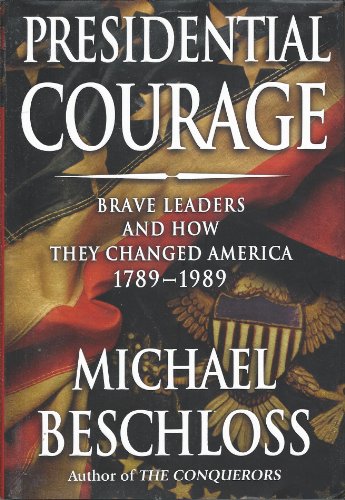

Documents crucial historical moments in each of the first forty-three presidencies during which the future of the United States has been dramatically affected by a bold executive decision, in an account that offers insight into the factors that influenced the most difficult choices made by each president. 250,000 first printing.
"synopsis" may belong to another edition of this title.
About the Author:
Michael Beschloss has been called "the nation's leading Presidential historian" by Newsweek. He has written eight books on American Presidents and is NBC News Presidential Historian, as well as contributor to PBS's The NewsHour with Jim Lehrer. He lives in Washington, D.C., with his wife and two sons.
Excerpt. © Reprinted by permission. All rights reserved.:
Chapter One
A Speedy Death to General Washington!
In August 1795, at Mount Vernon, drenched by what he called a "violent Rain," George Washington nervously paced down a garden path, elegantly covered by crushed oyster shells.
He was desperate to return to the national capital of Philadelphia, but the biblical torrents had washed out roads and bridges. Adding to his frustration, his mail had been cut off.
Back inside, as the rains pelted his red shingle roof, spinning the dove-of-peace weathervane, the President bent over his candlelit desk, dipped a quill in black ink and tensely scratched out letter after letter. He was feeling "serious anxiety" in a time of "trouble and perplexities."
For twenty years, since the start of the Revolution, he had taken as his due the bands playing "The Hero Comes!" and the lightstruck Americans cheering "the man who unites all hearts." His anointment as President by the Electoral College in 1788 and 1792 had been unanimous.
But now the national adoration for Washington was fading. Americans had learned that a secret treaty negotiated by his envoy John Jay made demands that many found humiliating. One member of Congress said the fury against "that damned treaty" was moving "like an electric velocity to every state in the Union."
As the public tempest had swelled, some wanted Washington impeached. Cartoons showed the President being marched to a guillotine. Even in the President's beloved Virginia, Revolutionary veterans raised glasses and cried, "A speedy Death to General Washington!"
With the national surge of anger toward Washington, some Americans complained that he was living as luxuriously as George III, the monarch they had fought a revolution to escape. Using old forgeries, several columnists insisted that Washington had been secretly bribed during the war by British agents.
Still others charged that the President stole military credit from soldiers who had bled and died: "With what justice do you monopolize the glories of the American Revolution?"
Reeling from the blows, the sixty-three-year-old Washington wrote that the "infamous scribblers" were calling him "a common pickpocket" in "such exaggerated and indecent terms as could scarcely be applied to a Nero."
One still-friendly gazette moaned, "Washington has been classed with tyrants, and calumniated as the enemy of his country. Weep for the national character of America, for, in ingratitude to her Washington, it is sullied and debased throughout the globe!"
President Washington had brought the national furor upon himself by trying to avert a new war with Great Britain that threatened to strangle his infant nation in its cradle.
In the spring of 1794, the British were arming Indians and spurring them to attack Americans trying to settle the new frontier lands that would one day include Ohio and Michigan. London was reneging on its pledge, made in the peace treaty ending the Revolutionary War, to vacate royal forts in the trans-Appalachian West -- Oswego, Niagara, Detroit, Michilimackinac.
Since Britain was at war with France, British captains seized U.S. ships trading with the French West Indies. Renouncing the agreed-upon border between the U.S. and Canada, Britain's governor in Quebec predicted a new Anglo-American war "within a year."
Former Secretary of State Thomas Jefferson, who hated England and adored France, demanded retaliation against the British. But Secretary of the Treasury Alexander Hamilton warned the President not to plunge into a war that America could not win.
The religious Martha Washington could not abide Hamilton's Byzantine intrigues or his infidelities to his wife, Elizabeth. When Martha adopted a tomcat, she named it "Hamilton."
But for the President, who knew his own shortcomings, Hamilton was an endless fount of provocative ideas, tactics and language.
During his first term, Washington had told Hamilton and Jefferson that their gladiatorial clashes over foreign policy, economics and personalities were "tearing our vitals" and had to stop.
Instead, Jefferson quit in 1793 and organized an opposition. The new political chasm between Federalists and Jefferson's Republicans killed Washington's old dream of eternal national unity with no need for political parties.
Retaining the President's ear, Hamilton urged him to send an "envoy extraordinary" to London. A new Anglo-American treaty could secure U.S. trade on the Atlantic and the Great Lakes, giving their country time to build its economy and defenses and settle its frontier. Then if America one day had to fight off Britain, it would be far better prepared.
Washington agreed, but he knew Hamilton must not be the envoy. That would inflame the Jeffersonians. Instead, at Hamilton's suggestion, he chose the aristocratic Chief Justice, John Jay of New York.
Privately Jay warned his wife that America might well have to battle England. But in May 1794, before sailing from lower Manhattan to London, he promised a cheering crowd he would do "everything" to "secure the blessings of peace." Soon after Jay's departure, the British reclaimed and fortified one of their old posts on American territory near Detroit.
Having jeopardized his prestige to talk with Britain, Washington was furious. He wrote Jay it was "the most open and daring act of British agents in America." Every "well informed" American knew that the British were instigating "all the difficulties that we encounter with the Indians...the murders of helpless women and innocent children."
He noted that some wished him to turn the other cheek: "I answer NO!...It will be impossible to keep this country in a state of amity with G. Britain long if the Posts are not surrendered."
Jay got the British to forgo such aggravations while they bargained. He assured Washington that Britain felt it was having a "family quarrel" with America, "and that it is Time it should be made up."
Jay reported that, excepting the King, the British respected no one more than George Washington. With such "perfect and universal Confidence" in Washington's "personal character," they had taken Jay's presence in London "as a strong Proof of your Desire to preserve Peace."
By the start of 1795, Washington heard rumors that Jay had managed to broker a treaty, but the expected dispatch case never arrived.
As it turned out, after making a deal in November, Jay had sent the President two copies of the treaty documents by a British ship that was seized by the French on the Atlantic. British sailors had thrown the papers overboard to keep them from French hands.
That spring, another ship brought duplicates to Norfolk, Virginia. By stagecoach and horseback, a mud-caked, frostbitten messenger rushed them to Philadelphia, where Washington received them at the President's House at 190 High Street.
In 1790, when Washington and his government moved from New York City to the temporary capital of Philadelphia, there was no official mansion for the President.
Thus the great man paid three thousand dollars a year to rent the four-story red-brick house owned by Robert Morris, financier of the Revolution and Senator from Pennsylvania.* Morris graciously moved next door to accommodate his old friend.
Washington found it "the best Single house in the City" but still "inadequate" for him. For instance, there were "good stables, but for twelve horses only."
During renovations, which Washington financed, a house painter allegedly attacked one of the President's housemaids, who shrieked. Face daubed with shaving cream, the half-dressed Washington was said to have kicked the painter down the stairs, crying, "I will have no woman insulted in my house!"
The President's servants included eight black slaves selected from the almost three hundred who lived at Mount Vernon. Knowing that Pennsylvania law freed any slave residing there for six months or more, Washington and Martha made sure that each of their slaves was quietly sent home to Virginia every five months or so.
"I wish to have it accomplished under pretext that I may deceive both them and the Public," the General wrote a trusted aide, insisting that the ruse "be known to none but yourself and Mrs. Washington."
Upstairs at his mansion, Washington frowned at Jay's "Treaty of Amity, Commerce and Navigation." He knew that if he approved it, Americans would excoriate him for truckling to their old oppressor across the sea.
Most inflammatory was Article Twelve: America could trade with the West Indies, but not with large vessels. Nor could the U.S. export any products natural to those islands.
Jay's deal would also cosset the lucrative British fur trade in the American Northwest. The U.S. would pledge never to seize British assets in America, surrendering an important potential weapon for America's defense.
The treaty would also allow the British to keep on halting U.S. exports to France -- and to escape paying reparations for American slaves they had carried off during the Revolutionary War.
To keep public indignation from building against the treaty before he sent it to the Senate, Washington ordered Secretary of State Edmund Randolph to keep its contents "rigidly" secret "from every person on earth" -- even the rest of his Cabinet.
Unlike his successors, Washington took literally the Constitution's demand that a President ask the Senate's "advice and consent" on treaties. He would not finally decide whether to approve Jay's Treaty until the Senate voted.
Vice President John Adams feared the pact would be political trouble. "A Battle Royal I expect at its Ratification, and snarling enough afterwards," he wrote his wife, Abigail. "I am very much afraid of this Treaty!...Be very carefull, my dearest Friend, of what you say....The Times are perilous."
On Monday morning, June 8, 1795, two dozen U.S. Senators in powdered wigs and ruffled shirts sat down in Philadelphia's Congress Hall for a special closed-door session on Jay's Treaty.
Washington had insisted that the men in the emerald green Senate chamber discuss the treaty in absolute secrecy.
The Aurora, published in Philadelphia by Benjamin Franklin Bache, the Fr...
"About this title" may belong to another edition of this title.
- PublisherSimon & Schuster
- Publication date2007
- ISBN 10 0684857057
- ISBN 13 9780684857053
- BindingHardcover
- Edition number1
- Number of pages448
- Rating
Buy New
Learn more about this copy
US$ 13.40
Shipping:
FREE
Within U.S.A.
Top Search Results from the AbeBooks Marketplace
Stock Image
Presidential Courage: Brave Leaders and How They Changed America 1789-1989
Published by
Simon & Schuster
(2007)
ISBN 10: 0684857057
ISBN 13: 9780684857053
New
Hardcover
Quantity: 1
Seller:
Rating

Book Description Condition: New. Book is in NEW condition. Seller Inventory # 0684857057-2-1
Buy New
US$ 13.40
Convert currency
Stock Image
Presidential Courage: Brave Leaders and How They Changed America 1789-1989
Published by
Simon & Schuster
(2007)
ISBN 10: 0684857057
ISBN 13: 9780684857053
New
Hardcover
Quantity: 1
Seller:
Rating
Book Description Condition: New. New! This book is in the same immaculate condition as when it was published. Seller Inventory # 353-0684857057-new
Buy New
US$ 13.41
Convert currency
Stock Image
Presidential Courage: Brave Leaders and How They Changed America 1789-1989
Published by
Simon & Schuster
(2007)
ISBN 10: 0684857057
ISBN 13: 9780684857053
New
Hardcover
Quantity: 1
Seller:
Rating
Book Description Hardcover. Condition: New. Seller Inventory # DADAX0684857057
Buy New
US$ 13.44
Convert currency
Stock Image
Presidential Courage: Brave Leaders and How They Changed America 1789-1989
Published by
Simon & Schuster
(2007)
ISBN 10: 0684857057
ISBN 13: 9780684857053
New
Hardcover
Quantity: 1
Seller:
Rating
Book Description Condition: New. Fast Shipping - Safe and secure Mailer. Seller Inventory # 521PY60025JR
Buy New
US$ 10.97
Convert currency
Stock Image
Presidential Courage: Brave Leaders and How They Changed America 1789-1989
Published by
Simon & Schuster
(2007)
ISBN 10: 0684857057
ISBN 13: 9780684857053
New
Hardcover
Quantity: 1
Seller:
Rating
Book Description Hardcover. Condition: new. New. Fast Shipping and good customer service. Seller Inventory # Holz_New_0684857057
Buy New
US$ 20.71
Convert currency
Stock Image
Presidential Courage: Brave Leaders and How They Changed America 1789-1989
Published by
Simon & Schuster, New York
(2007)
ISBN 10: 0684857057
ISBN 13: 9780684857053
New
Hardcover
First Edition
Quantity: 1
Seller:
Rating
Book Description Hardcover. Condition: New. Dust Jacket Condition: New. 1st Edition. New hardcover, dust jacket. We ship fast. Seller Inventory # 021683
Buy New
US$ 19.99
Convert currency
Stock Image
Presidential Courage: Brave Leaders and How They Changed America 1789-1989
Published by
Simon & Schuster
(2007)
ISBN 10: 0684857057
ISBN 13: 9780684857053
New
Hardcover
Quantity: 1
Seller:
Rating
Book Description Hardcover. Condition: new. Buy for Great customer experience. Seller Inventory # GoldenDragon0684857057
Buy New
US$ 22.89
Convert currency
Stock Image
Presidential Courage: Brave Leaders and How They Changed America 1789-1989
Published by
Simon & Schuster
(2007)
ISBN 10: 0684857057
ISBN 13: 9780684857053
New
Hardcover
Quantity: 1
Seller:
Rating
Book Description Hardcover. Condition: new. New. Seller Inventory # Wizard0684857057
Buy New
US$ 26.84
Convert currency
Stock Image
Presidential Courage: Brave Leaders and How They Changed America 1789-1989
Published by
Simon & Schuster
(2007)
ISBN 10: 0684857057
ISBN 13: 9780684857053
New
Hardcover
Quantity: 1
Seller:
Rating
Book Description Hardcover. Condition: new. New Copy. Customer Service Guaranteed. Seller Inventory # think0684857057
Buy New
US$ 26.87
Convert currency
Stock Image
Presidential Courage: Brave Leaders and How They Changed America 1789-1989
Published by
Simon Schuster
(2007)
ISBN 10: 0684857057
ISBN 13: 9780684857053
New
Hardcover
Quantity: 1
Seller:
Rating
Book Description Condition: new. Seller Inventory # FrontCover0684857057
Buy New
US$ 28.91
Convert currency