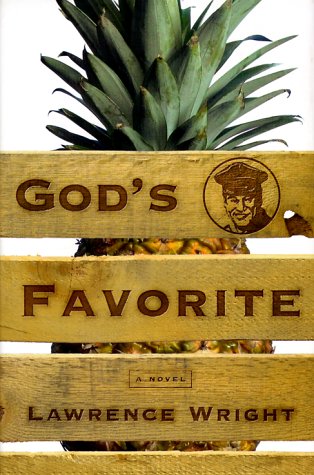
Provides a fictional account of the events that took place in Panama in the late 1980s that led to the capture of Panamanian leader Manuel Noriega
"synopsis" may belong to another edition of this title.
Lawrence Wright is a staff writer for The New Yorker and the author of five books, including Remembering Satan, based on an article that won the National Magazine Award for reporting and the John Bartlow Martin Award for public interest magazine journalism. He lives in Austin, Texas.
Lawrence Wright is a staff writer for The New Yorker.
The final days in power of Panama's military strongman Manuel Noriega are the subject of this savvy and bleakly comic first fiction by New Yorker reporter Wright (Twins: Their Remarkable Double Livesand What They Tell Us About Who We Are, 1998, etc.). Wright's ``Tony'' Noriega is an appalling, fascinating, and at times even sympathetic figure. He enters the novel following an account of the discovery of populist ``revolutionary'' Hugo Spandafora's headless corpse, and a brief dose of the irreverent cynicism indulged by Archbishop Morette, ``banished'' to Panama City by the Vatican. Noriega, at this time, is in Geneva, receiving extreme-measure medical treatment for ``acne vulgaris.'' Thereafter, the story careens gracefully between illustrations of Noriega's iron-fisted rule (specifically, as experienced first-hand by the Archbishop's idealistic and unworldly subordinate, Father Jorge Ugarte) and often hilarious debunkings of the Great Man's relationships with puppet politicos who clamor for at least the appearance of authority, military aides who inconveniently develop consciences, Noriega's wrathful wife Felicidad and petulant mistress Carmen, murderous Colombian drug-lord Pablo Escobar and neighboring fellow dictator Fidel Castro; even visiting ``diplomat'' Colonel Oliver North (who blithely preaches George Bush's gospel of international pragmatism). There are horrors aplenty, and handsome, earnest Father Jorge offers the perfect contrast to the introverted, paranoid, deeply insecure General Noriega, whose most trusted associates are the specimens that reside in his private aviary (notably, Pepe, ``a neurotic sulfur-crested cockatoo'') and his personal ``psychic,'' witch-doctor, and sex consultant, Santeria priest Gilbert Blancarte. Wright takes no prisoners (even a well-meaning former ``Presidente'' imagines himself ``a soldier of economic enlightenment, imposing the stern teachings of Milton Friedman on the Third World, much as the Conquistadors had imposed bloody Christianity on the savages of the past''), in a vigorous full-dress satiric farce that neatly skewers the self-righteous mendacity of all the Americas, ours very much included. The wittiest political novel we've seen in some time, and a fine beginning to what one hopes is this accomplished journalist's second career. -- Copyright ©2000, Kirkus Associates, LP. All rights reserved.
Wright's timely first novel is a historical fiction recalling the events, beginning with the murder of opposition leader Hugo Spadafora, that led to the 1989 U.S. invasion of Panama and the removal of its illegitimate leader, General Manuel Antonio Noriega, to stand trial in Florida for drug trafficking. Minor characters include Colombian drug boss Pablo Escobar, who feuds with Noriega; Fidel Castro, acting as an intermediary in the feud; and Oliver North, acting as an intermediary with the shadier aspects of the U.S. government. Although Wright's invented characters give the story depth and keep it from going too far over the top, it is Noriega (Tony in the story) who commands center stage. There are some very surreal moments involving the Zen/Christian/voodoo-worshiping Tony--one, specifically, where he debates the nature of sin with a young, antigovernment priest while in the confessional--and also some comic ones. The cumulative effect of these is to somewhat overshadow one's sense of the tragedy that was engulfing the Panamanians at the time, though the novel succeeds because Wright pins down the insanity, the moral and ethical vagueness, and the hypocrisy of U.S. government policy toward Panama in the 1980s. Frank Caso
Wright, an award-winning New Yorker staff writer, here follows Panamanian strongman Manuel Antonio Noriego as he flees U.S. troopsAall the way to the Vatican Embassy. Look for the motion picture.
Copyright 1999 Reed Business Information, Inc.
Chapter 1
For twenty minutes the policeman sat with the villagers watching the golden frog. As long as the frog did not move, the Indians from the village did not move, and therefore the policeman waited, knowing that there was no need to hurry. If he broke the frog's spell it might be seen as a bad omen, and so he rested on his haunches, as he remembered doing in his own village many years before.
The frog seemed to be growing ever more powerful as it defended the little patch of sunlight that squeezed through the guayacan trees in the ravine. Its ancient wedge-shaped face pointed directly at the policeman, as if he knew that the matter now rested between them. But the frog was in no hurry, either. He was in a paradise of flies. He was sleepy from eating, and the lids bobbed on his gold-slitted black eyes, but he gripped the sides of the large canvas mailbag like a miser clutching his purse. Two human feet protruded from the mailbag.
"And who discovered this?" the policeman said in a low voice.
After a pause the oldest of the men responded, "The boy. He came to fish in the river."
The policeman saw a child half-hidden behind his mother's dress.
"At what time of day?"
"It was evening."
The policeman absorbed the fact that a night and part of the morning had passed before anyone had come to El Roblito to notify him. Perhaps they wanted to own this mystery for a while, before giving it to him. Certainly the frog had not been sitting here all that time.
The policeman glanced at his camera and thought about taking photographs of the scene, but then he saw the villagers shift like grass stirring in the slightest breeze, and so he relaxed again into mindlessness. He was scarcely aware of how much time passed before a cloud shadowed the mailbag and the frog leapt into the ferns, but when the villagers abruptly rose to their feet, he understood that he could now go about his work.
The policeman unrolled a yellow tape that he tied to bushes and trees in a rough square around the crime scene. This was what the villagers expected, and they nodded approvingly, having seen such actions on television. The policeman took his time. He was alone in this outpost, and he did not feel that he had the authority to order the villagers to leave. Also, he enjoyed making a show of professionalism. He put on rubber gloves and took out a plastic bag from his kit, along with a pair of tweezers. There was a gum wrapper on the ground that he picked up and examined.
"Has anyone been down here?" he asked in general.
The Indians looked at one another, and the same old man responded, "No."
The policeman took photographs of the footprints on the edge of the ravine, then walked down to the riverbank to get water for the plaster casts. He knew what the villagers were waiting for, but he also knew that their anticipation was worth savoring. They would not hurry him.
He could tell from the tire tracks that the body had been dumped out of a truck with double tires on the back, and already that worried him, because the only such trucks he knew of in the area belonged to the Panama Defense Forces. He did not want to find one of their victims. It was also obvious that the body was meant to be found. There were hundreds of square miles of jungle around them, places few humans had ever passed through, but this village was just across the border of Costa Rica, along a road everyone used. It appeared that the body had been driven across the river and dumped in the nearest ravine. Done quickly but carelessly. With arrogance. This also worried him.
Finally the policeman moved through the electric curtain of flies. He looked closely at the weave of the mailbag. There was some printing on the underside that he could just see, so now he touched the bag and felt the sodden heaviness. It took real force to turn the bag to one side, so that the twisted, naked knees of the corpse inside were now pointing upward, and the bare, exposed feet were hanging in the air. U.S. MAIL, it said on the bag. The policeman lowered the bag into its original position and sat back on the ferns.
Presently, he stood and began to tug roughly at the bag, but the body was stiff and ungainly and did not come loose willingly. He had to grasp one of the legs to work the knees through the opening. He did not like to touch the dead, and he could sense the villagers withdrawing a bit into their own reluctance. It was not like anything else. The hardness of the limbs felt wrong and alien. The hair on the dead man's legs was repulsive to him, but he could not stop until he had gotten the body out of the bag. His audience was quietly insistent on this.
Now that the bloody legs were out, the policeman pulled again on the corners of the mailbag, and he felt the canvas surrender its cargo. He heard the villagers gasp, and one of the women screamed, but his own thoughts had not yet focused on what he was actually seeing. The wrongness was blinding his senses. And then he understood that the corpse's head was gone.
He did not mean to vomit, it just came out of him, perfectly naturally and spontaneously. He stood gaping in surprise at the sight and at his own violent reaction. Then he came to himself and began to do the things he knew he was expected to do. He took pictures. It helped to see the corpse through the lens; it was as if he were viewing something in another element, underwater, as it were.
The body was covered with purple contusions and deep wounds that were not meant to kill. The genitals were swollen to the size of mangoes. The policeman did not want to think about what the man had endured before death spared him. He knew that he was going to become very drunk tonight.
When he had taken enough photos of the front, he took a breath, then heaved the body over. Now he saw something else that he didn't want to see: F-8 was crudely carved into the dead man's back.
The policeman stood. He reached into his evidence bag and took out the gum wrapper, which he dropped back onto the ground. There would be no further investigation.
The library of the papal nunciature was a pleasantly formal room, and although the building lacked the most basic tropical appliances -- central air-conditioning and a dehumidifier -- the library itself remained remarkably cool and free of mildew, a sanctuary from the steam-bath climate and the unnerving, noisy vitality of Panama City. The library floors were made of Italian marble, and the walls of thick limestone bricks in the classic colonial style. Here is where Monseñor Henri-Auguste Morette, the official representative of the Vatican, spent most of his working days. Morette was seventy-one years old, and although he was still hearty and erect, lately he had begun to bend and shrink with age, so that his hatchet nose and great Gallic ears appeared to have been borrowed from a much larger man. His skin -- so unsuited to the tropics -- was starkly pale and marbled with blue veins, and his thin, white hair lay close to his skull. All this pallor was in shocking contrast to his shining dark eyes and his riotous, exclamatory black eyebrows, which gave him a look of predatory ferocity.
Many vanquished opponents had underestimated Morette's cunning and resourcefulness. His native talent for intrigue had been sharpened to a fine edge by twelve years of Vatican politics. Within this intimate arena, Archbishop Morette had been a figure of speculation and controversy. His excoriating intelligence and snapping wit set him apart from the bureaucratic herd, and his linguistic skills -- he was fluent in five languages -- made him indispensable within the Vatican Secretariat of State. Even his most jealous colleagues had marked him as a future member of the College of Cardinals, while conspiring to limit his influence.
In the end, however, it was Morette who brought himself down,
"About this title" may belong to another edition of this title.
Seller: World of Books (was SecondSale), Montgomery, IL, U.S.A.
Condition: Good. Item in good condition. Textbooks may not include supplemental items i.e. CDs, access codes etc. Seller Inventory # 00095539832
Seller: World of Books (was SecondSale), Montgomery, IL, U.S.A.
Condition: Acceptable. Item in acceptable condition! Textbooks may not include supplemental items i.e. CDs, access codes etc. Seller Inventory # 00088428655
Seller: Better World Books, Mishawaka, IN, U.S.A.
Condition: Good. Former library copy. Pages intact with minimal writing/highlighting. The binding may be loose and creased. Dust jackets/supplements are not included. Includes library markings. Stock photo provided. Product includes identifying sticker. Better World Books: Buy Books. Do Good. Seller Inventory # 2419648-6
Seller: Better World Books, Mishawaka, IN, U.S.A.
Condition: Very Good. Former library copy. Pages intact with possible writing/highlighting. Binding strong with minor wear. Dust jackets/supplements may not be included. Includes library markings. Stock photo provided. Product includes identifying sticker. Better World Books: Buy Books. Do Good. Seller Inventory # 4404877-6
Seller: Better World Books: West, Reno, NV, U.S.A.
Condition: Very Good. Former library copy. Pages intact with possible writing/highlighting. Binding strong with minor wear. Dust jackets/supplements may not be included. Includes library markings. Stock photo provided. Product includes identifying sticker. Better World Books: Buy Books. Do Good. Seller Inventory # 4404877-6
Seller: ThriftBooks-Phoenix, Phoenix, AZ, U.S.A.
Hardcover. Condition: Good. No Jacket. Pages can have notes/highlighting. Spine may show signs of wear. ~ ThriftBooks: Read More, Spend Less. Seller Inventory # G0684868105I3N00
Seller: ThriftBooks-Dallas, Dallas, TX, U.S.A.
Hardcover. Condition: Very Good. No Jacket. May have limited writing in cover pages. Pages are unmarked. ~ ThriftBooks: Read More, Spend Less. Seller Inventory # G0684868105I4N00
Seller: ThriftBooks-Atlanta, AUSTELL, GA, U.S.A.
Hardcover. Condition: Very Good. No Jacket. May have limited writing in cover pages. Pages are unmarked. ~ ThriftBooks: Read More, Spend Less. Seller Inventory # G0684868105I4N00
Seller: ThriftBooks-Dallas, Dallas, TX, U.S.A.
Hardcover. Condition: Good. No Jacket. Pages can have notes/highlighting. Spine may show signs of wear. ~ ThriftBooks: Read More, Spend Less. Seller Inventory # G0684868105I3N00
Seller: ThriftBooks-Atlanta, AUSTELL, GA, U.S.A.
Hardcover. Condition: Very Good. No Jacket. Former library book; May have limited writing in cover pages. Pages are unmarked. ~ ThriftBooks: Read More, Spend Less. Seller Inventory # G0684868105I4N10