
Items related to Led to Follow: Leadership Lessons from an Improbable...
Synopsis
With an open, honest, and conversational style, a minister who also manages and a manager who also ministers share insights they've gained through failures, successes, and struggles in their personal and professional journeys. From crises in the family business to existential struggles in the face of recurring cancer, what they show us is this: the heart and soul of leadership is found in following: following your call, following others' input, following your failures, following change, and even following the unknown. If you seek wisdom for your journey, if you seek a life of deep dedication and fulfillment, this book is for you.
"synopsis" may belong to another edition of this title.
About the Author
Cal Turner, Jr. is Chairman of the Cal Turner Family Foundation and the retired CEO, Chairman, and President of Dollar General Corporation. Mr. Turner is active in supporting programs at Duke Divinity School and Vanderbilt Divinity School, as well as the Cal Turner Program for Moral Leadership in the Professions at Vanderbilt University.
Excerpt. © Reprinted by permission. All rights reserved.
Led to Follow
Leadership Lessons from an Improbable Pastor and a Reluctant CEOBy J. Howard OldsAbingdon Press
Copyright © 2008 The United Methodist Publishing HouseAll right reserved.
ISBN: 978-0-687-65079-8
Chapter One
FOLLOWING: A NEW UNDERSTANDING
Leadership for a large part means to be led. Henri Nouwen
It is often said that unless you are the lead dog pulling the sled, the scenery never changes. Neither, we could add, does the smell.
There, in a nutshell, lies our problem with following. We like neither the look nor the smell of it. Ask the contestants on American Idol, The Apprentice, or Survivor. Ask the athletes using chemical means to enhance performance. Ask the executives willing to do anything to boost quarterly numbers. No one is scrambling for the chance to yell, "We're Number 7!"
How many times have we heard, "If you want to be somebody, become a leader"? Dare to challenge that outlook by noting that leaders require followers, and the reply is always swift and certain: "Well, I know which position I prefer."
It should be no surprise, then, that there are plenty of books on leadership. The average bookstore can inundate you with them. Politicians like Rudy Giuliani and corporate executives like Jack Welch share their experiences and life lessons. Coaches like John Wooden and Rick Pitino tell people how to succeed using the principles of sports. Entrepreneur pastors like Bill Hybels encourage clergy to be courageous leaders.
The most popular of them all is minister-turned-businessman John Maxwell, who cranks out long lists of irrefutable laws and indispensable qualities related to leadership. His most recent title, The 360° Leader, bolsters a long-held suspicion that leaders really do spend a lot of time running around in circles.
All of these books are helpful—there are tried and true principles that separate success from failure and winners from losers—and many of us have benefited greatly from reading and applying their teachings. These leadership principles, however, generally focus on the self, on personal skills and traits to be cultivated, when true leadership requires looking beyond our own capabilities to something greater than ourselves. Such leadership goes beyond simply putting others' needs before our own. In the thirty years since Robert Greenleaf gave the world his book Servant Leadership, many politicians, pastors, CEOs, and athletes have stumbled and fallen. A president has been impeached. High-profile preachers have gone to prison. Sports heroes have found themselves in court. Television personalities like Martha Stewart have been convicted of wrongdoing. Executives at Enron have brought about the biggest corporate failure in United States history. Too often we have seen leaders betray their trust, embarrass themselves, and, in the case of Enron, cost others millions of dollars in lost revenue and retirement benefits.
These leaders did not slip and fall because of their lack of knowledge. They knew how to run companies, lead governments, develop churches, and win ball games. But something was missing! Beautifully rigged ships with broken rudders will run aground. Expensively mounted political campaigns flounder for a moment's lapse in moral judgment. And talented, charismatic leaders can waste promise and opportunity if they operate with an incomplete view of leadership. It is this missing ingredient that we propose to address in this book.
We believe this ingredient is followership—the ability and willingness to follow something greater than ourselves. Just as leadership is more than mere leading, followership is a calling higher than simply following another leader. Rather, it is leadership with a moral compass, guided by the magnetic north of mission and bound by empathy and mutual respect for those with whom it shares the journey. It follows a powerful vision and embraces the unpredictability of life and work.
On the surface, leading by following couldn't seem like more of an oxymoron—an apparently incongruous phrase like jumbo shrimp, civil war, old news, or even United Methodists—but can anyone lead who is not willing to follow? Can a leader who honors no calling higher than his or her own objectives truly inspire and influence others to greatness? Do leaders fail because they refuse to follow?
Follow may not be a very popular word, but here's the truth—all great leaders are great followers! It was true of Moses, of Paul, of Winston Churchill, of Nelson Mandela. These were people whose charisma was more a product of the purity of their vision, of their ability to hold fast to a cause, than of any talent or skill they had developed. They are examples of the fact that we are talking about an elevated form of following, one that qualifies us for true leadership.
Followership is more attitude than action, more "being" than "doing," a matter of the heart as well as a decision of the head. We tend to measure people by what they do or fail to do. Accomplishment is the name of the game in business, in sports, and yes, even in the church. But what if our successes or failures, our accomplishments or hesitations, our actions or inactions, come from a deeper, more obscure part of our personhood? What if our "being" determines our "doing"? If this is the case, if leadership is more a matter of who we are than what we do, then we must look deeper into our souls to find the essence of leadership. We must find and follow the things that will lead us to a life of mission and fulfillment.
We might ask ourselves questions like these:
• What is my core identity as a person?
• What is my purpose for being?
• Am I willing to learn from others, and to share credit and control?
• How can I best handle failure?
• Am I able to adapt to changing circumstances?
• Do I seek wisdom by finding answers, or by asking the right questions and living with confidence even when there are no clear answers?
Thoughtful responses to these questions, which we will address in the coming chapters, help lay a foundation on which a life of followership might be built. It is a process that demands much of us, for to lead we must follow our true selves; our mission; the people we hope to serve; the faults, failures, and changes that come with life; and yes, even the questions that have no easy answers. Followership relies on unshakable core values and personal integrity, and a life purpose to which the leader is truly dedicated. Flaws in those underlying structures will always show through.
The true leader draws from a deep sense of calling and purpose, staying focused on the mission, while also listening to the people sharing the path and supporting the mission. The result is truly inspirational leadership that is as individual as the time and place it inhabits, and yet as universally recognizable as the quality, integrity, and charisma that infuse it.
Bosses and managers can be faceless, wishy-washy, interchangeable. The leader immersed in the principles of followership will be anything but. It's the difference between the faceless bureaucrat and the spellbinding orator, between the sycophantic courtier and the spirited coach. Sometimes its approach is quiet and deliberate, and sometimes it is impassioned and energetic, but always it is purposeful and potent. Followership is Moses smashing tablets, John calling out in the wilderness, Winston Churchill's "blood, toil, tears, and sweat" speech, Nelson Mandela's long stint in that South African jail cell. Forget bleating sheep. Think noble ram.
Followership is about being tuned-in to group creativity and strength, about recognizing and drawing out the best in other people in light of the vision at hand, whether it is winning a ball game, inspiring a nation to a great cause, or simply living a life of integrity and selflessness. It is about neither ego-driven will nor being led by the mob. It is walking with others on a path guided by a shining star and made smooth by mutual inspiration. Its communication is based on respect of others, empathy for them, and genuine dialogue with them.
In this book, we will discuss the nature and practical application of followership, not with empirical data or rigid steps to follow, but with the experiences and insights of real people who struggle to lead from within. To begin, consider the stories of an admired modern-day general and of an itinerant preacher regarded by many as the greatest leader to ever walk the earth.
The military is full of people following orders, but at least one modern military hero seems to have made following his calling and his colleagues a vital part of his leadership. For his book American Generalship, Edgar Puryear Jr. asked Colin Powell why he believed he was selected to be chairman of the Joint Chiefs of Staff. Powell replied:
I was very loyal to people who appointed me, people who were under me, and my associates. I developed a reputation as somebody you could trust. I would give you my very, very best. I would always try to do what I thought was right and I let the chips fall where they might.... It didn't really make a difference whether I made general in terms of my self-respect and self-esteem. I just loved being in the army.
Powell led by following his passion for the military, his personal integrity, and his respect for his colleagues. He relied not on his own charisma or talent, but followed values greater than he, becoming a leader whom others could not help following.
Nearly two billion people claim to be followers of Jesus Christ. Over 80 percent of Americans consider themselves Christians. Nonetheless, even those among us who are lifelong students of the life and teachings of Jesus can still be captured by the simplicity and directness of his call. It consisted of these compelling words: "Follow me!" He issued that invitation to fishermen and tax collectors, homemakers and prostitutes, high-profile officials and leprous beggars. The amazing thing is that people readily answered that call and followed Jesus. Immediately, without hesitation, they left their nets and their places of business, their families and their friends, and followed. They did not know where they were going or how they would get there. They just followed! What caused them to go so quickly? What did this Master Teacher touch in the human spirit that stimulated that kind of devotion?
From beginning to end, it's plain that this carpenter from Nazareth was a follower too. He followed his heavenly Father, his unique identity, and his redemptive purpose for being on earth in the first place. He resisted the temptation of stardom that causes so many to stumble. He could handle criticism and defeat without compromising his personhood. He lived with questions that he continued to ask all the way to his death. One cannot study his life without sensing that he was clearly a man on a mission, following a calling far bigger than his own immediate gratification. Still today, people feel compelled to follow this great follower.
BECOMING A LEADER WORTH FOLLOWING
With examples as illustrious as Jesus Christ, we may ask what followers today look like. What are the character traits that enable a leader to be a true follower? To name a few of the obvious ones: Great followers have a teachable spirit. They are humble. They know that they do not know it all. Followers are willing to learn from anyone, regardless of stature. They are not afraid to ask probing, insightful questions. They use their mistakes as learning tools. They are willing to try new ideas and distill the insights for the benefit of all. Of course, such openness requires a sturdy self-identity and a strong identification with the common mission.
Disciple is a word seldom used in our time, but it is a good word for people with these traits. A disciple is a student, a learner, and, yes, a follower. Disciples do not always get it right the first time, often making the same mistakes over and over, but disciples keep coming back until they do get it right. Jesus called twelve men to be his disciples. While there were a good many more followers and admirers, these twelve were often taken away for special training and instruction. Did they fail? Did they misunderstand? Were they afraid? Of course! Yet Jesus entrusted the continuation of his whole mission on earth to these twelve teachable followers, who in turn became leaders of the original Christian community of 120, which in turn grew into the millions of people who follow the Christian faith today.
Great followers are also trustworthy. They are dependable, reliable, loyal, and faithful to the end. They can keep a confidence. They can achieve a goal. They are willing to take responsibility. Trust is a precious commodity. It is never automatic, but must be built gradually. While a boss can command unquestioned authority, the true leader will earn the trust of those he or she is leading.
Great followers are truthful. Truth, of course, is more than mere gossip, and truth is more than stating facts. Facts can be cold, hard, and brutal; so we are instructed to speak the truth in love. Truth might be defined as the purposeful selection of relevant, appropriately actionable facts. Aristotle urged people to speak the right truth to the right person at the right time for the right reason in the right way. Simply telling people what you think they want to hear is helpful neither to the receiver nor to the giver. We will talk more about communication in chapter 4, but the importance of honest dialogue between leaders and those carrying out the mission cannot be overstated.
Great followers are tenacious. They are willing to do whatever it takes to get the job done right. Followers do not quit in the face of struggle or turmoil. They are not defeated by detours and delays. They treat dead ends as opportunities for new ideas. Commitment is a great mainsail in a sea of uncertainty. We cannot control the weather, world events, personal troubles, community change, or the stock market. We can only control what we do with the situation as it is. The problem with life is that it has an "if" right in the middle of it. Life is "iffy," but we don't have to be. Tenacity calls us to be there regardless of the weather, the woes, the weariness, or even the wars of life. Great leaders will follow their vision and circumstances no matter how difficult the road may become.
Last, great followers are team players. They know it's the team that deserves and gets the credit. Great followers share the spotlight. The University of Florida Gators won rare back-to-back NCAA basketball championships in 2006 and 2007. Now, sports commentators like to enumerate the attributes of great coaches and name star players for each game. Sports fans love heroes. But as the championship Gators cut down the nets in celebration of their victory, analysts struggled to name an individual star player. The Florida Gators did not have the best players in college basketball. They had the best team in college basketball.
All of us would be wise to take that team concept to work with us each day. Superstars alone do not win championships or build great businesses. It takes teamwork to get the job done. Anything less is not enough. Teamwork assumes mutual responsibility and accountability. Ideas come from everybody. So do credit and criticism. The name of the game is cooperation, not competition.
Now, speaking of teamwork, you might think that a minister and a businessman make a rather odd couple. Why should a clergyman and a retired CEO try to write a book together? That question is something we have pondered many times. It helps that we have become friends through the process of sharing the lifetime of experiences that have shaped us. We have talked about the good and the bad, the high points and the struggles, the things that have improved us and those which nearly derailed us.
As we shared, we also discovered how much our respective vocations overlapped. One of us is a minister who manages, and the other is a manager who ministers. We recognized first that whether we are leading a business or a church, our successes or failures are tied directly to the personal values and core convictions we bring to the table. We are what we follow! Refined techniques and high-tech operations can never replace the soul of a person. We agreed that churches can benefit from the wisdom of business, and business can learn from the mission of the Church. Clergy are often more likely to read leadership books written by business gurus than by other clergy. Likewise, the phenomenal success of Pastor Rick Warren's The Purpose Driven Life is evidence that the secular world is starving for a purposeful life built on something other than materialistic, self-serving standards of success.
(Continues...)
Excerpted from Led to Followby J. Howard Olds Copyright © 2008 by The United Methodist Publishing House. Excerpted by permission of Abingdon Press. All rights reserved. No part of this excerpt may be reproduced or reprinted without permission in writing from the publisher.
Excerpts are provided by Dial-A-Book Inc. solely for the personal use of visitors to this web site.
"About this title" may belong to another edition of this title.
Search results for Led to Follow: Leadership Lessons from an Improbable...

Stock Image
Led to Follow: Leadership Lessons from an Improbable Pastor and a Reluctant CEO
Seller: ThriftBooks-Atlanta, AUSTELL, GA, U.S.A.
Seller rating 5 out of 5 stars

Hardcover. Condition: Very Good. No Jacket. May have limited writing in cover pages. Pages are unmarked. ~ ThriftBooks: Read More, Spend Less. Seller Inventory # G0687650798I4N00
Stock Image
Led to Follow: Leadership Lessons from an Improbable Pastor and a Reluctant CEO
Seller: World of Books (was SecondSale), Montgomery, IL, U.S.A.
Seller rating 5 out of 5 stars
Hardback. Condition: Very Good. Seller Inventory # 00032303593
Stock Image
Led to Follow : Leadership Lessons from an Improbable Pastor and a Reluctant CEO
Seller: Better World Books, Mishawaka, IN, U.S.A.
Seller rating 5 out of 5 stars
Condition: Good. Pages intact with minimal writing/highlighting. The binding may be loose and creased. Dust jackets/supplements are not included. Stock photo provided. Product includes identifying sticker. Better World Books: Buy Books. Do Good. Seller Inventory # 46405802-6
Stock Image
Led to Follow: Leadership Lessons from an Improbable Pastor and a Reluctant CEO
Seller: Wonder Book, Frederick, MD, U.S.A.
Seller rating 5 out of 5 stars
Condition: As New. Like New condition. Like New dust jacket. A near perfect copy that may have very minor cosmetic defects. Seller Inventory # L08Q-00127
Stock Image
Led to Follow: Leadership Lessons from an Improbable Pastor and a Reluctant CEO
Seller: HPB-Diamond, Dallas, TX, U.S.A.
Seller rating 5 out of 5 stars
hardcover. Condition: Very Good. Connecting readers with great books since 1972! Used books may not include companion materials, and may have some shelf wear or limited writing. We ship orders daily and Customer Service is our top priority! Seller Inventory # S_474764477
Stock Image
Led to Follow: Leadership Lessons from an Improbable Pastor and a Reluctant CEO
Seller: World of Books Inc, Montgomery, IL, U.S.A.
Seller rating 4 out of 5 stars

Hardback. Condition: Very Good. Seller Inventory # CIN0687650798VG
Stock Image
Led to Follow: Leadership Lessons from an Improbable Pastor and a Reluctant CEO Turner, Cal Jr
Seller: Ocean Books, Dacula, GA, U.S.A.
Seller rating 5 out of 5 stars
Hardcover. Condition: As New. Nice book. Minor wear to DJ edges and corners. Seller Inventory # TQ-VJBN-E6JN
Stock Image
Led to Follow: Leadership Lessons from an Improbable Pastor and a Reluctant CEO
Published by
Abingdon Press, Nashville, TN, 2008
ISBN 10: 0687650798
ISBN 13: 9780687650798
Used
Hardcover
Signed
Seller: Dogwood Books, Rome, GA, U.S.A.
Seller rating 5 out of 5 stars
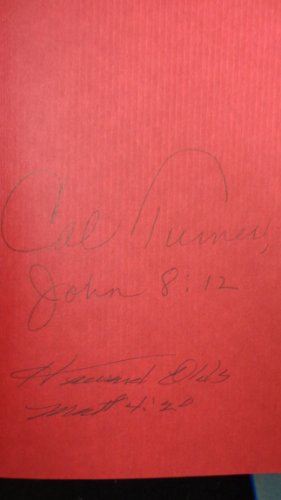
Hardcover. Condition: Very Good. Dust Jacket Condition: Very Good. The dustjacket shows light edgewear. Inscription from the author on the half title page. Signed by Author(s). Seller Inventory # 035992
Stock Image
Led to Follow: Leadership Lessons from an Improbable Pastor and a Reluctant CEO
Seller: BennettBooksLtd, Los Angeles, CA, U.S.A.
Seller rating 5 out of 5 stars
hardcover. Condition: New. In shrink wrap. Looks like an interesting title! Seller Inventory # Q-0687650798