
Items related to Path Without Destination: An Autobiography
Synopsis
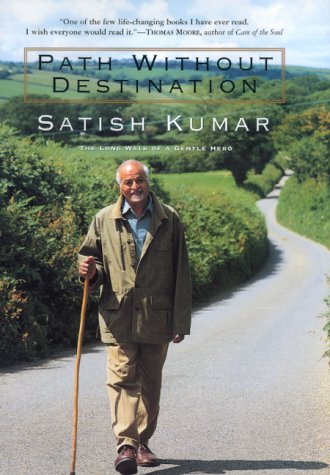
At the age of nine, the author joined a roaming brotherhood of beggar monks until he was presented with Gandhi's vision of a peaceful world and embarked on a religious walking journey from India to America, in an intimate portrait of the remarkable co-creator of the "small is beautiful" movement. Original.
"synopsis" may belong to another edition of this title.
About the Author
Satish Kumar is the editor of Resurgence magazine and director of programme at Schumacher College. He has lectured at such places as Harvard University, where his progressive ideas have gained new respect. He's been profiled in The New York Times, The Times (London), The Gazette (Montreal), the Minneapolis Star Tribune, Parabola, and Utne Reader. Kumar resides in England.
Reviews
For Kumar, the enemy is the global economy, mass production and multinational corporations, which lead to alienating work and extremes of poverty and wealth. His ideal world is a loose confederation of self-reliant, frugal, ecological communities and bioregions practicing small-scale local production. If that sounds like a page from E.F. Schumacher's Small Is Beautiful, it's no accident. Kumar, a former Jain monk born in India in 1936, was a close associate of Schumacher in London in the mid-1970s and, after the latter's death, founded the Schumacher Society to promote a decentralized, low-tech, egalitarian civilization. In this spiritual autobiography, he renders these ideas powerful by virtue of the example of his own commitment to them. In 1962, with a mixture of lofty idealism and personal callousness, Kumar left his new wife and their three-week-old daughter in India and, with a fellow activist, set off on a two-year, round-the-world walk, stopping in Moscow, Paris, London and Washington to urge government leaders to abolish nuclear weapons and end the arms race. His "peace pilgrimage" makes for an incredible road adventure, but the book later threatens to become one long, exhausting itinerary as he re-creates trips to Japan, Tibet, Nepal and his four-month pilgrimage on foot in 1985 to Britain's sacred sites and alternative communities. Many will view Kumar's prescriptions as fantasy, but none can doubt that these pages are animated by a fierce integrity. Agent, Andrew Blauner.
Copyright 1998 Reed Business Information, Inc.
When he was a boy of nine, Kumar joined an order of monks who wandered the Indian countryside in search of spiritual enlightenment. Though a faithful student of the order's teachings, by his mid-teens Kumar felt some larger work calling him. He moved to a city, became an assistant editor of a local paper, and got married. Still, all this was not enough. Then in 1962, he and a friend hit upon an idea to combat the growing insanity of the cold war: the two would travel 8,000 miles--by foot--to the capitals of all the nuclear powers in a pilgrimage for peace. Spiritually speaking, Kumar is still walking. Today, as editor of the English magazine Resurgence, Kumar advocates a small-is-better philosophy, arguing for strong, self-contained communities guided by environmental awareness. An autobiography of an important modern-day philosopher whose faith in the human spirit seems limitless. Brian McCombie
Excerpt. © Reprinted by permission. All rights reserved.
Chapter 1
Mother
BEFORE I WAS BORN, while my mother was still pregnant with me, she often had a dream ( always the same one. A wise old man with a long beard was riding with her on the back of an elephant into a forest. He promised to take her to a land of gold and jewels. "Why are we on the back of an elephant?" Mother asked. "Let's go on horseback so we can move more quickly." The wise man said, "I don't know the way. Only the elephant knows the way." Mother argued, "This is stupid. A horse is much more intelligent than an elephant." The wise man replied, "It's not a question of intelligence but a question of going the right way." Mother's dream always ended with her and the wise man riding on the elephant, never reaching their destination.
On the ninth of August 1936 I was born in the town of Sri Dungargarh, at four in the morning: the time of Brahma, the god of creation, a time of complete stillness, calm, and peace. As the rays of the sun touch the earth, so the rays of knowledge come to the soul.
When Mother consulted the Brahmin who was the village astrologer about her dream, he said that I was the child of her unfulfilled wishes and that I would never have gold or jewels and that I would never reach my destination. Life for me would be an unending, continuous journey. Then, offering ghee (melted butter) to the fire, the Brahmin named me Bhairav Dan, which means "gift of Shiva."
I was four years old when my father died. My only memory of him, except for holding his index finger and walking, was of his body wrapped in a white cloth and heaped with marigolds and jasmine, only his face showing, his eyes closed as if in deep sleep. His body lay on a wooden stretcher in the courtyard of our home. Relatives and friends came from miles around, all the women wearing green saris as a sign of mourning. When they reached the beginning of our street, they started wailing loudly.
Mother retreated into her room in tears. One by one she removed the precious pieces of jewelry which Father had given her when they were married ( golden chains, bracelets and rings, pearls, diamonds, and silver bangles. She took off the pendant from her forehead, the diamond stud from her nose, her diamond earrings, her gold armlet, her belt of gold wire studded with pearls, her silver anklets and silver toe rings. She removed her yellow sari embroidered with gold and put on a plain green one. She sat on the floor in the corner of the room. For days she didn't move, she didn't speak to anybody, she didn't take food. She just stayed in the corner of the room weeping. I came to her asking, "Why are you here, why don't you come out, why don't you come to the kitchen, why don't you..."
Four men took Father's body on to their shoulders and carried him in a funeral procession. Outside the town they laid him on the funeral pyre. Wood and coconuts were heaped over his body, and the fire was lit, Melted butter and sandalwood incense was poured onto the fire while the village priest chanted mantras. We stood in a circle around the pyre until the fire died. Next day the ashes were collected and then taken by my brother to Benares to be offered to the holy river Ganges.
I followed Mother like her own shadow. I went wherever she went. I was part of her body. She breast-fed me until I was two years old. She massaged my body daily with sesame oil. I slept in the same bed as Mother and always ate off her plate. She rose at four in the morning and meditated for forty-eight minutes, the prescribed period in the Jain religion, the religion of our family. She sat alone on the veranda with the glass sand timer, and meditated partly in silence and partly chanting the Jain mantra of Surrender:
I surrender to those who are Enlightened and therefore have no enemies
I surrender to the Released Spirits
I surrender to the Wise Gurus
I surrender to the Spiritual Teachers
I surrender to the Seekers of Enlightenment
She chanted it one hundred and eight times, counting with her bead necklace. After her meditation she took a daily vow to limit her needs. For example on one day she might say, "Today I will not eat anything other than the following twelve items: rice, lentils, wheat, mango, melon, cucumber, cumin, chili, salt, water, milk, and butter, and today I will not travel more than ten miles, and only towards the East."
At dawn she ground the flour by hand with a stone mill and churned butter from yogurt. At sunrise she milked our cows and the water buffalo. Then she would turn the animals out for the cowherd to take them to graze for the day. We were a large family ( my three brothers, my four sisters, my uncle and great-uncle, their sons, wives, and grandchildren all lived in the house. If we were all together, the number of us would be about forty. Breakfast was generally a glass of milk ( tea and coffee were never allowed.
The family would eat the midday meal from eleven o'clock onward. Mother would make sure that each member's taste was catered for too. Eating in our family was never a social occasion, it was an act of personal satisfaction. No conversation was allowed while eating. Though she limited her own appetite, Mother would prepare for each of us our favorite foods ( but food was also her weapon to punish us for disobedience. For all of us Mother was the only mother, the head of the household: my cousins would call their own mother "Sister."
Copyright (c) 1999 Satish Kumar
"About this title" may belong to another edition of this title.
Search results for Path Without Destination: An Autobiography

Stock Image
Path Without Destination: An Autobiography
Seller: World of Books (was SecondSale), Montgomery, IL, U.S.A.
Seller rating 5 out of 5 stars

Hardback. Condition: Good. There are a lot of diet plans out on the market, but when you need to lose weight to improve your health right away, then you need to go on the HCG diet. This diet plan has been around for some time and promises that you will lose up to a pound (sometimes more) each day that you are on the diet plan. This guidebook will help you to learn everything that you need to get started on the HCG diet. It can be a complicated diet, but it will give you the results that you want in no time. Some of the topics that we will explore the HCG diet includes: The history of the HCG dietWhat the HCG diet isHow this diet plan worksThe benefits of using the HCG dietWhat you can expect with the HCG dietWhether you should go with the injections or dropsWhat to do when hunger strikesFAQ's about the HCG dietThe foods that you can have on the HCG dietThe recipes you should try outA diet calendar to make the HCG diet easier.When you are ready to lose a pound or more a day, safely and effectively, make sure to check out this guidebook to learn everything you need to get started with the HCG diet.Click the buy now button to change the way you feel, eat and be happier than ever>. Seller Inventory # 00072650403
Stock Image
Path Without Destination: An Autobiography
Seller: Orion Tech, Kingwood, TX, U.S.A.
Seller rating 5 out of 5 stars
hardcover. Condition: Very Good. Seller Inventory # 0688164021-2-37929897
Stock Image
Path Without Destination : An Autobiography
Published by
HarperCollins Publishers, 1999
ISBN 10: 0688164021
ISBN 13: 9780688164027
Used
Hardcover
Seller: Better World Books, Mishawaka, IN, U.S.A.
Seller rating 5 out of 5 stars
Condition: Good. First U.S. Edition, first Printing. Pages intact with minimal writing/highlighting. The binding may be loose and creased. Dust jackets/supplements are not included. Stock photo provided. Product includes identifying sticker. Better World Books: Buy Books. Do Good. Seller Inventory # 4065527-6
Stock Image
Path Without Destination : An Autobiography
Published by
HarperCollins Publishers, 1999
ISBN 10: 0688164021
ISBN 13: 9780688164027
Used
Hardcover
Seller: Better World Books, Mishawaka, IN, U.S.A.
Seller rating 5 out of 5 stars
Condition: Very Good. First U.S. Edition, first Printing. Former library copy. Pages intact with possible writing/highlighting. Binding strong with minor wear. Dust jackets/supplements may not be included. Includes library markings. Stock photo provided. Product includes identifying sticker. Better World Books: Buy Books. Do Good. Seller Inventory # 3397731-6
Stock Image
Path Without Destination: An Autobiography
Seller: BooksRun, Philadelphia, PA, U.S.A.
Seller rating 5 out of 5 stars
Hardcover. Condition: Very Good. With dust jacket. It's a well-cared-for item that has seen limited use. The item may show minor signs of wear. All the text is legible, with all pages included. It may have slight markings and/or highlighting. Seller Inventory # 0688164021-11-1-29
Stock Image
Path Without Destination: An Autobiography
Seller: Copper News Book Store, Ajo, AZ, U.S.A.
Seller rating 4 out of 5 stars

Hardcover. Condition: Good. Dust Jacket Condition: Good. **YOUR PURCHASE SUPPORTS A SMALL BUSINESS!!**. Seller Inventory # 016693
Stock Image
Path Without Destination: An Autobiography
Seller: World of Books Inc, Montgomery, IL, U.S.A.
Seller rating 4 out of 5 stars
Hardback. Condition: Good. There are a lot of diet plans out on the market, but when you need to lose weight to improve your health right away, then you need to go on the HCG diet. This diet plan has been around for some time and promises that you will lose up to a pound (sometimes more) each day that you are on the diet plan. This guidebook will help you to learn everything that you need to get started on the HCG diet. It can be a complicated diet, but it will give you the results that you want in no time. Some of the topics that we will explore the HCG diet includes: The history of the HCG dietWhat the HCG diet isHow this diet plan worksThe benefits of using the HCG dietWhat you can expect with the HCG dietWhether you should go with the injections or dropsWhat to do when hunger strikesFAQ's about the HCG dietThe foods that you can have on the HCG dietThe recipes you should try outA diet calendar to make the HCG diet easier.When you are ready to lose a pound or more a day, safely and effectively, make sure to check out this guidebook to learn everything you need to get started with the HCG diet.Click the buy now button to change the way you feel, eat and be happier than ever>. Seller Inventory # CIN0688164021G
Stock Image
Path Without Destination: An Autobiography
Seller: HPB Inc., Dallas, TX, U.S.A.
Seller rating 5 out of 5 stars
hardcover. Condition: Very Good. Connecting readers with great books since 1972! Used books may not include companion materials, and may have some shelf wear or limited writing. We ship orders daily and Customer Service is our top priority! Seller Inventory # S_469406538
Stock Image
Path Without Destination: An Autobiography
Seller: ThriftBooks-Dallas, Dallas, TX, U.S.A.
Seller rating 5 out of 5 stars
Hardcover. Condition: Very Good. No Jacket. May have limited writing in cover pages. Pages are unmarked. ~ ThriftBooks: Read More, Spend Less. Seller Inventory # G0688164021I4N00
Stock Image
Path Without Destination: An Autobiography
Seller: ThriftBooks-Atlanta, AUSTELL, GA, U.S.A.
Seller rating 5 out of 5 stars
Hardcover. Condition: Fair. No Jacket. Readable copy. Pages may have considerable notes/highlighting. ~ ThriftBooks: Read More, Spend Less. Seller Inventory # G0688164021I5N00