
Items related to The Civilization of Europe in the Renaissance
Synopsis
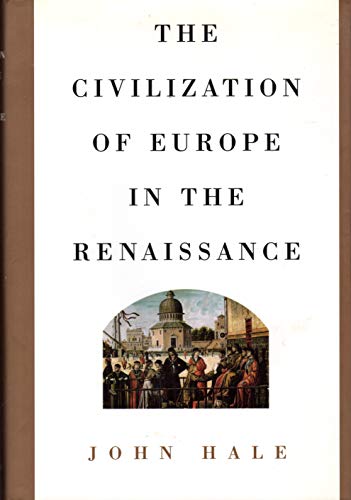
Looks at European history between 1450 and 1620, describes the intellectual life and social conditions of the period, and discusses the cultural changes that took place
"synopsis" may belong to another edition of this title.
About the Author
Sir John Hale is a Fellow of the British Academy and Emeritus Professor of Italian History at University College, London.
Reviews
A deft survey by a leading British authority on the period's political, military, and art history. Hale presents the Renaissance as the age in which, first through cartography, the nations of Europe (Britain included) gained an awareness of being, however precariously, a cohesive entity. But he places as much stress on the countries' developing prejudices, antipathies, and insular ``mini-economies'' as on their sense of kinship or alliance. After chapters mapping the ``discovery'' of Europe as an idea, its countries, and its divisions, Hale crosses these borders to discuss ``transformations,'' ``transmissions,'' and ``migrating styles'' of art and culture. His examples of local adaptations of Italian works are particularly telling, e.g., a Polish translator of Castiglione's Courtier removed the women from its dialogues, sure that his readers would doubt ``their participation in such a cultivated debate.'' Hale, while furnishing essential information on the culture's immense achievements, ultimately stresses Renaissance Europe's blind spots and omissions, shortcomings and contradictions. Sensual indulgence as opposed to new social controls is exemplified by the fact that ``one out of seven'' Britons were accused of sexual misconduct in Elizabethan England and the inclusion of prostitutes as guests at Vatican entertainments; other problems range from the lack of practical theories of social reform to the excess of engineering ideas that were ``theoretically plausible but impractical'' yet were ``accepted by the wisest council of the soberest government[s] of Europe.'' Galileo, who destroyed the very premises of astrology, still ``cast horoscopes for his Medici patrons and their friends.'' While noting Europe's growing sense of modernity, Hale also traces the continent's cultural ``drawing in on itself,'' regions' rising separatism, cities' found-and-lost civility, and individuals' adoption of ``Melancholy'' out of ``hopeless... inner confusion.'' The art descriptions are wittily precise, the illustrations well-chosen, and the quotations often come from superb period translations. Masterful portraiture. -- Copyright ©1994, Kirkus Associates, LP. All rights reserved.
Hale describes the end of "Christendom" and the beginning of a new understanding of the terms "Europe" and "European" during the period 1450-1620. He stresses the 16th and early 17th centuries, rather than 15th-century Italy, and is concerned not only with the "new age" of learning but with the characteristics of daily life among Europeans and the roots of contemporary Europe and its culture.
Copyright 1999 Reed Business Information, Inc.
Just what is Europe? asks this distinguished British historian, and his answers begin with the renewed interest in antiquity during the 1500s. Hale examines the myth of Europa's rape by a bullheaded Zeus, discusses the intensity of mapmaking that placed Europe at the center of the world, and then sets forth to capture the entire, vast panorama of European civilization. His text reflects lifelong scholarship, yet Hale carries his gravitas lightly, with a buoyant absence of pedantry. In those passages keyed to his 200-odd illustrations, Hale goes beyond art history to convey what the images say about the changes occuring in day-to-day life. The new paintings by Titian, Raphael, and Hans Holbein, for all their aesthetic exquisiteness, signaled a new continental sensibilityand that sensibility was also rising in the proto-capitalism of trade and in intellectual life. In the everyday world of social control, prejudices, disease, and death, Hale navigates just as steadily, showing that though this was not a humanitarian age, a new definition of civilized life developed that the world retrospectively acknowledges was revolutionary. A brilliant guide to the fifteenth and sixteenth centuries. Gilbert Taylor
"About this title" may belong to another edition of this title.
Search results for The Civilization of Europe in the Renaissance

Stock Image
The Civilization of Europe in the Renaissance
Seller: ThriftBooks-Dallas, Dallas, TX, U.S.A.
Seller rating 5 out of 5 stars

Hardcover. Condition: As New. No Jacket. Pages are clean and are not marred by notes or folds of any kind. ~ ThriftBooks: Read More, Spend Less. Seller Inventory # G0689122004I2N00
Stock Image
The Civilization of Europe in the Renaissance
Seller: ThriftBooks-Atlanta, AUSTELL, GA, U.S.A.
Seller rating 5 out of 5 stars
Hardcover. Condition: As New. No Jacket. Pages are clean and are not marred by notes or folds of any kind. ~ ThriftBooks: Read More, Spend Less. Seller Inventory # G0689122004I2N00
Stock Image
The Civilization of Europe in the Renaissance
Seller: World of Books (was SecondSale), Montgomery, IL, U.S.A.
Seller rating 5 out of 5 stars
Hardback. Condition: Good. Seller Inventory # 00079916029
Stock Image
The Civilization of Europe in the Renaissance
Published by
Scribner (edition 1st ptg.), 1994
ISBN 10: 0689122004
ISBN 13: 9780689122002
Used
Paperback
Seller: BooksRun, Philadelphia, PA, U.S.A.
Seller rating 5 out of 5 stars
Paperback. Condition: Very Good. 1st ptg. It's a well-cared-for item that has seen limited use. The item may show minor signs of wear. All the text is legible, with all pages included. It may have slight markings and/or highlighting. Seller Inventory # 0689122004-11-1
Stock Image
Civilization of Europe in the Renaissance
Published by
Simon & Schuster Children's Publishing, 1994
ISBN 10: 0689122004
ISBN 13: 9780689122002
Used
Softcover
Seller: Better World Books, Mishawaka, IN, U.S.A.
Seller rating 5 out of 5 stars
Condition: Good. 1st American ed. Former library copy. Pages intact with minimal writing/highlighting. The binding may be loose and creased. Dust jackets/supplements are not included. Includes library markings. Stock photo provided. Product includes identifying sticker. Better World Books: Buy Books. Do Good. Seller Inventory # GRP102165524
Stock Image
Civilization of Europe in the Renaissance
Published by
Simon & Schuster Children's Publishing, 1994
ISBN 10: 0689122004
ISBN 13: 9780689122002
Used
Softcover
Seller: Better World Books, Mishawaka, IN, U.S.A.
Seller rating 5 out of 5 stars
Condition: Good. 1st American ed. Pages intact with minimal writing/highlighting. The binding may be loose and creased. Dust jackets/supplements are not included. Stock photo provided. Product includes identifying sticker. Better World Books: Buy Books. Do Good. Seller Inventory # 4413997-75
Stock Image
Civilization of Europe in the Renaissance
Published by
Simon & Schuster Children's Publishing, 1994
ISBN 10: 0689122004
ISBN 13: 9780689122002
Used
Softcover
Seller: Better World Books, Mishawaka, IN, U.S.A.
Seller rating 5 out of 5 stars
Condition: Very Good. 1st American ed. Pages intact with possible writing/highlighting. Binding strong with minor wear. Dust jackets/supplements may not be included. Stock photo provided. Product includes identifying sticker. Better World Books: Buy Books. Do Good. Seller Inventory # 2423712-75
Stock Image
The Civilization of Europe in the Renaissance
Seller: HPB-Movies, Dallas, TX, U.S.A.
Seller rating 4 out of 5 stars

hardcover. Condition: Very Good. Connecting readers with great books since 1972! Used books may not include companion materials, and may have some shelf wear or limited writing. We ship orders daily and Customer Service is our top priority! Seller Inventory # S_470672393
Stock Image
The Civilization of Europe in the Renaissance
Seller: Redux Books, Grand Rapids, MI, U.S.A.
Seller rating 5 out of 5 stars
Paperback. Condition: Very Good. Hardcover with dust jacket. Pages are clean and unmarked. Covers show very minor shelving wear. Binding is tight, hinges strong. Dust jacket shows light edge wear. Previous owners name on end paper.; 100% Satisfaction Guaranteed! Ships same or next business day! Seller Inventory # 132511060009
Stock Image
The Civilization of Europe in the Renaissance
Seller: Orion Tech, Kingwood, TX, U.S.A.
Seller rating 5 out of 5 stars
paperback. Condition: New. Seller Inventory # 0689122004-11-37317832