
Items related to If a Bus Could Talk: The Story of Rosa Parks
Synopsis
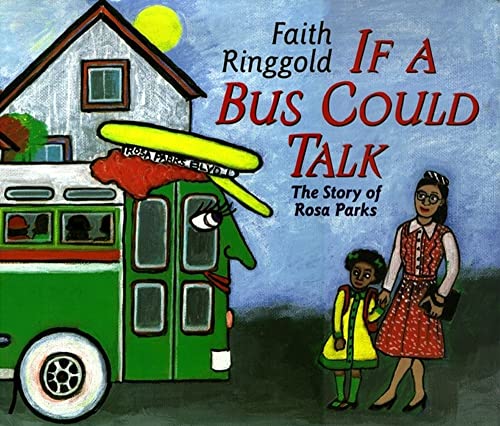
From a Caldecott Honor Award and Coretta Scott King Award–winning illustrator comes a bright and offbeat picture book with a unique perspective on the story of Rosa Parks.
A young girl named Marcie has a magical bus ride where the bus itself tells her the story of the mother of the Civil Rights Movement, Rosa Parks. Because she was black, Rosa had to walk miles to a one-room schoolhouse while white children could take the bus, and as an adult, Rosa could only sit in the back.
But when the day came that Rosa refused to give up her seat, she helped set the wheels in motion for black people to sit where they wanted. Marcie learns all this and more then gets a special surprise at the end of her trip!
"synopsis" may belong to another edition of this title.
About the Author
Faith Ringgold grew up in Harlem, has a master’s degree in education, and has taught art in New York City public schools. Deeply influenced by the Black Power movement, Faith developed an art style based on her African American heritage. She created a series of narrative quilts about the lives of black women, one of which inspired her first picture book, Tar Beach, winner of a Caldecott Honor Award and a Coretta Scott King Award for Illustration. She went on to publish several more acclaimed picture books, including Aunt Harriet’s Underground Railroad in the Sky and My Dream of Martin Luther King. Faith Ringgold divides her time between New Jersey and Southern California.
Reviews
Ringgold's biography of Rosa Parks packs substantial material into a few pages, but with a light touch, and with the ring of authenticity that gives her act of weary resistance all the respect it deserves. Narrating the book is the bus that Parks took that morning 45 years ago; it recounts the signal events in Parks's life to a young girl who boarded it to go to school. A decent amount of the material will probably be new to children, for Parks is so intimately associated with the Montgomery Bus Boycott that her work with the NAACP before the bus incident is often overlooked, as is her later role as a community activist in Detroit with Congressman John Conyers. Ringgold, through the bus, also informs readers of Parks's youth in rural Alabama, where Klansmen and nightriders struck fear into the lives of African-Americans. These experiences make her refusal to release her seat all the more courageous, for the consequences of resistance were not gentle. All the events are depicted in emotive naive artwork that underscores their truth; Ringgold delivers Parks's story without hyperbole, but rather as a life lived with pride, conviction, and consequence. (Picture book/biography. 5-9) -- Copyright ©1999, Kirkus Associates, LP. All rights reserved.
Kindergarten-Grade 4-A talking bus is literally the vehicle for this picture-book biography. Marcie, on her way to school, finds herself on a driverless bus occupied by a group of unfamiliar passengers who don't seem to notice she's there. A disembodied voice tells her that this used to be the Cleveland Avenue bus but is now the Rosa Parks bus, and then launches into an account of the woman's life. Ringgold recounts the dramatic events triggered by Parks's refusal to give up her seat: the Montgomery bus boycott; the leadership, persecution, and death of Dr. Martin Luther King, Jr.; the Supreme Court decision to ban bus segregation; and public recognition of the woman who started it all. The story ends when Parks herself enters the bus for a birthday celebration with the passengers who are now revealed as personages from her history. While the artifice of the talking bus and a few minor lapses in logic sometimes detract from a solid telling, the story does much to humanize a larger-than-life figure. Ringgold's colorful, textured acrylic-on-canvas paper paintings done in a na?f style are a perfect complement to the stark realism of the events and the simple dignity of the subject. Color and line are used to suggest ideas, such as the turbulent purple, black, blue, and chalky white and the jagged forms depicting the Ku Klux Klan and bombings. Text and art harmonize, with print changing from black to white and appearing on each page in an interesting variety of layouts. An accessible telling and beautiful illustrations result in a worthy contribution to this developing genre.
Marie Orlando, Suffolk Cooperative Library System, Bellport, NY
Copyright 2000 Reed Business Information, Inc.
Underdeveloped poetic conceits short-circuit this profile of civil rights activist Rosa Parks. Marcie, an African-American child, is waiting for the bus to school when a strange bus pulls up; for some reason, she boards it. There is no driver, but the bus itself talks. It informs Marcie that she is riding on "the Rosa Parks bus," the very vehicle that Parks had been riding in 1955 when, refusing to give up her seat to a white man, she helped trigger the Montgomery Bus Boycott. (In a bizarre irony, Marcie is made to give up her seat, which is ostensibly intended for Parks.) The bus then recounts Parks's childhood, education and tireless work as a civil rights activist; Marcie's fellow passengers serve as chorus, intermittently chiming in, "Amen! Amen!... We know, we were there." The account is full of hard-hitting information but suffers from confusing prose ("The Montgomery Bus Boycott was the beginning of a national movement in which people of every race organized protests against segregation in their own towns"). Finally, Parks boards the bus, and it emerges that Marcie's fellow riders include Parks's husband and Martin Luther King Jr.; in a throwaway ending, Marcie debarks at her school ("I can't wait to tell my class about this!"). Ringgold's paintings help animate this uneven tale, but a depiction of the bus with facial features, hair and hat compromises her powerful folk-art style. Other picture books chronicle Parks's life more lucidly; this is a disappointingly bumpy ride. Ages 5-9. (Nov.)
Copyright 1999 Reed Business Information, Inc.
There have been several children's books about Rosa Parks over the years, including the moving autobiography I Am Rosa Parks (1997), written with Jim Haskins. However, this picture-book biography condescends to kids, as if they require a sweet-faced talking bus with cute, flapping eyelashes and a smiling mouth, to entice them to the history. But beyond the intrusive frame, Ringgold tells the story in a direct text and bright acrylic narrative paintings, showing Parks as a political activist whose refusal to give up her seat on the bus sparked the Montgomery Bus Boycott. There are dramatic landmark scenes from the civil rights movement, including the lunch counter sit-ins, the leadership role of Dr. King, and the grief at his assassination. On the final pages, the magic realism is integral to the story as the passengers on the bus turn out to be Dr. King and other leaders paying tribute to "the mother of the Civil Rights movement . . . who, by sitting down, inspired people all over the world to stand up for freedom." Hazel Rochman
"About this title" may belong to another edition of this title.
Search results for If a Bus Could Talk: The Story of Rosa Parks

Stock Image
If a Bus Could Talk: The Story of Rosa Parks
Published by
Simon & Schuster Australia, 2000
ISBN 10: 0689818920
ISBN 13: 9780689818929
Used
Hardcover
Seller: World of Books (was SecondSale), Montgomery, IL, U.S.A.
Seller rating 5 out of 5 stars

Hardback. Condition: Good. Ringgold, Faith (illustrator). If a bus could talk, it would tell the story of a young African-American girl named Rosa who had to walk miles to her one-room schoolhouse in Alabama while white children rode to their school in a bus. It would tell how the adult Rosa rode to and from work on a segregated city bus and couldn't sit in the same row as a white person. It would tell of the fateful day when Rosa refused to give up her seat to a white man and how that act of courage inspired others around the world to stand up for freedom. In this book a bus does talk, and on her way to school a girl named Marcie learns why Rosa Parks is the mother of the Civil Rights movement. At the end of Marcie's magical ride, she meets Rosa Parks herself at a birthday party with several distinguished guests. Wait until she tells her class about this. Seller Inventory # 00091929480
Stock Image
If a Bus Could Talk: The Story of Rosa Parks
Published by
Simon & Schuster Books for Young Readers, 1999
ISBN 10: 0689818920
ISBN 13: 9780689818929
Used
Hardcover
Seller: Your Online Bookstore, Houston, TX, U.S.A.
Seller rating 5 out of 5 stars
Hardcover. Condition: Good. Ringgold, Faith (illustrator). Seller Inventory # 0689818920-3-19469299
Seller Image
If a Bus Could Talk: The Story of Rosa Parks
Published by
Simon & Schuster Books for Young Readers, 1999
ISBN 10: 0689818920
ISBN 13: 9780689818929
Used
Hardcover
Seller: ZBK Books, Carlstadt, NJ, U.S.A.
Seller rating 5 out of 5 stars
Condition: very_good. Ringgold, Faith (illustrator). Fast & Free Shipping â" Very Good condition book with a firm cover and clean pages. Shows normal use and some light wear or limited notes markings. A solid, nice copy to enjoy. Seller Inventory # ZWV.0689818920.VG
Stock Image
If a Bus Could Talk: The Story of Rosa Parks
Published by
Simon & Schuster Books for Young Readers (edition First Edition), 1999
ISBN 10: 0689818920
ISBN 13: 9780689818929
Used
Hardcover
First Edition
Seller: BooksRun, Philadelphia, PA, U.S.A.
Seller rating 5 out of 5 stars
Hardcover. Condition: Very Good. Ringgold, Faith (illustrator). First Edition. It's a well-cared-for item that has seen limited use. The item may show minor signs of wear. All the text is legible, with all pages included. It may have slight markings and/or highlighting. Seller Inventory # 0689818920-8-1
Seller Image
If a Bus Could Talk: The Story of Rosa Parks
Published by
Simon & Schuster Books for Young Readers, 1999
ISBN 10: 0689818920
ISBN 13: 9780689818929
Used
Hardcover
Seller: Bay State Book Company, North Smithfield, RI, U.S.A.
Seller rating 5 out of 5 stars
Condition: good. Ringgold, Faith (illustrator). The book is in good condition with all pages and cover intact, including the dust jacket if originally issued. The spine may show light wear. Pages may contain some notes or highlighting, and there might be a "From the library of" label. Boxed set packaging, shrink wrap, or included media like CDs may be missing. Seller Inventory # BSM.121JT
Stock Image
If a Bus Could Talk: The Story of Rosa Parks
Published by
Simon & Schuster Books for Young, 1999
ISBN 10: 0689818920
ISBN 13: 9780689818929
Used
Hardcover
Seller: HPB-Diamond, Dallas, TX, U.S.A.
Seller rating 5 out of 5 stars
hardcover. Condition: Very Good. Ringgold, Faith (illustrator). Connecting readers with great books since 1972! Used books may not include companion materials, and may have some shelf wear or limited writing. We ship orders daily and Customer Service is our top priority! Seller Inventory # S_460835879
Stock Image
If a Bus Could Talk: The Story of Rosa Parks
Published by
Simon & Schuster Books for Young Readers, 1999
ISBN 10: 0689818920
ISBN 13: 9780689818929
Used
Hardcover
Seller: ThriftBooks-Dallas, Dallas, TX, U.S.A.
Seller rating 5 out of 5 stars
Hardcover. Condition: Very Good. No Jacket. Ringgold, Faith (illustrator). Missing dust jacket; May have limited writing in cover pages. Pages are unmarked. ~ ThriftBooks: Read More, Spend Less. Seller Inventory # G0689818920I4N01
Stock Image
If a Bus Could Talk: The Story of Rosa Parks
Published by
Simon & Schuster Books for Young Readers, 1999
ISBN 10: 0689818920
ISBN 13: 9780689818929
Used
Hardcover
Seller: ThriftBooks-Atlanta, AUSTELL, GA, U.S.A.
Seller rating 5 out of 5 stars
Hardcover. Condition: Fair. No Jacket. Ringgold, Faith (illustrator). Former library book; Readable copy. Pages may have considerable notes/highlighting. ~ ThriftBooks: Read More, Spend Less. Seller Inventory # G0689818920I5N10
Stock Image
If a Bus Could Talk: The Story of Rosa Parks
Published by
Simon & Schuster Books for Young Readers, 1999
ISBN 10: 0689818920
ISBN 13: 9780689818929
Used
Hardcover
Seller: ThriftBooks-Atlanta, AUSTELL, GA, U.S.A.
Seller rating 5 out of 5 stars
Hardcover. Condition: Very Good. No Jacket. Ringgold, Faith (illustrator). Missing dust jacket; May have limited writing in cover pages. Pages are unmarked. ~ ThriftBooks: Read More, Spend Less. Seller Inventory # G0689818920I4N01
Stock Image
If a Bus Could Talk: The Story of Rosa Parks
Published by
Simon & Schuster Books for Young Readers, 1999
ISBN 10: 0689818920
ISBN 13: 9780689818929
Used
Hardcover
Seller: ThriftBooks-Dallas, Dallas, TX, U.S.A.
Seller rating 5 out of 5 stars
Hardcover. Condition: As New. No Jacket. Ringgold, Faith (illustrator). Pages are clean and are not marred by notes or folds of any kind. ~ ThriftBooks: Read More, Spend Less. Seller Inventory # G0689818920I2N00