
Synopsis
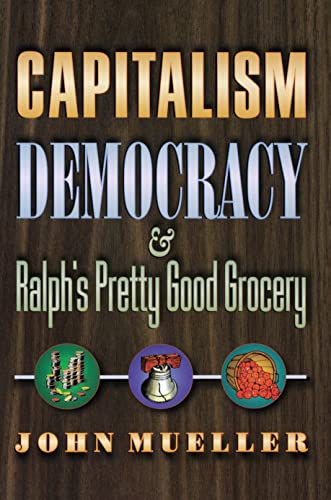
Democracy is overrated. Capitalism, on the other hand, doesn't get enough credit. In this provocative and engaging book, John Mueller argues that these mismatches between image and reality create significant political and economic problems--inspiring instability, inefficiency, and widespread cynicism. We would be far better off, he writes, if we recognized that neither system is ideal or disastrous and accepted instead the humdrum truth that both are "pretty good." And, to Mueller, that means good enough. He declares that what is true of Garrison Keillor's fictional store "Ralph's Pretty Good Grocery" is also true of democracy and capitalism: if you can't get what you want there, "you can probably get along without it."
Mueller begins by noting that capitalism is commonly thought to celebrate greed and to require discourtesy, deceit, and callousness. However, with examples that range from car dealerships and corporate boardrooms to the shop of an eighteenth-century silk merchant, Mueller shows that capitalism in fact tends to reward behavior that is honest, fair, civil, and compassionate. He argues that this gap between image and reality hampers economic development by encouraging people to behave dishonestly, unfairly, and discourteously to try to get ahead and to neglect the virtuous behavior that is an important source of efficiency and gain.
The problem with democracy's image, by contrast, is that our expectations are too high. We are too often led by theorists, reformers, and romantics to believe that democracy should consist of egalitarianism and avid civic participation. In fact, democracy will always be chaotic, unequal, and marked by apathy. It offers reasonable freedom and security, but not political paradise. To idealize democracy, Mueller writes, is to undermine it, since the inevitable contrast with reality creates public cynicism and can hamper democracy's growth and development.
Mueller presents these arguments with sophistication, wit, and erudition. He combines mastery of current political and economic literature with references to figures ranging from Plato to P. T. Barnum, from Immanuel Kant to Ronald Reagan, from Shakespeare to Frank Capra. Broad in scope and rich in detail, the book will provoke debate among economists, political scientists, and anyone interested in the problems (or non-problems) of modern democracy and capitalism.
"synopsis" may belong to another edition of this title.
About the Author
John Mueller is Professor of Political Science at the University of Rochester. His previous books include War, Presidents, and Public Opinion, Retreat from Doomsday: The Obsolescence of Major War, and Quiet Cataclysm: Reflections on the Recent Transformation of World Politics. He is a regular contributor to numerous academic journals and has written editorial page columns in The New York Times, The Wall Street Journal, and The Los Angeles Times. Outside the field of political science, Mueller has written the prize-winning Astaire Dancing: The Musical Films (Knopf) and cowritten A Foggy Day, a musical presented at the Shaw Festival in Ontario.
From the Back Cover
"John Mueller deftly paces us through the practical realities of democratic development, rescuing the very idea of democracy from the idea mongers who have oversold the links between democracy and prosperity and between democracy and virtue. Stepping nimbly through the historic and contemporary links among democracy, capitalism, and virtue, he makes an important contribution to a practical theory of democracy."--Sam Popkin, University of California, San-Diego
"John Mueller has written an outstanding book about capitalism and democracy. He argues that each system has existed without the other, but that both are improved when they occur in tandem. Capitalism and democracy differ in cultural repute. Capitalism has a bad press even though as a result of competition, it tends to treat the customer well. Capitalist leaders are not 'robber barons,' but nice guys who finish first. Democracy, on the other hand, is perhaps over-praised: it embodies the play of special interests and while conceding political rights, only benefits the people as a whole when it is tied to a capitalist growth strategy. Fortunately, economists are now able to provide that strategy so that by following their advice, societies can progress. Neither democracy nor capitalism, however, satisfies all human or psychic wants. They are at best a reflection of Ralph's Pretty Good Grocery (where you can get everything you really need) rather than Alice's Restaurant (where you can get anything you want). Mueller has contributed a new and provocative interpretation that will resonate for years to come."--Richard Rosecrance, University of California, Los Angeles
"This is a lively, smart, well-written, and often compelling book. The frequent and pointed comments that visions of perfect democracy and markets miss the point of how a society can work are well made."--Russell Hardin, New York University
"We have here a seasoned political scientist and thinker with total control over his material. The result is an extremely engaging text, one that will be read for its excitement in the best graduate seminars and the best political science programs in the country. I have little doubt that, even in this heavily researched area of economics and democracy, his book will make a big splash, comparable to Inglehart'sCulture Shift or Putnam's Making Democracy Work."--Michael Lewis-Beck, University of Iowa
From the Inside Flap
"John Mueller deftly paces us through the practical realities of democratic development, rescuing the very idea of democracy from the idea mongers who have oversold the links between democracy and prosperity and between democracy and virtue. Stepping nimbly through the historic and contemporary links among democracy, capitalism, and virtue, he makes an important contribution to a practical theory of democracy."--Sam Popkin, University of California, San-Diego
"John Mueller has written an outstanding book about capitalism and democracy. He argues that each system has existed without the other, but that both are improved when they occur in tandem. Capitalism and democracy differ in cultural repute. Capitalism has a bad press even though as a result of competition, it tends to treat the customer well. Capitalist leaders are not 'robber barons,' but nice guys who finish first. Democracy, on the other hand, is perhaps over-praised: it embodies the play of special interests and while conceding political rights, only benefits the people as a whole when it is tied to a capitalist growth strategy. Fortunately, economists are now able to provide that strategy so that by following their advice, societies can progress. Neither democracy nor capitalism, however, satisfies all human or psychic wants. They are at best a reflection of Ralph's Pretty Good Grocery (where you can get everything you really need) rather than Alice's Restaurant (where you can get anything you want). Mueller has contributed a new and provocative interpretation that will resonate for years to come."--Richard Rosecrance, University of California, Los Angeles
"This is a lively, smart, well-written, and often compelling book. The frequent and pointed comments that visions of perfect democracy and markets miss the point of how a society can work are well made."--Russell Hardin, New York University
"We have here a seasoned political scientist and thinker with total control over his material. The result is an extremely engaging text, one that will be read for its excitement in the best graduate seminars and the best political science programs in the country. I have little doubt that, even in this heavily researched area of economics and democracy, his book will make a big splash, comparable to Ingleharts Culture Shift or Putnams Making Democracy Work."--Michael Lewis-Beck, University of Iowa
Reviews
"If you can't get it at Ralph's, you can probably get along without it" is the motto of the mom-and-pop retailer in Garrison Keillor's fictional town of Lake Wobegon, Minn. It's a slogan that serves Mueller, a University of Rochester political science professor, as an adroit summation of both capitalism and democracy. Both are imperfect systems, according to Mueller. Capitalism is driven by selfish acquisitiveness and provides no guarantees of economic security; democracy is preferable to other forms of government but is dominated by special interests and, as a result, is "unlikely ever to achieve orderly deliberation, political equality, or wide and enlightened participation by the mass of the public." Both concepts suffer from serious image problems, according to Mueller. Capitalism gets a bad rap from Hollywood, the church and intellectuals who decry the rapaciousness of the business world; in fact, capitalism actually rewards such virtues as honesty, fairness and civility, he writes. Democracy, on the other hand, is idealized and can never foster the orderly, fair society to which its advocates aspire. Mueller is an entertaining guide through economic and political history, using references to Shakespeare, Adam Smith, Hume, Mencken and many more writers to produce deft explanations of complex ideas. One may question the wisdom of his faith in the free market, or in the fairness and civility of big corporations that, these days, are gradually devouring the Ralph's Groceries of the world. But it's hard not to find much to like in a brash manifesto that proudly extols the virtues, as Mueller puts it, of "the pretty good over the ideal." (Oct.)
Copyright 1999 Reed Business Information, Inc.
Mueller is a political science professor at the University of Rochester who has varied interests. He has written books on how public opinion affects military policy, on the obsolescence of major war, and on the dance films of Fred Astaire. This new book is based on a simple assumption that likely will be challenged all along the political spectrum. Mueller asserts that capitalism is not nearly so bad as its critics claim and that we expect too much from democracy. Fans of Garrison Keillor will recognize Ralph's as the store where, if an item isn't stocked, you probably don't really need it. This is the analogy Mueller intends. Neither capitalism nor democracy is perfect, but both are "pretty good!" Mueller traces the development of democracy and capitalism worldwide during the past two centuries. Citing from an eclectic assortment of sources--his bibliography runs 25 pages--he explores and contrasts the strengths, shortcomings, and vagaries of capitalism and democracy, and analyzes the connections between the two philosophies. David Rouse
The thesis behind Mueller's cleverly worded title is that capitalism gets terrible press (for promoting greed and deceit) while democracy's is na?vely positive and uncritical (it can never be as egalitarian and participatory as it claims). Mueller (political science, Univ. of Rochester) feels that Ralph's Pretty Good Grocery, from Garrison Keillor's mythical Lake WobegonAthe motto is, "If you can't get it at Ralph's, you can probably get along without it"Ais a more realistic model for approaching the two entities. Mueller argues that our unrealistic images of capitalism and democracy prevent us from claiming the full benefit of each. Throughout, he is careful to qualify rather than make bold declarative statements that would be damned by exceptions. Many thought-provoking ideas are packed into this nuanced work, and Mueller's case is strong and well documented. The sophisticated argument, however, will limit its value to academic collections or public libraries where there is an active interest in political science.APatrick J. Brunet, Western Wisconsin Technical Coll. Lib., La Crosse
Copyright 1999 Reed Business Information, Inc.
"About this title" may belong to another edition of this title.
Other Popular Editions of the Same Title

Search results for Capitalism, Democracy, and Ralph's Pretty Good...

Stock Image
Capitalism, Democracy, and Ralph's Pretty Good Grocery.
Published by
Princeton University Press, 1999
ISBN 10: 0691001146
ISBN 13: 9780691001142
Used
Hardcover
Seller: ThriftBooks-Atlanta, AUSTELL, GA, U.S.A.
Seller rating 5 out of 5 stars

Hardcover. Condition: Very Good. No Jacket. May have limited writing in cover pages. Pages are unmarked. ~ ThriftBooks: Read More, Spend Less. Seller Inventory # G0691001146I4N00
Stock Image
Capitalism, Democracy, and Ralph's Pretty Good Grocery.
Published by
Princeton University Press, 1999
ISBN 10: 0691001146
ISBN 13: 9780691001142
Used
Hardcover
Seller: ThriftBooks-Phoenix, Phoenix, AZ, U.S.A.
Seller rating 5 out of 5 stars
Hardcover. Condition: Very Good. No Jacket. May have limited writing in cover pages. Pages are unmarked. ~ ThriftBooks: Read More, Spend Less. Seller Inventory # G0691001146I4N00
Stock Image
Capitalism, Democracy, and Ralph's Pretty Good Grocery.
Published by
Princeton University Press, 1999
ISBN 10: 0691001146
ISBN 13: 9780691001142
Used
Hardcover
Seller: ThriftBooks-Dallas, Dallas, TX, U.S.A.
Seller rating 5 out of 5 stars
Hardcover. Condition: Fair. No Jacket. Missing dust jacket; Readable copy. Pages may have considerable notes/highlighting. ~ ThriftBooks: Read More, Spend Less. Seller Inventory # G0691001146I5N01
Stock Image
Capitalism, Democracy, and Ralph's Pretty Good Grocery.
Published by
Princeton University Press, 1999
ISBN 10: 0691001146
ISBN 13: 9780691001142
Used
Hardcover
Seller: ThriftBooks-Dallas, Dallas, TX, U.S.A.
Seller rating 5 out of 5 stars
Hardcover. Condition: Good. No Jacket. Pages can have notes/highlighting. Spine may show signs of wear. ~ ThriftBooks: Read More, Spend Less. Seller Inventory # G0691001146I3N00
Stock Image
Capitalism, Democracy, and Ralph's Pretty Good Grocery.
Published by
Princeton University Press, 1999
ISBN 10: 0691001146
ISBN 13: 9780691001142
Used
Hardcover
Seller: World of Books (was SecondSale), Montgomery, IL, U.S.A.
Seller rating 5 out of 5 stars
Condition: Good. Item in good condition. Textbooks may not include supplemental items i.e. CDs, access codes etc. Seller Inventory # 00102332339
Stock Image
Capitalism, Democracy, and Ralph's Pretty Good Grocery.
Published by
Princeton University Press, 1999
ISBN 10: 0691001146
ISBN 13: 9780691001142
Used
Hardcover
Seller: World of Books (was SecondSale), Montgomery, IL, U.S.A.
Seller rating 5 out of 5 stars
Condition: Acceptable. Item in acceptable condition! Textbooks may not include supplemental items i.e. CDs, access codes etc. Seller Inventory # 00088438909
Stock Image
Capitalism, Democracy, and Ralph's Pretty Good Grocery.
Published by
Princeton University Press, 1999
ISBN 10: 0691001146
ISBN 13: 9780691001142
Used
Hardcover
Seller: Midtown Scholar Bookstore, Harrisburg, PA, U.S.A.
Seller rating 5 out of 5 stars
hardcover. Condition: Acceptable. Ex-library with usual stamps, stickers and markings This is a damaged book. May be ex-library, water-damaged, or spine creased/broken. Acceptable, Reading copy only, with writing/markings and heavy wear. Standard-sized. Seller Inventory # mon0000300031
Stock Image
Capitalism, Democracy, and Ralph's Pretty Good Grocery
Published by
Princeton University Press, 1999
ISBN 10: 0691001146
ISBN 13: 9780691001142
Used
Hardcover
Seller: Better World Books, Mishawaka, IN, U.S.A.
Seller rating 5 out of 5 stars
Condition: Good. Former library copy. Pages intact with minimal writing/highlighting. The binding may be loose and creased. Dust jackets/supplements are not included. Includes library markings. Stock photo provided. Product includes identifying sticker. Better World Books: Buy Books. Do Good. Seller Inventory # GRP68688145
Seller Image
Capitalism, Democracy, and Ralph's Pretty Good Grocery
Published by
Princeton University Press, Princeton, 1999
ISBN 10: 0691001146
ISBN 13: 9780691001142
Used
Hardcover
First Edition
Seller: Adelaide Booksellers, Clarence Gardens, SA, Australia
Seller rating 5 out of 5 stars
Hardback. Condition: Fine. 1st Edition. Octavo Size [approx 15.5 x 22.8cm]. Fine copy in Fine dustjacket. DJ now protected in our purpose-made clear archival plastic sleeve. An excellent copy. Robust, professional packaging and tracking provided for all parcels. 335 pages. Seller Inventory # 331439
Buy Used
US$ 21.53
US$ 22.50 shipping
Ships from Australia to U.S.A.
Ships from Australia to U.S.A.
Quantity: 1 available
Seller Image
Capitalism, Democracy, and Ralph's Pretty Good Grocery
Seller: The Book Exchange, Amsterdam, Netherlands
Seller rating 4 out of 5 stars

Hardcover. Condition: Very Good. Dust Jacket Condition: Very Good. Light edgewear. Liight soiling to top page edges. Literary agent's stamp on bottom corner of ffep. Contents clean and unmarked. Seller Inventory # 004020
Buy Used
US$ 22.26
US$ 27.87 shipping
Ships from Netherlands to U.S.A.
Ships from Netherlands to U.S.A.
Quantity: 1 available